
Sturges rule
Contenido keyboard_arrow_down
The Sturges rule, proposed by Herbert Sturges in 1926, is a rule of thumb about the number of classes that should be considered when constructing a histogram.
This number is given by the following expression:
- Where M is the size of the sample.

Which can be written from base 10 logarithms in the following way:
- Where M is the size of the sample.
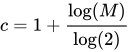
The value of c (number of classes) must be rounded to an integer. It is common to round it with the following criterion: if the integer of the result prior to rounding is "even" is rounded up and if the integer is "odd" It is rounded down, always resulting in an odd number of classes (which allows us to see the accumulation close to the mean in a normal distribution).
Contenido relacionado
Poisson process
MediaWiki:Userstatstext
Statical bias
Más resultados...