
Statical bias
In statistics, the bias of an estimator is the difference between its mathematical expectation and the numerical value of the parameter it estimates. An estimator whose bias is zero is called unbiased or centered.
In mathematical notation, given a sample and an estimate of the population parameter The bias is:

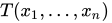


Unbiased is a desirable property of estimators. A property related to this is that of consistency: an estimator may have a bias, but its size converges to zero as the sample size increases.
Given the importance of the lack of bias, sometimes, instead of natural estimators, other corrected ones are used to eliminate the bias. This is the case, for example, with the sample variance.
Sources of bias in experimental sciences
In the design and preparation of a clinical research study, there may be different types of biases:
- selection: because groups are not comparable because of how patients or subjects were chosen.
- information: because groups are not comparable because of how the data was obtained.
- confusion: due to a mixture of effects due to a third variable (variable of confusion).
Contenido relacionado
Inferential Statistics
Mathematical hope)
Statistics
Hypergeometric distribution
Χ² distribution