
Poisson process
In statistics and simulation, a Poisson process, also known as the law of rare events, is a continuous-time stochastic process consisting of " count" rare events (hence the name "rare events") that occur over time. The time between each pair of consecutive events has an exponential distribution with parameter λ; each of such times is independent of the rest. It is named for the mathematician Siméon Denis Poisson (1781–1840).

Mathematical definition
A Poisson process with intensity (or rate) is a process of counting on time Where is a collection of random variables with the following properties:


1. .

2. Yeah. , then .


3. For everything and , random variables They're independent.



4. For all and and They have the same distribution.


5. .

6. .

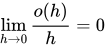
Where o(h) is a function such that:
Intuitive interpretation
is the number of events that have occurred from the moment zero to the moment . As in any stochastic process, in the zero instant is a random variable; however, after the instant It's a data.

Properties
From the definition, it is possible to show that:
- Random variables have Poisson distribution with parameter .
- Yeah. denotes the time elapsed from (k-1)-simo event to the k-simo, then is a random variable with exponential distribution and parameter .
- Yeah. denotes the time elapsed from the beginning of the count to the n-simo event, then has Gamma distribution with parameters .


Insurance application
An important application of the Poisson process is in the probability of bankruptcy of an insurance company. The problem was formally addressed by Filip Lundberg in his doctoral thesis in 1903. Later, Harald Cramér developed Lundberg's ideas and gave rise to what is now known as the ruin process or Cramer-Lundberg model.
Inhomogeneous Poisson processes
Models based on inhomogeneous Poisson processes, where the arrival rate is a function of the time parameter, λ(t), are often more realistic. Formally this means that an inhomogeneous Poisson process is a counting process that satisfies:
1.

2. The increments in foreign intervals are independent.
3.

4.

The three best-known methods of generating an inhomogeneous Poisson process of this type are based on time scale modification, conditioning, and an adaptation of the rejection method.
For homogeneous processes there is an average density . That means the average events at a time interval That's it. .

The time between two events of a Poisson process with medium intensity is a random variable of exponential distribution with parameter .
Applications
Many phenomena can be modeled as a Poisson process. The number of events at a given time interval is a random distribution variable of Poisson where is the average number of events at this interval. The time until the event occurs in a process of intensity Poisson is a random variable with gamma distribution or (the same) with Erlang distribution with .


The classic example of phenomena very well described mathematically through a Poisson process was deaths caused by a kick from a horse in the Prussian army, as demonstrated by Ladislaus Bortkiewicz in 1898. This economist and statistician Polish also analyzed data on child suicides according to this model.
The Poisson process has also been applied for the following examples:
- Number of traffic accidents (or injured/deceased) in a specific area.
- Goles scored in a football game.
- Individual requests for documents on an Internet server.
- Particle emissions due to the radioactive disintegration of an unstable substance; in this case the Poisson process is not homogeneous in a predictable manner; the emission rate declines as the particles are issued.
- Powers of action issued by a neuron.
- L. F. Richardson demonstrated that the outbreak of war was presented as a Poisson process between 1820 and 1850.
- The count of photons arriving at a photodium, particularly in environments with low luminosity; this phenomenon is related to the so-called shooting noise.
- Opportunities for companies to adjust payroll prices.
- The arrival of innovations in research and development.
- The call request in switches.
- In queue theory (see Agner Krarup Erlang), the number of incoming calls in a telephone station can be calculated as a Poisson process.
- The number of customers entering a store.
- The number of cars passing through a highway.
- The arrival of people in a waiting line.
- The evolution of the Internet in general (the changes in the pages, not those of Wikipedia in particular).
Composite Poisson process
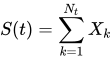
A composite Poisson process is a stochastic process that combines a Poisson process with another independent random variable in such a way that for each discontinuous jump of the Poisson process the other variable assumes a real value. The model is widely used to model, for example, an insurance portfolio, in this modeling the claims for damages to the insurer follow an ordinary Poisson process, but the amount of the claim is an additional random variable, in such a way that the claims amount is a Poisson process composed of the form:
Contenido relacionado
Positive number
Distribution
Math operation)