
Photochemical smog

Photochemical smog is the name given to air pollution, mainly in urban areas, by ozone originated by photochemical reactions, and other compounds. As a result, an atmosphere of a lead or black color is observed. Ozone is an oxidizing and toxic gas that can cause respiratory problems in humans.
This type of smog was first detected in Los Angeles in 1943, and it usually occurs in cities with a lot of traffic (emission of nitrogen monoxide, NO, and volatile organic compounds, VOCs), warm and sunny, and with little movement of air masses.
Training
Contaminants
The main primary pollutants are nitrogen oxides (NOx) and volatile organic compounds.
Nitrogen monoxide (or nitric oxide) is formed when atmospheric oxygen and nitrogen react at high temperatures. This reaction occurs, for example, in automobile combustion engines as follows:
- N2+O2→ → 2NO{displaystyle N_{2}+O_{2}rightarrow 2 NO}

However, nitric oxide is a highly unstable molecule in air, as it oxidizes rapidly in the presence of oxygen, becoming nitrogen dioxide according to the reaction:
- 2NO+O2→ → 2NO2{displaystyle 2 NO+O_{2}rightarrow 2 NO_{2},!}

Volatile organic compounds (VOCs) include unburned hydrocarbons that can also be emitted by vehicles, as well as solvents or fuels that can easily evaporate. These can also come from arboreal areas, as hydrocarbons are naturally emitted, mainly isoprene, pinene and limonene.
The secondary pollutants, formed from the above, through a complex series of reactions promoted by solar radiation, are ozone, HNO3, peroxyacyl nitrate (PAN) and other compounds.
Reactions
During the day nitrogen dioxide dissociates into nitrogen monoxide and oxygen radicals:
- NO2→h.. NO+O⋅ ⋅ {displaystyle NO_{2} {xrightarrow {hnu }} NO+Ocdot }
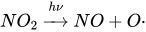
O combines with molecular oxygen to generate ozone:
- O⋅ ⋅ +O2Δ Δ O3{displaystyle Ocdot + O_{2}longrightarrow O_{3}}

In the absence of VOCs, this ozone oxidizes the nitrogen monoxide from the previous stage:
- O3+NOΔ Δ O2+NO2{displaystyle O_{3}+NOlongrightarrow O_{2}+ NO_{2}}}

But in the presence of COVs, these are transformed into peroxide radicals that in turn oxidize to NO: ROO⋅ ⋅ +NOΔ Δ RO⋅ ⋅ +NO2{displaystyle ROOcdot + NOlongrightarrow ROcdot + NO_{2}}}Thus NO is not available to react with ozone and it accumulates in the atmosphere.

Many of the generated RO· radicals end up forming aldehydes. These, when the NO concentration is low (as the day progresses), can react with NO2 giving rise to compounds of the RCOOONO2 type (when R is a methyl it is called acetylnitrate peroxide, PAN, a toxic compound).
The formation of HNO3 occurs at the end of the day by reaction of NO2 with hydroxyl radicals:
- NO2+OH⋅ ⋅ Δ Δ HNO3{displaystyle NO_{2}+OHcdot longrightarrow HNO_{3}

During the night, OH· radicals can react with NO to give nitrous acid, which dissociates in the presence of light, but is stable at night.
- OH⋅ ⋅ +NOΔ Δ HONO{displaystyle OHcdot + NOlongrightarrow HONO}
- HONO→h.. OH⋅ ⋅ +NO{displaystyle HONO {xrightarrow {hnu}} OHcdot + NO}


During the night, photochemical smog reactions are greatly reduced as they need light to function, although they can continue through other compounds.
Reduction
To reduce the formation of photochemical smog it is necessary to reduce the emission of NOx and VOCs.
The amounts of volatile hydrocarbons in the atmosphere are quite large compared to those of NOx, so they are often in excess. In this way, a reduction in these leads to less than expected reduction in photochemical smog. In addition, the hydrocarbons emitted naturally can be enough to continue producing smog (although in urban areas these are not usually the most important). In any case, it is still important to reduce the levels of these volatile hydrocarbons in the atmosphere.
One of the largest sources of NOx is from vehicles. Nitrogen oxide emissions are reduced by using three-way catalysts (two-way catalysts do not treat these gases) that reduce them to molecular nitrogen and oxygen. These catalysts, in the case of gasoline engines, are between 80% and 90% effective, but only when they are hot. Also, the catalyst wears out and becomes less effective over time. In the case of diesel engines, the effectiveness is lower.
Another major source of NOx is emissions from power plants. NOx can also be reduced through reduction processes, although there are other methods such as carrying out combustion in several stages or reducing the temperature of the flame.
Contenido relacionado
Acacia dealbata
Trappa
Gum resin