
Paternal
Paterna is a town and municipality in the Valencian Community, Spain. It is located in the province of Valencia, in the Huerta de Valencia region (in the current administrative region of Huerta Norte), 5 km northwest of Valencia, and on the left bank of the Turia River. It had a census population of 71,880 inhabitants in 2022 (INE), being the ninth city by number of inhabitants in the Valencian Community and the third in the metropolitan area of Valencia.
There is evidence of settlement in the area since the Neolithic. However, the current town seems to have originated in Roman times from the Roman town of Paterna, which became a vicus around the iii century. Medieval Paterna stood out above all for its ceramic production, of which the most characteristic product is probably the socarrats. The medieval era was a time of economic boom that was cut short towards the 16th century with the virtual disappearance of ceramic production, and was aggravated by the rebellion of the Germanías (1520-1522) and the expulsion of the Moors (1609), which left the area almost depopulated. Thus, Paterna's economy became fundamentally agricultural and of food processing (in the town's mills), without the economy beginning to diversify again until the 19th century. >, something to which the arrival of the railway in 1888 (current line 2 of Metrovalencia) also contributed. In the second half of the century xx Paterna experiments a demographic explosion: the 3,516 inhabitants of 1900, in 1940 there were already more than 11,000, which increased to 16,951 in 1960 and 29,656 in 1975. This rapid increase was caused both by the appearance of large industrial areas (for example, the Fuente del Jarro) as well as the construction of large residential areas outside the urban center itself, among which La Cañada stands out. Currently, Paterna is a city of services, with a very diverse industrial production: food, wood, products metal, machinery construction, manufactured plastic materials, paper, leather, chemicals, etc.
Paterna preserves an important historical and artistic heritage, made up of the Arab tower, the county palace, the church of San Pedro, a group of cave houses, modernist chalets, as well as hydraulic works, highlighting its mills and weirs. It also has a rich archaeological heritage, among which the Lloma de Betxí and the Roman villa of Paterna stand out, and an important Ceramics Museum, with an outstanding collection of medieval ceramics. Among the main cultural events are the major festivals, with parades of Moors and Christians and the great Cordà of Paterna, declared a Festival of National Tourist Interest in 2017.
Toponymy
The toponym Paterna apparently comes from the Latin paterna, 'of the father' or 'of Paternus'.
Geography
The municipal area of Paterna occupies an area of 35.85 km² and is located at an average altitude of 70 m s. n. m. It borders with Benimámet (Valencia), Bétera, Burjasot, Cuart de Poblet, Godella, La Eliana, Manises, Ribarroja del Turia and San Antonio de Benagéber.
Border locations
| Northwest: La Eliana, San Antonio de Benagéber | North: Bétera | Northeast: Godella |
| West: Ribarroja del Turia |  ' ' | This: Burjasot |
| Southwest: Manises | South: Cuart de Poblet, Manises | Sureste: Benimámet (Valencia) |
Hydrography and orography
The most notable physiographic feature of the municipality of Paterna is the Turia River, which forms the southern border of the municipality with the municipalities of Manises and Cuart de Poblet. To the north of the town of Paterna, the Endolça ravine stands out, currently urbanized and transformed into a fast route to the ring road.
Climate
The climate of Paterna is semi-arid and mesothermal Mediterranean. Continentality is diminished by a breeze regime that softens maximum summer temperatures, as well as by moderate relative humidity. Winters are relatively mild and snow is infrequent., while the summers are warm and usually have an open sky. However, the climate is noticeably colder and drier than that of Valencia, given the higher altitude and distance from the sea of Paterna.
Precipitation follows a seasonal regime. The maximum occurs in autumn, with a weak secondary maximum during the spring and a dry summer period of about four months in which hardly any precipitation is received. For its part, the average annual temperature is just over 16 °C, with temperatures that range between 9.5 °C on average in January (the coldest month) and 24.1 °C in August (the hottest month). The most frequent winds during the summer are from the east (they constitute 13.2% of the annual total), while in autumn and winter northerly winds predominate (slightly more common, making up 14.1% of the annual total).
 Average Paterna climate parameters Average Paterna climate parameters | |||||||||||||
|---|---|---|---|---|---|---|---|---|---|---|---|---|---|
| Month | Ene. | Feb. | Mar. | Open up. | May. | Jun. | Jul. | Ago. | Sep. | Oct. | Nov. | Dec. | Annual |
| Average temperature (°C) | 15.3 | 14.8 | 18.1 | 19.8 | 22.6 | 25.9 | 28.8 | 29.1 | 27.2 | 23.2 | 18.7 | 15.9 | 21.6 |
| Average temperature (°C) | 10.8 | 10.8 | 13.2 | 15.1 | 18.1 | 21.5 | 24.5 | 24.9 | 22.7 | 18.5 | 14.1 | 11.4 | 17.1 |
| Temp. medium (°C) | 6.4 | 6.9 | 8.3 | 10.4 | 13.6 | 17.2 | 20.2 | 20.7 | 18.2 | 13.9 | 9.6 | 7 | 12.7 |
| Total precipitation (mm) | 32 | 32 | 34 | 35 | 33 | 24 | 11 | 18 | 53 | 83 | 51 | 42 | 448 |
| Source: Climate-Data.org September 13, 2017 | |||||||||||||
History
Prehistory and antiquity
The first signs of human settlement in Paterna date back to the Neolithic and Bronze Age and have been found in the areas of La Vallesa (la Lloma de Betxí) and Despeñaperros, in an area of small hills near the Turia River that allowed the water supply. The Iberians left their mark in these areas, having found remains of a defensive wall and walls of small huts in La Vallesa.
The documentation relating to the arrival of the Romans is limited to literary references to nearby events in Valentia (Valencia), Edeta (Liria) and Saguntum (Sagunto). For decades there had been speculation about the possible Roman origin of the nucleus of Paterna, without archeology providing conclusive evidence, until in February 2009 the excavation of a plot where a housing estate was being planned revealed a Roman villa, dated between the centuries i and iii, the first Roman vestige of an inhabited place between Valencia and Liria. At this time Paterna would take its current name, from the Latin paterna, 'of the father' or 'of Paternus'. The intensity of settlement must have been great at this time, having found small villas also in the Cano and La Font ravines. In the municipal area, remains of a network of aqueducts that extend between Ribarroja del Turia and Masamagrell have also been found.
Middle and Modern Ages
In Muslim times, Paterna was an important population center. It had a walled enclosure at the top of the old fortress (current site of the Calvario and the Town Hall), which was the residence of the feudal lords until the century xv. During this time ceramic and manufacturing activity developed and agriculture developed, incorporating new irrigated lands and introducing crops such as rice, mulberry and sugar cane. In 1065, an ambush by the army of Ferdinand I of León on the defenders of Balansiya, led by King Abd al-Malik ben Abd al-Aziz al-Mansur, took place near Paterna. The battle of Paterna resulted in numerous casualties on the part of the Valencians and the Leonese retook the siege of Balansiya, although they had to lift it shortly after due to health problems of Fernando I.
The Muslim cemetery of Paterna was discovered in the 1970s to the northwest of the old town, separated from it by a ravine on a southeast-facing slope. The tombs had been dug into the rock of the hillside and covered with rudimentarily roughened stone slabs, socarrats and brick. The tombs of the adults make up, as usual, an elongated cavity facing East, the bottom of which was excavated a narrower grave, with a step to settle the covering elements. Although it has not been possible to date it precisely, it is likely that it stopped being used towards the end of the 15th century.
On April 10, 1237, King James I of Aragon peacefully entered the municipality of Paterna. According to the Llibre del Repartiment, the Paterna farmhouse is handed over to Artal de Luna, one of those appointed by Jaime I to draft the Fueros. The Lunas became feudal lords between the centuries xiii and xv. Despite the havoc caused by the Union War (1348), which seriously affected the town, during this time Paterna ceramics reached its maximum production. This is confirmed both by the high production and by the concentration of testars, ovens and workshops, as well as the quality and variety of styles.
The juries of the city of Valencia, seeking to comply with the jurisdiction that prohibited the planting of rice in its boundaries, decided to uproot the rice fields in 1360. The main objective was Paterna, since several Christian rice fields had been found (from between 5 and 2 hanegadas) and Muslims (2, 3, 6 and 8 hanegadas). For this they sent the armed militia of the city, but the authorities of Paterna did not give in, claiming not to be part of the contribution of Valencia and The policy of force failed. Some years later, Pedro IV ordered the rebuilding of the Alcázar of Paterna, which was in poor condition due to the previous war with Castile.
;_de_1883.jpg)
In 1436 Alfonso the Magnanimous handed over the possessions of Paterna to the Infante Enrique, son of Fernando I of Antequera and Duke of Segorbe. At this time, the Muslim community of Paterna continues to be active; Thus, in 1450, an alfaquí from Paternero introduced the Sexagenarium, a common astronomical work in Cairo, which Joan of Bosnia translated in 1456 into Catalan and Latin, also in Paterna. However, in the century xvi a crisis began in ceramic production and, therefore, in the general economy of the town. This was also aggravated by the rebellion of the Germanías (1520-1522), of a marked anti-lordly nature, for which Paterna was punished and repressed by both the Viceroy of Valencia and the Duke of Segorbe. A few decades later, the expulsion of the Moors (1609) forced a good part of the population into exile and Paterna suffered depopulation and the almost total paralysis of its already fragile economy.
The ceramics of Paterna
Between the centuries xii and xv Paterna was one of the main ceramic producing centers of the Iberian Peninsula, competing with other important centers such as Teruel or Manises and reaching distribution throughout the Mediterranean. Its wide distribution is attested to by the fact that remains of Paterna ceramics have been found in points very far from the city, such as the Russian Republic of Tatarstan or the Moscow Kremlin itself. The brilliance and fixity of its glaze, the ornateness of its drawings and the decoration in blue and gold or green stand out in Paterna's ceramics. and manganese. The motifs are very varied: human, animal, vegetable or heraldic figures. The socarrat is the most characteristic piece of Paternera ceramics: rectangular clay pieces that are used to decorate the space between the beams of the houses, of which Paterna was perhaps the exclusive manufacturing center. Other characteristic pieces of Paterna ceramics are the joguins ('toys'), small containers that repeated the shapes of various utensils for boys and girls to play with.
18th and 19th centuries
Antonio Pando y Bringas bought the jurisdiction of Paterna from the Duke of Segorbe y Medinaceli in 1746, thus becoming the first count of Villapaterna. In 1769, by Royal Decree, the cultivation of rice, which had been done before, was prohibited. of the Christian conquest, in order to alleviate malarial fevers. Throughout this period, agriculture was practically the only economic activity that was developed in the town. It is at the beginning of the xix century when they began to appear. the first cave houses, since they hardly required construction materials and were opened on common land. Towards the middle of the century, a certain economic recovery is noted, with a diversification of production. In Madoz's Dictionary (1845- 1850) the following description of Paterna and its term appears:
PATERNA: villa with city council of the province [...] of Valencia (a league) [...]. Situada in uneven terrain on the left bank of the river Turia: the winds of the east and south generally beat; climate is temperate and healthy. It's 480. housesincluding that of the city council and prison; a palace of the Marquis of Miraflores, counts of this villa, whose building has ceded it for the teaching and room of teachers and poor widows; school of children to which 80 [...]; another of girls with 120 of assistance [...]; parish church (St Peter and St John the Baptist) [...]; 2 hermits entitled the Lane of the well of the Virgin and Holy Christ and a cemetery; Turia that enter the acequia of Moncada. [...] On its radio is a tower or watchtower and some remains of fortification to the northeast, which appear to be of the time of the Moors, and several bushes and prominences, in one of which there is a gunpowder warehouse and in another a drum of artillery of all the calibers, which has been built a few years ago for the practical school of this weapon [...] The field is of very good quality dry and garden, which fertilizes with the waters of the Turia through the acequia of Moncada. Ways: the cart that leads to Liria, and others of horseshoe to the neighboring villages quite deteriorated [... ] Produces: wheat, corn, hemp, beans, melons, wine, oil, clagarroba, and vegetables; it maintains lanars, some rabbit hunting and little eel fishing. Industry: the agricultural, 10 flour mills, a cardar and hilar wool machine, and more than 100 looms for tapes of thread and cotton, in which girls and young singles are employed. [...] Population: 343 neighbors, 1595 souls.Madoz Dictionary

In the following decades, demographic growth (due to a positive migratory flow) led to the beginning of an urban expansion plan for the town, with the construction of the Campamento neighborhood, where chalets and homes were built for the Valencian bourgeoisie, as well as a military barracks. The appearance of Paterna changed to face the new social, economic and political needs of the population. One of the most symbolic acts was the inauguration, in 1881, of a new Town Hall house (current headquarters of the Municipal Museum of Ceramics). During those years, the water was also channeled (1866) and the narrow gauge railway of the Valencia-Liria line was built (inaugurated on April 22, 1888), which improved communication with the capital.
From the 20th century to the present day
In September 1909 Juan Olivert Serra carried out the first powered flight in Spain. During the Spanish Civil War (1936-1936) Paterna, like the rest of the Valencian Community, remained in Republican territory until the end of the war and the final victory of the rebels. The new regime chose the walls of the Paterna Cemetery (and occasionally the nearby shooting range, today the Parc Central) as the scene of executions, with around 50% of those executed in the territory of the Valencian Community having died there. In total, 2,237 people (anarchists, communists, republicans, etc.) were executed between 1939 and 1956; most came from the Valencian provinces, although there are a certain number from the rest of Spain. As a result, there are large mass graves at the entrance of the cemetery, one of which has more than 400 bodies. As a result, numerous events have been held in which public figures, such as Xelo Llopis Roca, have taken part.
At the beginning of the 20th century, Paterna still had only about 3,500 inhabitants. It was towards the end of the 1940s when an increasingly accentuated immigration flow began (from the rural areas of Spain), which was accentuated in 1963 with the creation of the Fuente del Jarro Industrial Estate. Thus, the municipality became an industrial and service center as industrial estates, commercial areas and development centers such as the Valencia Technology Park multiplied. During this century, old rural areas or chalets such as La Cañada, Terramelar, La Coma, Cruz de Gracia, Mas del Rosari or Lloma Llarga were also formed as population centers.
Demography
In 1572 the town of Paterna had 80 residents (about 360 inhabitants), which increased to 120 residents (about 540 inhabitants) in 1609. After the expulsion of the Moors, the population was drastically reduced, counting four decades later, in 1649, with only 63 neighbors (about 284 inhabitants). Throughout the century xviii Paterna recovered and in 1787 it already had 1,084 inhabitants, which had multiplied to 3,060 in 1877, less than a century later. However, it was in the second half of the xx century when it experienced Paterna a demographic explosion: in 1940 there were already more than 11,000 inhabitants, which increased to 16,951 in 1960 and 29,656 in 1975. The municipality, which has an area of 35.85 km², had according to the municipal register for 2017 INE with 68,547 inhabitants and a density of 1912.05 inhabitants/km².
The growth of the population has been due to the creation of new residential areas along with the expansion of industrial areas in the municipality. Regarding the foreign population, in 2012 this constituted 8.78% of the population total, with Romanian (17.9%), Moroccan (8.5%) and Colombian (7.4%) being the main foreign nationalities.
| Graphic of demographic evolution of Paterna between 1842 and 2022 |
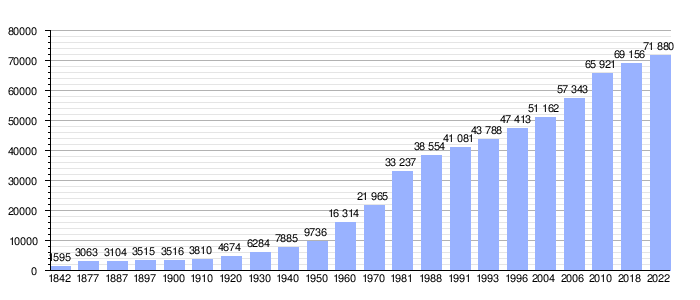 |
Population of law according to population censuses of the INE.Population according to the 2017 municipal register. |
Between 1991 and 2001, the term of the municipality decreased because it made San Antonio de Benagéber independent.
Population by nuclei
The population centers of the municipality are: Cruz de Gracia (Bobalar, Casas Verdes and Santa Gemma), La Cañada (La Cañada, El Plantío, Montecañada, La Vallesa), La Coma (Mas del Rosari), Lloma Llarga (Valterna), Paterna (Centro, Alborgí, Campamento, Santa Rita) and Terramelar.
| Population entity | Inhabitants | Coordinates | Distance (km) |
|---|---|---|---|
| Cross of Grace | 119 | 39°32′14.29′N 0°26′25.97′ / 39.5373028, -0.4405472 | 4 |
| The Cañada | 11 171 | 39°31′36.4′N 0°29′13.44′O / 39.526778, -0.4870667 | 5.5 |
| La Coma | 9301 | 39°31′14.35′N 0°25′56.93′′O / 39.5206528, -0.4324806 | 3 |
| Lloma Llarga | 6677 | 39°30′56.83′′N 0°26′4.34′′O / 39.5157861, -0.4345389 | 1.5 |
| Paterna | 37 404 | 39°30′2′N 0°26′22.11′′O / 39.50056, -0.4394750 | - |
| Terramelar | 2484 | 39°30′30.01′N 0°25′43.48′ / 39.5083361, -0.4287444 |
Sources: INE 2014 (data of 2013), Google Earth, Geonet, Francisco Ruiz, Population of Spain-datos and maps: Nomenclátor Data
Administration and politics
Paterna is governed by a local corporation made up of councilors elected every four years by universal suffrage who in turn elect a mayor. The electoral roll is made up of all residents registered in Paterna over 18 years of age and nationals of Spain and the other member countries of the European Union. According to the provisions of the Law of the General Electoral Regime, which establishes the number of eligible councilors based on the population of the municipality, the Municipal Corporation of Paterna is made up of 25 councilors. The Paterna City Council is currently chaired by the PSPV-PSOE with an absolute majority, and consists of 14 councilors from this party, 6 from the PP, 3 from Vox, 2 from Compromís. The current Mayor is Juan Antonio Sagredo.
| Period | Name | Party |
|---|---|---|
| 1979-1983 | Bernardino Giménez Santos |  PSPV-PSOE PSPV-PSOE
|
| 1983-1987 | Bernardino Giménez Santos | PSPV-PSOE
|
| 1987-1991 | Bernardino Giménez Santos | PSPV-PSOE
|
| 1991-1995 | José Enrique Bargues López | PSPV-PSOE
|
| 1995-1999 | José Francisco Romero Valls (1995-1997) Censorship Motion Francisco Borruey Palacios (1997-1999) |  P PSPV-PSOE P PSPV-PSOE
|
| 1999-2003 | Francisco Borruey Palacios | PSPV-PSOE
|
| 2003-2007 | Francisco Borruey Palacios | PSPV-PSOE
|
| 2007-2011 | Lorenzo Agustí Pons | P
|
| 2011-2015 | Lorenzo Agustí Pons (2011-2014) Condemned by Prevarication Elena Martínez Guillem (2014-2015) | P
|
| 2015-2019 | Juan Antonio Sagredo Marco | PSPV-PSOE
|
| 2019-2023 | Juan Antonio Sagredo Marco | PSPV-PSOE
|
| 2023- | Juan Antonio Sagredo Marco | PSPV-PSOE
|
| Political party | 2023 | 2019 | 2015 | 2011 | ||||||||
|---|---|---|---|---|---|---|---|---|---|---|---|---|
| Councillors | Votes | % | Councillors | Votes | % | Councillors | Votes | % | Councillors | Votes | % | |
| Socialist partit of the Valencià Country
| 14 | 16 677 | 48.60 % | 13 | 14 484 | 47.41 % | 6 | 7 442 | 22.54 % | 7 | 7 649 | 24.43 % |
 Popular Party Popular Party
| 6 | 8 080 | 23.55 % | 4 | 4 395 | 14.39 % | 6 | 6 839 | 20.71 % | 14 | 15 997 | 51.08 % |
 Vox Vox
| 3 | 4 541 | 13.23 % | 2 | 2 136 | 6.99 % | - | 266 | 0.81 % | - | - | - |
 Compromis per Paterna Compromis per Paterna
| 2 | 2 826 | 8,23 % | 3 | 3 268 | 10.70 % | 6 | 6 827 | 20.68 % | 2 | 2 433 | 7.77 % |
 Citizens Citizens
| - | 483 | 1.40 % | 3 | 3 975 | 13.01 % | 4 | 4 315 | 13.07 % | - | - | - |
.svg) Podem-EUPV: United Nations-PASIP Podem-EUPV: United Nations-PASIP
| - | 1 041 | 3.03 % | - | 1 238 | 4.05 % | 2 | 3 216 | 9.74 % | - | - | - |
 United Esquerra del País Valencià United Esquerra del País Valencià
| PODEM (2023) | - | 822 | 2.69 % | 1 | 2 087 | 6.32 % | 2 | 228 | 7.11 % | ||
 Union, Progress and Democracy Union, Progress and Democracy
| - | 672 | 2.04 % | - | 796 | 2.54 % | ||||||
| Parties Without Representation
(Not 5 %) | - | 308 | 0.89 % | - | 71 | 0.23 % | - | 896 | 2.71 % | - | 1 502 | 4.80 % |
| Total voters | 25 | 34 575 | 66.90 % | 25 | 30 656 | 60.66 % | 25 | 33 334 | 67.81 % | 25 | 31 790 | 65.44 % |
| Abstaining | 17 100 | 33,09 % | 19 880 | 39.34 % | 15 822 | 32.19 % | 16 791 | 34.56 % | ||||
| White. | 353 | 1.02 % | 161 | 0.53 % | 456 | 1.38 % | 711 | 2.27 % | ||||
| Nulls | 266 | 0.76 % | 106 | 0.35 % | 318 | 0.95 % | 474 | 1.49 % | ||||
Economy

The tertiary sector is the main employer in the municipality. 61.4% of the assets worked in the services sector in the 2000s, highlighting two shopping and leisure centers, one of them measuring 42,000 m². However, Paterna stands out especially for its industrial activity. One of the main industrial areas of the Valencian Community is located in the municipality of Paterna, with 14% of the municipal area (5,558,200 m²) occupied by industrial areas. The proximity to Valencia, good communication routes and the existence Abundant land at a good price led to the creation of these areas, for industrial decongestion in the capital. In the 2000s, the industry occupied 37% of the municipality's active population. This is distributed in a series of large areas, around the main communication routes: Fuente del Jarro Industrial Estate (2,352,400 m²), a public initiative (built by the Ministry of Housing, through the Urban Planning Management, in 1963), is located in the center of the municipality, next to the A-7 and the CV-365 and crossed by line 2 of the Valencia metro; the Tactic Business Park (1,056,100 m²), next to Fuente del Jarro; the Technology Park Valencia (1,038,400 m²), in the north of the municipality, dedicated to high-tech companies, R&D and research centers; the Science Park (417,900 m²); the Sector 9 L'Andana Estate (357,700 m²) and the Municipal Estate (335,700 m²), next to Táctica. Industrial production is very diversified: food, wood, metal products, machinery construction, manufactured plastic materials, paper, leather, chemicals, etc.
For its part, agriculture, which had been the main economic engine after the disappearance of the ceramic industry in the 16th century, is in decline and only occupied 1.5% of the active population in the 2000s. However, in 1997 there were still 1,118 hectares of agriculture, with a slight predominance of irrigation (671 hectares), in which citrus trees stand out (529 hectares). and herbaceous (133 ha), on the dry land (447 ha), where the predominant crops are carob trees (370 ha), olive trees (50 ha), table grape vines (15 ha) and almond trees (9 ha).
Evolution of outstanding debt
The concept of outstanding debt contemplates only debts with savings banks and banks related to financial credits, fixed income securities and loans or credits transferred to third parties, therefore excluding commercial debt. The municipal outstanding debt per inhabitant in 2015 amounted to €600.02.
| Graphic of evolution of the city council's living debt between 2008 and 2015 |
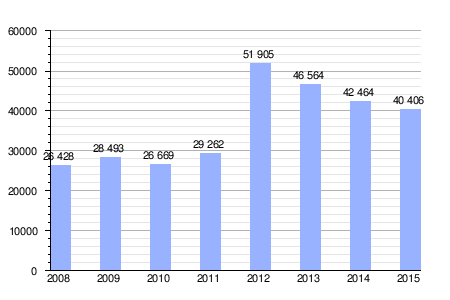 |
Living city council debt in thousands of Euros according to data from the Ministry of Finance and Ad. Public. |
Services
Transportation
Currently, the district of Paterna is crossed by one of the densest communication networks in the region, which has contributed to the urban, residential and industrial development of the city.

Roads
The main communication routes of Paterna are:
- Autopista A-7 that communicates the Mediterranean axis between Barcelona and Algeciras
- Autovía A-3 that communicates Valencia with Madrid
- Autovía V-30 that communicates with the Port of Valencia and the coast.
- Autovía CV-35 which runs to the interior of the province of Valencia (Autovía Valencia - Liria - Ademuz)
- Autovía CV-30, known as Ronda Norte de Valencia.
- Road CV-365, known as the North Distributor, links the CV-35 to Terramelar with the V-30 in Fuente del Jarro.
- Carretera CV-368, link the urban center with La Cañada and CV-35 to the height of San Antonio de Benagéber.
- Road CV-371, link the urban center with Manises.
Bus
The city of Paterna currently has several urban bus lines, the service is operated by the company Edetania Bus SA, under the commercial name Transport Municipal de Paterna (TMP).
- Line A: La Cañada - Paterna - Heron City
- Line C: Hospital La Fe - Burjassot Specialty Center
- Line D: València - Valterna
As for the interurban bus service, it is carried out under the commercial brand of the Generalitat Valenciana MetroBús, as it is a very large municipal area, not all lines pass through the urban center of the town, some of them pass through the Technology Park by Heron City himself. The two companies are:
- Edetania Bus SA
- Line 130: València-Heron City-Parque Tecnológico
- Line 131: València-Heron City-Mas Camarena
- Line 140: Valencia-Paterna-El Plantío
- Line 144: València-Parc Tecnològic-L'Andana
- Line 147: València - Táctica Business Park
- Line 148: Valencia-industrial polygon Fuente del Jarro (lanzadera)
- FernanBús SA
- Line 165: Quart de Poblet-campus Universitario de Burjassot, with tour of Manises and Paterna (operated since February 2021)
Metro and tram
Paterna has a metro and surface tram service from the MetroValencia company:
Line 2: Llíria - Torrent Avinguda. Stops:
- Campament
- Paterna
- Santa Rita
- Jarro Source
- The Canyada
- La Vallesa
Line 4: Mas del Rosari/Lloma Llarga-Terramelar - Dr. Lluch. Stops:
- Lloma Llarga-Terramelar
- Santa Gemma
- Thomas and Valiente
- La Coma
- Mas del Rosari
Heritage


Paterna has a large number of monuments, many of which are protected. This is the case of its entire traditional historic center, which has been declared an asset of local relevance. However, the monuments and heritage areas are not limited only to the urban area, but are spread throughout the municipal area. This led the Valencian Government to grant the category of Municipality of Tourist Interest to Paterna in 2000.
Architectural heritage
- Tower of Paterna
The Paterna tower is an old defense tower of Islamic origin, which belonged to the successive lords of the town until it was donated to the Spanish Army in 1869. Its construction dates back to the end of the century xi and the beginning of the century xii with a square plan, acquiring its characteristic truncated conical shape, probably during the century xiv, after the Christian conquest. Its height is 19.5 m, with a lower diameter of 12.70 m and an upper diameter of 9.60 m It consists of three floors (the first two with a square base and the third octagonal) and a terrace (with a circular base) and was restored in 1971-1972. It is declared an asset of cultural interest along with the cave houses that emerged. later in its surroundings, which now make up the "urban park of the Tower and the Palau."
- Palacio de los Condes de Villapaterna
The Palace of the Counts of Villapaterna (Palau dels Comtes de Vilapaterna) is a stately palace built by the counts of Villapaterna in 1760. It is a building with a marked classicist feel, designed by Antonio Gilabert y Fornés, who was director of the San Carlos Academy of Fine Arts in Valencia. It has a wide exterior staircase, ground floor and two floors. In the middle of the century xix< /span> it was used as a school, teachers' room and poorhouse. In 1887 the banker Enrique Trénor y Bucelli bought it and it passed into private hands again, although in 1921 it was used again for public purposes, as a hospital for the sick and wounded from the war in Africa. It was restored in 1977 and was used as an art gallery, once the city council had acquired it in 1983. However, in 1989 it was decided to transform it into the headquarters of the Paterna City Council, function that it continues to fulfill today. To this end, in addition to the original building, some modern annexes were built at the back of the building, where the palace stables had been. It is declared an asset of cultural interest.
- Calvary
The Calvario of Paterna (the Calvari) is located on a terrace with views of the Turia River, the orchards and the nearby towns. It is the highest point of the old town, where The old Muslim and Christian fortress was built. Currently only remains of the old wall and one of the gates remain, as well as a tunnel built with a barrel vault, rediscovered in surveys carried out in 1911. The current site is occupied by a calvary and, in the center of the square, a clock tower. It has been declared an asset of cultural interest.
- Caves
In the urban area of Paterna, several groups of cave houses are preserved, where 40% of the population of Paterna and of which there were more than 500 until they began to become uninhabited well into the 1950s. Currently there are three groups that are still standing. The Coves d'Alborgí are located to the north of the town and still constitute living space. The Coves de la Torre are distributed around the Torre de Paterna and they were the largest group, currently many have been demolished due to ruin and in their place the cultural space La Cova Gran was created and, between this and the remaining caves, an urban park. For Lastly, in the Coves del Batà, located to the south of the town on the road that led to Campanar, a cultural space has been created that includes an ethnographic museum. These last two groups are declared of cultural interest due to the same layout as the Paterna tower.
The dwellings excavated as caves are of Moorish origin, although in Paterna they were not found in large numbers until the xix century. They can differentiate two typologies: those excavated directly in a slope in the ground (coves de façana) and those that excavate a common patio that serves as a façade to a group of two to four homes (coves enclotades ). In 1824, 38 caves were censused, which multiplied around 1850 to 200, where 35% of the population lived. In 1920 there were already 365 caves and they reached their historical maximum, 509, in 1945., although by then they housed only 20% of the population. Starting in the 1950s, they were progressively abandoned; of the 449 that were still inhabited in 1970, only 106 remained in 1994. The Paterna city council has promoted In recent decades the conservation of the remaining caves, after the consolidation of cultural spaces, with projects such as the "city of lost crafts" or the "potters' cave" that give spaces in the caves to local artisans.
- Church of Saint Peter
The church of Saint Peter (església de Sant Pere) was originally built in the xiv century, under the invocation of San Pedro and San Juan Bautista, on the site occupied by the mosque. However, in 1370 the parish of San Juan Bautista de Manises was created, segregated from the parish of Paterna, which has since remained under the current dedication. The current temple, with a single nave with side chapels, was built at the end of the 18th century on the previous building, in neoclassical style, and was restored in 1940. It is declared an asset of local relevance.
- Old Town Hall
The demographic expansion of Paterna in the xix century led to the construction of a new town hall in 1881, since the previous one (located just opposite in the current Plaza del Poble) was no longer large enough to satisfy the new needs of the municipality. It is a building with a neoclassical façade, two floors with an interior patio. It served as the town hall until 1989, the year in which the town hall moved to the Palace of the Counts of Villapaterna. Currently it is the headquarters of the Municipal Museum of Ceramics, as well as some socio-cultural services. Next to the building, In a covered access, there is the cistern that received the waters from the town's source, in the Font ravine.
- Modernist architecture
A certain number of Valencian modernist style chalets from the end of the xix and beginning of the xx. Particularly noteworthy are those currently located at numbers 16 and 18 on Juan Magal Benzo Street (both designed by José María Manuel Cortina Pérez, one of the greatest exponents of Valencian modernism), as well as the one located at number 29 Benito Pérez Galdós Street. Also by José María Manuel Cortina is the Fountain of Teniente Cortina, his nephew. Another important modernist work is the Campament Station, by 1926, declared an asset of local relevance.
- Molinos
The Paterna mills (molins) constitute a complex of hydraulic mills of the whole of the Moncada irrigation canal as it passes through the municipality of Paterna. At the end of the century xix the historical maximum of 18 casales was reached, of which eight are currently preserved (although two of them in state ruinous), five on the Moncada irrigation canal (Molinos del Testar y de la Escaleta, Molino de la Vila, Molino de la Tandera, Molino del Batán and Molino de la Peña), two on the secondary arm of the Uncía (Molino de la Ferrando and Molino de Donderis) and the last one on the Tormos irrigation canal (Molino del Vado), next to the ford that allowed the Turia to be crossed between Paterna and Manises. Seven of the eight preserved mills (with the exception of Donderis) are unfinished. as an asset of local relevance.
- Azudes
Five historic weirs (assuts) of the Valencian Huerta are located in the municipality of Paterna, on the Turia River, all of them declared assets of cultural interest: Azud de la Acequia de Mestalla, Weir of the Acequia of Mislata, Weir of the Acequia of Quart-Benàger-Faitanar, Weir of the Acequia of Tormos and Weir of the Real Acequia of Moncada.
Archaeological heritage

- Lymma of Betxí
La Lloma de Betxí is an archaeological site from the Bronze Age, located on a hill 99 m above sea level. n. m. and 30 meters above the valley of the Turia River, in the Vallesa de Mandor area. Its chronology is between 1800 and 1300 BC. C. within the so-called Valencian Bronze Age. It is declared an asset of local relevance.
- Roman Villa of Paterna
The Roman villa of Paterna is a Roman villa, dated between the centuries i and iii. It is the first Roman vestige of an inhabited place between Valencia and Liria and is the probable origin of the later medieval town of Paterna. It is declared an asset of local relevance.
- Other deposits
Other archaeological sites have been found in the area of Paterna, the remains of some of which are exhibited in the Museum of Prehistory of Valencia and the Ceramics Museum of Paterna, among others. Among them are the Roman remains of an aqueduct in Mas de Vélez, declared an asset of local relevance; and two important sites of discarded ceramics (testars), that of the Olleries Menors i> and the Olleries Majors or Testar del Molí, both declared assets of local relevance.
Natural heritage
Of the 35.85 km² of the municipality of Paterna, 9.84 are integrated into the Turia Natural Park. This territory includes mountainous and wooded areas around the area occupied by La Cañada and that run parallel to the course of the Turia River. Among the places included, the La Vallesa forest stands out (about 6 hectares), which is home to an abundant population of pine trees and bushes typical of Mediterranean forests such as thyme, rosemary, holm oak or gorse. La Vallesa also includes a small reservoir of importance for biodiversity and outstanding landscape value, which is why it has been included in the catalog of wetlands of the Valencian Community. During the summer months, this reservoir is covered with a dense layer of duckweed The entire southern limit of the municipal area is also included within the territory of the natural park, bordering the terms of Manises and Ribarroja del Turia (also included in the Park) and which include remnants of traditional gardens and heritage spaces, such as hydraulic mills. or weirs and deposits such as Lloma de Betxí.
Another important natural area is the one formed on the banks of the Fuente ravine, which presents a wide variety of flora and fauna of the region. The ravine culminates in the Fuente del Jarro (Font del Gerro ), currently located at one end of the industrial estate of the same name, which was canalized in 1866 and restored in 2007.
Urbanism
The original nucleus of Paterna was formed in the vicinity of the Roman town of Paterna. The town, originally a rural residence, became a vicus (village) around the century iii, and is the probable origin of the later medieval town of Paterna. In any case, it reached an important entity in the xi, around the fortress (current Calvario) and the Tower. The old town of Paterna, around the current Plaza del Poble, still preserves a sinuous layout typical of the Muslim urbanism, although the exact physiognomy of the urban core and the walled enclosure is very imperfectly known.
Currently, the town of Paterna is conurbated with Benimámet (district of Valencia) and is not the only urban center in the municipality: a series of developments and housing groups have ended up reaching a relatively important urban entity. Thus, highlighting primary residence developments such as La Cañada, isolated neighborhoods such as La Coma, and developments such as La Cruz de Gracia, Cumbres de San Antonio, Terramelar, Lloma Llarga-Valterna and Mas del Rosari.
Culture
.jpg)
Museums
- Municipal Museum of Ceramics
The Municipal Museum of Ceramics (Museu Municipal de Ceràmica) has been located since 1990 in Plaza del Poble, in the old Town Hall building. It was created in September 1980 with a collection of socarrats, found by chance in the urban area of Paterna, and was initially housed in the Tower.
This is a museum specialized mainly in Paterna ceramics, especially medieval ones, and has one of the best collections of these characteristics in the world. The collections on the first floor include representative pieces from the periods between the xii century and the xviii century, all of them found in the term of Paterna, and which include socarrats, green and manganese ceramics, blue and gold ceramics and aspra work. There are also reproductions of a pottery oven and a pottery wheel, among others.
On the ground floor there are two rooms with other types of objects. In the first, more recent ceramics are exhibited, up to the 19th century, also found in the town. The second exhibits some of the objects found in the Roman town of Paterna, whose chronology goes from the century i to the iv and includes funerary steles, metal figures, coins, some vitreous paste objects, tools for the repair of dolia and early imperial ceramics.
- Cultural Space Coves del Batà
The Cultural Space Coves del Batà presents a municipal ethnographic collection in the space of old cave houses. It consists of a set of eight old houses connected to each other, which make up a total of 28 rooms, with an area of about 450 m². Of the permanent exhibition, the ones focused on agricultural implements and the activity of forging and locksmithing stand out. Likewise, the reproduction of a cave house with its traditional furniture and distribution is included., and an exhibition dedicated to the Cordá de Paterna.
Theaters and auditoriums


- Gran Teatro Antonio Ferrandis
The Great Theater (Gran Teatre) began to be built in 1927 at the initiative of Vicente Brull Bayona and under the direction of Mariano Agustí Monrabal, and it was inaugurated on May 8, 1928. After several decades of use as a theater, cafe and cinema, it had already fallen into disuse when the city council took over the building in 1986, after it was classified as a protected building. Thus, the building was restored and adapted and reopened in 2000. adding the name of the well-known paternero actor Antonio Ferrandis Monrabal. The current theater has capacity for 600 spectators and a stage that includes a 56 m² pit for the orchestra. Likewise, the theater building includes three rooms for meetings, exhibitions or essays.
- Capri Theatre
The Capri Theater (Teatre Capri) was inaugurated around 1924 under the name "Teatro de la Unión", although it was popularly known as Teatre del Batà, by the nearby Batà caves. The venue was popular for its excellent acoustics, in addition to theatrical performances, films were projected. It also fell into disuse and the founding partners sold it, passing through several hands until in 1988 the "Centro de Arte y Danza S.A." was created, a company that contacted the Paterna city council to arrange a sale, which was carried out. in 1992, with the building undergoing renovation in 1998. Like the Gran Teatro, it was reopened in 2000.
- Cultural Space The Big Cova
It was excavated in the northern area of the Coves de la Torre, following the depression of the terrain itself and preserving the aesthetics of the historical complex. It is made up of an open-air amphitheater and the central library of Paterna, which houses more than 16,000 volumes.
- Auditorio Antonio Cabeza
Auditorium with capacity for 480 (and four additional places for the disabled), inaugurated in 2011. The Paterna Musical Center School is housed in the same building.
Parties
- Judgements
The Fallas of Paterna are celebrated in the week of March 19 in honor of Saint Joseph. In Paterna there are 18 Fallas commissions, which prepare the monuments and organize the celebrations.
- Major parties
They are celebrated in the last two weeks of August in honor of Cristo de la Fe and Saint Vicente Ferrer, under the motto "foc, festa i fe" ('fire, celebration and faith'), elements that respectively represent the three main activities: the cordà (declared a Festival of National Tourist Interest in 2017), the Moors and Christians parades and the liturgical events.
The festivities begin with the proclamation, which starts the aforementioned events and others of a cultural nature, such as the literary awards known as «Jocs Florals» ('floral games') and the «Coets d' Or» ('golden rockets') to the personalities most involved in the development of the festivities. They also include concerts, theatrical performances and exhibitions. During the first week, events related to the Moors and Christians predominate, in which they participate around 3000 festivities and which have been taking place since the 1970s However, the main event of the festivities is the Cordà, with more than a century of tradition and which takes place on the last Sunday of August. It is a fire and pyrotechnics show in which, for about 25 minutes, 70,000 rockets are lit along Calle Mayor and which constitutes a spectacle of light, fire and color. A cordà of the same characteristics is launched the day before in the Coetòdrom, where it can be observed more clearly and by more people; In addition, other events related to fire are carried out such as the recordà or correfocs.
Gastronomy
The traditional gastronomy of Paterna, eminently Mediterranean, is typical of the Huerta de Valencia, whose main ingredients are rice and vegetables from the garden. Some important dishes are the traditional Valencian paella, rice with beans and turnips, the caragolà (snails with spicy sauce) or the carne a lo pastor (lamb's head stewed in spicy sauce). Highlights in Paterna are the cachap, a typical flaky sweet of the town, which is filled with egg yolk (or occasionally angel hair) and whose recipe regarding ingredients and exact preparation is the subject of speculation.
Sports
- Ciudad Deportiva de Paterna: one of the sports complexes of Valencia Club de Fútbol, with an extension of 180 000 m2 and thirteen football fields, is the usual place of work not only of first team, but also of all those that make up the lower categories of the club.
- It has a team of Football Room that currently participates in First Division of Football Room called Levante UD FS (Paterna - Valencia)
Featured people
- Antonio Ferrandis (1921 - 2000): actor, mainly remembered by his character Chanquete of Blue summer and its leading role in Go back to startThe first Spanish film that won an Oscar.
- Vicente Mortes Alfonso (1921 - 1991): Minister of Housing from 1969 to 1973 and promoter of the Polígono Industrial Fuente del Jarro. He also promoted the creation of the Polytechnic University of Valencia, the satellite city of Tres Cantos and the Dalí Theatre-Museum in the city of Figueras.
- Arturo Rojas de la Cámara (1930 -): hysterist.
- Isabel Llácer Gil de Ramales (1939 - 2014): linguist and translator, co-founder of the Archive, War and Exile Association.
- Javier Subirats (1957 -): football player and football coach.
- Rubén Martínez Caballero (1977 -): footballer.
- José Ibáñez Liern (Paterna, 1938) Photographer and painter. In Photography, multiple exhibitions at the school of La Salle, within the festivals of the Camp de which was also pregoner in 2012. His most important work "Paterna through time" where he compares the same location on different dates and can be seen on Facebook.
- Quico Catalan current president of Levante UD FS.
- Sheila Martínez European champion boxing feather weight.
Twinning cities
 Adeje
Adeje Marino
- Jódar


Contenido relacionado
Tudela
Suomenlinna
Sacramento Colony
Financial District (Manhattan)
Ctesiphon