
Financial District (Manhattan)
The Financial District, known as the FiDi (in English: Financial District) It is a neighborhood located in the southern borough of Manhattan, New York, which contains the offices and headquarters of many of the most important financial institutions in the city, such as the New York Stock Exchange and the Bank of the New York Federal Reserve. Led by Wall Street, located in the Financial District, New York is generally considered to be the most economically powerful city in the world and the financial center of the world, and the New York Stock Exchange is the largest stock exchange in the world. world by total market capitalization. The Financial District is also home to other major exchanges, including the New York Mercantile Exchange, NASDAQ, the New York Board of Trade, and the former American Stock Exchange.
This neighborhood roughly coincides with the boundaries of the late 17th century settlement of New Amsterdam. The Financial District has experienced significant population growth in recent years: it has gone from 23,000 registered in the 2000 census to about 43,000, almost double, in 2014.
Description and history
The Financial District roughly covers the area of Lower Manhattan south of City Hall Park, but does not include Battery Park or Battery Park City. The old World Trade Center complex was located in this neighborhood until its destruction in the attacks of September 11, 2001; Currently, the new complex, still under construction, with the tallest building in New York, One World Trade Center, stands in its place. The hub of the Financial District is often considered to be the corner of Wall Street and Broad Street, both streets belonging entirely to the neighborhood. The northeast Financial District (along with Fulton Street and John Street) was known in the early 1900s. 20th century as the Insurance District, due to the large number of insurers who had their headquarters or offices here in New York.
On the corner of Wall Street and Nassau Street stands the Federal Hall National Memorial, which was the first United States Capitol and where George Washington was inaugurated as the first President of the United States.
Until the end of the 20th century or beginning of the XXI, the neighborhood was primarily considered a destination for many office workers from all over New York and surrounding areas. Today, the neighborhood has a growing number of full-time residents. In 2010 an estimated 61,000 people lived in the area, a large increase from the 15,000-20,000 who lived before 2001, which has seen many office buildings converted to apartments and apartments in recent decades. condos.
It also has several tourist attractions, including the adjacent South Street Seaport Historic District, the New York City Police Museum, and the Museum of American Finance. Bowling Green is the traditional starting point for Broadway's ticker-tape parades, which is also known as the Canyon of Heroes.;). The Museum of Jewish Heritage and the Skyscraper Museum are in adjacent Battery Park City, which also contains the World Financial Center.
Although the term Financial District is sometimes used as a synonym for "Wall Street," the latter is sometimes applied metonymically to designate the financial markets as a whole, plus the street located in the neighborhood, while the Financial District or Financial District implies a true geographic location.
Tallest buildings
| Name | Image | Height (m) | Plants | Year | Notes |
|---|---|---|---|---|---|
| One World Trade Center |  | 541.3 | 104 | 2014 | It is the fourth highest building in the world and the highest building in the United States since it was crowned on 10 May 2013. It is also the highest building in the Western Hemisphere and the highest office building in the world. |
| 70 Pine Street |  | 290 | 66 | 1932 | 22nd highest building in the United States. Formerly known as American International Building and Cities Service Building Currently, 70 Pine is being transformed into a residential skyscraper with 644 rental residences, 132 hotel rooms and 35 000 m2 of shops. |
| The Trump Building |  | 283 | 70 | 1930 | 26th tallest building in the United States; it was the highest building in the world for less than two months in 1930; formerly known as Bank of Manhattan Trust Building; also known as 40 Wall Street |
| 28 Liberty Street |  | 248 | 60 | 1961 | |
| 50 West Street |  | 237 | 63 | 2016 | |
| 200 West Street |  | 228 | 44 | 2010 | Also known as Goldman Sachs World Headquarters |
| 60 Wall Street |  | 227 | 55 | 1989 | Also known as Deutsche Bank Building |
| One Liberty Plaza |  | 226 | 54 | 1973 | Formerly known as U.S. Steel Building |
| 20 Exchange |  | 226 | 57 | 1931 | Formerly known as City Bank-Farmers Trust Building |
| 200 Vesey Street |  | 225 | 51 | 1986 | Also known as Three World Financial Center |
| HSBC Bank Building |  | 210 | 52 | 1967 | Also known as Marine Midland Building |
| 55 Water Street |  | 209 | 53 | 1972 | |
| 1 Wall Street |  | 199 | 50 | 1931 | Also known as Bank of New York Mellon Building |
| 225 Liberty Street | | 197 | 44 | 1987 | Also known as Two World Financial Center |
| 1 New York Plaza |  | 195 | 50 | 1969 | |
| Home Insurance Plaza |  | 192 | 45 | 1966 |
Image gallery

The facade of the New York Stock Exchange towards Broad Street.

The New York Federal Reserve Bank Building.

The old House of Morgan building on 23 Wall Street.
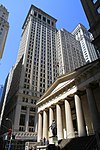
Federal Hall, former U.S. Customs, currently a museum, with Wall Street towers behind it.
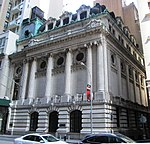
The Chamber of Commerce Building at 65 Liberty Street, one of the many historic buildings in the neighborhood.
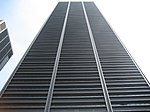
One Liberty Plaza, one of the many modern skyscrapers in the area.


.jpg)

Contenido relacionado
Chaco
Baldassarre Peruzzi
Morale of Hornuez