
Wired logic

Wired logic, wired system, contact logic or programmed logic, is a way of performing semi-automatic and/or automatic control. Physical, electromechanical devices are used such as: keypads, limit switches, etc. These correspond to the system inputs.
Unlike programmed systems, the structure of a wired system is usually rigid and therefore difficult to change. To develop schemes, in a simple way, it is convenient to resort to Boolean algebra.
Description
In the meaning of electromechanical technicians, industrial wired logic is the design technique of small to complex automata used in industrial plants, basically with wired relays. In the sense of telecommunications and computer technicians, wired logic uses discrete logic gates (TTL, CMOS, HCMOS) to implement digital communication and computer circuits.
Industrial wired logic consists of the design of automations with wired circuits between auxiliary contacts of electromechanical relays, power contactors, time delay relays, diodes, protection relays, oil-hydraulic or pneumatic valves and other components. Wiring includes command and control, signaling, protection and power functions. The power, in addition to electrical circuits, includes pneumatic circuits (pressurized air control) or hydraulic oil (pressurized oil control). Create rigid automations, capable of performing a series of tasks sequentially, without the possibility of changing variables and parameters. If another task has to be carried out, it will be necessary to carry out a new design. It is used in small automatisms, or in critical places, where the safety of people and machines cannot depend on the failure of a computer program.
In larger systems or that require flexibility in their operation, the programmable controller is used, among which are the PLC programmable logic controller, the RTU Remote Terminal Unit or programmable relays, or computers or servers for industrial use. These automata are not programmed in traditional languages like any computer, they are programmed, for example, in Ladder, a language in which the instructions are nothing more than lines of wired logic. Thus, knowledge of wired logic is of fundamental importance for those who program a programmable controller or PLC. Wired logic, more than a technique, nowadays constitutes a philosophy that allows structuring circuits in an orderly, neat and safe way, whether in wired or programmed circuits. The practice of wired logic has been assimilated by other branches of technology such as telecommunications and information technology, with the introduction of structured cabling in buildings, offices and commercial premises, places where handling schematics and drawings of facilities is unusual. electrical, except for power, the preparation of detailed projects and wiring in an orderly manner through the use of terminal blocks and strips, which came to be called "patch boxes" in the case of data and telephone networks. PLCs can also be programmed, according to their brand and model, in other languages such as the instruction list, BDF (function block), Grafcet (functional diagram)
Advantages
The main advantage of using a system of this type is usually its manufacturing cost in those systems without too much complexity or for very specific functionalities. This is the main reason for the choice between a wired system or a programmed one. Currently, three technologies allow the creation of different wired systems:
- Electromagnetic relays.
- Pneumatic logical modules.
- Electronic cards or modules.
In certain cases, a wired system may have a very low reaction time (delay time) to an input signal (in the order of nanoseconds), because the delay is imposed by the physical delay of the components themselves electronics. This makes it the only feasible solution for systems with a critical reaction time.
Photos

Variables logic employed in wiring logic compared to logic, digital circuits, pneumatic and oil-hydraulic.
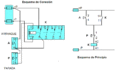
Different ways to represent an electrical scheme; the connection scheme and the principle scheme.

Typical Start Scheme of a command and control wiring.

Examples of different ways to identify a wiring logic wiring.

Command polarity formation in a cabled logic circuit; continuous current polarization and alternating current polarization.
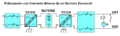
Command polarity formation in a cable logic circuit of an essential service, where the service cannot be stopped in case of power cut.

Distribution of positive polarity +P through a garland, and distribution through a polarity bar built with a bridge terminal block.

The terminals and relays in general are mounted on rails, there are two basic types; the asymmetric and symmetrical, also known as the omega rail.

Born border of arrival of the armed cables to the cabinet containing the wiring logic.

The name relay includes, in addition to the electromechanical relay, any electrical or electronic device with analog or digital inputs, and with one or more outputs by dry contacts.

Basic elements or components used in wiring logic.

One of the ways to draw normal open, normal closed contacts and relay coil, and polarity. In this case the drawings are shown according to European rules items.

The logical functions employed in wiring logic are the same as those used in digital electronics or logical gates.
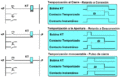
There are many time or timer functions, but three of them are the best known, the timer at the close, the opening and pulse or the monostable.
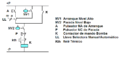
Every automatic circuit always has a manual control for testing, maintenance and emergencies. The selection is made with a Manual-Automatic selector key.

Signaling of states and alarms is performed with light or signaling lamps. The signaling is polarized with an independent polarity of the command, in order to avoid drawbacks in the command in case of a luminous failure.

Enslavement prevents contradictory commands from acting at the same time. There are various ways to resolve them, two of them are the clamping between pushers, another is between the relays or contacters.

Sequential command example with states 1, 2, 3,..., initially operated by a pusher.

The self-maintaining function of the wired logic holds similarity with the slip-flop or bi-set of the digital electronics.

The colors of the command pushers, and the luminous of states and alarm, are chosen according to international standards such as CIS 73.


Contenido relacionado
Douglas Aircraft Company
LabVIEW
Second decade of machine translation