
Williams racing

Williams Grand Prix Engineering Limited, commonly known as Williams Racing, is a Formula 1 team created in 1977 by Frank Williams and Patrick Head.
Williams is considered one of the four great Formula 1 teams, along with Ferrari, McLaren and Mercedes. The team's first race was at the 1977 Spanish Grand Prix, when the team raced on a March chassis and Patrick Neve as pilot. Williams began building its own cars the following year. Swiss Clay Regazzoni won the first race for the team at the 1979 British Grand Prix, while at the 1997 British Grand Prix, Canadian Jacques Villeneuve won the 100th race for the team. In this way, Williams became one of the only three teams in Formula 1, along with Ferrari and McLaren, also English, to win 100 races.
Seven drivers have been world champions with Williams: Alan Jones, Keke Rosberg, Nelson Piquet, Nigel Mansell, Alain Prost, Damon Hill and Jacques Villeneuve. In turn, the team won 9 Constructors' Championships between 1980 and 1997. This was a record until it was surpassed by Ferrari in 2000.
Williams has worked with many engine manufacturers, but most successfully with Renault: Williams has won 5 of its 9 Constructors' Championships with the French manufacturer.
All Williams cars are called "FW-number", after the initials of team co-founder Frank Williams. In addition to Formula 1, Williams also participated in other motorsport championships, both as a constructor and as a team.
In 2020, after more than 40 years of participation and despite the prestige garnered in the Formula 1 arena, the team was acquired by the financial holding Dorilton Capital, who bought the team from the Williams family in August and presented its new board of directors in September.
History
Beginnings
Williams Grand Prix Engineering Ltd was founded by Frank Williams and Patrick Head in 1977. Frank Williams had previously owned the Frank Williams Racing Cars team, but this was converted to Walter Wolf Racing after 1976. The company was first based in an empty carpet warehouse in Didcot, Oxfordshire, bought a chassis in March of that year to compete in F1 during the second half of the 1977 season
In 1978 Williams returned with Alan Jones as sole driver. The Australian pilot will manage to get on the podium at the United States GP. The 1979 season is even better, Jones teamed up with Clay Regazzoni, Williams wins his first victories and finishes second in the final constructors' standings.
1980s
In the 1980 season, with 5 victories, Alan Jones becomes world champion and Williams wins its first constructors' crown. In 1981, Williams won a new constructor's title, but no driver's title. In 1982, Keke Rosberg won the world title with just 44 points, while the team had to settle for fourth place in the standings. In 1983, Williams switched to the Honda engine, with no better results. After a moribund 1984 year, Williams finished third in 1985, to win two new constructor's titles in 1986 and 1987, thanks to Nigel Mansell and Nelson Piquet, the last world champion in 1987. In 1988, Williams is abandoned by Honda, the new Judd engine does not give the expected results. In 1989, the Renault era begins. Behind the dominant McLaren-Honda, the Williams will slowly garner better results: runner-up in 1989 and 1991. And that's where the long line of driver and manufacturer titles begins.
1990s
In 1992, Nigel Mansell crushed the season, winning the first 5 championship events. In 1993, Alain Prost won 7 victories to win a fourth world crown. In 1994 and 1995, Damon Hill will fail twice against Schumacher, especially in 1994, where he lost the title only because of a collision caused by the German. But the British will finally win the title in 1996, ahead of Jacques Villeneuve, his teammate who won the title in 1997. During that time, the constructor side, between 1992 and 1997, Williams will win 5 championships out of 6, failing in 1995 against the Benetton team, helped by Schumacher.
The 1998 and 1999 seasons the results declined. First with the Mecachrome engine, then Supertec.
2000s
In 2000, the first year with the BMW engine, the team's situation will change little. In the year 2001 Juan Montoya and Ralf Schumacher allowed the team to obtain new victories and face their biggest rivals. In 2002, behind Scuderia Ferrari, the Williams-BMW managed to win the double in Malaysia and take McLaren to third place in the constructors' championship.
In 2003, Williams starts off pretty poorly, but will bounce back well by mid-season and put Montoya up as a title contender. In the final, Williams will finish second in the manufacturers' championship.
In 2004, Williams introduced the FW26 with a revolutionary nose. But the results are not like that, and they return to a more conventional nose that does not prevent the team from descending to fourth place. In 2005, Williams has two Formula 1 contenders, Mark Webber and Nick Heidfeld. Both drivers managed to get on the podium in Monaco. But the whole season is still comparable to 2004, not necessarily good performances.
In 2006, Williams suffered a severe blow with the departure of BMW, which decides to buy Sauber. To replace Nick Heidfeld, Frank Williams appointed Nico Rosberg, son of the famous 1982 world champion, as second driver.
In 2007, the season is already much better than the previous one: the team regularly accumulates points and even takes advantage of the chaos of the Canadian Grand Prix to return to the podium. The team ultimately ranks fourth.
In 2008, Rosberg is accompanied by Kazuki Nakajima, son of Satoru Nakajima. Despite good performances on urban circuits such as Monaco, Melbourne or Singapore, the team finishes in eighth place.
For 2009, the team finishes in sixth place.
2010s
It is too much for the young Nico Rosberg who signs without hesitation in Mercedes. Nakajima is fired and Williams can start the 2010 season with a change of everything.
In fact, the Cosworth engine is returning to competition, replacing the Toyota engine. 2009 GP2 champion Nico Hülkenberg is committed and has the support of the experienced Rubens Barrichello who is looking for a new challenge. Especially Frank Williams is slightly behind and hands over the team presidency to Adam Parr. The start of the season with the FW32 is difficult and both drivers have problems to hang points. But in the second part of the season things improve and Barrichello manages to regularly finish in the top ten. In a negative start, Hülkenberg had a great end to the season and signed pole position with the Brazilian GP, the team's first in five years. In the end, although no podium finishes could be earned, Williams finished sixth in the manufacturers' standings, just ahead of Force India.
But sadly, for 2011, the team suffers the departure of its main sponsors, forcing it to call up a paying driver. Despite his good services, Hülkenberg is grateful and replaced by the Venezuelan Pastor Maldonado, GP2 champion supported by the government of his country. In March 2011, the team also attempted a bet unprecedented in the world of F1: an IPO.
In the 2013 season, the drivers were Valtteri Bottas and Pastor Maldonado. The team finishes in ninth place.
From 2014, and under the direction of Claire Williams, the team announced the use of Mercedes power units (engines) from 2014. Felipe Massa replaces Pastor Maldonado. Both drivers took podium finishes during the season, allowing the team to finish in third position, behind Mercedes and Red Bull Racing (which would also be repeated in 2015, but this time behind Mercedes and Ferrari). The 2016 season the team would finish fifth in the constructors' championship.
In the 2017 season, Bottas is replaced by Lance Stroll, finishing the team again in fifth place.
The 2018 season was pretty bad for the team. Felipe Massa is replaced by Sergey Sirotkin, finishing the team in last place.
In 2019, Lawrence Stroll leaves his alliance with Williams and becomes the new owner of the former Force India, Stroll leaves Williams to join his father's team. With the arrival of ROKiT as the new main sponsor and a new duo of drivers, George Russell and Robert Kubica, expectations were high, going so far as to say that 4th place was their goal. But after a delay in the preseason in which they arrived two days later, demonstrating the economic problems. They were 1-2 seconds behind the penultimate and Robert Kubica had a lot of adjustment problems, coming to be almost a second behind Russell.
Years 2020
The year begins with George Russell and Nicholas Latifi as official drivers. Likewise, the agreement with Mercedes-Benz for the supply of engines continues. During the month of May 2020, Williams announced his break with his main sponsor ROKiT, and the option to sell part or all of the team.
Offering and acquisition by Dorilton Capital
On May 29, 2020, the Williams Racing team was announced for sale, due to financial problems derived from the stoppage of sports activities due to the global Coronavirus pandemic. This decision was also made in light of the breakdown of the agreement with its main sponsor, the ROKiT firm.
On August 21, 2020, Williams Racing was acquired by the financial group Dorilton Capital, who initiated the transfer process with the Williams family.
Finally, on September 3, 2020, Claire Williams made her resignation from the Williams Grand Prix Holdings board official, setting a date for her departure after September 6, once the Italian Grand Prix takes place. After this announcement Hours later, the new board of directors that will command the shares of Williams Racing, made up of Dorilton president Matthew Savage, marketing graduate Darren Fultz and former driver James Matthews, was presented.
Team names
Name of the Williams team through the years:
| Seasons | Name | Comments |
|---|---|---|
| 1977-1978 | Williams Grand Prix Engineering | Foundation Name of Frank Williams Second Team |
| 1979 | Albilad-Saudia Racing Team | Sponsorship agreement with Albilad-Saudia airline. |
| 1980-1981 | Albilad-Williams Racing Team | |
| 1982-1983 | TAG Williams Team | Sponsoring agreement with the TAG watch manufacturer. |
| 1984 | Williams Grand Prix Engineering | End of agreement with TAG. Retake your foundational name |
| 1985-1987 | Canon Williams Honda Team | Sponsoring agreement with the Canon optical and photo manufacturer. Official support and engine supply by Honda. |
| 1988-1993 | Canon Williams Team | End of official agreement with Honda. Judd's entry as a engine supplier in 1988. Renault's entry as a engine supplier since 1989. |
| 1994-1997 | Rothmans Williams Renault | Sponsorship agreement with Rothmans tobacco. Official support of Renault. |
| 1998-1999 | Winfield Williams | Sponsoring agreement with the Winfield tobacconist. Renault agreement and withdrawal. |
| 2000 - 2005 | BMW Williams F1 Team | Sponsoring agreement and supply of engines with BMW. Change of the official team name to Williams F1 Team |
| 2006 | Williams F1 Team | End of agreement with BMW. |
| 2007-2011 | ATRT Williams | Sponsorship agreement with the AT hypothesis communication company. |
| 2012-2013 | Williams F1 Team | End of agreement with AT fakeT. Take your second official name. |
| 2014-2018 | Williams Martini Racing | Sponsorship agreement with Martini Racing (Martini ' s & Rossi Sports Division). |
| 2019 | ROKiT Williams Racing | End of agreement with Martini. Sponsorship agreement with ROKiT. Third official name change to Williams Racing. |
| 2020-current | Williams Racing | Termination according to ROKiT. It is made known by its third official name. |
Pilot Academy
Single-seaters
Constructors' Championship Winners
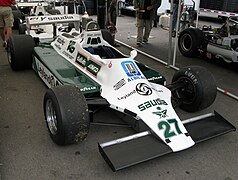
Williams FW07, 1980 season builder champion

Williams FW07C, builder champion season 1981

Williams FW11, 1986 season builder champion

Williams FW11B, 1987 season builder champion
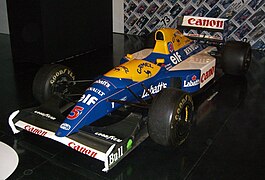
Williams FW14B, 1992 season builder champion

Williams FW15C, Champion of Builders Season 1993

Williams FW16, 1994 season builder champion

Williams FW18, 1996 season builder champion
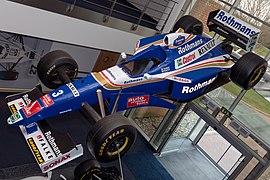
Williams FW19, 1997 season builder champion

.jpg)


Honours of Prizes

- Formula 1 World Championship (9): 1980, 1981, 1986, 1987, 1992, 1993, 1994, 1996, 1997
- Formula 1 World Championship (7): 1980 (Alan Jones), 1982 (Keke Rosberg), 1987 (Nelson Piquet), 1992 (Nigel Mansell), 1993 (Alain Prost), 1996 (Damon Hill), 1997 (Jacques Villeneuve).
- Trophy DHL Quick Stop (1): 2016 (Williams FW38)

Alan Jones, pilot champion in the 1980s

Keke Rosberg, pilot champion in the 1982 season
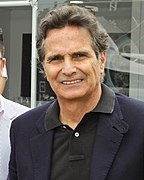
Nelson Piquet, champion of pilots in the 1987 season
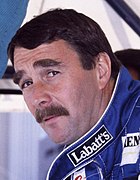
Nigel Mansell, champion of pilots in the 1992 season

Alain Prost, champion of pilots in the 1993 season
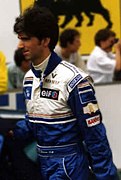
Damon Hill, pilot champion in the 1996 season

Jacques Villeneuve, champion of pilots in the 1997 season


Driver Stats
Data updated until the 2022 French Grand Prix
.svg)


.svg)
.svg)

- Negrita: Pilot in activity, currently competing for Williams.
Results
Other activities
In 1984, Williams was involved in the development of the MG Metro 6R4, a Group B rally car.
Williams competed in the British Touring Car Championship from 1995 to 1999 as a works Renault team, driving the Renault Laguna. Swiss Alain Menu was drivers' champion with Williams in 1997, and the French brand won the manufacturers' title in 1995 and 1997. As part of Renault's Formula 1 program and in touring cars in various European countries, the sports version of the Renault Clio I carried the Williams name, although the team was not involved in development.
Williams developed the Formula 2 car in use since the championship's revival in 2009, which is powered by Audi engines. Also, as part of the agreement with the Volkswagen group, Williams developed a kinetic energy recovery system for the Porsche 911 hybrid that competed in several grand touring car races.
Drag Races
At the end of the 2000s, Williams was in charge of the design and construction of several sports prototypes commissioned by the German brand BMW to compete in the 24 Hours of Le Mans. In 1998 he put the BMW V12 LM on the track, which demonstrated engine cooling problems and ended up in private hands in the American Le Mans Series and the FIA Sports Prototype Championship.
In 1999, Williams and BMW launched the BMW V12 LMR. That year the model won the 24 Hours of Le Mans, the 12 Hours of Sebring and three dates in the American Le Mans Series.
Williams in the media
Television
- Williams (2017): Documentary led by Morgan Matthews, which addresses the family and professional life of Sir Frank Williams.
- Formula 1: Drive to Survive (2019): Documentary on the 2018 Formula 1.
Books
- Williams, the story of a racing team (Bruce Grant-Braham, 1990)
- Williams the Business of Grand Prix Racing (Alan Henry, 1991)
- Williams: The legendary story of Frank Williams and his F1 team in their own words (Maurice Hamilton, 2012)
- Williams: A Different Kind of Life (Virginia Williams 2017)