
Virgin of Carmen
Virgen del Carmen or Our Lady of Mount Carmel is the common name usually received by Santa María del Monte Carmelo, one of the various invocations of the Virgin Mary. Her name comes from her veneration on Mount Carmel, in the Holy Land, near Haifa. Carmelo or Carmen derive from the Hebrew word Karmel or Al-Karem which could be translated as ' garden of God'. The veneration of this Marian dedication has been spread throughout the world by the Order of Our Lady of Mount Carmel, called Carmelites.
In Spain, Puerto Rico and Costa Rica she is the patron saint of the sea, she is also the patron saint of the Spanish Navy. In the Dominican Republic there are some traditions around the celebration of the day of Our Lady of Mount Carmel. She is considered queen and patron of Chile, of its Armed Forces and of the carabineros; She is the patron saint of the National Police, the National Army, sailors and drivers in Colombia; In Bolivia she is the patron saint of the nation and its Armed Forces; In Peru she is the patron saint of Creoleism and perpetual mayor of the city of Lima and in Venezuela she is the patron saint of the Army and drivers. In addition, she was patron of the Army of the Andes which, led by General José de San Martín, achieved the independence of Argentina, Chile and Peru. In Spain she is patron of the Armed Forces, patron of Rute (Córdoba) and patron of San Fernando (Cádiz).
This Marian invocation gives name to all those people who are called Carmen, Carmela or Carmelo, and who celebrate their name day on the holiday of Our Lady of Mount Carmel, on July 16, which the Catholic Church commemorates as an optional memory.
Origin of devotion
The name of Mount Carmel comes from Karm-El (Hebrew: 'garden' or 'vineyard of God'). Mount Carmel is located in modern-day Israel, between the Mediterranean Sea and the valley of Jezreel. It appears in the book of the prophet Isaiah 35:2 as a beautiful place. The prophet Elijah lived in a cave in Carmel. In this place, the prophet Elijah demonstrated the power of the Lord in front of the priests of the pagan god Baal.
The veneration dates back to the group of hermits who, inspired by the prophet Elijah, retired to live on Mount Carmel. These devotees, around 1200, formed the Order of Our Lady of Mount Carmel (Carmelites).
According to Carmelite tradition, on July 16, 1251, the image of the Virgin of Carmel had appeared to Saint Simón Stock, superior general of the Order, giving him the scapular, the main sign of the Carmelite Marian cult, promising to free those who wore it from eternal punishment. The scapular received papal recognition in 1587 and has been endorsed by subsequent pontiffs.
Also, according to tradition, in the XIV century the Virgin appeared to Pope John XXII and promised him help against his adversaries if he granted new approval to the Carmelites. The Virgin also promised the salvation of professed Carmelites and devotees who wore the sign of the habit or scapular and fulfilled prescriptions of prayer and, if it corresponded to her canonical status, chastity. The Virgin would descend to Purgatory on the first Saturday after the death of people to take their souls to heaven, hence this was called the Saturday privilege. This was approved by Pope John XXII in the Sabatina Bull of March 3, 1322. Later, it was also approved by Pope Clement VII with the "Breve Dilecti filii" from 1527.
The Virgin of Carmen is also called Star of the Sea (in Latin Stella Maris) and is the patron saint of sailors. Marian devotion to the Virgin of Carmen spread to many countries in Europe, and through Spain and Portugal to Latin America, starting in the 16th century.
Devotion in Europe
Spain


Spain is one of the countries where this dedication is most deeply rooted. She is the patron saint of sailors, which includes fishermen and merchant sailors. On April 19, 1901, the Regent María Cristina of Habsburg and the Minister of the Navy Cristóbal Colón de la Cerda, Duke of Veragua, endorsed with their signatures the Royal Order by which the Blessed Virgin of Carmen was proclaimed Patroness of the Spanish Navy..
At the General Chapter of London (1254) of the Carmelites, the order was given to found in Spain and as a consequence, around 1270, the first foundations were carried out in some of the most important cities of the Crown of Aragon. His initiative was promoted by monarchs such as James I (1213-1276) or his grandson James II. In the Crown of Castile, the first foundation was in Valladolid, in the convent of San Pablo de la Moraleja (1315). Its spread was rapid throughout the Iberian Peninsula, reaching Seville in 1358, the city from which the creation was promoted. of the outstanding Betic Carmelitan Province, in 1499. At this time, the first female communities of Carmelite nuns began to emerge throughout the territory. Saint Teresa of Jesus and Saint John of the Cross, during the XVI century, introduced profound reforms within the Order giving origin to the "Discalced Carmelites", a new, more austere congregation that separated from the parent order, which was renamed "Calzado Carmelites" or of the "Ancient Observance". Despite this division, they continued their spiritual path throughout the world in successive centuries.

Practically all the towns and cities on the Spanish coast pay religious worship to the Virgin of Carmen, organizing processions and colorful maritime pilgrimages carrying her image every July 16. Although there are cases like in Rute, an inland town located in the province of Córdoba, where the miraculous image of the Virgen del Carmen Coronada, the main devotion and Patroness of the town, who for centuries is venerated has enjoyed a very important fervor since its beginnings back in the XVII century until today. This image of the Virgin with the baby Jesus are works by an unknown author dating from the XVII century and attributed to the Granada school near Diego de Mora, and the image of the divine infant is from the Neapolitan school. It has a rich material, musical and historical heritage, such as the “Auroros de la Patrona de Rute”, which are popular songs and couplets of great antiquity, dedicated to the Virgin of Carmen. These were pioneers in the area and are sung in different events such as Rosaries, Cults, Processions or even Ruthenian mothers sang them as a “lullaby” to put their children to sleep. It is worth quoting one of the most well-known and endearing popular refrains from his couplets, and it goes like this: “…the Virgin of Carmen spread her hair, she made a chain that reached heaven…” or “ God save you, beautiful Carmelite, the people of Rute chose you as our Queen and Patroness..” On the day of her festival, July 16, the Triduum is celebrated in her honor, and it is displayed in devout hand kisses.. She processions twice, on the first Sunday in July and at the Patron Saint Festivities of Rute on August 15.
In another town in the interior of Andalusia, the Virgin of Carmen is also its patron saint. This is the case of Benalúa in the province of Granada. In this town, its patron saint festivities are celebrated in honor of this Marian dedication, and every July 16, her image is processed through the streets of this town.
In the capital of Cordoba we find two great devotions with this dedication, Our Lady of Carmen in San Cayetano and in the Puerta Nueva neighborhood. This first, founded by Carmelite friars around the year 1600 in the Conventual Church of San Cayetano. The image of the Virgin is of an unknown author, around the XVIII century, attributed to the image maker Alonso Gómez de Sandoval, authorship that is shared with the baby Jesus carried by the Virgin. It has a rich heritage and was canonically crowned in May 2012 in the Holy Cathedral Church, celebrating novena and kissing hands on the dates prior to its festivity, concluding with its congratulations at dawn on July 16 and its triumphant procession under the Palio.
In the Puerta Nueva neighborhood of the city of Córdoba, the image of Our Lady of Carmen, located in the Conventual Church of the same name, and known as “the Carmen of Puerta Nueva”, also enjoys great devotion. Its history dates back to around the XVII century, outside the walls of the ancient city, where the Order was established and the corporation was founded., in the old hermitage of the Virgen de la Cabeza, which continues to receive worship. Over the years it enjoyed great splendor, which is why the Conventual Church of Carmen in Puerta Nueva has one of the best Pictorial altarpieces in Spain, the work of the illustrious Sevillian painter Juan Valdés Leal. The image of the Virgin is dated to the XVIII century, by an unknown author and attributed, like the previously mentioned one, to Alonso Gómez by Sandoval, except for the image of the child, being a serial model.

Virgen del Carmen de La Orotava (Santa Cruz de Tenerife)

Virgen del Carmen de Peñausende (Zamora)

Virgen del Carmen de Rincón de la Victoria (Málaga)

Virgen del Carmen de Santurce (Vizcaya)

Virgen del Carmen de Santa Pola (Alicante)

Virgen Del Carmen de Garrucha (Almería)

Virgen Del Carmen de Olula del Río (Almería)

Virgen del Carmen, Patrona de Rute (Córdoba)


.jpg)
.png)

The devotion to the Virgin of Carmen was carried by Spanish missionaries at the time of the Spanish colonization of America, being therefore closely linked to the history of Latin America.
Italy
.jpg)

In the south of Italy, in the town of Acquafondata, the Virgin of Monte Carmen is worshiped in the small sanctuary built on the site of the apparition of the Virgin Mary on July 16, 1841.
The city of Palmi commemorates every November 16 the so-called 'miracle of the Virgin of Carmen'. At its origins is the earthquake that, on November 16, 1894, devastated the aforementioned Italian city and the sixteen days prior to the catastrophe, during which it was possible to observe how the statue of the Virgin of Carmen del Santuario had a certain movement in its eyes and changed the color of his face. The local and national press took up the case and, finally, on the night of November 16, the faithful improvised a procession in which they carried the statue of the virgin on their shoulders through the streets of the municipality. When the procession reached the end of the city, a violent earthquake shook the entire district of Palmi, in which most of the houses were ruined, but in which there were only nine victims of its 15,000 inhabitants, since almost all The population was processioning the statue of the virgin. Since then, a procession has been held in which the Virgin of Carmen is carried on the shoulders of the same streets as in 1894, accompanied by a festive atmosphere in which firecrackers are set off and stalls are set up for the sale of various items. The Catholic Church officially recognized the miracle, with the decree issued by the Holy See on September 22, 1895, and the statue was crowned on November 16, 1896.

Virgen del Carmen in Palmi
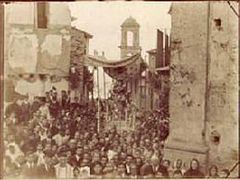
procession of 16 November 1894 in Palmi


Malta
The Virgin of Carmel is the patron saint of the Maltese capital, the city of Valletta.
Devotion in America
Argentina

The Virgin is venerated in numerous cities throughout the country. This Marian dedication is the patron saint of the Army of the Andes, founded by General San Martín. and the Argentine Federal Penitentiary Service. It is one of the invocations of the Virgin Mary who receives the treatment of Virgin General of the army.
She is the patron saint of the following cities in the province of Buenos Aires:
- Cañuelas, her main parish bears her name: "Our Lady of Carmen".
- In Arroyo Corto the Parish and the Primary School bear their name.
- In Lobos.
- In the City of General Rodríguez, every 16th of July she worships the Virgen del Carmen, Patrona de la Ciudad.
- Zárate is also her patron virgin.
- In Las Flores it is also her employer.
- In Necochea, her main parish bears her name: "Our Lady of Carmen".
- In Lobería it is also its patron and the party is celebrated on July 16.
- Three Arroyos.
- In Benavídez it is also the Patron.
- General Lamadrid.
- In the parish of General Villegas.
- In the town of Pasteur (Pcia de Bs.As.). People's patron.
- In the main city of the Patagones Party, "Carmen de Patagones", is the parish that bears its name, pays tribute to all 16 July of each year.
- In the City of Carmen de Areco every 16th of July the Virgin of Carmen is worshiped, religious activities are carried out in honor of the Sta. Patrona, the pilgrimage on foot next to the image of the virgin to the parish that bears her name "Our Lady of Carmen", there is the Mass. 60 days before the celebration hundreds of images go to the homes and return the day before the celebration.
- In Chivilcoy one of its main temples, associated with the Italian immigration of the nineteenth century, is dedicated to the advocation of the Virgin of Carmen; in the recent past its festival was celebrated with a striking fireworks show; and even today on 16 July it remains as a day of popular celebration.
- In Carlos Casares, patron of the village and its main parish bears its name: "Our Lady of Carmen".
- In El Socorro It is the patron of the people.
- At the Colegio Nuestra Señora del Carmen de Suipacha.
- At the Colegio Nuestra Señora del Carmen de Lomas de Zamora.
- Carmen Arriola de Marín, San Isidro College in Buenos Aires.
- In the Catholic church and school of Nuestra Señora del Carmen in Villa del Carmen, a neighborhood of Del Viso.
- In the parish and school "Our Lady Del Carmen" in Villa Urquiza, Buenos Aires City.
In the province of Córdoba:
- In the City of Cordoba, in the neighborhood of Alta Córdoba in the parish of Nuestra Señora del Carmen and the Instituto Nuestra Señora del Carmen.
- In the town of Villa Allende.
- In the town of Capilla del Carmen.
- In the town of Chaján.
- In the town of Cruz del Aje (Patrona de la Diocese de CRUZ del EJE y Patrona de la ciudad) also the Cathedral Church of the Diocese is in honor of the Stma. Virgin
- In the town of La Cumbre (Patrona del pueblo)
- In the town of Inriville, the village church bears its name.
- In the town of Pascanas, the village church has its name.
- In La Localidad de Villa de las Rosas (Valle de Traslasierra)
In the province of Tucumán she is the patron saint of:
- El Barrio Villa 9 de julio, en la capital tucumana.
- The City of Famailla, where it is known as the Virgin of the Long Hairs.
- The City of Aguilares, with great devotion.
- Tafi del Valle.
- El Pueblo de La Madrid (Graneros department).
In all these Tucuman towns the patron saint's day is celebrated on July 16 with great displays of faith and devotion.
In the province of Santiago del Estero:
- It is patron of the City of Santiago del Estero and the Basilica Cathedral of the city offers its main altar to this image, patron of the Santiagueño people.
- It is patron of Villa la Punta, a village located in the south of the Sierras de Guasayán.
In the city of Nogoyá, province of Entre Ríos, the virgin is highly venerated and is the patron saint of the town; She was initially known as Nuestra Señora del Carmen de Nogoyá.
In the province of Corrientes:
- She is a patron in the city of Bella Vista.
- In the city of Sauce, his image is also venerated with great devotion.
In Formosa it is the patron saint of the province, established by law of the first constitutional government and there is a parish (Cathedral Church) with the name of the virgin, in which the image brought by the founder of the city Colonel Luis is venerated Jorge Fontana. Every July 16, the traditional procession takes place through the streets of the city where thousands of faithful gather to worship the patron saint of the city of Formosa, patron saint of the entire diocese and patron saint of the province. When the holy image arrives at the cathedral she is greeted by a shower of petals and papers and by numerous thunder bombs.
In Puerto Iguazú, province of Misiones, is the Virgen del Carmen Parish, patron saint of the city and the Iguazú Falls.
In the City of El Carmen (province of Jujuy) every July 16, La Virgen del Carmen is also worshiped, mentioning the particularity that from July 1 to July 31, cultural, sports and religious activities are carried out in honor to the Holy Patron organized by different institutions in the city, as well as the local municipality, being the only city in the country that has this particularity.
On July 15, the itinerant pilgrimage takes place along the Las Maderas and La Ciénaga dams, then we walk along the image of the Virgin 7 km to the parish. There at 8 pm the mass is prayed, then a serenade and at 00:00 on the 16th the mañanitas are sung with the Mariachis and the entire population receiving their day with fireworks. On the 22nd the civic and military parade takes place in the city of El Carmen.
In the Province of Salta:
- In the Diocese of the New Oran, and the city of San Ramon de la Nueva Orán (the last city founded by the Spanish in America) is co-sponsored by San Ramón Nonato. In this diocese since 2001 is carried out the Youth Pilgrimage Mariana, which runs 24 km from the city of Pichanal to Oran. The motto that brings together young people around the Virgin of Carmen and her escappulary is "Mary, in your hands my Hope".
- In the city of San José de Metán is a co-sponsor of the city, next to San José; the Hospital of the city bears its name and is venerated in the Penitentiary Unit based in the city.
- In Juramento, the party of Metan, the convent of the New Disciples Brothers of Jesus of St John the Baptist, bears his name and finds the Novicios under his advocation.
- In Thermal Complex El Sauce, in the place of the same name of the town of El Bordo, every 16th of July or the following Saturday, the entire community of the Association of Retired and Pensioned of the Province of Salta (AJPS) gathers to honor the Virgin of Carmen and ask her for her blessing from all homes.
In the Province of Santa Fe:
- In Timbues (locality) the parish bears its name, being the patron saint of the village.
- In Helvecia, the parish bears its name as it is the patron of the village.
- In the city of Santa Fe there is the Basilica of Our Lady of Carmen, a church that was elevated to that category by Pope John Paul II.
- In the city of Funes, the parish of Nuestra Señora del Carmen was opened on November 10, 1912. Carmen Lejarza and Estela Jaccuzzi, both honorary presidents of the commission of ladies, contributed to the support of which in principle had been a chapel. Mrs. Lejarza, by whom the parish is named, brought from Europe the image of the Virgin Del Carmen and thus was imposed as Santa Patrona.
In the Archdiocese of Rosario, she is Patroness of the parishes and the following towns: Soldini, Pérez, Pujato, Timbúes (locality). Furthermore, in the city of Rosario there is a parish with her name run by the Carmelite Fathers.
- It is the patron of Carmen de Patagones, in the province of Buenos Aires. Its image is located in the parish of our Lady of Carmen, which is the first and oldest built in Argentina Patagonia. At his side are Ceferino Namuncurá and Artémides Zatti and there are also 2 flags, belonging to the Brazilian navy, because on March 7, 1827, Brazil tried to invade Argentina and was defeated by the forces of the fort of Patagones and the neighbors.
Bolivia

The devotion to the Virgin of Carmen brought by Spanish missionaries in colonial times is closely linked to the history of Bolivia. During the time of the fight for independence, the patriots took her as their protector. On July 16, 1809, a revolution took place in the city of La Paz, led by Don Pedro Domingo Murillo against the Spanish government, taking advantage of the procession during the feast of the Virgin of Carmen. After dismissing the royalist authorities, the Tuitiva Junta proclaimed the liberation of these lands from the power of the Spanish crown. Days later, the patriots once again took out the image of the Virgin of Carmen in procession, in thanksgiving for the triumph of the uprising, but this time with the Phrygian cap of freedom instead of the crown and with a saber on the head. hand.
Pope Pius IX proclaimed her "Patron Saint of Bolivia" by a Papal Bull in 1851 and ratified by the government of Bolivia in 1852. Subsequently, by Law of October 11, 1948 she was proclaimed "General and Patroness of the Armed Forces of the Nation." Her feast day is celebrated with great devotion and solemnity in many towns and cities in the country, and with the participation of the Nation's Armed Forces with the rank of General. The image is more than 206 years old, it was restored in 2011 by the Ministry of Culture at the insistence of the Church. She is the same Image of the Revolution of July 16, 1809 in the city of Our Lady of La Paz, which marked the follow-up of the different revolutionary movements in South America. The Paceños have a special devotion to the Virgen del Carmen the "Revolutionary" or also called in La Paz the "Linda" image that is venerated in the Church of Carmen in the heart of the Ballivian City on the corner of Colón, former Monastery of the Discalced Carmelites.
In Punata In the town of Villa Rivero; One of the most important religious festivities is Virgen del Carmen, which is celebrated from July 22 to 25. The image of the Virgin is more than 600 years old, it was made in Spain and brought to Bolivia during the colony and later gifted to the town of Villa Rivero
Chile
Virgin of Carmen de La Tirana


In La Tirana, a town in the interior of Iquique, every July 16 the faithful make a pilgrimage to the sanctuary, where this Marian dedication is celebrated with greater devotion. In this town the founding story referring to the Indian ñusta (princess) Huillac is told:
In the autumn of 1535, the conqueror Diego de Almagro left Cusco to Chile with some 500 Spanish and ten thousand indigenous people. Among them he carried, as hostages, Huillac Huma, the last high priest of the cult of the sun, and her 23-year-old daughter, the ñusta Huillac. The young woman managed to flee and took refuge with some followers in an oasis of the Tamarugal Pampa. He executed every foreigner or indigenous person who had been baptized to fall into his hands and called it "the Tirana del Tamarugal". One day a handsome young man appeared, Vasco de Almeida. The ñusta fell in love with loss and invented how to delay her death. Vasco conveyed to him the Christian faith and his devotion to Carmel, and such was the love among them, that the ñusta asked him if it was true that there was a supreme God who gave eternal life after death, associating this one, asked him to baptize him, and at that time, when his followers discovered his betrayal, they killed them both in a rain of arrows, shed blood on those lands. Years later, a Spanish evangelizer, Brother Antonio Rondón, discovered among the branches of tamarugos a coarse wooden cross. In the context of the tragedy, a chapel was erected in honor of the Virgin of Carmen.
Since then the festival has been celebrated in July, beginning on the 10th and ending on the 17th, when the image of the virgin is brought up to her dressing room. These days are marked by the arrival of pilgrims who dance to the image of the virgin—dances such as the diablada, the cuucacas, the Chinese dance, etc.—for ten days dancing day and night.
On the 15th, the solemn Eucharist of Vespers is held in the sanctuary square, where the 16th of July is awaited with fireworks, thus bringing together more than two hundred thousand pilgrims who sing and dance.
On the 16th, the image of the Virgin is lowered from the top of the sanctuary with the singing of the Chilean anthem to the thousands of faithful who are gathered on the esplanade, where the solemn Eucharist on the day of the Virgin begins. party. After finishing the Eucharist, the pilgrims gather at the sanctuary to celebrate the massive procession of the festival, where the images of the Virgin, Saint Joseph and Jesus the Nazarene are taken for a walk through the streets of La Tirana for more than eight hours. Later at night, on the esplanade of the sanctuary, everyone gathers to wait for the arrival of the procession with the images to say goodbye to them.
On the morning of the 17th, the procession takes place around the sanctuary and around noon the solemn farewell Eucharist is celebrated, when the image of the Virgin is carried up to her dressing room with the tricolor ribbons that fill the sanctuary.
Arrival of devotion to Santiago
When the friars of the order of Saint Augustine arrived in Chile in 1595, they began the propagation of the Virgin of Carmen and several years later created their first brotherhood. Her image is used as the patron saint of the Liberation Army of Argentina and Chile. On December 5, 1811, a mass of thanksgiving was celebrated by order of José Miguel Carrera and Bernardo O'Higgins in the name of the Virgin, while on January 5, 1817 it was José de San Martín who officially declared it "Patron Saint of the Army of the Andes", placing the baton in the right hand of the religious image. On the eve of the battle of Chacabuco, O'Higgins proclaimed the Virgin of Carmen "Patroness and General of the Chilean Arms."
Given the imminent final outcome of the war of independence after various royalist victories, whose troops were approaching Santiago, prayers were held in the city cathedral praying for the victory of the patriotic troops. There, O'Higgins, supreme director of the country, promised the construction of a temple in honor of the Virgin in that place where the independence of Chile was assured:
In the same place where the battle is given and the victory is obtained, a Sanctuary will be raised to the Virgin of Carmen, Patrona and General of the Chilean Army, and the foundations will be placed by the same magistrates who make this vow, in the same place of his mercy, which will be that of his glory.
The patriot victory in the Battle of Maipú, on April 5, 1818, assured Chilean independence and, fulfilling his promise, O'Higgins ordered the construction of the Votive Temple in the current commune of Maipú. His holiday, July 16, has been celebrated in the country since 2007, replacing the Corpus Christi holiday.
Consecration
On April 3, 1987, Chile was consecrated to the Virgin of Carmen by Saint John Paul II in the National Sanctuary of Maipú.
Colombia

Colombian transporters adopted her as their patron saint for the protection and intercession attributed to the Virgin of Carmen in dangerous situations. It is common to see sanctuaries built in honor of the Virgin on Colombian roads with dozens of candles around them, and car lamps placed by drivers who pass by the place and stop to pray to her. Likewise, drivers order scapulars and images to be blessed, which they hang and stick on their vehicles as a protective shield.
The origin of this devotion is located in the Colombian Caribbean; In almost all the municipalities of the seven departments of that region in the north of the country, but especially in those of the formerly called Bolívar Grande, various tributes are paid to the Virgin of Carmen on her day and the drivers participate in the processions in honor. their patron saint decorating their vehicles and sounding their horns. In the riverside towns of the Río Grande de la Magdalena, people go out in procession along the river, carrying the image escorted by hundreds of boats (commonly in the Municipality of Guamal). Then, the land transporters carry the image in a gigantic caravan in which they sound the car horns, making themselves noticed by each town they pass. A commemorative parade is also held.
The main municipality where the celebration of July 16, a day dedicated to the Virgin, stands out is El Carmen de Bolívar; where prestigious patron saint festivities are held throughout Colombia, around July 7 to 17. These festivities commonly begin with a musical dawn performed by a wind band, with different cultural actions on previous days. The pilgrimages are danced and sung with their patron saint who is no stranger to dance, as she is carried on shoulders to the rhythm of a sabanero joint. On the nights of the novena, after finishing playing the wind band is placed in the atrium of the Sanctuary. People gather in the city center to "play" or simply see the traditional Bolas de Candela. On the 15th, 16th and 17th there are burnings of castles and the so-called 'mad cows'. On the other hand, it should be added that its foundation name was "Our Lady of Carmen".
Likewise, highlight the image of the municipality of El Carmen de Viboral whose patronage is devotedly given to the Virgin of Carmen, to such an extent that it is reflected in its various festivities.
Since July 16, 1992, it was declared in various archdioceses and dioceses at the national level in their minutes, as a religious holiday almost of obligation for the majority of cities and towns in Colombia, which in various ways pay tribute to its Patron Saint in an exceptional way with dawns, processions, parades and blessings of vehicles.
As is the case in: Honda (Tolima) a banquet is held in honor of the Virgin of Carmen days before the festival with cultural displays. In the historic center of Bogotá 'La Candelaria', is the District Sanctuary of the Virgen del Carmen, where every July 16 different events are held that bring together the city's drivers, especially taxi drivers, who They pay tribute to their patron saint. The drivers and owners of tractor trailers located near the Antiplano Cundiboyacense pay tribute at the Tocancipá racetrack. The racing festival of these vehicles that come from all corners of the country to pay tribute to their benefactor opens with a Eucharist.
It is also worth highlighting that the Virgin of Carmen is Patron and Queen of the Armed Forces of Colombia, the National Police, the Marine Corps and the Air Force. She is also patron of the Fire Department.
Costa Rica
In 1913 in the city of Puntarenas, news spread that "El Galileo", a pearl shell ship, with its entire crew on board, had been shipwrecked near Caño Island. Don Hermenegildo Cruz Ayala, a Panamanian Chirican, who like so many others at that time came to try their luck in the young Costa Rican port, was the owner of the collapsed boat.
Don Hermenegildo, driven by the pain of the relatives of the crew of his ship, and faced with the shock of the people of Buenos Aires, goes to the city temple to ask the Virgin of Carmen for his workers.
The Catholic people, led by Father Carmona - the local parish priest - pray for the men about whom they had no news.
The miracle happens a few days later, when the news arrives that the crew of the Galileo are transferred to Puntarenas, by a ship that rescued them on the mainland.
In the midst of the uproar of the citizens, those men for whom they had prayed arrive at the port, to the surprise of all the believers. They talk about a woman who, in the midst of the storm and tragedy, fed and accompanied them so that they had enough strength to swim to land where they were rescued.
That same day they went to the temple, accompanied by their family and friends, and climbing the Church on their knees, they arrived at the place where the Virgin of Carmen was, where the captain and one of the sailors narrated the miracle of the appearance of the Virgin. and his unexpected rescue in the middle of the storm.
Since then, the people of Buenos Aires call her the Virgin of the Sea, and all the fishermen go out through the Gulf of Nicoya to honor her. They thank him for the fruit of her work and confidently ask him to protect them every time they go out to sea to look for sustenance for her children.
Every year, on July 16, Costa Ricans from all over the country come to Puntarenas to give thanks.
Ecuador
In Ascázubi, a parish belonging to the Cayambe Canton in Pichincha-Ecuador, a very strong faith is rooted. This began with a group of parish residents who, due to their Catholic faith, built a church, with very hard work. After finishing, the residents of Asczázubi went to ask the Quinche, the closest convent, to celebrate masses in the new church and since at that time the distance was an obstacle they could not go since the only way to get there was on foot or by car. a bus that only left at special times.
Seeing that there were no favorable results, they decided to send a letter asking for a resident priest to the Curia in Quito. Shortly afterward they came to carry out an inspection, and after a couple of weeks of requesting it, a Priest arrived with a Brother of the Franciscan order, who were totally surprised by the work done by the residents.
Seeing that it was a new church, the priest decided to appoint a patron of Ascázubi, then this is where the intrigue in the town was born, there a vote was taken.
The intrigued residents did not know who their patron would be, every time they could the father told them different stories about Saints, but one day came when the Story of the Virgin of Carmel reached their ears, this story was shocking.
And from there everyone chose their patron saint. And little by little faith in her grew. The residents, shortly after, bought the image of the Virgin of Carmen.
Currently the Virgin of Carmen is responsible for many miracles done to the residents of Ascázubi, such as giving them health, money, emotional stability, work, and that is publicly known since faithful have given cloaks to their patron saint..
Additionally, the Virgin of Carmen is the patron saint of the city of Zaruma, in the province of El Oro, where, in the month of July, the election of the Queen of Zaruma, National Queen of Coffee, is celebrated, in addition of the processions on the day of the Virgin (July 16).
It also traces back today the belief of its devotees in the Parish that bears its name located in the south of the city Atenas of Ecuador Cuenca, we are talking about La Parroquia el Carmen de la Unión located in the Santa Isabel canton best known for national and foreign tourists to the Yunguilla Valley.
Guatemala

Devotion to the Virgin of Carmen in Guatemala is widespread, with several temples dedicated to her devotion in the Capital City, the main one being the Sanctuary of Cerrito del Carmen, place of the original seat of the Capital of Guatemala in its quarter transfer in 1776. The image of the Virgin of Carmen was brought to Guatemala in the XVII century. Legend has it that Saint Teresa of Ávila wanted this image to be taken to the New World, predicting that a great city would rise at its foot; It was given by the Carmelites of Ávila (Spain) to Juan de Corz, who came to the New World as a hermit.
After his arrival in Mexico from Spain, aboard the ship “María Fortaleza”, Corz headed towards Guatemala. During her passage through a hill, in the Valley of the Cows, the Virgin told the hermit that she wanted to rest in that place, and under that will a church-fortress was erected in 1620, on the summit of the hill that has since been known as Cerrito. from Carmen.
Thus, the Virgin of Carmen became the first guest and patron saint of the Valley that was renamed 'Valley of the Virgin', where more than a century later the New Guatemala of the Assumption would be founded., current capital of the Republic of Guatemala.
Mexico

Our Lady of Carmen is highly venerated in Ciudad del Carmen, in Campeche. The devotion of this town arose from the expulsion of the pirates from the island in the early hours of July 16, 1717, the triumph being attributed to the Patron Saint of Sailors. Later, a fort was built to defend the town and in the center a chapel was built in honor of the Virgin of Carmen.
At the beginning of 1900, the city's fishermen gave the Virgin a gold crown; as well as a smaller one for the child, in 1956, the year in which the centenary of the elevation of the Town to a City was also celebrated. At the initiative of Monsignor Faustino Rebolledo Blanco, the image was pontifically crowned by order of Pope Pius XII; The person in charge of crowning her was the bishop of the diocese of Campeche. The image received a new crown, more aesthetic and beautiful, which has the shield of Ciudad del Carmen on the front, above the shield, a star-shaped compass rose. The boy wears a smaller version of the crown on his temples; The shrimpers gave him a halo that he wears on his back.
That same year the Virgin was paraded through the city bay aboard the shrimp boat 'Centenario del Carmen'; but only for that occasion, since many people considered it sacrilege and for 12 years she did not parade her, until in 1968 she was carried in procession again. Curiously, the following year, in March, oil wells were discovered in the surrounding marine area, so the Virgin was attributed with blessing the sea floor to find the oil. Since that year she walks around him uninterruptedly. There is a legend that when hurricanes or storms approach the island, the Virgin walks around it to ward off the storms, thus leaving her habit full of sand and thistles. On the La Perla boardwalk of the 'Gulf of Mexico', as Isla del Carmen is also known, is the highest religious monument in the sea, a statue of Our Lady of Carmen, with almost 25 meters high, called Stella Maris. In honor of her, the National Floral Games are held within the framework of the Carmen International Expo-Fair, rewarding the poet laureate with a golden rose. Ciudad del Carmen is the pride of the Aztec nation, being recognized worldwide as the Mexican Capital of oil.
He is also venerated in the city of Catemaco, in the state of Veracruz, where there is a basilica in his honor and where according to legends he made his appearance in 1664 in a place on the shore of Lake Catemaco called Tecalli or Tegal (House of Stone). Its solemn feast is on July 16 and is celebrated with a popular fair, which begins on July 14 when the Virgin goes out in procession through the main streets of the city to later take a tour of the lake, passing through the place. where she appeared in 1664 to the fisherman Juan Catemaxca, she is accompanied by wind and marimba music, as well as pilgrims coming from all over the state and the country. Also in Gutiérrez Zamora (Veracruz) every year the Fair of Our Lady of Carmen is celebrated, beginning with a walk of the Virgin along the Tecolutla River.
Likewise, she is venerated in Playa del Carmen, Quintana Roo, a tourist city, in the Municipality of Solidaridad, Quintana Roo and where every year a fair is held in her honor whose queen is crowned within the framework of said celebrations. According to tradition, the Virgin of Carmen appeared to some fishermen who were lost at sea and thanks to her they were rescued. Hence, the fishing village at that time was baptized with the name of Playa del Carmen. Today, in the tourist destination, during the Virgen del Carmen Fair, the banquet, the “Cabeza de Cochino” procession, independent dances, with the traditional Yucatan jarana, the Quintana Roo hipil, Yucatecan terno, colorful flowers, etc.
Also, in Teziutlán (Puebla), the Virgin of Carmen makes her journey (through the various streets of the city, lasting more than 3 hours), from her sanctuary on July 6 to the Holy Cathedral and returns to her sanctuary on July 16 to conclude with confirmations, communions and baptisms and it is said that she arrived by boat, that is why on her tour they always take her on a "boat" simulated, her honor guard always accompanies her. Next December 2012 will mark 200 years since she was appointed General of the Teziuteca Forces in their fight against the Austrian invaders. Furthermore, in the city of Puebla the image of Our Lady of Carmen is very revered, so much so that the neighborhood and colony where it is located is called “El Carmen”, its festival being one of the busiest and oldest in the city, since lasts 1 week on average.
In the same way he is venerated in El Carmen, the town to which he gives his name, the original Hacienda del Carmen, a town of La Barca (municipality) in the State of Jalisco, with the dedication of the Virgin of Carmen.
In the city of Celaya in the state of Guanajuato, one of the most important religious festivities is that of the Virgin of Carmen on July 16, during which the image of the Virgin is taken down from its altar and receives the visit of thousands of faithful between religious celebrations and popular festivals. The temple consecrated to the Virgin of Carmen is one of the emblematic buildings of the city, built from 1802 to 1807 in a neoclassical style. Cataloged as the majestic culminating work of Eduardo Tresguerras, in which he develops not only the splendors of design, but also expresses his skills as a sculptor and painter. Hence the nickname "Mexican Michelangelo " became due to his world-renowned works and the dome similar to that of Michelangelo Buonarroti.
Around the year 1696 the first Spanish settlers of the city of Oaxaca de Juárez (then Antequera) established sites for Christian worship. The hermitage replaced the great Teocalli of Huaxyacac, where the indigenous city celebrated, every July, the great Festival of the Lords in which the sacrifice of a maiden was carried out in honor of Centeótl, Goddess of Corn and Agriculture. The festival was Christianized and transformed into the current festival of Guelaguetza or Monday of the Hill, which coincides with the festivals in honor of the Virgin of Carmen.
Nicaragua
The Virgin of Carmen is venerated as the patron saint in the city and port of San Juan del Sur, and in the city of Río Blanco, both municipalities of Nicaragua are the only places in all of Nicaragua that celebrate every July 16 at the call "Queen of the Sea and the Rivers" (Stella Maris) and as "Protector of the Fishermen".
The celebrations begin on the day when the image of the patron saint San Juan Bautista is uploaded and then the image of the Virgen del Carmen, co-patron of the town, is lowered. Before July 16, the image visits different homes On the occasion of the prayer of a novena, already on July 15 with eve, at night a vigil is held on the beach of the bay, songs are sung in honor of the Virgin, with bands philharmonic musicals or chicheros, marimbas and organs.
In the City of Río Blanco, it is celebrated with the so-called toros encuetados, where models in the shape of bulls are decorated and gunpowder of all kinds is placed on them. Then, some volunteers put on the model and walk through the streets of the city following every person they find. Likewise, a procession takes place in the streets of the city, until reaching the Nuestra Señora del Carmen church, located west of the La Ermita river.
The altar is decorated with accessories alluding to the sea or rivers. On July 16 in the morning the reveille is performed to the sound of chicheros; later, the solemn mass in honor of La Virgen del Carmen; Then, a procession through the main streets of the city until reaching the fishing terminal, where it remains until 3 in the afternoon, when the procession takes place at sea - this lasts approximately an hour and a half -, various boats decorated with Colored pennants accompany the Queen of the Sea on her journey. It is common for dolphins to approach the boat that carries the image of the Virgin to pay tribute to her. The patron saint festival of Virgen de Carmen takes place in Estelí in Nicaragua.
Panama
Virgin of Carmen in Santiago de Veraguas In Panama, devotion to this devotion extends throughout the territory. In Panama City there is the Iglesia del Carmen, on Via España, which is the center chosen by a significant number of couples to be "blessed" by the Virgin and where numerous weddings take place. In the interior of the country, the largest celebrations are held in Pocrí (Corregimiento of the Aguadulce District), since in this town is the Virgen del Carmen National Sanctuary, where thousands of devotees attend throughout the year, as in the historic town of Natá de los Caballeros. In addition, it is celebrated in other cities such as Aguadulce in the town of Pocrí, a renowned procession with images of the Virgin of Carmen in which her sanctuary has been built that bears her name, and in Llano Sánchez.
In Natá de los Caballeros you can see one of the oldest images of Our Lady of Mount Carmel in the Americas. Also in the Diocese of David, in the Province of Chiriquí, the cult of the Virgin of Carmen is widespread thanks to the Franciscan order, which built the Church of Carmen in the city of David. In Sabana Grande de Pesé, the cult of the Virgin of Carmen is celebrated with great faith, in the town of Los Higos de Parita, the Virgin of Mount Carmel has been celebrated for a few decades and which remains an ancient image.
The artisanal fishermen of the coastal towns of the districts of Chame and San Carlos in the western sector of the province of Panama, in El Puerto beach, in the district of Guararé and Playa Monagre, in the province of Los Santos, al Like those in the coastal sector of the province of Coclé (Farallón, Santa Clara, Juan Hombón among others), they carry out an aquatic procession to a certain point, where they meet fishermen from other communities, where she is venerated as the patron saint of fishermen. and they dedicate the day to honoring those who protect them on each trip to the sea. In La Palma de Darién the Virgin of Carmen is also highly venerated by that town. It is a huge celebration; fishing boats arrive at the town and take the virgin along the entire mouth of the Tuira River. Likewise, in Táboga the patron saint of the sea is celebrated with all the merits.
Peru

In Peru, six festivities in honor of the Virgin of Carmen have been proclaimed Cultural Heritage of the Nation, these are:
- The one of Paucartambo, in the Cuzco
- The District of Huarocondo, in Cuzco
- Pisac District, Cuzco
- Chavín de Huantar, Ancash
- La del Carmen de La Legua, in El Callao
- The District of Acora (Suyo), in Puno
- La de Barrios Altos, Lima
- Huancabamba, Piura
The festivities of the Virgin under this dedication also occur in several other areas of the country, such as in Chincha, where a large number of Afro-Peruvian population reside; in Huancavelica, in the Lircay District; in Ancash, Llipa District; in Huancabamba, capital of the province of the same name and in Llata (Huánuco) with her sanctuary in the Chapel of the Virgen del Carmen, Patroness of the city of Llata. In the Andean city of Abancay, she is the only one that has its own church. In the department of Piura they also celebrate the festival of the Virgin of Carmen, specifically in the Province of Huancabamba where she is the patron saint of the city and whose festival is the most important of the year. In Pasco, the Virgin of Carmen is venerated in the town of Huachón, district of Huachón, also in the town of Michivilca, district of Tapuc, province of Daniel Carrión and in Colquijirca district of La Fundificación de Tinyahuarco, Province and Region of Pasco; Added to this are two large institutions named after her, the Colegio Nacional Industrial No 31 Nuestra Señora del Carmen and the EPM No 34045 Virgen del Carmen, both in the province of Pasco. In Celendín, Cajamarca, the people of Celendín celebrate a festival of several days in her honor, with bullfights and plenty of pomp. Likewise, in Bambamarca, capital of the Province of Hualgayoc, in the Cajamarca Region, Our Lady of Carmen is Patroness of the Festival that is celebrated in her honor from July 6 to July 21 of each year. This celebration begins with novenas and masses in honor of the Blessed Virgin, continues with the processions of our patron saint through the various streets of the city and culminates with the lavish bullfight in her honor. In the department of Piura, in the district of La Unión, there is a neighborhood with the name of Virgen del Carmen, where the great devotion to her patron saint is evident.
Lima

There is also great devotion in Peru, as occurs in Lima, where she is considered Patroness of the Upper Barrios and Creole Music. The festival, in this ancient area of the city adjacent to the Historic Center of Lima, dates back to the XVI century; festive place, full of cultural, musical and culinary traditions. The festival in honor of the Virgin is celebrated in the month of July, with its central day being the 16th of that month; Her image goes out in procession from her Church in Barrios Altos and brings together the people of Lima, who honor her with revelry, food and Creoleism. It is traditional for Creole music singers to honor the Virgin. In addition, the Lord of Miracles, one of the most revered images in Latin America, will visit her in his procession on October 18, on his traditional route through the Lima streets of the Barrios Altos.
Likewise, the Virgin of Carmen de Lima is the custodian of the Keys of the City of Lima, she was twice decorated with the Civic Medal of the City, she has the Order of the Sun of Peru in the degree of Grand Cross and it was imposed on her on the occasion of the Canonical Coronation. This same order was imposed again in 1993 but with the Degree of Grand Cross with Diamonds on the occasion of the Monastery's 350th anniversary of founding.
The Virgin of Carmen de Lima is also the Perpetual Mayor of the City of Kings, a decoration and title since time immemorial, having Mrs. Ana Fernandini de Naranjo, who intuits her with that title and Mr. Alfonso Barrantes who officially gives him the Keys to the City of Lima, it is because of them that the Image of the Virgin can freely leave the Center of Lima and go to other districts.
It is documented that when the Image leaves the Sanctuary and the City of Lima in processional routes, the transporters leave the vehicle units for a few minutes so that they can pay their respects to the Patroness of Lima. The policemen reveal their caps or kepis as the Lady passes by and the businesses pay prayers or tributes to the Virgin's passing. The BoyScouts of Lima have their private mass in honor of the Virgin of Carmen
The Virgin of Carmen de Lima is the only image of the Carmel of Lima, which can travel through all the Avenues and Streets of the District, in any order and direction, likewise, it was the only image that on July 18 In 2009, it stopped briefly on Abancay Avenue, being the only image that blessed and greeted the 4 cardinal points in the middle of the same avenue, without altering any transportation unit.
The Virgin is also the Head of the Brotherhood of the Blessed Virgin of Carmen of Lima. In the months of July they hold services in her honor and has 20 groups of Charger brothers, 1 group of Sahumadora sisters and 1 group of Singing sisters, among which the Glorious First Gang stands out for being the founder of the Brotherhood and matrix of the other gangs, and the Fourteenth Gang, for being the cradle of the Guardian Brothers of the Virgin (men and trusted personnel of the Community of Mothers Carmelites) and being the Cuadrilla most attached to the Monastery because it was founded within the Sacristy of the Carmel of Lima.
Within the Brotherhood, this Fourteenth Squad also stands out, for being the cradle of the Mixtureros Brothers, Sacristanes, Acolitos and Patrons of Anda.
She, along with the Lord of Miracles, are the patron saints of Lima, but it is the Virgin who has the most government titles and decorations.
Callao
In El Callao, where it is known as Virgen del Carmen de la Legua. Historical data indicate that The Virgin of Carmen de La Legua was the first image brought from Spain to Peru by Domingo Gómez de Silva and Doña Catalina María Doria, who was saved from a shipwreck and in gratitude to the Patroness of sailors she brought this image. so that he could be worshiped in Peru.

Doña Catalina María Doria was born in Milan in the second half of the XVI century, possibly in 1556. Orphan of Diego Doria and Blanca Vera, was trained in the school for girls of that condition founded by Cardinal San Carlos Borromeo (1538-1584) in Milan. She was lady-in-waiting to Doña Brianda Portocarrero de Guzmán, wife of Don Sancho de Guevara y Padilla, governor of Milan in the years 1580-83. In that court she married Domingo Gómez de Silva with whom according to history she went to Peru bringing the image of a Virgin of Carmen in 1605. Catalina María Doria spread devotion to the Virgin of Carmen and Saint Teresa of Jesus. In this small church that we would call the Legua hermitage, she began to teach classes to orphan girls who had had a story similar to hers. Already in 1619, history places Catalina Doria in the Barrios Altos in Lima, where she, together with her husband, built at her expense a church and retreat of Nuestra Señora del Carmen, in which the schoolgirls had to wear the Carmelite habit.. She took the habit of novice on December 17, 1643 and professed as a black-veiled nun on July 29, 1646 with the name Sister Catherine Mary of the Holy Trinity. The monastic profession was a symbolic gesture because after a few months as a novice she asked for archbishop's license to live as a blessed or beguine in rooms adjacent to the monastery. She died on February 19, 1648, at 92 years of age.
Since her arrival in Peru it was always a dream to found a Carmelite Monastery, Doña Catalina María, her husband Domingo, the Bishop of Quito Dr. Agustín Ugarte y Saravia and a group of religious sisters began the dream of founding what is currently It is the Monastery of Discalced Carmelite Mothers of Lima in the Barrios Altos that materialized on December 17, 1643. The image of La Virgen del Carmen initially brought stayed in Callao. The Virgin of Carmen de La Legua was the first image of Carmel Crowned Canonical and Pontifical on October 7, 1951. The Virgin leaves her Sanctuary on July 16 of each year and visits Callao, settling in the Mother Church until the second Sunday of the month of October, the date on which he returns to his Sanctuary. Also known by all the Chalacos (originally from Callao) as "La Cholita Linda", the Virgin goes out in procession accompanied by a crowd of faithful who announce her arrival along with the Archangel San Rafael, an image brought by the congregation of San Juan de Dios who administered the Sanctuary of La Legua since 1610 for almost 100 years, (Ref: Historias Chalacas, Martin Tokumori Neyra, 2004). The festival of La Virgen del Carmen de La Legua, which is celebrated in the months of July and October, has been declared Cultural Heritage of the Nation with Vice-Ministerial Resolution No. 065-2013-VMPCIC dated Friday, October 11, 2013. File presented by the Decentralized Directorate of Culture of Callao counting on the archives of the Brotherhood of Cult and Chargers of Nuestra Señora del Carmen de La Legua in the person of Mr. Martin Tokumori Neyra, general secretary of the brotherhood, who supported the observations of the project.
The Brotherhood of Cult and Chargers of Nuestra Señora del Carmen de la Legua was founded on September 30, 1923 initially with the 1st, 2nd. 3rd and 4th gang; Later the other groups were founded; It currently has 17 crews.
| Cuadrilla: | Date of Foundation: | Current Capataz: |
|---|---|---|
| 1 | 30 / 09 / 1923 | Felix Solari Garay. |
| 2° | 02 / 10 / 1923 | Carlos Rojas Altamirano. |
| 3° | 10 / 1923 | Henry Rossel Rodríguez. |
| 4° | 10 / 1923 | Willian Montes Gutiérrez. |
| 5° | 07 / 1925 | José David Granda. |
| 6° | 16 / 07 / 1926 | Daniel Moreyra Echazu. |
| 7° | 10 / 1928 | Javier Romero Contreras. |
| 8° | 30 / 09 / 1940 | Ernesto Flores Soriano. |
| 9° | 16 / 03 / 1941 | Angel Benítez Soto. |
| 10° | 13 / 06 / 1947 | José Rojas Mendoza. |
| 11° | 15 / 07 / 1949 | Carlos Castro Arones. |
| 12° | 13 / 05 / 1953 | Guillermo Quiroz Oré. |
| 13° | 20 / 05 / 1960 | Alberto Cordero Rios. |
| 14th | 20 / 05 / 1960 | Alfredo Ramos Serrano. |
| 15° | 24 / 05 / 1975 | Hector Rojas Quesquén. |
| 16° | 01 / 07 / 1980 | Juan Carlos Tito Mejía. |
| 17° | 19 / 06 / 1981 | Edgar Cruz Uriarte. |
Puerto Rico
In Puerto Rico one of the most popular devotions is that of the Virgin of Carmen. The most important pilgrimage center is located in the eastern part of the island and is called the Virgen del Carmen Diocesan Sanctuary, located in the municipality of San Lorenzo, in the sector best known as the Holy Mountain. The Virgin of Carmen is also the patron saint of the municipality of Villalba, located in the south center of the island. Her beautiful parish church was erected in her honor. In addition, the Catholic school in this town is named after Nuestra Señora del Carmen.
Under the patronage of Our Lady of Carmen, it was erected as a sanctuary on September 29, 1985 by Monsignor Enrique Hernández Rivera, Bishop of Caguas. However, the place had already been visited by thousands of people for almost 100 years and was considered a Marian sanctuary by religious people from nearby places who continually made pilgrimages to the Holy Mountain.
Also celebrated every year in the month of July during the patron saint festivities in Cataño is a procession from Cataño to the Fortaleza (official residence of the Governor of the Commonwealth of Puerto Rico), by boat with the image of the Virgin of the Carmen in a boat in front. It is very beautiful and any Catholic who has a boat can participate in it every year.
Uruguay
In Montevideo, on Avenida 18 de Julio, the main street that connects the Obelisk with Plaza Independencia, is the Nuestra Señora del Carmen Parish, cared for by the secular Clergy, and permanently visited by the parishioner. At the same time, in the Prado neighborhood, there is the Gothic style Parish, Nuestra Señora del Carmen y Santa Teresita, belonging to the Order of Carmelite Friars. In the Aguada neighborhood, on Avenida del Libertador Juan Antonio Lavalleja, is the Nuestra Señora del Carmen Parish. These three Parishes are very old, and therefore witnesses of the faith of the people for more than a hundred years of the history of the Eastern Republic of Uruguay, whose foundations are based on Christianity since its beginnings of freedom.
In the city of Piriapolis, located on a pedestal in the middle of San Antonio Hill, there is a statue representing the virgin. She is known as the Virgin of the Fishermen. She is also known as Stella Maris.
In Uruguay, in the department of Colonia del Sacramento, is the city of Carmelo. This town has Our Lady of Carmen as its patron saint, she is located in the Sanctuary of Carmen.
Venezuela
In Venezuela one of the most popular devotions is that of the Virgin of Carmen. In the town of San Joaquín de Carabobo, the devotion is so great that its faithful on July 1st evoke a large caravan of cars to announce to the entire town that the month of their beloved patron saint has arrived, the replica of the original image that is venerated walks through all public and private institutions, bringing the message of faith to the Sanjoaquineros. As a humble mother, she saw this town grow because her beautiful image has been venerated for 300 years [ citation needed ] ; She saw when her son, a humble priest, was building, with all her brothers, the temple that would shelter him; She gave the essence of love to the panelas, and dance sounds to the shepherds; and when she saw the man who would give us freedom pass by on the royal street, she made him prostrate before her image to ask for clemency and safety. And so, years later, the first Carmelite friars arrived in Venezuelan lands to this land blessed by God.
The most important pilgrimage center is located meters above Plaza Bolívar in the city of Boconó in the State of Trujillo and is called the Church of Our Lady of Carmen (Boconó) in which a long pilgrimage is organized through the different streets of the parish on the eve of July 15 outside the church in which dances, serenades and presentations of musical groups stand out and the central day is July 16 in which the solemnity of this Marian dedication is celebrated; The mass is always celebrated by the bishop of the diocese and concelebrated by invited priests. This ecclesiastical parish is named after him.
It is also venerated in the state of Trujillo, in the city of Carache and in the Concepción parish, in the Pampanito Municipality of the Trujillo state. In the Sucre municipality, in the same state of Trujillo, Our Lady of Carmen is also celebrated, more specifically in the Sabana de Mendoza Parish and whose Church is named after Our Lady of Carmen, which has a great pilgrimage from the Pan American Axis of the State during their Patron Saint Festival.
Similarly, it is celebrated in the Colina Municipality in the Falcón State, on the island of Margarita in the cities of Porlamar, La Asunción and Juangriego, in the city of Petare, in the Miranda State (where the Chapel is located Nuestra Señora del Carmen, current evangelization center of the El Campito neighborhood), and in the El Calvario sector, in Hatillo, in the Candelero neighborhood in Ocumare del Tuy, Miranda State.
It is also venerated in the Táchira State, in the Virgen del Carmen de Cuqui church in Rubio, a Place of worship in the mountains This Church was built by the devotion and faith of Lorenza Marín who in 1891 found a small piece of cloth in the Agualinda ravine, on which a small image of the Virgin of Carmen could be seen. Mrs. Lorenza spent several days lighting candles on an improvised altar in her house, until one day she took it down to Rubio, taking the small image to the priest of the Santa Bárbara Church to show it to him. Finally, it was he who visited the place with Lorenza and made her first altar and blessed it. This is how this Church was born, humble, beautiful and simple. Now they are the devotees who, due to the favors received, care for and adore her image.
Likewise, she is venerated in the state of Zulia, specifically in La Guajira Venezuela, where since colonial times, missionaries destined for the evangelization of the Añú and Wayuu indigenous peoples instilled devotion to their patron saint and protector.
She is also venerated in the Píritu Municipality (Falcón state) and is the patron saint of the Araira parish in the Miranda State.
In the state of Zulia it is celebrated in the Mara Municipality, specifically in the town of Carrasquero, with a devotion that has been professed to it for more than 70 years and San Rafael de El Moján since the arrival of its image from Italy whose original destination was Maracaibo, it is stated that the image did not want to start from this town.
Similarly, in the La Cañada de Urdaneta municipality, specifically in the Carmelo parish (birthplace of General Rafael Urdanteta) and San José de Potreritos, it is celebrated with a devotion of more than 200 years on July 16 and on August 15 respectively. The difference in dates arises from the distance between the two parishes in colonial times, which shared the same priest, making it impossible to celebrate on the same day.
In the state of Mérida, in the Campo Elías municipality, they celebrate on May 31 the Descent and Coronation of the Virgin of Carmen in the Nuestra Señora del Carmen de Montalbán Church in the city of Ejido, a tradition carried out since 2010, and after a pilgrimage of a smaller size pilgrim image for a few days, the original image is sent in the hands of its devotees to a neighboring parish, while the patron of this neighboring parish arrives at theirs, that is, the Montalbán church receives San Buenaventura, who is also the patron saint of the city of Ejido, and its churches, which belong to the Main Parish of Ejido, receives the venerated Marian image and all its faithful. The next day both meet on Ayacucho Street (the border of both parishes) to meet and take the images back to their respective temples. Afterwards, the pilgrimages continue and the long-awaited patron saint festivities arrive.
On July 14, the Church and the Ejidense people celebrate their patron saint, San Buenaventura, and the next day, from 7:00 p.m. m., to Plaza Montalbán to witness the musical, pyrotechnic and folkloric spectacle of the traditional serenade to the Virgin of Carmen, in addition to performing groups of all kinds, the float that will carry the image of the Virgin is presented under a sky painted with fireworks. virgin from the morning hours of that day until the 17th of this month.
On July 16, the Virgin receives all her faithful who accompany her with gunpowder, other floats that allude to the dedication or others, rosaries and songs passing her through the main streets of the city of Ejido.
After everything celebrated in the month and the past, the faithful gather, for the last time, in the church to say goodbye to the image of their patron saint, which will be raised to her altar and lowered next year to see up close. its faithful who visit it year after year. Also in various parts of the state it is common to see this live celebration, such as in the Andes of Merida, in the cathedral of the state and the city and in various churches of Merida.
This celebration is the patron saint of Barquisimeto, originating from the beginning of Spanish colonization, in the current state of Lara.
Another celebration in honor of the Virgin of Carmen takes place in the city of Guasdualito, in the state of Apure, of which she has been the patron saint since July 16, 1835. Every year, during the week before the 16th July, the image of Our Lady travels from house to house, in a joint prayer in which the community participates with faith. On the 16th, a small group of 50 to 60 people goes to the river and, in canoes, transport the image along the Salare River to the house of another parishioner. Once the image returns to the coast, the procession and the people in the streets accompanying it ends at the Church of Our Lady of Carmen, where the party continues until nightfall.
Another important place in Venezuela, where the Virgin of Carmen is the center of devotion every July 16 and celebrates the traditional journey that the holy image makes through the parish, Aguada Grande, Urdaneta Municipality in the state of Lara. For this town of Larense, the Virgen del Carmen is the patron saint who intercedes for this in the cocuiza and corn fields, very common in the area; In addition, single women take the opportunity to ask her for a boyfriend.
In Ciudad Guayana, the civil parish of Vista al Sol celebrates the patron saint festivities of the Virgen del Carmen ecclesiastical parish with mass at 8 a.m. m. in the Nuestra Señora del Carmen Church, it goes down in procession to the Madre del Salvador chapel within the same parish. The procession sings religious songs and calypsos to the parish patron saint.