
Venezuela's flag
The current Venezuelan flag is one of the most important symbols of this country. It is tricolor: yellow, blue and red and consists of three horizontal stripes of equal size and in the middle of the blue stripe, eight five-pointed white stars placed in an arc with the convexity upwards. It was adopted for the first time as the national flag of Venezuela in 1811, during the American Confederation of Venezuela, being modified by subsequent governments until reaching the current version.
The eight stars represent the seven provinces that signed the Act of Independence of Venezuela and the Province of Guayana.
Regarding the colors, the first partial description of the meanings of the colors of the national flag is attributed to the president of the Sovereign Congress of Venezuela, Francisco Antonio Zea, who in his speech on December 17, 1819 expressed the next:
I do not know why you fluctuate citizens, our National Pavilion symbol of public liberties and the redeemed America must have three different colors. Be the first yellow to mean the peoples we want and love the Federation; the second blue, color of the seas, to demonstrate to the despotas of Spain, that separates us from its ominous yoke the immensity of the ocean. The third red one in order to make them understand the tyrants that before accepting the slavery that has imposed us for three centuries, we want to drown it in our own blood, swearing war to death in the name of humanity; in the center of the shield we will put the image of our Andean condor to imitation of the Romans who placed on their flags the famous eagles that conquered the world.Francisco Antonio Zea, December 17, 1819.
The Venezuelan national flag has not always been yellow, blue and red. After the fall of the First Republic of Venezuela in 1812, the Second Republic adopted a tricolor that consisted of a black rectangle set within a white diamond, placed in turn on a red background. Years later, this flag became a symbol of protest against the socialist and left-wing governments in Venezuela, being branded as neo-fascist and Nazi by the media of Chavista ideological currents.
There are currently three countries that have as their own a national flag inspired by the Venezuelan one, the Republic of Colombia and the Republic of Ecuador. These countries, together with Panama, formed the Greater Colombia, and from it they inherited the symbols based on the first flag of Venezuela. The Gran Colombian flag was also the inspiration for the banner of the Independent State of the Spanish part of Haiti (currently the Dominican Republic) in the year 1822. The flag of Spanish Haiti included, in addition to the three colors in a 2:1:1 ratio, a arch of five stars similar to the one used by Venezuela today.
Construction of the flag
.svg)
The Constitution of the Bolivarian Republic of Venezuela establishes in Article 8 that the national flag with the colors yellow, blue and red; the national anthem Gloria al Bravo Pueblo and the coat of arms of the Republic are the symbols of the homeland. The Law of the National Flag, National Anthem and Coat of Arms of the Republic establishes that it is formed by the colors yellow, blue and red, in united, equal and horizontal stripes in the order that is expressed, from superior to inferior and, in the In the middle of the blue, eight white five-pointed stars, placed in an arc of a circle with the convexity upwards.
The overall proportions, the shape of the arch of stars and the exact colors of the Venezuelan flag have not been exactly defined officially and vary widely popularly.
History
Colonial Period

.svg)
Venezuela under Spanish domination did not have an official flag, either for the general captaincy or for the provinces, but instead used the banners of the Spanish Empire, of which it was a part. The last Spanish flag used by Venezuela was the rojigualda adopted in 1785, still in use by the Kingdom of Spain, and completely replaced by the Miranda tricolor flag on July 24, 1823 after the patriot victory against the royalists in the Naval Battle of Lake Maracaibo and the definitive expulsion of the Spanish forces in the country
Flag of the Curimagua Insurrection
It is referred to by the Venezuelan historian Vinicio Romero Martínez under the presumption of the existence of a document in which an official designated it as a "purple cloth of the rest " raised in that revolt.< i>
It was used during the insurrection of free blacks and slaves; Free mulattoes and Indians, the latter with respect to tributes, some exempt (the caquetíos) and others delayed (the jiraharas and "ajaguas"), headed by the zambo peasant José Leonardo Chirino and the blacks "Cristóbal Acosta" and Juan Bernardo Chiquito.
Flag of Picornell, Gual and Spain
On the night of July 13, 1797, the conspiracy of the pedagogue Juan Picornell, Captain Manuel Gual and Lieutenant Justice José María España was discovered, who were taken prisoner, and in whose possession the design of their flag was found. This flag had six stripes, two horizontal and four vertical, the horizontal white and blue; the white triple width of the blue and in its center a sun; in the blue the four white stars; and the verticals in the following order: yellow, red, white and blue.
In the report sent to King Carlos IV of Spain by the Governor and Captain General of the Captaincy General of Venezuela, Pedro Carbonell Pinto Vigo y Correa, on August 28, 1797, he says:
His houses were registered; and in Gual's were found several papers, many of his fist and lyrics, and some of another that, although unknown, is inferred from the reo Juan Picornell, a flag design and quatricolor scarapela that he intended to use, alusive to the four classes of white, brown, black and Indian; to the same number of provinces: Caracas, Maracaibo, Guamaná andPedro Carbonell Pinto Vigo y Correa, August 28, 1797.
The distinctive to be known was to be called brothers and to use white, blue, yellow and incarnated cuatricolor.Pedro Carbonell Pinto Vigo y Correa, August 28, 1797.
In the manuscript referring to Juan Picornell, article 44 says:
It will be the currency a cuatricolor scarapela, namely, white, blue, yellow and incarnated.Juan Picornell.
In a letter from Manuel Gual sent to a friend who was involved in the process of that attempt, among other things he says:
I also include a flag that will give Yours an idea of my wishes on the form of government. The sun, symbol of the homeland and equality, which is the law, must be one for all; the four stars are the four provinces of Cumaná, Guayana, Maracaibo and Caracas; and the four stripes the intimate union for the great cause.Manuel Gual.
Currently this flag is used as a regional symbol of the State of Vargas.


Flags of Francisco de Miranda Rodríguez
Columbia Flag

.svg)
 Flag described by Francisco de Miranda Rodríguez (1801).
On May 24, 1801, in the city of London, General Francisco de Miranda Rodríguez presented a project for the materials and equipment he needed for his army, called "columbiano ", and included the list of its flag with the rainbow and defined the three colors of the currency that were red, yellow and blue, and ordered them into three stripes.
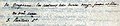
Letter from Francisco de Miranda Rodríguez, May 24, 1801.


By the middle of 1805, Miranda already had enough economic resources and political support to finance his project. It was then, that on February 3, 1806, the heterogeneous expedition, made up of Germans, English, Russians, Portuguese, Italians, Poles, French, Americans and Austrians, among others, who were mostly lazy and criminals from the docks from New York and Brooklyn, recruited by the butcher "John Fink" with promises of fortune, they left Staten Island, New York, for Jacmel, Empire of Haiti (now the Republic of Haiti), aboard a brig of about 200 tons and 16 cannons, bought by Miranda in the United States of America, with the $20,000 donated by the merchant Samuel Ogden and other contributions, which he named after his little son, "Leandro", commanded by the Honduran captain Thomas Lewis. And there were 200 people on board, among whom was Colonel "Kirkland". The ship was packed with war materials and even had a printing press with its operators. The effective force that made up the landing force was 183 men.
On February 17, 1806, in a general order to his army, Miranda set the color for each of the corps:
The Infantry will dress in blue and yellow; artillery in blue and red; rifles in green, and dragons in yellow and blue.Francisco de Miranda Rodríguez, February 17, 1806.
Flags of Ocumare de la Costa
At quarter past eight in the morning of April 28, 1806, the expedition was already in Ocumare de la Costa, Captaincy General of Venezuela, where by surprise the brig and the schooners «Argos" and "Celoso" under the command of lieutenant Agustín Blanco Maldonado, fiercely attacked the schooner "Bacchus", shortly after the schooner lowered its sails and cast anchor, surrendering to the coast guard. At eleven in the morning, the "Leandro" entered to face the coast guard. Shots were exchanged but the three vessels were too far apart for their bullets to hit. Thomas Lewis attempted a move away maneuver to separate the coast guards in order to face them as a unit, but they did not follow it but instead headed against the now defenseless expedition's two schooners as the "Leandro" moved away from them. The maneuver failed. and it concluded in the capture of the two schooners and 57 crew members at the hands of the coast guards. But even so, Miranda would not give up and undertook a tactical withdrawal towards the island of Bonaire, where they stocked up on water. On May 1 they headed for the island of Grenada.
Among the materials captured were; Miranda's portraits, proclamations, uniforms, some flags and articles, which were taken to Caracas and sent to burn in the Plaza Mayor (today Plaza Bolívar) by Captain General Guevara Vasconcelos on August 4, while the 57 prisoners were transferred to the dungeons of the Castillo de San Felipe, in Puerto Cabello. Ten officers would be hanged and dismembered on July 21 in the presence of the city's inhabitants, and their heads sent to various cities in Venezuela to be displayed as a warning for public ridicule, those sentenced to death were: First Lieutenant Miles Hall; the officer "John Ferris"; Major Thomas Donahue; Bacchus captain James Gardner; Lieutenant Francis Ferguson; Captain Thomas Billops; Lieutenant "Paul George"; the cavalry captain Gustavo Bergood; Lieutenant Daniel Kemper and Lieutenant "Charles Jhonson"; the other 47 prisoners marching silently in the presence of the corpses of their companions were transferred to Cartagena de Indias and other cities in Latin America, where they would suffer imprisonment for more than ten years in the dark dungeons, some managed to escape. The American first lieutenant and printer Miles Hall has been considered the first martyr of the printing press in Venezuela.
Carlos Medina Chirinos, in his work «Observations on the Venezuelan flag», taking as reference the letter that Fray Mateo de Espinoza sent from Caracas to his brother in Cumaná, says:
Flag of Miranda for his projected Army with the name "Columbian» (1806).Among the drawings appeared in the Archive of the Indies of Seville, referring to the expedition of Miranda of 1806, I made a model of flag with the following colors: black, red and yellow, horizontal, with this legend apart from each of those colors: black, brown, Indian, respectively; up, flagpole, this sign is read: "Vandera de Miranda for his projected Army with the name of Colombiano".Carlos Medina Chirinos.
Due to its historical value, in 2006 the Miranda State Legislative Council adopted the colours, size and disposition of the old military flag of Miranda, as its own flag of that region adding a coat of arms and 6 representative stars of the municipalities of this federal entity.
In April 1806 two of the ships of the expedition of the Precursor were seized on the coasts of Ocumare; of them were taken the revolutionary flags that on August 4 of the same year made Guevara Vasconcelos burn in Caracas and Puerto Cabello, with the portrait and other papers of the invader. The drawings of such flags were to give to the King, the same as that of Gual and Spain of 1797.Carlos Medina Chirinos.

 Miranda Pavilion in her corvette (1805-1806).
The other flag, of the various that the Precursor brought in 1806, is all blue, upon it, a sun that springs from the waters; in the center of the blue, the face of the full moon, and up, the flag's side, a red gallardete, in which it is read; 'Muera la Tiranía i Viva la Libertad'; below, it shall be read, 'Pavellón de Miranda'. We assume that to these colors, blue, yellow and red has to refer to Lieutenant Biggs when he speaks of rainbow colors in his Chronicle, because in this 'Miranda Pavilion in his Corveta' appears the yellow of the sun, the blue of the cloth and the red of the gallardete, but in no way is tricolor, because in it exists the white of the full moon...Carlos Medina Chirinos.
Symbolized by the sun, American freedom rises on the horizon, while the power of Spain, represented by the moon, begins to decline. On August 3, 2006, the regional government of the Falcón State decreed it as state flag for its historical significance and relationship with the region.
And Chorus
.svg) Flag described by Francisco Labastida (1806).
Flag described by Francisco Labastida (1806).In the early morning of August 3, 1806, the expedition disembarked in the port of La Vela de Coro. As the ships unloaded their artillery and the La Vela pillboxes responded, as well as musketeers from the bushes on the beach, Francisco de Miranda Rodríguez and his men rushed ashore and immediately headed for the pillboxes to capture them, which they quickly accomplished. It was then in the loopholes of the San Pedro fort, at dawn, that the rising sun showed the tricolor of "Columbia " flaming. Likewise, it was hoisted in the most prominent places in the city of Coro, like the tower of the parish church (current cathedral). The advance of the invading troops towards Coro was relatively easy, entering the city on August 4. However, to Miranda's misfortune, the towns were abandoned by their inhabitants, as the authorities had spread terrible stories of what the invaders would do to them: "like a pirate who came to plunder their towns". Only those who had not been able to escape for reasons of health or advanced age, as well as the prisoners in jail, remained in the town.
Miranda sent emissaries with proclamations and flags of truce to invite the citizens to return to their homes, but no one accepted his invitation due to the true feelings of the people towards Spain.
Days passed and the inhabitants did not return. Some royalist soldiers took it upon themselves to harass the advance troops and rumors spread that reinforcements for the royalist troops were about to arrive. By August 10, a council of war, in which Miranda participated, decided to re-embark and leave the squares on August 13. Once the invading forces had withdrawn, the authorities formed a cause to find out the details of what had happened. Among the various testimonies of the design of that pavilion, there is only one, coming from an eyewitness, Francisco Labastida, mayordomo of the parish church. He was interrogated on August 19 by the commander of the Coro garrison, Captain "Juan de Salas."
In the parish tower, a flag of three-coloured lanilla was sent to the parish tower: a blue, superior, in the yellow and below incarnated.Francisco Labastida, August 19, 1806.
The reason Miranda inverted the colors of the red, yellow, and blue tricolor was because it had been captured and burned.
Cucarda of the Revolutionaries
 Cucarda de la Junta Suprema Conservadora de los Derechos de Fernando VII (1810-1811).
Following the revolutionary movement of April 19, 1810 (inspired by the Conspiracy of the Mantuanos), on May 4 of the same year the «Supreme Conservative Board of the Rights of Fernando VII» established through the Gazeta de Caracas, the use of a cockade that the revolutionaries had to carry on their left arm. This one had the colors: red, yellow and black, with the letters "FVII".
The cucarda that has been allowed to take the inhabitants of Venezuela has been fixed and interpreted as follows:The red and yellow colors mean the Spanish Flag that is common to us, and the black our alliance with England, timbreated these with the portrait, or the initials of the august name of Fernando FVII, to whose freedom the combined efforts of both Nations and the general votes of the Americas have been directed.
Gazeta de Caracas, N.o 96, Friday, May 4, 1810.
Among the testimonies of the monarchist authorities of the Captaincy General of Venezuela who were expelled after April 19, 1810, was Colonel Manuel del Fierro, who upon arriving at the Captaincy General of Puerto Rico declared the following, among other things:
A cover of the red, yellow and black colors was established, with the original portrait or letters of the name Fernando VII.Manuel del Fierro.
Another is a printed sheet without imprint, dated in Caracas on October 24, 1810, addressed to the «Generous Caraqueños» and referring to the use of the cucarda, it says the following:
The red, yellow and black Cucarda, with the initials of our King Fernando, which is the distinctive with which all nations already know the illustrious Caraqueños.Caracas, October 24, 1810.
Flags of the First Republic
At three in the afternoon on July 5, 1811, in the Supreme Congress of Venezuela, the current president, Juan Antonio Rodríguez Domínguez, stated that it was: «...absolute Independence solemnly declared of Venezuela". That same afternoon a commission was appointed "for the assignment of the national flag and crest to Mr. Miranda, Clemente and Sata...", this The latter would deal with the national cucarda.
On July 9 of the same year, the Supreme Congress of Venezuela approved without objection the design presented by deputies Francisco de Miranda Rodríguez and Lino de Clemente y Palacios, it was the yellow, blue and red tricolor with horizontal stripes, which had the yellow one occupying the upper half of the surface, and the blue and red ones occupying the lower half, in equal parts. The national flag featured the following coat of arms: a rectangle with an Indian woman, sitting on a rock, with a horn that ended in a Phrygian cap in the right hand, and the sun that appears over the horizon; next to the Indian, emblems of commerce, science and the arts; an alligator and vegetables; behind it the inscription " Venezuela " and at its feet a ribbon with the word " Colombia ", referring to the American continent.
By order of the Supreme Executive Branch of the Venezuelan Confederation, it was arranged to be hoisted at dawn on July 14 at the San Carlos Barracks, a few steps from the current National Pantheon, in Caracas, as a tribute to the anniversary of the Taking of Bastille. That same day, it was deployed in the Plaza Mayor, current Plaza Bolívar, attended by the corps of all arms, commanded by the military governor Juan Pablo Ayala. The standard-bearers were the sons of José María España, the young "José María" and Prudencio España Sánchez, cadets of the First Veteran Battalion of Caracas, in the same place where their father had been hanged twelve years before.
Shortly after the independence of Venezuela was proclaimed, the Supreme Executive Power of the Confederation of Venezuela sent the design of the flag and national crest to several countries, among which were: the Republic of Cundinamarca or the Province of Cartagena in New Grenada (now Colombia), the United States of America and the United Kingdom of Great Britain and Ireland.
On February 15, 1812, the Supreme Congress of Venezuela changed the Indian coat of arms to one that was a condor holding arrows in its left claws and a caduceus crowned with a Phrygian cap in its right claws. condor there was a sun that had a number 19 as its center, which was reminiscent of April 19. On the condor there was a motto in Latin that read: "Concordia Res Parve Crescunt" translatable into Spanish as: " Small States Grow Greater with Harmony”.
 Flag of 1811-1812. (Proportion 2:1:1).
.svg)
 Variation with strips 3:2:1.
 Flag of 1812. (Proportion 2:1:1).
.svg) Variation with strips 3:2:1.
Variation with strips 3:2:1.
Flag of the War to the Death
After the fall of the First Republic, the Admirable Campaign was organized, which left Cúcuta for Caracas. Later this design was decreed when the War to the Death was declared on June 15, 1813 in the city of Trujillo. After the occupation of Caracas on August 6, it would serve as the official flag of the Second Republic until its dissolution in 1814.
This flag consisted of a black rectangle fitted within a white rhombus, placed in turn on a red background. Its design may have been inspired by the flag of the Italian Republic of 1802, or that of the later Kingdom of Italy of 1805. Today it rests in the National Museum of Colombia.

 Flag of War to Death used during the period of the Second Republic of Venezuela.
.svg)
.svg)
Wonderful Campaign Flags
Cartagena flag
This flag whose design is; red, yellow and green square, with the eight-pointed star in the center, conceived on November 17, 1811, and later adopted by the congress of the United Provinces of New Granada as the national flag on April 26, 1814, It was the flag used by the troops of General Simón Bolívar. There is evidence of the death of the brave Colonel Atanasio Girardot, who carried it on September 30, 1813, the day he went on to glory by planting it and then dying on top of the Bárbula.
Bolívar's response to a letter sent by the president in commission of the congress of the United Provinces of New Granada, Don "Juan Marimón", written in Cartagena on April 3, 1815, reads as follows:
V.E. tells me that the Venezuelan pavilion has been flying in the Popa. In the Popa no flag has been flagged: they have made, yes, signs with one of a Granada battalion, colors, yellow, green and incarnated. If there was a national, I'd be flying.Simon Bolivar, April 3, 1815.
.svg)
 Flag of Cartagena, used by the troops of Simon Bolivar in 1813.
.svg) Second flag of the United Provinces of New Granada.
Second flag of the United Provinces of New Granada.Return of the Mirandina Flag
On October 30, 1813, Bolívar wrote to the governor of the Province of Margarita, General Juan Bautista Arismendi, mentioning said flag:
The pavilion that victory has championed in all the peoples of Venezuela and that must adopt the whole nation, is the same that was used in the first time of the Republic, this is, of the three colors blue, yellow and incarnated.Simon Bolivar, October 30, 1813.
Flags of the Federal Government of 1817
Flag of May 17
On May 12, 1817 in the city of Pampatar, Province of Margarita, the authorities emanating from the Congress of Cariaco, restored the federal government that had disappeared when the Venezuelan Confederation fell on July 25, 1812, where They promised to respect and comply with the Federal Constitution for the States of Venezuela, automatically restoring the national flag of the year 1811, but as a consequence of the contingencies of the war, the coat of arms is difficult to make since there are no people who ready to board it; for this reason, the Executive Power decreed on May 17, that for the use of the warships of the Republic of Venezuela, seven blue stars would be placed in the yellow field, as a symbol of the seven provinces that make up the republic; Barcelona, Barinas, Caracas, Cumaná, Margarita, Mérida and Trujillo.
The Respectable Executive Power in decree of the day has declared that seven blue stars in the yellow field should be used in the Flags of the warships of the Squad of the Republic of Venezuela, representing their seven provinces, and the Mercants only the tricolor. And I communicate it to you in order of the same Respectable Power for your intelligence. Government Palace. In Pampatar, May 17, 1817.CASIANO BEZARESHonorable Admiral General Captain of Sea and Earth, Luis Brion.Office of the Secretary of the Government Casiano Bezares Admiral Luis Brion, May 17, 1817.
.svg) Flag of 1817. (Proportion 2:1:1).
Flag of 1817. (Proportion 2:1:1)._(version_1).svg) Variation with strips 3:2:1.
Variation with strips 3:2:1._1859.svg) Variation with strips 1:1:1.
Variation with strips 1:1:1.Flag of the Liberator
After the victorious Guayana Campaign, General Simón Bolívar added the eighth star to the tricolor on the yellow field, representing the new liberated province. In the government palace of Angostura, on November 20, 1817, Bolívar issued the following decree:
BLOOD SIMON, Supreme Chief etc.The number of the provinces that make up the Republic of Venezuela by the incorporation of the Guayana decreed on October 15 last, I decreed and decreed:
Unique article.— To the seven stars bearing the national flag of Venezuela will be added one, as emblem of the Province of Guayana, so that the number of stars will be from now on eight.
Done signed by my hand, sealed with the provisional seal of the State and endorsed by the Secretary of Despacho, at the Government Palace of the city of Angostura, on November 20, 1817-7.o.
BLOWN.Simon Bolivar, November 20, 1817.
 Flag of 1817. (Proportion 2:1:1).
.svg) Variation with strips 3:2:1.
Variation with strips 3:2:1.Colombian flags
Flag of 1819
On June 3, 1818 in Angostura, the liberator Simón Bolívar sent a letter to Don Luis López Méndez, then «Agent of the businesses of the Republic of Venezuela in London», telling him that will send you a copy of the national flag and that there will be a new design for the coat of arms, which would be used a year later in the nascent Republic of Colombia.
The same adopted by the Constituent Congress of Venezuela. The seal has changed by the effect of the vicissitudes of war. I've recently ordered to break one like Gral's. Miranda, that is, the image of Freedom in the center with the Venezuela Libre bike divided on the two sides.Simon Bolivar, June 3, 1818.
In the year 1819, the Sovereign Congress of Venezuela, when dictating the «Fundamental Law of the Republic of Colombia» sanctioned by Simón Bolívar as president, ordered that the national flag of the new republic would be decreed by the General Congress and that in the meantime the name of the Republic of Venezuela would continue to be used "because it is better known".
Cucuta Flags
On May 6, 1821, the General Congress was installed in Villa del Rosario de Cúcuta and began considering a new version of the «Fundamental Law of the Republic of Colombia», which would replace the one given by the Sovereign Congress of Venezuela in 1819.
In the session of June 26, the national flag of the Republic of Venezuela was approved as belonging to the Republic of Colombia.
The 1.a discussion of articles 7.o, 10.o, 13.o and 14.o of the Basic Law was terminated, and the proposal made by Mr. Castle and supported Mr. Chairman: to be declared by the Republic the flag of Venezuela, and that the Law Commission report on weapons and which should be.Cúcuta Congress, June 26, 1821.
Due to the disorganization and pressure from the executive branch for the approval of a new "Fundamental Law", in the session of July 12, the congress returned to leave the national flag in a “provisional” status. The next day, doctor Pedro Gual makes it clear that there is no text on the coat of arms and it was resolved to reform the decree, sanctioned on July 18:
Art. 11. While the congress does not decree weapons and the ward Colombia, will continue to be used from the current weapons of New Granada and Venezuelan pavilion.Cúcuta Congress, July 13, 1821.
On September 27, the bill to determine the coat of arms was accepted. On September 28, the first discussion and observations on article 11 took place.
On October 4, Congress changed the coat of arms through the law «Designating the arms of the Republic», sanctioned on October 6.
Designating the arms of the RepublicThat by article 11 of the Basic Law of the Republic it is incumbent upon it to designate weapons, which must distinguish it in the future among the independent nations of the earth, it has come to decree and decree the following:The General Congress of Colombia
ConsideringArt1. It will then be used instead of weapons of two cornucopias full of fruits and flowers of cold, temperate and warm countries, and of the Colombian fasces, which will consist of a docillo of spears with the crossed segurt, arches and cross arrows, tied with tricolor ribbon at the bottom.
Cúcuta Congress, October 4, 1821.
From the adoption of this coat of arms two national flag designs were given. Initially the coat of arms was used in the yellow field, but later, without explanation, the coat of arms was changed to the center of the flag.
The reason why the coat of arms was changed again to a more "neutral" one, was surely the discontent of Venezuela, due to the fact that New Granada replaced the Venezuelan coat of arms of 1819.
 First flag of the Great Colombia, between 1819 and 1820.
_recolor.svg) Second flag of the Great Colombia, between 1820 and 1821.
Second flag of the Great Colombia, between 1820 and 1821. Third flag of the Great Colombia, between 1821 and 1830.
 Variation with the shield in the center and bouquets. (Proportion 1:1:1).
Flag of 1830
When the movement known as "La Cosiata" was consummated, Venezuela and Nueva Granada separated from the Republic of Colombia on January 13, 1830, the Constituent Congress meeting in the city of Valencia decreed, on October 14, the The same national flag for the republic, only varying the coat of arms, with the difference that the cornucopias will be turned down and in the lower part will bear the inscription "State of Venezuela". Sanctioned by the president of the State of Venezuela, General José Antonio Páez and the interim secretary of state in the interior office Antonio Leocadio Guzmán.
Art. 1.o It is a shield of arms for the State of Venezuela, it will be from the publication of this decree, the same of Colombia, with the difference that in the field of gold the cornucopias will be turned down, and at the bottom of the orla will carry the inscription State of Venezuela. They will rule in provisional class until the next legislature determines the matter.Decree No. 54, 14 October 1830.
Later, the coat of arms came to be used without the oval, with the cornucopias in a field of gold and bordered by this motto: Republic of Venezuela.

.svg) Variation with strips 3:2:1.
Variation with strips 3:2:1..svg) Variation with strips 1:1:1.
Variation with strips 1:1:1.Flag of 1836
In 1834, the Senate of the Republic projected the following national flag:
The colors of the National Pavilion of Venezuela will be: yellow, blue and carmesi on equal horizontal lists in the order in which they are expressed from above to below.Senate of the Republic, 1834.
The decree of April 18, 1836 that was endorsed on April 20 by the vice president of the republic in charge of the Executive Branch, Andrés Narvarte, reforms the 1830 coat of arms and indicates the national flag, referring to this pray the following:
The Senate and the R. de la Ra Ca. of Venezuela gathered in Congress, considering: That the decree of 14 October 1830 provisionally appointed the coat of arms of the Republic leaving the Constituent Congress to the constitutionals the power to establish it in a permanent way, decree:Art. 1.o Venezuelan weapons will be a shield, whose field will carry the colors of the Venezuelan pavilion in three barracks. The barracks on the right will be red, and in it will be placed a handjob of mies, that will have so many ears as the provinces of Venezuela, symbolizing at the same time the union of these under their political system and the wealth of their soil. The one on the left will be yellow and as an emblem of the triumph will carry weapons and pavilions linked with a crown from laurel. The third barracks that will occupy the entire bottom will be blue and contain a horse White indomit, Independence Company. The shield will have the emblem of the abundance that Venezuela had adopted by currency, and at the bottom a branch of laurel and a palm tied with blue and incarnated tours, in which the gold letters will be read Registrations: Freedom – April 19, 1810 – July 5, 1811.
Art. 2.o The National Pavilion will be without any alteration that Venezuela has adopted since the year 1811 in which his independence was proclaimed, whose colors are yellow, blue and red in lists equal horizontal and in the order that are expressed from above to below.
Art. 3.o Flags flying in warships, fortresses and others public places, and those deployed by agents of the Republic in foreign countries, They will carry the weapons of the Nation in the third of the immediate yellow color to the asta.
Art. 4.o National weapons will be placed in the halls and exterior doors of the Congress, Executive branch, provincial councils, municipal councils, courts of justice and other public offices.
Art. 5.o The decree of 14 October 1830 is repealed. Given in Caracas to 18 April 1836, 7.o and 26.o.Decree No. 213, April 18, 1836.
.svg)
Flags of the Federation
They were in force in the barracks, on the battlefields and on navy ships, for the federalist forces. The 1836 flag would continue to be the official flag of the country during the Federal War, especially to represent the central government until the end of the conflict.
Flag of February 25, 1859
At eight o'clock on Sunday, February 20, 1859, a revolutionary movement broke out in the city of Coro that recognized Commander Tirso Salaverría as the military chief of the province and a junta made up of Mr. Nicolás as the provisional government Saldarriaga, "José Toledo" and "Pedro Torres". On February 25, said board decreed that the national flag would be that of the extinct Republic of Venezuela (referring to the change of name, since, with the revolution, the Republic of Venezuela passed renamed the United States of Venezuela) with the addition of seven blue stars in the yellow strip to represent the seven provinces that had constituted the Venezuelan federation in 1811.
THE PROVISIONAL GOVERNMENT OF THE STATEIn exercise of the general functions of the FederationRIGHT:1.o The National Pavilion is that of the extinct Republic of Venezuela, with the addition of seven blue stars in the yellow strip, to symbolize with its number the seven provinces that constituted the Venezuelan Federation of the eleventh year.
The Army and Navy will use this pavilion until the General Assembly of States decrees what it deems appropriate.
Done in Coro, 25 February 1859, 1st Year of the Federation.
NICOLAS SALDARRIAGA. - ALL RIGHT. - PEDRO TORRES.Provisional Government of the Coro State, 25 February 1859.
Flag of June 1859
After four months of war (June), in the city of Barinas, General Ezequiel Zamora, known as the «General of the Sovereign People» issued a decree ordering that the flag of the federal states It was the same as the republic, with the difference that in the yellow strip it would have twenty blue stars, symbolizing the twenty entities that were to constitute the Venezuelan federation.
The Pavilion of the Federal States is the same of the Republic, with the difference that in the yellow strip will carry twenty blue stars, which symbolize the twenty Provinces that form the Venezuelan Federation.Ezequiel Zamora.
,_june_1859.svg)
Flag of 1863
 National Flag of the State of Venezuela / United States of Venezuela (1863-1905).
When the liberal rebels triumphed in the Federal War after the so-called Car Treaty and the assumption of Marshal Juan Crisóstomo Falcón as president, he decreed on July 29, 1863 that the stars were 7 white placed in the blue stripe forming 6 of them a circle and the seventh arranged in the center of it:
The presence of the white stars in the blue strip somewhat offsets the optical effect.
Juan C. Falcón, President of the Venezuelan Federation, considering: 1.o It is necessary to determine the placement of the seven stars with which the peoples have distinguished the national pavilion in the glorious war of the Federation: 2. That the political transformation that the Republic has verified, in the same way compels the corresponding modifications to the arms shield set by legislative act of 20 April 1836, decree:Article 1.o: The national pavilion will be the tricolor that Venezuela adopted when it declared independent; whose colors are yellow, blue and red, in lists of equal horizontal latitude and in the order that are expressed from above to below.
Article. 2.o: The seven stars will be placed in the middle of the blue list, forming six a circle and the seventh in the center of it.
Article 3. The Venezuelan Federation weapons will be the same shield that the Republic has used until today, divided into three barracks. The barracks on the right will be red and there will be a handful of mys that will have so many ears as the states of the Federation. The one on the left will be yellow, and as an emblem of the triumph will carry weapons and pavilions linked with a laurel crown. The third barracks that will occupy the entire lower part will be blue, and will contain an indomitous white horse, as a symbol of independence and freedom. The shield will have the emblem of abundance, and at the bottom a branch of olive and a palm tied with blue and yellow strips, in which the following inscriptions will be read: in the center, God and Federation; on the left 5 July 1811-Independence; on the right, the date on which the Constitution of the United States of Venezuela is promulgated.- Freedom.
Article 4. This decree shall be authorized by all the Secretaries of State.
Given in Caracas, July 29, 1863, the fifth year of the Federation. J.C. Falcon.- To the President Citizen.- The Secretary of the Interior and Justice, Mariano de Briceño.- The Secretary of Finance and Foreign Affairs, Antonio Guzmán Blanco.- The Secretary of War and Marina, Manuel E. Bruzual.- The Secretary of Promotion, Guillermo Iribarren.Decree No. 1353, 29 July 1863.
Flag of 1905
 National Flag of the United States of Venezuela (1905-1930).
By means of a decree of March 28, 1905, the then provisional president of the United States of Venezuela, General Cipriano Castro, decreed the placement of the seven stars in circumference, without any in the center:
1930s flag
 National Flag of the United States of Venezuela (1930-2006).
On July 15, 1930, the Congress of the Republic repealed the decree of General Cipriano Castro, establishing again the position of the stars, placing them in a semicircle. This arrangement is the one that prevails to this day.
1942 flag
On June 22, 1942, the Congress of the Republic drafted a new «Ley de Bandera, Escudo e Himno Nacional» which, although it did not decree any changes to the flag, established in its second paragraph, that in the flags of individuals the use of stars is optional, that is, they can be used or not.
1954 flag
On February 17, 1954, another «Ley de Bandera, Escudo y Himno Nacional» was approved, repealing the previous one. It is established that in the coat of arms the inscription «República de Venezuela» be replaced by that of the «United States of Venezuela», this being the only change presented between it and the previous version of the flag.

Current flag
On October 19, 1999, the issue of the national flag was discussed in the National Constituent Assembly. To this effect, the proposed topic on the signs indicated that «the national flag with the colors yellow, blue and red and seven stars; the national anthem “glory to the brave people” and the coat of arms of the Republic are the symbols of the Homeland». The mention of the seven stars made the constituents of the Bolívar State; Alejandro Silva, Leonel Jiménez Carupe and Briceño Antonio will remember and requested the recognition of eight stars, the latter representative of their region Province of Guayana. It was recalled to this effect that General Simón Bolívar had issued a decree recognizing the Province of Guayana as the eighth star.
.svg) Flag proposal with 10 stars.
Flag proposal with 10 stars.Other constituents such as Vinicio Romero Martínez at the national level and Roberto Jiménez Maggiollo from the State of Zulia, indicated that the same claim should operate with respect to the provinces of Coro and Maracaibo. Even the writer Manuel Martínez Acuña, president of the Zulia Writers Association, raised the proposal to include as many stars as states, as is the case of the 50 stars of the United States, and not because all of them had participated in the War of Independence of America, but because they are representative entities of a country made up of 50 entities.
The constituent Jorge Olavarria intervened saying that the Constitution of Venezuela of 1819 stated that "Venezuela was one and only and that it had ten provinces", for which the stars would be ten. But when the Republic of Colombia was created in 1819, the stars were discarded. Consequently, the seven stars that at first meant for the canon José Cortés Madariaga and for the conspirators of the Congress of Cariaco the seven provinces under the republican regime, later became a symbol of union for all Venezuelans. Nowadays no one thinks that the seven stars symbolize a part of Venezuela and that another part of Venezuela is outside of that symbolism. He also recalled that at the beginning of the Federal War, General Ezequiel Zamora decreed the inclusion of 20 stars, representing the autonomous and sovereign states, but that later Marshal Juan Crisóstomo Falcón said: «Go back to the 7 stars or Put on the 7 stars”, and they stayed that way until 2006.

 National Flag of the Bolivarian Republic of Venezuela (2006-Presente).
On March 7, 2006, the National Assembly, by order of the president, Lieutenant Colonel Hugo Chávez, repealed the National Flag, Shield and Anthem Law of February 17, 1954.
On March 9, the National Assembly approved through official gazette number 38,394 the inclusion of an eighth star, representing the Province of Guayana, and in compliance with the decree of the liberator Simón Bolívar of November 20, 1817, in the one that ordered the inclusion of said symbol.
Variants
State and War Flag
.svg)
 Flag of State and War: The Presidency of the Republic and the National Armed Forces, as well as public buildings nations, stalks and municipalities, use this variant.
Also known as the «National Pavilion». According to Article 3 of the "Ley de Símbolos Patrios", State agencies, as well as the Bolivarian National Armed Forces, will use a variant of the flag established as a state symbol, this flag differs from the flag civil because it will carry in the upper left corner, next to the pole, the coat of arms of Venezuela. The use of this flag is common by the civilian population and the Merchant Navy, making no distinction between the official version and this version.
Civil and Merchant Flag
Civil flag.Also known as the «National Flag». According to Article 3 of the "Ley de Símbolos Patrios", it is intended for daily use by the civilian population for its display on national days and also for the identification of ships and vessels of Venezuelan nationality.
Military Flags and Insignia
Despite the fact that the national flag, in its civil and state version, covers and signals various functions of the same, the various components of the Venezuelan Armed Forces, as well as the presidency, have adopted different flags to symbolize their respective institutions.

National Army Standard of Venezuela.

National Navy bow flag.


Protocol
Flag Day
It was President Rómulo Betancourt who, in a decree of July 3, 1963, instituted March 12 of each year as Flag Day, considering «that this day should correspond to the historical moment in which the glorious emblem was raised for the first time as a symbol that inflamed the hearts of the Liberators with patriotism, to carry out the epic of National Independence...". Years later the president of the republic, Lieutenant Colonel Hugo Chávez Frías, on August 3, 2006, decreed this date as Flag Day, in justice for Generalissimo Francisco de Miranda Rodríguez and the martyrs who arrived 200 years ago at La Vela de Coro to hoist the national tricolor for the first time.
Daily use

.jpg)
Like most national flags, the Venezuelan flag must be hoisted every day at the facilities of public organizations at 7 in the morning, being lowered at 6 in the afternoon, in the case of the others private institutions, businesses and the civilian population, the flag must be flown on national holidays or when so provided by the National Executive. The facilities that must hoist the flag are:
- At the Federal Legislative Palace, during the sessions of the National Assembly and in the buildings where the Legislative Councils meet, while in session.
- In the national, state and municipal public offices, the declared days of the National Party and the other dates on which special resolutions are provided by the competent authorities.
- At the headquarters of the embassies, legations, consulates and agencies of the country abroad, the days of Fiesta Nacional or when prescribed by the protocol of each country.
- At the Palace of Miraflores, building of the Office of the President of the Bolivarian Republic of Venezuela, daily.
- In the facilities of the National Armed Forces, fortresses and other military buildings, in cases determined by the relevant laws and regulations.
- In Venezuelan merchant ships the national pavilion is maintained in its version without shield, because the merchant activity is net civil.
Currently there is no specific regulation about the dimensions of the national flag, its use within public or private institutions or the people in general or a regulation of its form and protocol acts that govern it for what they are determined by free will. However, following the model of the protocol acts instructed in the armed forces, educational institutions currently follow a similar protocol act for the raising of the flag during the days of special events within the institution, also called civic acts.
Out of respect for the flag, within popular culture it has been established that when the flag is hoisted, it will be hoisted simultaneously with the playing of the National Anthem, and each person present will adopt a motionless, upright position with clenched fists glued to the hips, looking towards the flag and without a cap or hat on the head.
Folding
Although there is no official regulation that determines the process of folding or folding the national flag, there is a very widespread technique in the country about the particular way of folding the flag as in other countries, especially within schools, scouting parties, and military institutions.
It is unknown when the practice of folding the flag began in the country, however some options can be considered such as the possibility of being an adaptation to the folding custom of other countries in the region such as the United States, where the unique way of folding the flag originated. In the Venezuelan case, the folding of the flag has two different ways depending on the flag that is taken, be it the State and War Flag, or the Civil and Merchant Marine Flag.
- For the case of the Flag of State and War (National Pavilion) the flag is taken once the flag is dropped and is held by its four corners, the red strip is folded in the first place so that it is positioned above the blue and then the yellow strip is placed above the red, so that the yellow strip and the national shield are seen on the upper side while the blue strip is reflected. Then, and in a triangular shape, it bends down, step by step the yellow strip from the flight edge to reach the end of the ed edge so that it can be introduced into the flap, so the flag will be dressed by the yellow color and the National Shield.
- The Civil and Merchant Flag (National Flag), after being lowered from the asta, is transported to the bent site, once there, is taken from the four point in a process made by at least 2 people and the yellow strip is positioned on the blue and on this the red one, remaining on the lower face the blue color with the stars and on the top the red color, and as in the previous process, the only one doubles to reach.
Student Anthem and Pledge
The national flag has its own anthem, which was composed in 1889 with music by Francisco Araldi and lyrics by Gerónimo Zolessi, which reads:
I
Oh Flag of the Caribbean People
live focus of light and honor
in your folds my homeland is displayed
great in glory and rich in value.
II
You spread through summits and plains
the epic of freedom
and you left over both oceans
the lights of heroicity.
III
Venezuela the beautiful and powerful
in his arms the glory lifted
and in your bosom of palpitating love
Seven stars of life lit.
In the same way, a Student Oath has also been attached to it, which consists of a Promise and a final Oath.
Promise
My Flag!
My country is you!
And the country is the land: Venezuela!
It's the Llano, it's the Andes, it's the Sea around us.
It is the Jungle and its riches.
It's their rivers.
They are their men, their wives and their children.
It's his music.
It's the Castellana Language we talked about.
It's the story Bolivar is.
They are my parents, my brothers, my friends, my teachers!
Here I come reverent,
The love, respect and commitment we owe you
Because you are, my Flag, all that! And you're more.
I promise, every day, to be better:
Study with dedication.
Be honest and capable.
Contribute to your greatness
And rise up to heaven,
Those yellow, blue and red stripes
And give him eight missing stars!
Oath
Master:
Young Venezuelan
that of the Flag you have done
an image of the Homeland!
You made a promise!
Do you swear to do it?
Students:
We swear!
Similar flags


Contenido relacionado
Iberian Peninsula
The Wolf (1941 film)
Castile and Leon