
Valladolid Province
Valladolid is a Spanish province belonging to the autonomous community of Castilla y León, in the northwest of the Iberian Peninsula. It is geographically located in the North Plateau, within the Duero basin. It has a population of 519,361 inhabitants in a total of 225 municipalities, an area of 8,111 km² and a population density of 64.19 inhab/km².
Its capital is the city of Valladolid. It limits with the provinces of Burgos, Palencia and León to the north; with Zamora, to the west; with the provinces of Salamanca and Ávila to the south; and with the province of Segovia to the east. It is, therefore, the only Spanish province surrounded only and totally by others from the same autonomous community. It is the only peninsular province that has absolutely no mountains.
Precisely because of its flatness, it is of great strategic importance because it is an important communications hub. From a national point of view, it is the road that connects Madrid with the entire north of Spain, from Vigo (Galicia) to San Sebastián (Basque Country). From an international point of view, the shortest land route connecting Portugal with France passes through here, from the north of Portugal (Porto) to the south of France (Hendaye).
In 2012, the province had a human development index of 0.978 (6th place in Spain), standing out as the province with the best educational level index in the country. In its gastronomy, foods such as suckling pig, suckling pig, stand out, blood sausages, sausages, breads, cheeses, soups and legumes, in addition to having several wines with denomination of origin: Ribera del Duero, Rueda, Cigales, Toro and Tierra de León.
In this province the capital of the Castilian court and former capital of the Spanish Empire was installed during the reigns of Carlos I, Felipe II and Felipe III, it has a province full of castles and fortresses. Its capital has an important historical-artistic heritage and one of the most important sculpture museums in Europe. The province of Valladolid is especially famous for its Holy Week processions, both in the capital and in the towns of Medina de Rioseco and Medina del Campo. In addition, the province has two Unesco heritage elements within the category. The Treaty of Tordesillas and the General Archive of Simancas.
History


_1.083_JUAN_PONCE_DE_LE%C3%93N.jpg)

The province of Valladolid was established as such by Royal Decree of September 29, 1833 promoted by Minister Javier de Burgos, being attached to the historic region of Castilla la Vieja.
The first stable population that settled in the current province corresponds to the pre-Roman people of the Vacceos (an area that was called the "Vaccean region"), who were settlers with a highly advanced culture and, like the rest of the Celtic peoples, They came to the peninsula from northern Europe (it should be noted that they also occupied territories that correspond to other provinces). Already then it was defined by the chronicles as a "free and discovered" region and "an open country, wheat fields, treeless land" and the vacceos were dedicated to livestock and especially agriculture (cereal). In the year 178 the Romans conquered the territory, although they were not able to fully pacify it until the 29th. Thus, the lands that make up the current province remained under their occupation, until the barbarian invasions at the beginning of the century V d. C. The territory came under the control of the new Visigothic Kingdom.
After the invasion of the Iberian Peninsula by the Muslims in the year 711, they arrived in these lands just one year later, in 712. However, it was a relatively unpopulated area. Later, during the Reconquest, this area was the object of battles between the Muslims and the Christian Kingdom of León in the 9th and 10th centuries. In 939, after the battle of Simancas, the dominance of the Duero basin was consolidated by the Christian kingdoms. Valladolid was repopulated in the year 1072 by Count Pedro Ansúrez. From then on, its history was linked to that of the Crown of Castile. Cities like Medina del Campo or Valladolid became important Castilian administrative centers and also experienced an economic boom (mesta, fairs...). It was of great importance in the Discovery of America in 1492 (Columbus would end up living the last years of his life until his death in 1506 in Valladolid) and the subsequent colonization with characters such as Juan Ponce de León —discoverer of Florida—. In fact, in some houses in Tordesillas, the Treaty of Tordesillas was signed, in which the division of the New World between the Catholic Monarchs and the Kingdom of Portugal was decided, giving rise to Latin America.
The uprising of the community members in 1520 ended with the leaders of that revolt being publicly executed in Villalar de los Comuneros. Valladolid became the capital of the Spanish Empire between the years 1601-1606. When the Spanish Empire begins to decline due to the continuous wars in which it is involved and the appearance of new emerging powers, an economic setback occurs in the area, as in the rest of the monarchy. In the War of the Spanish Succession (1700-1715) he sided with the Bourbon pretender, who would be the one who got the throne. During the Spanish War of Independence against France (1808-1814) (See the War of Independence in Valladolid), there was a succession of battles and the continuous performance of guerrillas such as "el Empecinado". In the XIX century, certain industrialization related to agriculture, livestock and the railway began.
Already in the XX century from the start of the Spanish civil war (1936-1939) it was an important nucleus of the uprising (see also: Spanish civil war in the province of Valladolid). During the Franco regime there was an exodus from the rural countryside to the industrial cities, and after the arrival of democracy in Spain, in 1983 the province became part of the new autonomous community of Castilla y León. It began a process of economic growth that reached its maximum with the real estate bubble in Spain and then suffered the economic crisis of 2008, like the rest of the country, until 2014. Subsequently, there is some economic growth until 2020, when the pandemic of coronavirus caused the declaration of the state of alarm throughout Spain, giving rise to a strong economic slowdown.
Symbols


Shield
The coat of arms used institutionally by the Provincial Council of Valladolid is also used as a symbol of the province. The coat of arms is similar to the coat of arms of Valladolid, except for the border. According to his heraldic description:
The coat of arms of the Provincial Council of Valladolid is presented in the field of Gules, with five jirones waving of gold from the right side. Silver edge with eight golden castles (against the heraldic laws). Timbre: royal crown open. Supports: two lions of their color lynched gules. It is loaded on a parchment field, paved to the Laureada Cross of San Fernando, and surrounding the shield a ribbon with the colors of the Spanish flag, loaded with eight shields, corresponding to the former Judiciary Parties and below, the motto, Excma. Provincial Council Valladolid.
Flag
The flag, like that of many municipalities in the province, adopts the crimson red background of the banner of Castilla with the coat of arms in the center.
Parties
Since 1957, with some interruptions, the Day of the Province, also known as the Day of the Municipalities, has been celebrated. It is not a holiday but it does honor the mayors of the 225 Valladolid municipalities and the rest of the Valladolid politicians and other famous people born in this province. It does not have a fixed day on the calendar, but it is usually celebrated at the end of September or the beginning of October.
Demographics
Demographic evolution
| Historical population | ||
|---|---|---|
| Year | Pob. | ±% |
| 1833 | 184 647 | - |
| 1860 | 246 981 | +33.8% |
| 1887 | 267 148 | +8.2% |
| 1900 | 283 045 | +6.0% |
| 1918 | 287 713 | +1.6% |
| 1930 | 311 414 | +8.2% |
| 1940 | 332 934 | +6.9% |
| 1950 | 348 185 | +4.6% |
| 1960 | 367 392 | +5.5% |
| 1970 | 413 026 | +12.4% |
| 1981 | 481 327 | +16.5% |
| 1990 | 494 912 | +2.8% |
| 1995 | 504 583 | +2.0% |
| 2000 | 495 690 | −1.8% |
| 2005 | 514 674 | +3.8% |
| 2010 | 533 640 | +3.7% |
| 2015 | 526 223 | −1.4% |
| 2020 | 520 716 | −1.0% |
| Graphic of demographic evolution (in thousands of rounded inhabitants) of the province of Valladolid between 1833 and 2021 |
 |
Source: Spanish National Statistical Institute - Graphical development by Wikipedia. |

Valladolid is the most populous province in Castilla y León, with 519,361 inhabitants as of January 1, 2021 (INE), which represents more than 21% of the total population of the community. In Spain as a whole, the province contributes 1.1% of the total weight, being the thirtieth most populous province.
The population of the province of Valladolid is characterized for being one of the longest-lived in Spain and Europe. Only one city has more than 100,000 inhabitants, another three have more than 20,000 inhabitants, and another nine have more than 5,000 inhabitants.
Population structure

If the population is divided into five-year age groups, it is observed that the majority is the age group between 45 and 49 years. Most of the population of the province of Valladolid (62.9 %) is older than 40 years.
Immigration
| Country | Amount | % |
|---|---|---|
 Bulgaria Bulgaria | 5160 | 20.89% |
 Romania Romania | 5039 | 20.40% |
 Morocco Morocco | 3432 | 13.89 per cent |
 Colombia Colombia | 1209 | 4.89% |
 Dominican Republic Dominican Republic | 863 | 3.49% |
 Brazil Brazil | 850 | 3.44% |
 China China | 812 | 3.28% |
 Portugal Portugal | 715 | 2.89% |
 Venezuela Venezuela | 683 | 2.76% |
 Italy Italy | 456 | 1.84% |
.svg) France France | 365 | 1.47% |
 Ecuador Ecuador | 352 | 1.14% |
Immigrants in Valladolid represent 5.6% of the population. In 2021 the registered immigrant population in the province of Valladolid represents a total of 28,860 people.
The population structure is younger compared to the global average for the province. The majority five-year group is between 35 and 39 years of age.
The majority of immigrants in the province come from the European community, being the most common nationalities of foreigners Bulgarian (5,272) and Romanian (5,117), which represents 40% of the total number of foreigners. The nationals of American countries (20%) and those of African countries (15%) also stand out.
Economy


The per capita GDP of the province is €27,523/inhabitant per year (INE data, 2019). If the Spanish average is taken as index 100, the province obtained 104.2%. The total GDP of the province amounted to €14,318,572 (2019). The unemployment rate went from a minimum of 6.87% in 2007 to 19.70% in 2013 due to the economic crisis of 2008-2013 in Spain. In the last quarter of 2021 this figure was at 9.42% and in the first quarter of 2022 it had dropped almost one point, to 8.47%.
Agriculture dedicated to the cultivation of cereals (wheat and barley), legumes, sugar beet, alfalfa, vegetables and vines. Important livestock. Intense industrial activity, especially concentrated in the capital, of agricultural derivatives (pasta, flour, chocolate, sugar, etc.), textiles, metallurgy, automobile manufacturing (FASA-Renault), chemicals, construction, paper, graphic arts etc In addition to the capital Valladolid, the towns of Medina del Campo, Peñafiel, Tordesillas, Cigales, Cabezón de Pisuerga, Tudela de Duero, Laguna de Duero, Íscar, Olmedo and Pedrajas de San Esteban stand out, the latter for its great pine nut production.
It is the Spanish province with the highest sugar beet and potato production. It is the second with the highest production of corn (behind León) and rye (behind Palencia) and produces more than half a million tons of barley.
Energy

Unlike other provinces of Castilla y León (which is the first Spanish autonomous community in installed capacity and the second in production) such as Burgos or León, the province of Valladolid does not have large nuclear, thermal or hydroelectric power plants nor of many wind farms or solar fields. This is due, among other reasons, to the absence of mountain ranges and valleys that could favor the construction of reservoirs to obtain energy. In La Mudarra there is an electrical substation, owned by Red Eléctrica de España, which distributes electricity to the entire northwest of Spain.
- Hydroelectric power plants
| Image | Name | Municipality | Comarca | Type | Power | Owner | Location |
.jpg) | San José hydroelectric plant | Castronuño | Land of Wine | Turbine Kaplan | 20,000 MWh (2'28 MW) | Iberdrola | 41°24′14′N 5°16′24′′ / 41.40389, -5.27333 |
- Wind farms
| Name | Company | Municipalities | Power MW | Technology | Number | Unitarian kW |
| Peñaflor III | Bionor | La Mudarra, Castromonte and Peñaflor de Hornija | 49 | Alstom - Ecotècnia | 30 | 2970 |
| Peñaflor IV | Bionor | Peñaflor de Hornija | 49 | Alstom - Ecotècnia | 30 | 2970 |
| San Lorenzo A | Wind farms San Lorenzo, S.L.U | Torrelobaton | 48,75 | Dresses | 26 | 1875 |
| San Lorenzo B | Wind farms San Lorenzo, S.L.U | San Pelayo, Torrecilla de la Torre, Castromonte, Peñaflor de Hornija and Torrelobatón | 39 375 | Dresses | 21 | 1875 |
| San Lorenzo C | Vapat | Castromonte, Peñaflor de Hornija and Torrelobatón | 28.13 | Gamesa | 15 | 2000 |
| San Lorenzo D | Vapat | Peñaflor de Hornija | 33,75 | Gamesa | 18 | 2000 |
| The Trapers | MTDE | Medina del Campo | 9.9 | Tecinsa | 6 | 1650 |
| TOTAL | 257 905 | 146 |
Communications
The province of Valladolid is of great strategic importance because it is an important communications hub. From a national point of view, it is the road that connects Madrid with the entire north of Spain, from Vigo (Galicia) to San Sebastián (Basque Country). From an international point of view, the shortest land route connecting Portugal with France passes through the province, from the north of Portugal (Porto) to the south of France (Hendaye).
Vehicles
| Name | From/ | Important cities of Valladolid where it passes |
|---|---|---|
 Northwest motorway Northwest motorway | Madrid-La Coruña | Medina del Campo, Rueda, Tordesillas, Urueña |
 Autovía Valladolid-León Autovía Valladolid-León | Valladolid-León | Valladolid, Medina de Rioseco, Mayorga |
 Autovía de Castilla Autovía de Castilla | Burgos-Portugal | Head of Pisuerga, Cigales, Valladolid, Simancas, Tordesillas, Alaejos |
 Autovía de Pinares Autovía de Pinares | Valladolid-Segovia | Valladolid, Boecillo, Portillo, Aldeamayor de San Martín |
 VA-11 VA-11 | Valladolid-Tudela de Duero | Valladolid, Tudela de Duero |
 VA-12 VA-12 | Valladolid-Boecillo | Valladolid, Laguna de Duero, Boecillo |
 VA-20 VA-20 | Valladolid-Arroyo de la Encomienda | Valladolid (circunvalation), Arroyo de la Encomienda |
 VA-30 VA-30 | Cigales-Arroyo de la Encomienda | Head of Pisuerga, Santovenia de Pisuerga, Renedo de Esgueva, Valladolid, Arroyo de la Encomienda |

| Name | From/ | Important cities of Valladolid where it passes |
|---|---|---|
| N-6 | Madrid-La Coruña | Medina del Campo, Rueda, Tordesillas, Mota del Marqués, Villardefrades |
| N-122 | Zaragoza-Portugal | Peñafiel, Quintanilla de Arriba, Quintanilla de Onésimo, Tudela de Duero, Valladolid, Tordesillas |
| N-601 | Madrid-León | Olmedo, Mojados, Laguna de Duero, Valladolid, Medina de Rioseco, Mayorga |
| N-610 | Palencia-Benavente | Villalón de Campos, Becilla de Valderaduey |
| N-620 | Burgos-Portugal | Valladolid, Tordesillas, Alaejos |

| Name | From/ | Important cities of Valladolid where it passes |
|---|---|---|
| E-80 | Lisbon-Gürbulak | Valladolid, Tordesillas, Alaejos |
| E-82 | Tordesillas-Oporto | Tordesillas |
Train
The route of the Spanish High Speed (AVE) has a stop in the town of Valladolid as part of the Madrid-Segovia-Valladolid high-speed line and the Valladolid-Palencia-León high-speed line. It is expected that in the future other towns such as Olmedo and Medina del Campo will have other high-speed lines such as the Olmedo-Zamora-Galicia High-Speed Line, which is in different phases of the project since it began in 2006. The future The Atlantic Corridor, which belongs to the basic network of the Trans-European Transport Network (TEN-T), will be a rail corridor for passengers and goods that will connect the ports on the Atlantic coast with the interior and the rest of Europe. It should be finished before the year 2031.
Airplanes

The province has an airport; Valladolid Airport, located in Villanubla. Before the COVID-19 pandemic, the airport handled around a quarter of a million passengers per year (249,224 in 2019). These figures suffered a major break due to the restrictions imposed by the pandemic. In 2021, the Valladolid airport managed 106,168 passengers, 5,643 operations and almost 2 tons of cargo. It ranks 31st in passenger movement within the 49 airports in the AENA network to which it belongs. It has become one of the main passenger hubs in Castilla y León. It was built in 1938 and renovated in 1972 and 2000. It shares the civil airport with a military air base. Its IATA code is VLL and its ICAO code is LEVD. It has trips to destinations such as Alicante, Barcelona, Palma de Mallorca, Ibiza, Menorca, Gran Canaria, Tenerife Sur, Lanzarote, Valencia or Málaga-Costa del Sol.
It also has a series of private aerodromes: the Alcazarén Aerodrome, the El Carrascal Aerodrome, the El Carrascalejo Aerodrome, the Matilla de los Caños Aerodrome, and the Mojados Aerodrome.
Politics

The Government and administration of the province of Valladolid corresponds to the Provincial Council of Valladolid, as stated in the statute of autonomy of Castilla y León. when the property was acquired by the Provincial Council.
The Provincial Council has powers in the field of advice, cooperation and assistance to municipalities and localities, also providing supra-municipal services of a provincial nature.

The composition of the Provincial Council is established by indirect election based on the results of the municipal elections. The number of deputies of the Valladolid Provincial Council, which depends on the number of inhabitants of the province, is twenty-five, distributed proportionally among the judicial parties that compose it.
Territorial organization
Municipalities

The basic administrative unit into which the province is divided are the municipalities. There are 225 today. The municipality with the most inhabitants is the provincial capital. Among the rest, municipalities in the center of the province stand out —mainly in the Valladolid district— such as Laguna de Duero, Arroyo de la Encomienda, La Cistérniga, Zaratán, Simancas, Santovenia de Pisuerga, Cigales or Cabezón de Pisuerga. In the south of the province, the city of Medina del Campo (the fourth in this aspect of the province) and Olmedo stand out in terms of number of inhabitants; to the east of the Peñafiel province, to the southeast Íscar and to the west Tordesillas.
The province has two enclaves in other territories: the largest is the Enclave of Roales and Quintanilla, formed by the municipalities of Roales de Campos and Quintanilla del Molar located between the provinces of Zamora and León, and the smallest is Dehesa of San Llorente, located within the province of León and which is part of the town of Mayorga. Both enclaves are part of the Tierra de Campos region.
The twenty most populated municipalities in the province of Valladolid are the following (according to the municipal register of the INE in 2020):


Taking into account that the population of Valladolid, Laguna de Duero, Medina del Campo and Arroyo de la Encomienda represents almost 70% of the total of the province or that the 23 municipalities of the metropolitan area of Valladolid contribute practically 80% of the total demographic weight, it is verified that there is a clear demographic contrast with highly depopulated areas with a marked rural character, especially in the Tierra de Campos region. Among the most depopulated municipalities in the province are Aguasal, Torrecilla de la Torre, Almenara de Adaja, San Salvador, Roturas and Fontihoyuelo, which do not exceed 40 registered inhabitants. It is the 3rd province in which there is a higher percentage of inhabitants concentrated in its capital (57.49%).

Minor local entities

Currently there are only 10 minor local entities (the name by which entities with a territorial scope lower than the municipality are known in the autonomous community of Castilla y León). They are Aldealbar (belonging to the municipality of Torrescárcela), Calabazas (belonging to the municipality of Olmedo), Foncastín and Torrecilla del Valle (belonging to the municipality of Rueda), Gordaliza de la Loma (belonging to Bustillo de Chaves), San Bernardo (Valbuena de Duero), La Santa Espina (Castromonte), Santiago del Arroyo (San Miguel del Arroyo) and Villamarciel and Villavieja del Cerro (belonging to the municipality of Tordesillas).
Country
In the province of Valladolid there is no consolidated regional division at the official level. However, there are more or less deeply rooted historical regions that encompass several municipalities, districts and residential areas that come together to manage common services such as garbage, cleaning or sanitation. For this reason we must distinguish between regions of administrative division and regions of historical and tourist designation.
According to some Castilian currents and the sources provided by the newspaper El Norte de Castilla, the province of Valladolid would be divided into eight historical regions:
- Land of Campos
- Esgueva moors
- Land of Pinares
- Campo de Peñafiel
- Montes Torozos
- Campiña del Pisuerga
- Tierra del Vino (Valladolid) (there is another "Land of Wine" in the province of Zamora that does not geographically limit the region of Vallisoletana)
- Land of Medina
The tourist website of the provincial council divides the province into 5 regions:
- Land of Campos (North Zone)
- Mountains Torozos (West Zone)
- Valladolid (Central Area)
- Duero-Esgueva (Eastern Zone)
- Land of Pinares (South Zone)
For certain historians, in the regional division, it should be taken into account that some also belong to other provinces:
- Land of Campos, which would spread through Palencia, Zamora and León
- Montes Torozos that would include the capital and also extends to the province of Palencia
- Land of Medina
- Land of Pinares, which would spread north of Segovia
- Ribera del Duero, which would be extended by Burgos
Geography

It limits to the north with the province of Palencia, to the east with the province of Burgos, to the southeast with the province of Segovia, to the south with the province of Ávila, to the southwest with the province of Salamanca, to the west with the province of Zamora and to the northwest with the province of León. It has two enclaves in other territories: the largest is the Enclave of Roales and Quintanilla located between the provinces of Zamora and León and the smallest is the Dehesa de San Llorente, located within the province of León. Both enclaves are part of the Tierra de Campos region.
| Northwest: León | North: Palencia | Northeast: Palencia |
| West: Zamora |  | This: Burgos |
| Southwest: Salamanca | South: Avila | Sureste: Segovia |
Provincial boundary


The province of Valladolid has an area of 8111 km², is located in the center of the Meseta Norte (upper half of the Iberian plateau) and is characterized by the uniformity of its orography (777 masl on average with a maximum drop of 300 meters) becoming the most geographically homogeneous province in Spain. The Duero River, which crosses it from east to west, becomes the backbone of the territory.

It is dominated by an extensive plain in which are distinguished: an area of limestone moors defined by the valleys of different rivers, some of which stand out in altitude, originating a mountainous landscape of witness hills, such as Montes Torozos, Cerro de Cuchillejo (932 m.a.s.l.), Cerro de San Cristóbal (843 m.a.s.l.) and the Sardanedo (854 m.a.s.l.); a country area, with gentle hills; and separating one and the other, the so-called "cuestas", deep ravines with steep slopes, such as those of Prado Ancho, Santovenía de Cabezón, de Pisuerga, etc.
It is the only peninsular province that has absolutely no mountains (obviously it has no coast either), and also -along with the province of Almería- the one with the least wooded area (less than 16% of the territory). The highest point It is in Castrillo de Duero and is the Cuchillejo hill (932 m). The lowest point is the Duero River as it passes through Villafranca de Duero (626 m). For this reason, it is also the only province of Castilla y León that does not reach 1,000 m above sea level at any point in its territory.
Hydrographic network dominated by the Duero River and its tributaries (Pisuerga, Esgueva, Adaja, Eresma, Duratón, Zapardiel and Cega, among others) and completed with the Castilla channel and the Duero channel. A single relevant lake: Laguna de Duero. The province has four reservoirs: Encinas de Esgueva, San José, Bajoz and Valdemudarra, all built in the XX century, except the latter being built in the first decade of the XXI century.
Climate
.PNG)
The continental Mediterranean climate is typical of the Central Plateau, in which the province of Valladolid is located. It is similar to the typical Mediterranean but with characteristics of continental climates, with more extreme temperatures, although it is not so different as to be classified separately. In addition, this climate is not influenced by the sea, which is why the temperatures are the most extreme in Spain, very hot summers and quite cold winters with an oscillation of 18.5 °C.
The summer season is the driest and frequently exceeds 30 °C, sporadically reaching more than 35 °C. However, in winter it is common for temperatures to drop below 0 °C, producing frost on cloudless nights and sporadic snowfall. When the frost joins the fog, the rime is formed, a very characteristic phenomenon of the area. This northern region of Spain, together with the rest of the provinces of Castilla y León, is the coldest region in all of southern Europe.


Precipitation follows a pattern very similar to that of the typical Mediterranean climate and is between 400 and 600 mm, with a maximum during autumn and spring. The lesser influence of the sea, however, makes it a drier than typical climate. In the province of Valladolid, the continental Mediterranean climate presents temperatures approximately two degrees higher than in the rest of the areas with this climate, mainly due to the scarcity of mountains in this province and the altitude, which is between 50 and 200 meters less on average than the whole of Castilla y León.
Therefore, the province of Valladolid has the most comfortable climate of the entire northern plateau, with an average annual temperature of 11.8ºC. Its average annual rainfall ranges between 400 and 600 millimeters per year, distributed throughout the year with a fairly strong minimum in summer and another very mild winter. Rainfall does not usually arrive in large quantities and torrentially, rainfall in the province of Valladolid arrive smoothly and over several days, which favors the countryside.
The extreme climatic values registered in one of the two observatories of the State Meteorological Agency (AEMet) in the province are the 40.2 °C registered on July 19, 1995 in the Valladolid observatory and the -18, 8 °C registered in Villanubla on January 3, 1971, in regards to temperatures. The strongest gust of wind recorded was 133 km/h on January 24, 1971 while the maximum accumulated precipitation in a single day was 90.8 l/m² on December 5, 1951.
| Main rivers of the province | |||
 | |||
| Length (km) | |||
|---|---|---|---|
| Name | Total | Valladolid | |
| 01 | Rio Duero | 897 | 155.77 - |
| 02 | Rio Sequillo | 123 | 72.09 - |
| 03 | River Hornija | 64 | 64.00 - |
| 04 | Pisuerga River | 283 | 61.30 - |
| 05 | Rio Esgueva | 116 | 58.52 - |
| 06 | Río Zapardiel | 103 | 53.33 - |
| 07 | Río Adaja | 163.5 | 49.73 - |
| 08 | Río Valderaduey | 157.72 | 39.21 - |
| 09 | Río Cea | 157 | 37.31 - |
| 10 | Río Cega | 133 | 33.40 - |
| Artificial canals | |||
| 01 | Canal del Duero | 52 | 52.00 - |
| 02 | Canal de Castilla | 207 | 33.13 - |
 Average climate parameters of Valladolid Average climate parameters of Valladolid | |||||||||||||
|---|---|---|---|---|---|---|---|---|---|---|---|---|---|
| Month | Ene. | Feb. | Mar. | Open up. | May. | Jun. | Jul. | Ago. | Sep. | Oct. | Nov. | Dec. | Annual |
| Average temperature (°C) | 8.3 | 11.4 | 15.0 | 16.3 | 20.5 | 25.9 | 30.4 | 29.8 | 25.7 | 18.8 | 12.6 | 8.8 | 18.6 |
| Temp. medium (°C) | 0.0 | 0.9 | 2.3 | 4.0 | 7.2 | 10.7 | 13.3 | 13.6 | 10.9 | 6.9 | 2.9 | 1.3 | 6.2 |
| Total precipitation (mm) | 40 | 32 | 23 | 44 | 47 | 33 | 16 | 18 | 31 | 42 | 51 | 56 | 435 |
| Source: State Agency for Meterology (AEMet) | |||||||||||||
| Average climate parameters of Villanubla | |||||||||||||
|---|---|---|---|---|---|---|---|---|---|---|---|---|---|
| Month | Ene. | Feb. | Mar. | Open up. | May. | Jun. | Jul. | Ago. | Sep. | Oct. | Nov. | Dec. | Annual |
| Average temperature (°C) | 7.4 | 10.3 | 13.4 | 14.8 | 18.7 | 23.9 | 28.5 | 28.2 | 24.2 | 17.6 | 11.8 | 8.1 | 17.2 |
| Temp. medium (°C) | -1.2 | -0.1 | 1.0 | 2.6 | 5.8 | 9.2 | 11.7 | 12.0 | 9.8 | 6.0 | 2.1 | 0.2 | 4.9 |
| Total precipitation (mm) | 42 | 33 | 23 | 48 | 54 | 35 | 19 | 19 | 30 | 45 | 48 | 55 | 455 |
| Source: State Agency for Meterology (AEMet) | |||||||||||||
Reservoirs
In the provincial territory there are 4 reservoirs: Encinas de Esgueva, San José, Bajoz and Valdemudarra, all of them were built in the XX century<< /span> except for the last one which was built in the first decade of the XXI century.
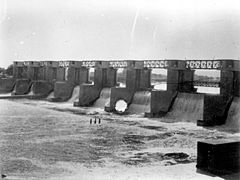
San José reservoir

Bajoz River reservoir

Valdemudarra reservoir

Esgueva Encinas Pack


Natural spaces


.jpg)


_in_Spain_fields.jpg)
- Natural Reserve of the Riberas de Castronuño-Vega del Duero: in the region of the Torozos Mountains, It is an area of moors and sedimented vegas. A migratory area and nesting area for aquatic birds. The Duero is surrounded by riparian forests and is a very interesting landscape ecosystem. It is an area of large meadows and the absence of large elevations. The fauna is abundant, such as royal claw, martinete, common garceta, snakes, ducks spoons, common porrors, dumb porns, cormorants, alcotan, fisherman eagle, collar snake, stairwell eagle, imperial claw, pilgrim falcon, ash gartijas and hurroja, ocelad lizard, frown, shin,
- Lagunas del Raso de Portillo: it is three lagoons of recent construction located on what had been a historical wetland that reached the 1900 hectares until it was dried in the centuryXIX. It is a privileged place to observe a large number of birds inhabiting wetlands or passing through in their migratory phase.
- Canal de Castilla: it began to be built in 1753 and it took almost a century to finish it since it was inaugurated in 1849. It has an inverted form of "Y" and its objective was to transport the wheat of Castile to the ports of the Cantabrian Sea but the arrival of the railway soon made it obsolete. It crosses 9 municipalities of the province. Over time, a series of wetlands of high ecological value, representing an island of biodiversity, have been formed at the margins of the canal. Its high ecological value is related to its diverse aquatic vegetation and to the significant number of vertebrate species that they contain. Within the birds, there are 121 species of nesting birds and also winter birds and migratory and accidental birds; 42 species of mammals, 15 of them insectivorous; 11 species of amphibians and 14 species of reptiles and 14 species of fish.
- Pinar de Antequera: it is considered as the authentic green lung of the city of Valladolid and the main natural resource of the capital of Vallisoletana. The pinar has spacious spaces for hiking, sport on foot or by bicycle. It is very frequented by the neighbors of the city during the weekends. The dominant vegetation is the piñonero pine, with an unmistakable round cup and the resin pine. We also find some holm oak, as well as several kinds of bushes such as albar thorn, majuelo, retama, aulaga, torvisco, jaguarcillo, wild sprawl, white and common thyme, and cantuese. In addition to numerous herbaceous plants such as lichens, fungi and moss. As for the fauna, the province has specimens of rabilargo, of great ecological value. Among the insectivorous birds are the picids and fringils, as well as couples of breeding, urracas, azores and alcotans. Among the typical scrub fauna is the common hare, the rabbit and even the partridge on the edges of the crops.
- Flora and Fauna de la D.O. Rueda: Today the Rueda region is considered to be one of the most ecologically prosperous areas of Valladolid due to the mass of vineyards and pine trees it has. There is a Special Protection Zone for Birds (ZEPA) known as La Nava-Rueda. Today this region has more than 7000 hectares of vineyards and the number increases year by year. Among the different fauna of this region are the bastard snake, the hare, the rabbit, some copies of wild boar, the partridge, the mouse eagle or the pilgrim falcon. Some of these animals live in the many pine forests of this region or in the alcornoque forest of the municipal district of Rueda. It is worth noting the large number of hectares in the region for the cultivation of cereals and the forest mass dedicated to olive cultivation.
- Natural Space of the Embalse del Río Bajoz: the modification of this reservoir, turned this area into a wet area, which modified the typology of the forest and turned it into a waterbird reduct. The valley is bathed by the Bajoz River. It is part of the Catalogue of Special Interested Zones. RAMSAR. There are zampullines, gallops or gallops, tens, bermes, wild boars and wolves.
- Esgueva Encinas Pack: bathing and fishing of species such as trout, common tent, royal tent, carp, barbeque, bogas, lucio, blackbass and percasol are allowed. In the deepest areas it reaches 15 meters deep. Nearby there is a merendero, which allows you to spend family holidays in the countryside. It also has a botanical route.
- Valdemudarra reservoir: Despite its recent construction it is already inhabited by various species of birds and fish, the color contrast between the fields of cultivation of cereals with the blue of the water packed.
- The Cuco Valley: is located in the region of Duero-Esgueva. In it is the creek of the Cuco, which flows into the river Duero forming the Vega del Río Duero, which is a humid area, with abundant waterbirds and other animals such as eagle, vulture, cuckoo, russian, cranes, threshing triton, gallipate, oats, sapoñas, common runner and frog.
- Penillanuras-Campos Norte: This is a special protection zone for birds (ZEPA) of the Natura 2000 Network. It is located at the limits of the provinces of Zamora, Valladolid and León. It is of particular importance for the conservation of these birds, especially for the avutarda, the cenizo aguilucho and the sison.
- Penillanuras-Campos Sur: This is a special protection zone for birds (ZEPA) of the Natura 2000 Network. It is located at the limits of the provinces of Zamora and Valladolid. It is of particular importance for the conservation of the stool birds, especially for the cenizo aguilucho, the aguilucho lagunero, the cernícalo primilla, the sison and the avutarda.
- La Nava - Campos Norte: it is a special protection zone for birds (ZEPA) of the provinces of Palencia, Valladolid and León that is located in the region of Tierra de Campos.
- The Carrascal: is a protected natural space that is part of the Natura 2000 Network located in much of the municipality of Quintanilla de Onésimo and Santibáñez de Valcorba. It also occupies Quintanilla terms above, Sardon de Duero and Cogeces del Monte. This is a place of community interest (LIC) of special importance for birds, mammals and amphibians.
- Land of Campiñas: it is a special protection zone for birds (ZEPA) in the provinces of Ávila, Valladolid and Segovia along the Trabancos River.
Vegetation
Vegetation reduced to high scrub, with different species of pines (pinus pinea and pinus pinaster), holm oaks (quercus ilex), oaks (quercus pyrenaica and Quercus faginea), cork oaks (quercus suber), elms, poplars, ash trees, willows, alders, poplars, honeysuckle reeds, cattails, scrub and grasslands.
Wildlife
In general, typical animals that live on the plateau, such as: rabbit, squirrel, hedgehog, vole, partridge, bustard, wader, great spotted woodpecker, little bustard, swallow, robin, cuckoo, nightingale, dove, magpie, Duck, Goose, Stork Sparrow, Common Frog, Toad, Natterjack Toad, Terrapin, Lizard, Gecko, Gray Heron, Purple Heron, Heron, Eagle, Golden Eagle, Shrew, Deer, Fallow Deer, Montagu's Harrier, Marsh Harrier, Hen Harrier, Falcon basking, short-toed eagle, lesser kestrel, crane, sandgrouse, buzzard, trout, carp, crayfish, otter, shrew, hare, roe deer, wild boar, fox, wolf, tree sparrow, goose, peacock
Culture


.jpg)

The most important cultural event in the Province is Holy Week, being the only one in Spain that has three declarations of International Tourist Interest.
Valladolid capital has a tradition that dates back to the XV century and which developed its greatest splendor in the XVII, being the Capital of the Spanish Empire, which motivated the settlement of the main sculptors of the time, such as Juan de Juni, Alonso Berruguete or Gregorio Fernandez. This has led it to be the headquarters of the National Museum of Sculpture, which, as a unique museum event in Spain, since 1922, has ceded 104 images from its collections, distributed in the corresponding passages. Their processions and acts are characterized by their devotion, silence and sobriety.
Medina de Rioseco also has an important collection of imagery. Coming from the XVI century, from the artisan guilds, it enjoys deep roots among the population.
Medina del Campo has to its credit the oldest Disciplinary Processions in Spain, established by San Vicente Ferrer in 1411, with its own characteristics that survive to this day.
The province of Valladolid is one of the most advanced in terms of museums, having some of the most important in Castilla y León and several national ones. Thus, the museums in the province of Valladolid are equipped with the latest technology and all of them have explanations for the deaf in writing. The province of Valladolid and in collaboration with the Junta de Castilla y León has launched a program for the dissemination of these and the creation of new ones. The province of Valladolid, and specifically its capital, has 3 of the most important house-museums in Spain, where very important figures from the culture and history of Spain lived, such as Miguel de Cervantes or Christopher Columbus.
Thus, the museums that operate at full capacity in the province of Valladolid are: Royal Monastery of Santa Clara, Royal Monastery of San Joaquín and Santa Ana, Planetarium of Valladolid, Interactive Museum of Man, Provincial Museum of Wine of Valladolid, Pedagogical Museum of Natural Sciences, Castilla y León Rural Life Interpretation Center, Oriental Museum, National Museum of Sculpture, Interparroquial Museum of Sacred Art, Museum of the Cavalry Academy, Diocesan and Cathedral Museum, Museum of the Monastery of Santa Isabel, Museum of Valladolid, Museum of San Antolín, Museum of the Royal Academy of Fine Arts of the Immaculate Conception, Museum of the Church of Santa María, Museum of the Collegiate Church of San Luis, Regional Museum of Sacred Art, Ecomuseum of Tordehumos, Center Joaquín Díaz Ethnographic Park, Mudéjar Theme Park, Zorrilla House Museum, Colón House Museum, Cervantes House Museum, Medina del Campo Fair Museum, Valladolid Science Museum, Fuenteu ngrillo, Campaspero Stone Museum, Pitcher Museum, Bread Museum, Fairs Museum, Cerro de la Ermita site, Almenara-Puras Roman Villa. Not all the museums in the province of Valladolid are on this list; You can find more on the website of the provincial council.
The province has several archives of historical documents, including the Simancas Archive, the Archive of the Royal Chancery of Valladolid, the Provincial Historical Archive of Valladolid, the Municipal Historical Archive of Valladolid, the General Archive of Castilla y León and the Ibero-American Falconry Archive. The honorary title of Villa del libro was given to Urueña in 1975, and there are now some 11 bookstores throughout the town, thanks to the support they have had from the council, which is why it is included in the network of Villas del Libro del mundo.
Unesco awarded the distinction of World Heritage Site within its Memory of the World category to the Treaty of Tordesillas in 2007 and to the General Archive of Simancas in 2017.
Language
In the area, a local variety of the northern Castilian dialect is spoken, which has diatopic features such as leísmo, laísmo and others of its own.
Some outstanding Valladolid personalities in the field of literature are:

José Zorrilla

Jorge Guillén
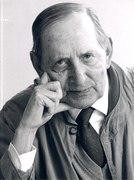
Miguel Delibes

Rosa Chacel

Gustavo Martín Garzo


Heritage


The province has a total of 188 monuments considered as Assets of Cultural Interest. A large part of them are castles, churches or historical complexes, although there are also archaeological sites or documentary archives. In the case of the churches and monasteries, there is a great variety of architectural styles, among which the pre-Romanesque, Romanesque, Mudejar, Gothic, Renaissance and Baroque stand out.

Church of San Cipriano de San Cebrián de Mazote, pre-Romanical style

Church of Our Lady of the Annunciada of Urueña, example of Romanesque architecture

Conventual Church of Saint Paul (Valladolid), example of Gothic architecture

Cathedral of Valladolid, example of Renaissance architecture of Herrerian style
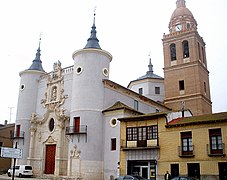
Church of Our Lady of the Assumption of Rueda, one of the best examples of baroque architecture


.jpg)


Castles
The province of Valladolid is one of the European regions with the most castles and which are also being improved for the use and enjoyment of all people. The importance of castles in this territory was such that it came to have its own type of model called Escuela de Valladolid. These are the preserved castles in the province of Valladolid:
- Alcázar de Alfonso X (Peñafiel)
- Peñafiel Castle (Peñafiel)
- Castle of La Mota (Medina del Campo)
- Castle of Fuensaldaña (Fuensaldaña)
- Simancas Castle (Simancas)
- Portillo Castle (Portillo)
- Torrelobaton Castle (Torrelobaton)
- Castle of Iscar (Iscar)
- Castle of Villafuerte de Esgueva (Villafuerte de Esgueva)
- Castle-Palacio de Curiel de Duero, (Curiel de Duero)
- Castle of Curiel de Duero, (Curiel de Duero)
- Tiedra Castle (Tiedra)
- Montealegre Castle (Montealegre)
- Castle of Encinas de Esgueva (Encinas de Esgueva)
- Villalba de los Alcores Castle (Villalba de los Alcores)
- Foncastín Castle (Foncastín)
- Mota del Marquis Castle (Mota del Marquis)
- Mutual Castle (Mutual)
- Castle of San Pedro de Latarce (San Pedro de Latarce)
- Castle of Trigueros del Valle (Trigueros del Valle)
- Urueña Castle (Urueña)
- Castillo de Villagarcía de Campos (Villagarcía de Campos)
- Castillo de Castroverde de Cerrato (Castroverde de Cerrato)
- Loma Bartial Castle (Loma Court)
- Alaejos Castle (Alaejos)
- Castle of Canillas de Esgueva (Canillas de Esgueva)
- Castillo de Fuente el Sol (Source the Sun)
- Tordehumos Castle (Tordehumos)
- Villavellid Castle (Villavellid)
- Castromembibre Castle (Castromembibre)
- Castle of Pozaldez (Pozaldez)
- Castle of San Martín de Valvení (San Martín de Valvení)
- Eván de Abajo Castle (Seven Churches of Trabancos)
- Arriba Castle (Seven Churches of Trabancos)
- Castillo de Villagómez la Nueva (Villagómez la Nueva)
- Fortified Palace of the Alderete (Tordesillas)
- Torreón de Fuentes de Duero (Fuentes de Duero, La Cistérniga)
- Jarrubia Tower (San Llorente)
- Pozal Tower of Gallinas (Pozal de Gallinas)
- Torreón de Villacid de Campos (Villacid de Campos)
Walled enclosures

- Cigales walls (Cigales)
- Muralla de Curiel de Duero (Curiel de Duero)
- Muralla de Mayorga (Mayorga)
- Muralla de Medina de Rioseco (Medina de Rioseco)
- Muralla de Medina del Campo (Medina del Campo)
- Olmedo Wall (Olmedo)
- Muralla de Peñafiel (Peñafiel)
- Wall of Pico de la Mora (Peñafiel)
- Portillo Wall (Portillo)
- Wall of Tordesillas (Tordesillas)
- Muralla de Torrelobatón (Torrelobatón)
- Wall of Tudela de Duero (Tudela de Duero)
- Muralla de Urueña (Urueña)
- Wall of Valbuena de Duero (Valbuena de Duero)
- Muralla de Valladolid (Valladolid)
- Muralla de Villabrágima (Villabrágima)
- Wall of Villalba de los Alcores (Villalba de los Alcores)
Monasteries
The monasteries are another of the most important cultural assets of the province. Some of them are in perfect condition and of others only ruins remain. Some of the most important are:
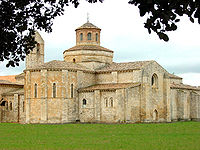
Monastery of Santa Maria de Valbuena
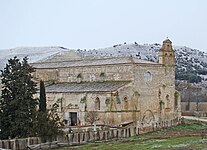
Monastery of Santa Maria de Palazuelos

Monastery of Santa Maria de Retuerta

Monastery of Santa Clara

Monastery of Santa Maria de La Santa Espina

Monastery of Santa Maria de Matallana


Gastronomy
.JPG)
The gastronomy of the province of Valladolid is typically Castilian, although each area presents different features. In the northern part of the province, especially in the Tierra de Campos region, the elaboration of sheep cheese is traditional, among which Villalón cheese stands out, cured or semi-cured; It is a fresh cheese also known as "Pata de Mulo". Garlic soups are also common, stew made slowly in a pot over the fire, stewed lentils made with the pardina variety typical of Tierra de Campos and pigeon or pigeon made with different techniques. Within the typical confectionery, the buns of the Virgen de las Fuentes typical of Villalón de Campos, the wooden donuts, orejuelas, oil cakes and pork rinds stand out. In Medina de Rioseco you can taste the traditional caramelized or sea almonds, puff pastry filled with cream and covered with sugar.

Meat
Meats and sausages are some of the most famous products for their flavor. The province belongs to the area of Castilian-type roasts. They have been part of Castilian cuisine since the invasion of the Roman Empire in the lands of Hispania. In this way you have roast lambs, roast suckling pig, roasts with vine shoots (characteristic dish in Santibáñez de Valcorba and surroundings) (beef steaks, lamb meat), garlic (typical in Peñafiel), as well as the popular suckling pig roast. The sausage called chitas that is made with marinated suckling pig meat is peculiar. Some sausages are made from the slaughter of the pig, being the Valladolid blood sausage (a kind of onion blood sausage), the Zaratán sausages. Chorizo is also used in dishes such as chorizo omelette. A tojunto de Castilla (of Aragonese influence) is made from the beef. There are preparations for small game such as rabbit a la cazadora.
Bread

Bread made in the province of Valladolid has a long tradition dating back to the IX century (see also: History of bread). In fact, during his retirement in the monastery of Yuste, Carlos I received the bread made in Valladolid and during the XVI century< /span> the Valladolid master bakers were financially supported by the Crown.
Typically Castilian bread is called durum bread, sobao or bregado, since durum wheat has been the most widely used variety of wheat since ancient times in Castile. It is a bread with a thin crust and slightly toasted, with a very white and compact crumb with a fine texture and characteristic flavor. This type of bread is suitable to accompany red meat, stews or legumes accompanied by local wines. Traditionally it is made by hand, with slow kneading and prolonged fermentation, finished by cooking in a wood-fired oven.
Under this denomination, different varieties are included; among them, the most outstanding is the variety of lechuguino bread, characterized by its typical drawing and care that gives the name to the variety, since in the past it was called, especially in rural areas, lechuguino to those people who were overdressed.
Other typical varieties are the four-bedroom bread, with a characteristic crack in the dough in which the central part is separated from the four beds or edges, the square bread, the pulley bread, with a slit made with a rope that imitates a pulley, the white or spiked bar and the fabiola, created in 1961 by a baker from Valladolid in honor of Fabiola Mora y Aragón.
Other types not so traditional in the province but widely consumed in the province are the rustic bar and the flame bar, which in Valladolid takes the common name of riche bar.

Wines
The province is home to five wine denominations of origin, considered to be of high quality. An example of the fame of these wines is the Vega Sicilia winery. The wines of the Rueda Designation of Origin were considered court wines at the time of the Catholic Monarchs. For its production, the Verdejo grape variety is used and, to a lesser extent, the Sauvignon grape. Under this denomination of origin there are white, sparkling, red, rosé and liqueur wines. For their part, the wines of the Ribera del Duero Designation of Origin are made with the country's ink and you can taste aged, young, reserve and great reserve red wines. The wines of the Toro Denomination of Origin are mainly white, rosé and red, those of the Tierra de León Denomination of Origin are white, rosé and red and finally there are the rosés of the Cigales Denomination of Origin.

Denomination of Origin Cigales

Denomination of Origin Ribera del Duero

Denomination of Origin of Rueda

Denomination of Origin Toro

Denomination of Origin Tierra de León


Sports

.JPG)
.jpg)

The most representative teams of the province are:
- Football
Real Valladolid with more than forty seasons in the first division of Spanish soccer and being the 13th team in the historical classification of the First Division, champion of the 1984 League Cup and twice runner-up of the Cup of the King of Soccer. The club plays its local matches at the Nuevo José Zorrilla stadium. Other notable teams are: Atlético Tordesillas, Club Deportivo Laguna and Medinense. The Valladolid Provincial Council Trophy is held annually.
Some historical soccer players from Valladolid are: Adolfo Mengotti, Julio Cardeñosa, Gregorio Fonseca, Eusebio Sacristán, Onésimo Sánchez, Benjamín Zarandona, Rubén Baraja, Sergio Escudero or Fernando Calero.
- Basketball
The now-defunct Club Baloncesto Valladolid, one of the historical teams of the ACB basketball league that became a member of the ACB League and which has given way to the current Real Valladolid Baloncesto since 2015, which began its career in LEB Plata and is currently He plays for LEB Oro. The club plays its local matches at the Pisuerga Sports Center. The BSR Valladolid team also stands out in wheelchair basketball, which plays its matches in the Pilar Fernández Valderrama Pavilion.
Some historical basketball players from Valladolid are: José Luis Llorente, Lalo García, Nieves Lobón, Nacho Martín or Fernando San Emeterio (Cantabrian raised in Valladolid).
- Balonmano
The BM Aula Cultural, which plays in the highest category of Spanish women's handball, and the BM Atlético Valladolid, created in June 2014 (replacing Balonmano Valladolid) and which two years later was promoted to Liga Asobal, also stand out. Both teams play their local matches at the Huerta del Rey Sports Center.
Some historical handball players from Valladolid are: Raúl González Gutiérrez, Chuchi Martínez, Fernando Hernández Casado or Juan Carlos Pastor (coach).
- Rugby
Valladolid stands out particularly when it comes to playing rugby, with two of the leading teams in the Division of Honor rugby, El Salvador and VRAC, which together have nineteen National League Championships, thirteen Copas del Rey and fourteen Spanish Super Cups. These 2 teams have historically contributed a significant number of players to the Spanish rugby team.
- Other sports
The existing sports offer in the province is completed with outstanding wheelchair basketball teams (BSR Valladolid), futsal, inline hockey (CPLV) and several important canoeing clubs based in Pisuerga. The city also has four golf courses, multiple clubs for football, basketball, handball, tennis, athletics, swimming, cycling, volleyball, martial arts, local sports, hunting and fishing, as well as clubs and sports facilities for other disciplines. It is also the city of high-level historical athletes such as Mayte Martínez, Laura López Valle, Isaac Viciosa, Miriam Blasco or Roldán Rodríguez and young athletes such as Álvaro Rodríguez or Mohamed Elbendir and the Paralympic swimmer Amaya Alonso.
The province of Valladolid has hosted several relevant sporting events, having hosted the 1982 Soccer World Cup, the 1985 Rhythmic Gymnastics World Championship, the final of the 1986 European Under-21 Soccer Championship, of the Final Phase of the Willi Brinkmann Eurocup wheelchair basketball in 2009, of the European Volleyball League, as well as important cycling events (including multiple stages of the Vuelta Ciclista a España), tennis championships, evenings boxing, horse riding, etc.
- Olympic medalists
- Adolfo Mengotti: Silver in the football competition in Paris 1924 (started on the Swiss team)
- Marcelino Gavilán and Ponce de León: Silver in Hypic in London 1948
- Angel León Gozalo: Silver in free gun 50 m in Helsinki 1952
- José Luis Llorente: Silver in basketball in Los Angeles 1984
- Narcissus Suárez Amador: Bronze in Pyragüismo in Quiet Waters in Los Angeles 1984
- Miriam Blasco: Gold in Judo in Barcelona 1992
- Fernando Hernández Casado: Bronze in balonmano in Atlanta 1996
- Raúl González Gutiérrez: Bronze in balonmano in Atlanta 1996
- Laura López Valle: Silver in synchronized swimming in Beijing 2008
- Juan Carlos Pastor: Bronze in Beijing 2008 (as a coach)
Media

- Press written
- El Norte de Castilla
- Valladolid Day
- Diario de Valladolid (The World)
To this are added some digital ones such as Tribuna de Valladolid, Noticias Castilla y León, Europa Press Valladolid, Here in Valladolid or Agencia ICAL.
- Generalist radios

- Radio Valladolid Cadena Ser
- Cope Valladolid
- Onda Cero Valladolid
- esRadio Valladolid
- RNE Valladolid
- Television
- 8 is the only channel dedicated entirely to provincial information
- TVE has local disconnections
Notable people
Contenido relacionado
Korea
Toronto
Alamo (Veracruz)