
Uniformly accelerated rectilinear motion

in physics, the uniformly accelerated rectilinear movement ( mrua ), also known as uniformly varied rectilinear movement ( mruv ), it is one in which a mobile moves on a straight path being subjected to constant acceleration.
An example of this type of movement is that of vertical free fall, in which the acceleration that intervenes, and considered constant, is the one that corresponds to gravity.
From the point of view of the dynamics, it can also be defined as the movement that makes a particle that starting from rest is accelerated by a constant force.
The uniformly Aaccelerated Rrectilinear motion Rmotion (MRUA) is a particular case of uniformly accelerated motion accelerated (MUA).
Uniformly accelerated rectilinear motion in Newtonian mechanics
In classical mechanics, the uniformly accelerated rectilinear movement (MRUA) presents two fundamental characteristics:
- The trajectory is rectiline
- Acceleration on the particle is constant
- From the second Newton Law you can express:
- F=ma{displaystyle mathbf {F} =m,mathbf {a} }
- Since the mass is a constant, if the resulting force applied is constant, the acceleration will also be constant.
- From the second Newton Law you can express:

Therefore, this determines that:
- Speed varies linearly over time.
- The position varies according to a quadratic relationship over time.
The figures show the relationships of acceleration, velocity, and displacement with respect to time, acceleration (constant, horizontal line), velocity (sloping line), and displacement (parabola).
 |  |  |
The acceleration a constant, in the example:
- a=a0{displaystyle a=a_{0}}

 |  |  |
We can see the graph of the acceleration function with respect to time, it is clear that they are horizontal lines.
The velocity v for a given time is:
- v(t)=at+v0{displaystyle v(t)=at+v_{0}}

For the same initial velocity with different accelerations we have a bundle of straight lines with different slopes:
 | |  |
with the same acceleration and different initial velocities we have parallel lines like the ones in the graphs:
 | |  |
Finally, the position as a function of time is expressed by:
- e(t)=12at2+v0t+e0{displaystyle e(t)={frac {1}{2}}at^{2}+v_{0}t+e_{0}}}
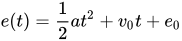
where e0{displaystyle e_{0},} It's the initial position.

The function position with respect to time, with a constant and non-zero acceleration, is a parabola, the initial velocity and the initial position are fixed, for different accelerations there will be different parabolas, which pass through the same position point initial and at that point they present the same slope.
 | |  |
With the same acceleration and with the same initial position, but with different initial velocities, the graphs are as follows:
 | |  |
The graphs in the case of the same acceleration and the same initial velocity, but with different initial positions, would be as follows:
 |  |  |
In addition to the previous basic relationships, there is an equation that relates the displacement and the speed of the mobile to each other. This is obtained by solving for the time of () and substituting the result into ():
- v2=2a(e− − e0)+v02{displaystyle v^{2}=2a(e-e_{0})+v_{0}^{2}},

Speed deduction as a function of time
Be part of the definition of acceleration
dvdt=a{displaystyle {cfrac {dv}{dt}}}=a}

and integrate this first-order linear differential equation
∫ ∫ v0vdv=∫ ∫ t0tadt{displaystyle int _{v_{0}}{v}dv=int _{t_{0}}}{ta,dt}
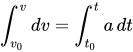
solve the integral for a constant:
v=a(t− − t0)+v0{displaystyle v=a(t-t_{0})+v_{0} }

where v0{displaystyle v_{0},} is mobile speed in the initial moment t0{displaystyle t_{0},}.


In case the initial moment is t0=0{displaystyle t_{0}=0,}It will be

v=at+v0{displaystyle v=at+v_{0} }

Deduction of the position as a function of time.
from the definition of speed
dedt=v{displaystyle {cfrac {de}{dt}}=v}

integrating:
∫ ∫ e0ede=∫ ∫ t0tvdt{displaystyle int _{e_{0}}{e}de=int _{t_{0}}{t}{tv,dt}
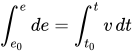
in which the previously obtained value is replaced v=v(t){displaystyle v=v(t),}

∫ ∫ e0ede=∫ ∫ t0t[chuckles]a(t− − t0)+v0]dt{displaystyle int _{e_{0}}{e}de=int _{t_{0}}{t}{t}{t_{0})+v_{0},dt}
![{displaystyle int _{e_{0}}^{e}de=int _{t_{0}}^{t}[a(t-t_{0})+v_{0}],dt}](https://wikimedia.org/api/rest_v1/media/math/render/svg/1ca84433d617b7f5bcffcb511275e199d7832aaf)
solving the integral, and bearing in mind that a{displaystyle a,} and v0{displaystyle v_{0},} are constant:

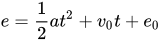
e=12a(t− − t0)2+v0(t− − t0)+e0{displaystyle e={frac {1}{2}}a(t-t_{0})^{2}+v_{0}(t-t_{0})+e_{0}}}}}}

where e0{displaystyle e_{0},} the position of the mobile in the instant t0{displaystyle t_{0},}.
In case of the initial time t0=0{displaystyle t_{0}=0,} the equation would be:
e=12at2+v0t+e0{displaystyle e={frac {1}{2}}at^{2}+v_{0t+e_{0}}
Non-temporal equation of motion
It is about relating position, velocity and acceleration, without time appearing.
It is part of the definition of acceleration, multiplying and dividing by de{displaystyle de,} you can remove time

a=dvdt=dvdtdede=dedtdvde=vdvde{displaystyle a={frac {dv}{dt}}={frac {dv}{dt}}}{frac {de}{de}}}{frac {de}{dt}}}{frac {dv}{de}}}}}{v{frac {d}{de}}}}}}}}}}}}

variables are separated and integration is prepared taking into account that a=cte.{displaystyle a={text{cte},}

∫ ∫ v0vvdv=∫ ∫ e0eade=a∫ ∫ e0ede{displaystyle int _{v_{0}}{v}vdv=int _{e_{0}}}{e}{eade=aint _{e_{0}}{e}{e}{e}de}
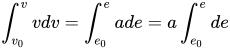
and integrates
12v2]v0v=ae]e0e{displaystyle left.{frac {1}{2}};v^{2}_{v_{0}}}{v}{v}=left.a;eright]_{e_{0}{e}{e}}
![{displaystyle left.{frac {1}{2}};v^{2}right]_{v_{0}}^{v}=left.a;eright]_{e_{0}}^{e}}](https://wikimedia.org/api/rest_v1/media/math/render/svg/2c832d404bd585eb22b75f17b14d37a342260850)
resulting
12(v2− − v02)=a(e− − e0){displaystyle {frac {1}{2}}(v^{2}-v_{0}^{2})=a(e-e_{0})}}
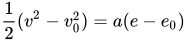
and ordering
v2=v02+2a(e− − e0){displaystyle v^{2}=v_{0}^{2}+2a(e-e_{0}}}}}}}

A similar result can be reached starting from these expressions
- {e=12at2v=at⇒ ⇒ t=va日本語⇒ ⇒ e=12a(va)2⇒ ⇒ e=12av2a2{displaystyle left{begin{array}{l}{l}{cfrac {1}{1}{2}}{at^{2}{v=atquad Rightarrow quad t={cfrac}{v}{a}{a}{a}{are}{array}}}{quadrrow
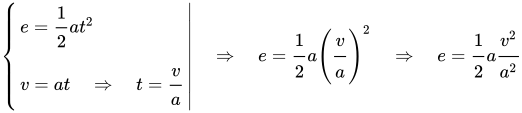
operating terms:
- e=v22a⇒ ⇒ v2=2ae⇒ ⇒ v=2ae{displaystyle e={cfrac {v^{2}}{2a}}{quad Rightarrow quad v^{2}=2aequad Rightarrow quad v={sqrt {2ae}}}}}}

The speed reached by a mobile, starting from rest, at constant acceleration, is equal to the square root of twice the acceleration times the space traveled. Keep in mind that time is not involved in this relationship.
Accelerated motion in relativistic mechanics

In relativistic mechanics there is no exact equivalent of uniformly accelerated rectilinear motion, since acceleration depends on velocity and maintaining a constant acceleration would require a progressively increasing force. The closest you get is the motion of a particle under a constant force, which shares many of the features of the MUA of classical mechanics.
The relativistic equation of motion for motion under a constant force starting from rest is:
(4){ddt(v1− − v2/c2)=Fm0=wv(0)=0{displaystyle {begin{cases}{cfrac {d}{dt}}}{left({cfrac {v}{sqrt {1-v^{2}/c^{2}}}}}{right)={cfrac {F}{m_{0}}}}}=wv(0end{cases}}}}}}}
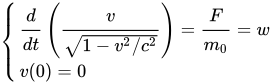
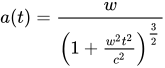
Where w is a constant that, for small values of velocity compared to the speed of light, is approximately equal to the acceleration (for speeds close to the speed of light the acceleration is much smaller than the ratio of force to mass). In fact the acceleration under a constant force is given in the relativistic case by:
a(t)=w(1+w2t2c2)32{displaystyle a(t)={frac {w}{left(1+{frac {w^{2}t^{2}}{c^{2}}}}{right)}{frac {3}{2}}}}}}}}}}{
The integral of () is simple and is given by:
(5)v1− − v2/c2=wt⇒ ⇒ v(t)=wt1+w2t2c2{displaystyle {frac {v}{sqrt {1-v^{2}/c^{2}}}}}}}}}=wtqquad Rightarrow qquad v(t)={frac {wt}{sqrt {1+{frac {w^{2}t^{2}{2}}{c}{f}}}}}}}}}}{f}}}}}}}}}}}}}{fre}}}}}}}}}}

And integrating this last equation, assuming that initially the particle occupied the position x = 0, we arrive at:
(6)x(t)=c2w[chuckles]1+w2t2c2− − 1]{displaystyle x(t)={frac {c^{2}}{w}}}{left[{sqrt {1+{frac {w^{2}t^{2}}}{c^{2}}}}}}}}}}{1right]}
![{displaystyle x(t)={frac {c^{2}}{w}}left[{sqrt {1+{frac {w^{2}t^{2}}{c^{2}}}}}-1right]}](https://wikimedia.org/api/rest_v1/media/math/render/svg/7a821d20fd0a4059b6849facc4b84190e7264a13)
In this case, the proper time of the accelerated particle can be calculated as a function of the coordinate time t by means of the expression:
(7)Δ Δ =cwln [chuckles]wtc+1+w2t2c2]{displaystyle tau ={frac {c}{w}}}{ln left[{frac {w}{wt{c}}}}}+{sqrt {1+{frac {w^{2}t^{2}}{c^{c}}}{c}}}}{right}}}}
![{displaystyle tau ={frac {c}{w}}ln left[{frac {wt}{c}}+{sqrt {1+{frac {w^{2}t^{2}}{c^{2}}}}}right]}](https://wikimedia.org/api/rest_v1/media/math/render/svg/4505431b9aafcbd45bb0ae4b229d9594bd807373)
All these expressions can be easily generalized to the case of a uniformly accelerated movement, whose trajectory is more complicated than the parabola, just as it happens in the classical case when the movement occurs on a plane.
Rindler Observers
The treatment of uniformly accelerated observers in Minkowski space-time is usually done using the so-called Rindler coordinates for said space, an accelerated observer is represented by a reference system associated with some Rindler coordinates. Starting from the Cartesian coordinates, the metric of said space-time:
ds2=− − c2dT2+dX2+dAnd2+dZ2,(T,X,And,Z)한 한 R4{displaystyle ds^{2}=-c^{2}dT^{2}+dX^{2}+dY^{2}+dZ^{2},qquad (T,X,Y,Z)in mathbb {R} ^{4}}

Now consider the region known as Rindler's wedge, given by the set of points that verify:
<math alttext="{displaystyle {mathcal {R}}_{Rind}={(T,X,Y,Z)in mathbb {R} ^{4}| 0<X<infty;-X<TRRind={(T,X,And,Z)한 한 R4日本語0.X.∞ ∞ ,− − X.T.X!{displaystyle {mathcal {R}}_{Rind}={(T,X,Y,Z)in mathbb {R} ^{4}UD 0X taxinfty;-X tax excl.x}}<img alt="{displaystyle {mathcal {R}}_{Rind}={(T,X,Y,Z)in mathbb {R} ^{4}| 0<X<infty;-X<T
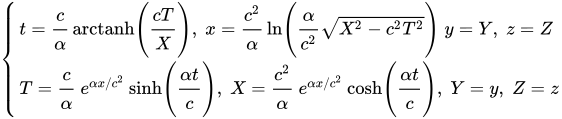
And define on it a change of coordinates given by the following transformations:
{t=cα α arctanh (cTX),x=c2α α ln (α α c2X2− − c2T2)and=And,z=ZT=cα α eα α x/c2sinh (α α tc),X=c2α α eα α x/c2cosh (α α tc),And=and,Z=z{cHFFFFFF}{cHFFFFFF}{cHFFFFFF}{cHFFFFFF}{cHFFFF}{cHFFFFFF}{cHFFFF}{cHFFFFFF}{cHFFFF}{cHFFFF}{cHFFFF}{cHFFFFFF}{cHFFFFFFFF}{cHFFFFFFFF}{cHFF}{cH00}{cH00}{cH00}{cHFFFFFFFFFFFFFFFFFFFFFFFFFFFFFFFFFFFFFF}{cH00}{cHFFFFFFFF}{cH00}{cH00}{cH00}{cH00}{cH00}{cHFFFFFFFFFFFFFFFFFFFF}{cH00}{cH00}{cH}{cHFFFFFFFF}{cHFFFFFFFF}{cH
Where:
- α α {displaystyle alpha ,}, is a parameter related to observer acceleration.
- (t,x,and,z){displaystyle (t,x,y,z),}, are the temporary and spatial coordinates measured by that observer.


Using these coordinates, the Rindler wedge of Minkowski space has a metric, expressed in the new coordinates, given by the expression:
ds2=e2α α xc2(− − dt2+dx2)+dand2+dz2,(t,x,and,z)한 한 × × R4{displaystyle ds^{2}=e^{frac {2alpha x}{c^{2}}}}(-dt^{2}+dx^{2})+dy^{2}+dz^{2},qquad (t,x,y,z)in times mathbb {R} ^{4}}}}}

These coordinates may represent an observer accelerated along the X axis, whose quadriaceleration obtained as the covariant derivative of quadvelocity is related to the value of the x coordinate:
► ► e0e0=α α e− − α α xc2e1,a=(a0;a1,a2,a3)=(0;α α e− − α α xc2,0,0){displaystyle nabla _{mathbf {e} _{0}mathbf {e} _{0}{alpha e^{-{frac {alphax}{c^{c}{2}{x1⁄2}{e}{1}{1},qquad mathbf {aFF}{aFF}{x1⁄2}{x1⁄2⁄2}{bf}}{x1⁄2}{x1⁄2}}{x1⁄2⁄2}}}}{x1⁄1⁄2⁄2}}}{bf}}{bf}{bf}{bf}{x1⁄1⁄2}{bf}{bf}{bf}}}{

Rindler's Horizon
It is interesting to note that a uniformly accelerated observer has an event horizon, that is, there is a spatial surface (which coincides with the boundary of the Rindler wedge):
HRind− − ={(T,X,And,Z)日本語X2− − c2T2=0!={(t,x,and,z)日本語x=− − ∞ ∞ !{displaystyle H_{Rind}^{-}={(T,X,Y,Z)ΔX^{2}-c^{2}T^{2}=0}={(t,x,y,z)

such that the light from the other side would never reach the accelerated observer. This event horizon is of the same type as the horizon seen by an observer outside a black hole; that is, the events on the other side of the event horizon cannot be seen by these observers.
The example of Rindler coordinates shows that the occurrence of an event horizon is not associated with space-time itself but with certain observers. The Rindler coordinates constitute a mapping of the Minkowski flat space-time. In such space an inertial observer does not see any event horizon but an accelerated observer does.
Accelerated motion in quantum mechanics
Motion under constant force in quantum mechanics
In quantum mechanics one cannot speak of trajectories since the position of the particle cannot be determined with arbitrary precision, so there are only imperfect quantum analogues of classical rectilinear motion. The simplest quantum equivalent of uniformly accelerated motion is that of a quantum particle (nonrelativistic and spinless) in a conservative force field in which potential energy is a linear function of the coordinate.
− − 22m▪ ▪ 2 ▪ ▪ x2− − xFEND END (x,t)=i▪ ▪ (x,t)▪ ▪ t{displaystyle -{frac {hbar ^{2}}{2m}}}{frac {partial ^{2}Psi }{partial x^{2}}}}}}-xFpsi (x,t)=i{frac {partial Psi (x,t)}{partial t}}}}}}{

The general solution of this equation can be written as a Fourier transform of the solution set of the stationary equation:
(x,t)=(m 2F2)1/3∫ ∫ − − ∞ ∞ +∞ ∞ AEEND END ^ ^ (x;E)e− − iEt/ dE{displaystyle Psi (x,t)=left({frac {m}{hbar ^{2}F^{2}}}}right)^{1/3}int _{-infty }^{+infty }A_{E} {hat {psi }}{x; e)e^{-e

Where AE{displaystyle scriptstyle A_{E}} the amplitude is a function of the energy to be chosen to satisfy the initial conditions and function END END ^ ^ (x;E){displaystyle scriptstyle {hat {psi }(x;E)} in the integration must be a solution to the equation of Schrödinger stationary:


− − 22m▪ ▪ 2END END E▪ ▪ x2− − xFEND END E(x)=EEND END E(x),END END E(x):=END END ^ ^ (x;E){displaystyle -{frac {hbar ^{2}}{2m}}{frac {partial ^{2}psi _{E}}{partial x^{2}}}}}}-xFpsi _{E}(x)=Epsi _{E}(x),qquad psi _{E(x):

Where:
- {displaystyle hbar ,} is the constant of rationalized Planck.
- m{displaystyle m,} is the mass of the particle.
- F{displaystyle F,} is the force exercised on the particle.
- E{displaystyle E,} is the energy of a stationary state of quantum hamiltonian.


Making the change of variable:
x! ! =− − (2m 2F)1/3(E+xF){displaystyle {bar {x}}=-left({frac {2m}{hbar ^{2}F}}right)^{1/3}(E+xF)}}
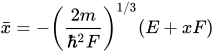
Then the equation () equals the equation:
d2END END E(x! ! )dx! ! 2− − x! ! END END E(x! ! )=0{displaystyle {frac {d^{2}psi _{E}({bar {x}}}}}{d{bar {x}}}{x}}}}{bar {x}}}{x}}}{{bar {x}}{x}}}}}{bar {x}}{x}}}}{bar {
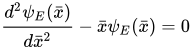
What is the Airy equation, so the general solution of the Schrödinger equation is in terms of Airy functions:
END END E(x)=AAi(x! ! )+BBi(x! ! ){displaystyle psi _{E}(x)=Amathrm {Ai} ({bar {x}}})+Bmathrm {Bi} ({bar {x}}})}

Due to physical considerations B = 0, since otherwise the previous function would not be bounded.
END END E(x)=AAi[chuckles](2m 2F)1/3(Fx+E)]{displaystyle psi _{E}(x)=Amathrm {Ai} left[left({frac {2m}{hbar ^{2}F}}}{1/3}(Fx+E)right]}}
![{displaystyle psi _{E}(x)=Amathrm {Ai} left[left({frac {2m}{hbar ^{2}F}}right)^{1/3}(Fx+E)right]}](https://wikimedia.org/api/rest_v1/media/math/render/svg/9ab5f165a08f3b47b237e592bbbd2f966e8ba7be)
Note that the previous equation has a solution for any value of E and therefore the possible energy states of a particle have a continuous spectrum (unlike what happens for other quantum systems with levels of discrete energy).
Unruh Effect
In 1975, Stephen Hawking conjectured that a production of particles should appear near the event horizon of a black hole whose energy spectrum would correspond to that of a black body whose temperature was inversely proportional to the mass of the hole. In an analysis of accelerated observers, Paul Davies proved that Hawking's same argument was applicable to these observers (Rindler observers).
In 1976, Bill Unruh, based on the work of Hawking and Davies, predicted that a uniformly accelerated observer would observe Hawking-type radiation where an inertial observer would observe nothing. In other words, the Unruh effect states that the vacuum is perceived as hotter by an accelerated observer. The observed effective temperature is proportional to the acceleration and is given by:
kT= a2π π c{displaystyle kT={frac {hbar a}{2pi c}}}}

Where:
- k{displaystyle k,}Boltzmann constant.
- {displaystyle hbar }, rationalized Planck constant.
- c{displaystyle c,}, speed of light.
- T{displaystyle T,}absolute temperature of the vacuum, measured by the accelerated observer.
- a{displaystyle a,}acceleration of the observer uniformly accelerated.


In fact, the quantum state perceived by the accelerated observer is a different thermal equilibrium state from the one perceived by an inertial observer. This fact makes acceleration an absolute property: an accelerated observer moving in open space can measure his acceleration by measuring the temperature of the surrounding thermal background. This is similar to the classical relativistic case, where an accelerated observer observing an electric charge at rest relative to him can measure the radiation emitted by this charge and calculate his own absolute acceleration.
Contenido relacionado
(24) Themis
Thetis
2004 FH