
Transfinite number
In set theory, transfinite number is the original term introduced by the German mathematician Georg Cantor to refer to infinite ordinal numbers, which are greater than any natural number.
In modern terminology, when referring to ordinals or cardinals, "transfinite" and "infinite" are synonymous. In modern terminology, cardinals are a special type of original number.
First transfinite issues
As with the natural numbers, transfinite numbers can be thought of as cardinals or ordinals:
- ω (omega): is the lowest transfinite ordinal. Its elements are the natural numbers, as they are constructed in the theory of assemblies, and represents the type of order of these.
- Русский0, alef-0: is the first alef number, and the first transfinite cardinal (assuming the axiom of choice). It is in conjunction identical to ω, but different notations are used to highlight the ordinal or cardinal aspect of the numberable sets.
- Русский1, alef-1: is the second alef number, and the cardinal next to Русский0 (assuming the axiom of choice).
- c = 2Русский0: is the cardinal of the continuum, the cardinal number of the points of a straight or of the actual numbers.
Assuming the axiom of choice, all that can be proved with the Zermelo-Fraenkel axioms is:

The hypothesis of the continuum states that in fact c = Русский1. However, the work of Kurt Gödel and Paul Cohen proves that the hypothesis is independent of such axioms: it cannot be refuted or demonstrated from them. That is, using the axioms of Zermelo-Fraenkel (ZF) it can be verified that the previous three cardinals fulfill . The hypothesis of the continuum states that in fact . Gödel proved in 1938 that this hypothesis is consistent with ZF axioms, and therefore can be taken as a new axiom for the theory of assemblies. However, in 1963 Paul Cohen proved that the denial of the hypothesis of the continuum is also consistent with ZF axioms, which proves that such hypothesis is totally independent of ZF axioms. That is, both "theory of cantorian assemblies" (in which the hypothesis of the continuum is a certain assertion), such as "theory of non-cantorian assemblies" (in which the hypothesis of the continuum is false). This situation is similar to that of non-Euclidian geometries.

Arithmetic of transfinite cardinals
For transfinite numbers the sum, multiplication and potency can be extended without ambiguity. Be for example two set-ups and , the sum and multiplication can be built from the cardinal of the union and the Cartesian product of these two sets:
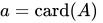
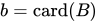

It is easy to check that these operations are well defined since:

Although sum and multiplication do not present problems, subtraction and division are not defined. Unlike the finite cardinals, operations equivalent to subtraction or division cannot be defined without ambiguity. The subtraction and division can be introduced between finite cardinals thanks to the fact that from the set of finite cardinals, which coincide with natural numbers , the whole of the whole and the rational can be built. The construction of integers and rationals is possible because every finite cardinal is regular with respect to the sum, that is, for any cardinals a, b and c 0, finites are fulfilled:

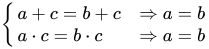
Those last two properties in fact are never fulfilled when one of the cardinals is transfinite, if have the following equality:


Transfinite cardinals endowed with addition or multiplication constitute a commutative monoid. Due to the lack of regularity of the transfinite cardinals, the monoid symmetrization theorem is not applicable, which would allow subtraction and division to be defined.
Empowerment requires building a more complicated set, but it is equally well defined. Yeah. A and B are any two sets and and can be defined the exponentiation as the cardinal of the set of functions B in A:


An interesting particular case occurs when a = 2, in this case we can for example A = {0,1}, and the set AB can be naturally identified with the set of parts of B or power set.

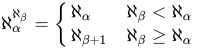
Potentiation also has curious saturation properties, so for cardinals of type aleph we have:
History and development
Georg Cantor realized that it was possible to talk about the number of elements in an infinite set just as one talks about the number of elements in a finite set. That is, he found that it was possible to "measure" the size of an infinite set, and indeed compare the size of two infinite sets to find that one was "greater" than the other, and he developed a theory to some extent rigorous regarding these ideas: the theory of transfinite numbers.[citation needed]
Cantor argued that mathematicians' contempt for infinity and its nature was due to an abuse of this concept. What Cantor meant was that the term infinite applied without distinction to any non-finite sets, being that, among them, it was possible to take some that are, in some way, measurable and of comparable sizes. Cantor's reflections and subsequent study on all this began when, sensing this some non-trivial result, he wondered if it was possible to correspond one to one the set of natural numbers with the set of real numbers. Cantor was soon able to show that there was no such correspondence, thus revealing a difference between the infinity of two infinite sets, which was ultimately a very interesting result. Cantor also proved that, contrary to what one might think, the set of rational numbers, which has the property of density, corresponds one to one with the set of natural numbers.[citation required]
It is easy to give an example of two sets that, one having all the elements of the other and more, correspond one to one. Take, for example, the case of natural numbers:[citation needed]

and now let's take only those numbers that are the square of some natural number (clearly not all natural numbers meet this characteristic, so many of them are discarded):

It is hardly necessary to explain more to realize that there is one-to-one correspondence between and its subset
.

In addition, Cantor found that the measurement of a set (whether finite or infinite) can be done in two ways: one of them considers nothing more than the number of elements in a set, while the other takes into account the number of elements in a set. order of the elements of a set. From this distinction arise the cardinal numbers and the ordinal numbers, which can also be transfinite. For finite sets, these two concepts are equivalent. However, the two concepts differ when applied to infinite sets.[citation needed]
Contenido relacionado
Riemann zeta function
Alain Connes
Richard Dedekind