
Tom Jobim
Antônio Carlos Brasileiro de Almeida Jobim (Rio de Janeiro, January 25, 1927 - New York, December 8, 1994), also known by his stage name Tom Jobim, was a Brazilian composer, arranger, singer, guitarist and pianist of bossa nova, popular music from his country and classical music.
He is considered one of the great exponents of Brazilian music, and one of the great composers of popular music of the XX century. He was the artist who internationalized bossa nova and, with the help of important American artists, fused it with jazz to standardize a new sound in the 1960s whose popular success was very remarkable.
Jobim's musical roots lie in classical music through great composers such as Claude Debussy, Frédéric Chopin and Heitor Villa-Lobos, who had a decisive influence on him. Added to this are Brazilian samba and folklore, the harmonies of cool jazz and Broadway musicals. As a pianist, his playing is simple and melodic, in the style of Claude Thornhill, although in some of his recordings he showed that he could be highly inventive. His guitar is mainly limited to a gentle accompaniment to the syncopated rhythms of jazz ; his voice, soft, simple and slightly hoarse, underscores the emotional aspects of the lyrics. Among his abundant production, the song "Garota de Ipanema" stands out, with lyrics by Vinicius de Moraes, one of the best-known Brazilian melodies in the world.
Biographical review
Jobim was originally headed for a career as an architect. However, around the age of twenty, the call of music became so powerful that he began playing the piano in nightclubs and working in recording studios. He made the first recording of it in 1954, accompanying singer Bill Farr as leader of "Take Your Band". His first great success came in 1956 when, together with the poet Vinícius de Moraes, he wrote part of the music for a play called Orfeo da Conceição (later made into a film, Black Orfeo ). In 1958, Jobim produced an album, due to his particular bossa nova style ('new trend' or new wave; from the Portuguese bossa: 'aptitude, tendency, vocation'), guitarist and singer João Gilberto, recording some of Jobim's songs with musical arrangements by himself, giving rise to the musical genre of bossa nova, with Chega de saudade being the starting point when it was released as a single in 1958.
Jobim's takeoff outside of Brazil came in 1962 when Stan Getz achieved surprising success with his song "Desafinado"; a year later, Jobim and several other Brazilian musicians were invited to participate in a show at Carnegie Hall. The performance was a great success for Brazilian music despite a boycott by the national press. Fueled by Jobim's songs, bossa nova became an international success, and jazz musicians took to it, recording numerous albums until its commercial pull on the pop scene exhausted in the late 1960s. Jobim also recorded a version of Garota de Ipanema with the American singer Frank Sinatra in 1967.
Jobim preferred the recording studio to touring, recording several albums of his music as a pianist, guitarist, and singer for Verve, Warner Bros., Discovery, A&M, CTI, and MCA in the 1960s and 1970s, returning to Verve in the last years of his life. Initially, he began to collaborate with the arranger and conductor Claus Ogerman. With the success of Brazilian music in the United States running out, Jobim concentrated on Brazilian film and television. But around 1985, with the rise of so-called world music and a second wave of Brazilian music, Jobim began touring with a group that included his second wife, Ana Lontra, his son Paulo, his daughter Elizabeth, and several musician friends.
Death
After finishing his album Antônio Brasileiro, Jobim complained of urinary problems to his doctor, Roberto Hugo Costa Lima. They detected a bladder tumor, but Jobim postponed the recommended immediate surgery for many months, because a Brazilian medium supposedly transmitted him a message from Frederick von Stein, a dead German doctor, who advised him not to do the surgery. Jobim started working on his new album Tom Jobim. Finally Jobim decided to abandon his spirit guide and undergo surgery. His operation took place at Mount Sinai Hospital (in New York) on December 2, 1994. On December 8 - while recovering from his surgery - Jobim suffered a pulmonary embolism that caused cardiac arrest. Two hours later he went into final cardiac arrest. His last album Antônio Brasileiro was released three days after his death.
Jobim's body was sent to Brazil on December 9, 1994 and he had a funeral on December 13 in Rio de Janeiro. His family and his friends —Miúcha, Edu Lobo, João Gilberto, Astrud Gilberto— attended the funeral. On December 20, 1994, he was buried in the São João Batista Cemetery in Rio de Janeiro.
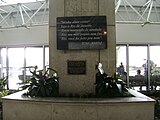
Registration in homage to Tom Jobim at the Rio de Janeiro International Airport "Tom Jobim" (Galeão).

Tom Jobim Monument in Ipanema


Record selection
- 1963: The composer of Desafinado, plays (Verve).
- 1967: Wave (A fakeM).
- 1967: Francis Albert Sinatra & Antonio Carlos Jobim (Reprise)
- 1970: Stone Flower (Epic/CTI).
- 1973: Matita Perê (Universal Int'l).
- 1973: Jobim MCA(LP) Verve(CD).
- 1974: Elis & Tom (Verve).
- 1976: Urubu (Warner Archives).
- 1980: Terra Brasilis (Warner Archives).
- 1987: Passarim (Verve).
- 1993: Antonio Carlos Jobim and friends, live (Verve).
- 1994: Antonio Brasileiro (Sony).
Acknowledgments
- The Rio de Janeiro International Airport is known with the name of Tom Jobim in honor of this Brazilian musician.
- The Montreal International Jazz Festival (FIJM) has been awarded every year since 2004 the Antonio Carlos Jobim Award.
Monuments
- On the beach Ipanema, the City of Rio de Janeiro inaugurated in early 2014 a statue of real size 22°59′17′S 43°11′40′ / -22.9879603, -43.1944764, made of clay and bronze, which shows the musician in his physical fullness, walking and carrying a guitar on the right shoulder, of the sculptor Christina Motta.
- In Santiago de Chile, Plaza Brasil houses the monument to Antonio Carlos Jobim (1927 - 1994), known for his artistic name Tom Jobim. Under a Tilo tree is located the monolith with the plate 33°26′26′′S 70°39′59′ / -33.4405048, -70.6663582 towards the west of the park, path towards the intersection of the streets Maturana with Company of Jesus. It was opened in March 1995.