
Tidal force
The tidal force is a secondary effect of the force of gravity that is responsible for the existence of the tides. It is the result of the difference in the gravitational force that exists along the diameter of a body. When a body of sufficiently large size is disturbed by the gravitational force of another body some distance away, the difference in the magnitude of the force of gravity between the near and far ends can be large. This fact alters the shape of the large body without changing its volume. Assuming that the shape was initially a sphere, the tidal force will tend to turn it into an ellipsoid.
Tidal forces in the Earth-Moon system
Effects of Lunar Gravity

The lunar mass represents an appreciable fraction of the Earth-Moon system, approximately 1:81. Because of this the system behaves more like a double planet than a planet with a satellite. The plane of the lunar orbit around the Earth is almost coincident with the plane of the earth's orbit around the Sun or the ecliptic plane, and it differs notably from the plane perpendicular to the axis of rotation of the earth or equatorial plane, which is what it usually happens in the case of other planetary satellites.
The mass of the Moon is large enough and close enough to raise tides on Earth: the land masses, and particularly the water in the oceans, bulge at either end of an axis that passes through the centers of gravity of the Earth and the Moon. This bulge closely follows the Moon in its orbit, but the Earth is not stationary, it rotates, completing one revolution once a day. This terrestrial rotation drags the position of the bulge, placing it slightly in front of the axis between the Earth and the Moon. As a consequence of this deviation, a considerable amount of the mass of the bulge is not aligned with the Earth-Moon axis, which causes an extra gravitational attraction in the direction perpendicular to the line between the Earth and the Moon, and therefore, creating a pair of forces between the Earth and the Moon. This pair is speeding up the Moon in its orbit, and slowing down the rotation of the Earth. As a result of these changes, the mean solar day, which is nominally 86,400 seconds, is becoming progressively longer, and its increase is now measurable by highly accurate atomic clocks.
If other effects are ignored, tidal forces would eventually make the Earth's rotation period equal to the Moon's orbital period. In that case, the Moon would always be on the same point on the Earth's surface. This situation in fact already occurs in the system formed by Pluto and its satellite Charon. In the case of the terrestrial system, the decrease in rotation speed is slow enough for this not to occur: the continuous increase in solar radiation in the next 2,100 million years will evaporate the terrestrial oceans sooner, greatly reducing the magnitude of tidal acceleration.
Secular disturbances
The tidal acceleration of the Earth-Moon system is one of the few examples in the dynamics of the solar system of a secular perturbation, that is, a perturbation with a cumulative effect and which is not periodic. Up to a high order of approximation, the gravitational perturbations between the planets of the solar system only cause variations in the orbits whose effects oscillate between a maximum value and a minimum value. Instead, the effect of tidal forces gives rise to a quadratic term in the equations that leads to unbounded growth. Although quadratic terms appear in the mathematical treatment of planetary orbits, they correspond to terms in the Taylor series of long-term periodic terms. The reason that the effects of tidal forces are different from those of other distant gravitational disturbances has to do with the fact that friction, which is an essential part of tidal effects, involves permanent loss of energy in the form of heat.
Tidal forces in general relativity
An entirely different context in which tidal forces appear, not directly related to gravitational perturbations of two planets or a nearby planet and satellite is general relativity.
In general relativity, tidal forces are particularly important, as they provide the basic ingredient for theory formulation rather than a side effect. According to the theory of relativity, the gravitational field is an effect of the curved geometry of space-time, material particles move along geodesic lines of this curved space-time. If we track down a set or cloud of particles in "free fall" in a gravitational field, the curvature of space-time becomes manifest in the "convergence" or approach of the geodesic lines that a cloud of particles would follow, the approach of the particles of a cloud can be interpreted as tidal forces.
To make these ideas more precise, let us consider a single-parameter family of geodesics:
![{displaystyle {mathcal {F}}={gamma _{s}:mathbb {R} to {mathcal {M}}|,sin [a,b]}}](https://wikimedia.org/api/rest_v1/media/math/render/svg/fa254b8a521f8ef7c5663f475ae047b56cc53b0f)
Where is the curved space-time in which the gravitational field exists. Consider that the curves are parameterized along their length by coordinated time t and consider the vector field of tangent vectors to these curves T and the vector field of separation X perpendicular at all points to geodetic lines:


If the evolution of these geodesic lines is followed, they alter their distance at a rate given by the curvature of space-time:
(1)

Under certain conditions on the momentum energy tensor it can be shown that future-directed geodesics tend to move closer to each other, as corresponds to the fact that gravity normally has an attractive effect. The apparent tidal force on a particle of mass m is precisely the product of the acceleration given by () for that mass.
Earth's gravitational field
As an example of tidal forces we can consider what happens in a gravitational field similar to that of the Earth, that is, in the field of a perfectly spherical planet that has a small rotation speed around itself. Under these conditions, the metric of space-time around that planet is precisely the Schwarzschild metric, which in quasi-spherical coordinates has the form:

If we consider a small body whose center of gravity falls approximately according to a radial geodesic, we have that its quadvelocity will coincide with the tangent vector to said geodesic:
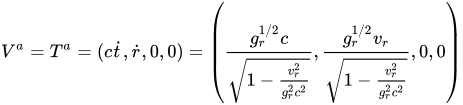
Where the dot indicates the derivative with respect to the proper time of the particle:

The forces per unit of mass within the solid due to the tide forces will not be equal in all directions. The forces on a plane that passes through the center of gravity of the body whose normal vector is given by are given by:


Calculating the non-nut components of the Riemann tensor and bearing in mind that the separation vector is space , assuming without loss of generality that the body is on the equatorial plane, is reached to:

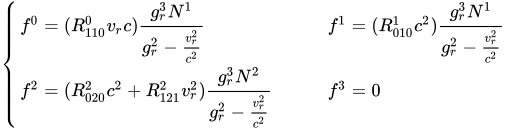
The non-zero components of the tensor that appear in the previous expressions are:

If we now consider two point particles that fall from rest and from the same height converging to the center of the earth, they will undergo a relative approach, which will be seen as an effective tidal force whose value at the initial instant is:

Contenido relacionado
Addendum:1 E7 s
Preorder Sets Category
(1877) Marsden