
Theodolite

.jpg)
The theodolite is a mechanical-optical measuring instrument that is used to obtain vertical and horizontal angles, in most cases, an area in which it has high precision. With other auxiliary tools you can measure distances and differences in level. It is portable and manual; It is made for topographical and engineering purposes, especially for triangulations. With the help of a scope and through tachymetry, you can measure distances. A more modern and sophisticated equipment is the electronic theodolite, and another more sophisticated instrument is another type of theodolite better known as a total station.
Basically, the current theodolite is a telescope mounted on a tripod and with two graduated circles, one vertical and one horizontal, with which the angles are measured with the help of lenses.
The theodolite is also a very easy tool to transport. That is why it is a tool that has many guarantees and advantages in its use. It is its precision in the field that makes it important and necessary for construction.
Classification

Theodolites are classified as repeater, repeater, compass and electronic theodolites.
Repeater theodolites
These have been manufactured for the accumulation of successive measurements of the same horizontal angle on the limb, thus being able to divide the accumulated angle and the number of measurements seen.
Reiterating theodolites
Also called directional, reiterating theodolites have the particularity of having a fixed limb and only the alidade can move.
Theodolite-compass
As its name says, it has a built-in compass with special features. This has a magnetic compass with the same direction to the horizontal circle on the diameter 0 to 180 degrees of great precision.
Electronic theodolite
It is the version of the optical theodolite, with the incorporation of electronics to take readings of the vertical and horizontal circle, showing the angles on a screen, eliminating errors of appreciation. It is simpler to use and because it requires fewer parts, it is simpler to manufacture and in some cases to calibrate.
The main characteristics that must be observed to compare these devices are: precision, the number of magnifications in the objective lens and whether or not it has an electronic compensator.
Axles

The teodolito has three main axes and two secondary axes.
Main axes
- Vertical Axis of Instrumental Rotation S - S (EVRI)
- Horizontal Axis of Anteojo Rotation K (EHRA)
- Optical Axis Z - Z (EO)
The Vertical Axis of Instrumental Rotation is the axis that follows the trajectory of the Zenith-Nadir, also known as the plumb line, and that marks the vertical of the place.
The optical axis is the axis where the points are focused. The principal axis is the axis where horizontal angles are measured. The axis that follows the path of the line of sight must be perpendicular to the secondary axis and this must be perpendicular to the vertical axis. The discs are fixed and the alidade is the moving part. The eclimeter is also the vertical disk.
The Horizontal Axis of Rotation of the Telescope or trunnion axis is the secondary axis of the theodolite, in which the scope moves. The trunnion axis must be measured when using direct methods, such as a measuring tape, and thus the geometric distance is obtained. If the height of the pole is measured, the elevated geometric distance will be obtained and if it is measured directly to the ground, the semi-elevated geometric distance will be obtained; Both are measured from the trunnion axis of the theodolite.
The collimation plane is a vertical plane that passes through the collimation axis, which is in the center of the device's viewfinder; is generated by rotating the target.
Secondary axles
- Line of faith
- Index line
- Vertical line
Parts
Main parts
- Levels: - The level is a small closed tube that contains a mixture of alcohol and ether and an air bubble; the tangent to the air bubble will be a horizontal plane. You can work with uncorriged levels.
- Precision: Depends on the type of theodolite used. There are from the ancients, which vary between the minute and the half minute; the modern ones, which have a precision of between 10", 6", 1" and up to 0.1".
- Spherical level: It is a cylindrical box covered by a spherical casket. The lower the less sensitive curvature radius will be; they serve to quickly obtain the horizontal plane. These levels have in the center a circle; the bubble must be placed inside the circle to find a fairly approximate horizontal plane. They have less precision than the toric levels; their accuracy is at 1' maximum, although the normal is 10 ́ or 12 ́.
- Theoretical level: If it is broken it prevents measuring. You have to fit it with the screws that the device carries. To correct the level you have to lower it a certain angle and then being in the horizontal plane with the screws you level the angle that has been determined. You can work when you are broken, but you have to change the constant that the manufacturer gives. A parallel plane is needed to work when it is broken. To measure towards the geographic north (sizes are measured; if there are no orientations) the general movement and the particular movement are used. They serve to guide the apparatus and if the acimutal is known, the directions will be known to the north.
- Plomada: It is used for the theodolito to be in the same vertical as the ground point.
- Ploma of gravity: Quite uncomfortable in its handling, it becomes little accurate especially the days of wind. It was the method used before the optical ploma appeared.
- Optical plumbing: it is the one that wears theodolites nowadays; by the eye one sees the soil and thus puts the apparatus on the same vertical as the point sought.
- Limbos: Graduated discs that allow to determine angles. They are divided from 0 to 360 degrees sexagesimales, or from 0 to 400 degrees centesimales. In vertical limbos you can see various graduations (cellular limes). Lips are graduated disks, both vertical and horizontal. Theodolites measure at normal graduation (dextrogy sense) or abnormal proficiency (levoic sense or contrary to clock needles). They measure cenital angles (cenitaldistance), slope angles (horizontal height) and nadiral angles.
- Nonius: Mechanism that allows to increase or decrease the accuracy of a limbo. They divide the n - 1 limbo divisions between the n divisions of the Norwegian. The sensitivity of the nonium is the difference between the magnitude of limbo and the magnitude of the nonium.
- Micrometer: It is the optical mechanism that allows to make the function of nonios but in a way that allows to see a series of graduations and an optical beam through mechanisms; this increases the accuracy.
Accessory Parties
- Tripods: They are used to work better; they have the same X and Y but different Z, as they have a height; the most used is the plateau. There are a few binding elements to attach the tripod to the device. Level screws move the vertical tripodsea platform.
- Pressure screw (general motion): It is the yellow-marked screw; the particular movement is fixed, which is that of the indexes, and the black disk is moved with the device. The point is sought and the pressure screw is fixed. This screw acts in a ratial way, that is to the main axis.
- Matching ring (special or slow motion): If you have to visa a far point, with the pulse you cannot; to focus the point the match screw is used. With this movement the vertical line of the filar cross is matched with the desired vertical, and it acts tangentially. The other two screws move the index and thus can be measured acimuth angles or readings with that orientation.
Theodolite movements
This instrument, previously installed on the tripod at a point on the ground called a station, makes movements along the main axes.
Movement of the alidade
This movement is carried out on the vertical axis (S-S), also present in the instruments of all theodolite generations. Allows the operator to rotate the telescope horizontally, in a range of 360.
Movement of the telescope
This movement is performed on the horizontal axis (K-K) and allows the operator to rotate from the fulcrum to the zenith, although these cases are very rare since they mostly cover an average range of 90° and another.
Fundamental construction characteristics
To carry out a good topographic survey, the following conditions must be considered:
- When the teodolito is perfectly installed in a station, the vertical axis (or main axis) (S-S) It's perfectly vertical.
- The axis of collision (Z-Z) must be perpendicular to the horizontal axis (K-K).
- The horizontal axis (K-K) must be perpendicular to the vertical axis (S-S). use of these is very important
History
Historical background
Before the theodolite, instruments such as the groma, the geometric square and the dioptra, and various other graduated circles (see circumferentor) and semicircles (see graphometer) were used to obtain measurements of vertical or horizontal angles. Over time, their functions were combined into a single instrument that could measure both angles simultaneously.
The first appearance of the word "theodolite" It is found in the topography textbook A geometric practice named Pantometria (1571) by Leonard Digges. The origin of the word is unknown. The first part of Neo-Latin theo-delitus could come from Greek θεᾶσθαι, "to contemplate or contemplate attentively" #34; The second part is often attributed to an unscholarly variation of the Greek word: δῆλος, meaning " evident" or "clear". Other Neo-Latin or Greek derivations have been suggested, as well as an English origin of "alidada".
The early precursors of the theodolite were sometimes azimuthal instruments for measuring horizontal angles, while others had an altazimuthal mount for measuring horizontal and vertical angles. Gregorius Reisch illustrated an altazimuth instrument in the appendix to his 1512 book Margarita Philosophica. Martin Waldseemüller, a surveyor and cartographer made the device in that year calling it the polimetrum. In Digges' book of 1571, the term "theodolite" was applied to an instrument for measuring horizontal angles only, but he also described an instrument that measured both altitude and azimuth, which he called a surveying instrument. Possibly the first instrument to approximate a true theodolite was the one built by Josua Habemel in 1576, complete with compass and tripod. The Cyclopaedia of 1728 compares "graphometer" with "half theodolite". Still in the 19th century, the instrument to measure only horizontal angles was called "simple theodolite" and the altazimuthal instrument, "flat theodolite".
The first instrument that combined the essential features of the modern theodolite was built in 1725 by Jonathan Sisson. This instrument had an altazimuth mount with an observation telescope. The base plate had spirit levels, compass and adjustment screws. The circles were read with a vernier scale.

The Great Theodolyte of Jesse Ramsden of 1787

An 1851 theodolito, which shows the open construction and the altitude and azimut scales that are read directly.
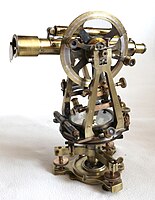
A traffic-type teodolito with six-inch circles, manufactured in Britain v. 1910 by Troughton & Simms

Theodolito Wild T2 originally designed by Heinrich Wild in 1919
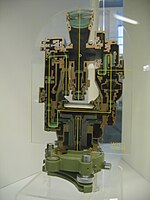
Theodolito de Wild seccionado that shows complex light paths for optical reading and closed construction


Use with weather balloons
There is a long history of using theodolites to measure winds aloft, using specially manufactured theodolites to track the horizontal and vertical angles of special weather balloons called pilot balloons. The first attempts at this were made in the early years of the 19th century, but the instruments and procedures were not fully developed until One hundred years later. This method was widely used in World War II and afterwards, and was gradually replaced by radio and GPS measurement systems from the 1980s onwards.
The pilot theodolite uses a prism to bend the optical path by 90 degrees so that the operator's eye position does not change when the elevation changes a full 180 degrees. The theodolite is usually mounted on a sturdy steel stand, configured to be level and pointing north, with the altitude and azimuth scales being zero degrees. A balloon is launched in front of the theodolite and its position is accurately tracked, usually once a minute. The balloons are carefully constructed and filled, so their rate of ascent can be known quite accurately in advance. Mathematical calculations on time, climb rate, azimuth, and angular altitude can produce good estimates of wind speed and direction at various altitudes.