
The Clover
El Trébol is a city and municipality in the department of San Martín, located in the west center of the province of Santa Fe, Argentina, 187 km from the provincial capital, 108 km from Gálvez and 157 km from the city of Rosario.
Toponymy
It was the result of the fact that the British company of FF.CC. Ferrocarril Central Argentino named three consecutive stations with symbolic plants for Great Britain: Las Rosas (in reference to England), Los Cardos ("The Thistles", for Scotland), and El Trébol ("The Clover", a symbol of Ireland). It is then, that the name of "El Trébol" the presence of immigrants of Irish origin is alluded to, and that through this nomenclature, this community tended to be honored. On the other hand, also during the construction of the railway branch from Cañada de Gómez to the "Las Yerbas" ranch, many workers whose country of origin was Ireland participated.

It is characterized by its agricultural-livestock production, being found in one of the dairy basins, in the Pampas region (the others in Rafaela (Santa Fe), and in Suipacha (Buenos Aires).
Origins and foundation
It is mentioned in the first instance, the presence of the original communities in various places, close to the current location of the town. One of the closest is the Querandíes tribe, located tens of kilometers from the place. Mention is made that in the area, due to the lack of important watercourses, it did not allow the establishment of these original communities; but with the passage of time, the expanses of the plain began to be fenced off and divided into the first estancias. Referring to these facts, a detailed investigation came to figure that in the year 1814, Agustín Rosa Mosqueda requested from the governor Eustaquio Díaz Vélez, a fraction of land located to the west of Coronda, about ten leagues, around the remembered Isleta de Martinez.
Cayetano Livi, who was in charge of this work, after his practice as a surveyor, could not determine if this person (Rosa Mosqueda) had settled in the corresponding fraction of land, but he concludes that these were done where the province of Santa Fe claimed its provincial autonomy, and the problems of limits and land spaces that corresponded to it were frequent.
In her subsequent investigation, Livi found that in 1865 there was the presence of the population of "Ventura Zuarez", a neighbor, who was dedicated to taking care of the Thomas Armstrong ranch, a site that currently remains in El Trébol district, in its northeast corner. In 1866, the state sold the land where the ranches "Los Laureles" and "Las Taperitas". In 1868, Marcelino Freyre, made the complaint through the surveyor Baltasar of his land about part of the sale of the lots that the state had sold 2 years ago. It is on this piece of land, on the southern edge of "Las Taperitas" that the new settler Chacón appears, close to the well-known lagoon "de Garro". And to mention, in 1873, Ana María Southam, together with her father Robert, traveled to their new ranch, with the purpose of knowing their future land, but at the hands of thieves, who with the idea of assaulting them, finished them off. murdering.
Among a compilation, the existence of many other residents of nearby ranches worried about the aforementioned event was made known. Subsequently, with the passage of time, the new traces of the fields and properties in the region are carried out; thus conforming the new rooms, which would give rise to the primitive community.
The Railway
Indispensable factor in the development of recently created estancias and communities, the railway contributed to the formation of numerous populated centers and agricultural colonies in the province and in the country. When the construction of a railway branch that linked the cities of Rosario and Córdoba was enjoyed in the 1860s; a new idea came to the surface: the construction of the laying of tracks that starting from the Rosario branch to the Mediterranean capital, would run through the western sectors of the province, in the Iriondo and San Gerónimo departments, which are currently divided into Iriondo and Belgrano for the first, and in San Gerónimo and San Martín for the second. On July 7, 1886, the Hume brothers obtained permission to carry out their construction project for the branch line. But this company would be affected by the influence of the Argentine Central Railway, winner of the tender for the union between Rosario and Córdoba; Therefore, on September 23, 1886, President Julio Roca signed in favor of the Argentine Central, taking into account the aforementioned work. In the end, after an in-depth debate, the company Central Argentino was authorized to carry out the work. On January 11, 1890, the inauguration of the second section of the branch "a Las Yerbas" was opened, by means of the decree signed by President Juárez Celman. On January 15, 1890, he arrived at the "El Trébol" the first locomotive, on its maiden voyage, this date would become the one considered as the foundation, entertaining all the surrounding communities. With this, immigration is brought along, which for a few years ago, was favored by the Nation and the provincial government itself. Within the framework of the immigration that successively occurred in the years that followed, the main nationalities of the people who decided to inhabit these lands were Italian, Spanish, German, English, Yugoslav, Polish, French, Russian, Syrian-Lebanese, Jews, among the most important in terms of numbers.
The towns
The conformation of the current city of El Trébol, is somewhat different from many of the entire Argentine Republic; since it does not result from the foundation of a single urban entity, but from the sum of 3 towns that united by provincial Resolution allowed the union of both in a single urban entity.
Eduardo Passo, in his position as representative of the ranch "Las Taperitas", formed in the year 1889 what he will call the town "Passo", whose distribution affects the shape of a triangle of 141 blocks, divided into 40 and 101 by the train tracks. The surveyor Mateo Luis Graham projected the subdivision in March 1889, foreseeing a plaza on both sides of the road, with sites for a church and a school in one case; and peace court and police station on the other.
José Tais, vice president of the San Jorge Development Commission, Italian by birth, imagined an agricultural colony around the station "El Trébol" and its corresponding urban subdivision. From the hands of Emeterio Cámara, Tais, who had configured special powers, the request for approval was carried out on May 28, 1894. At that time, the El Trébol Development Commission had already been configured. José Tais, in a later document, on the basis of tax exemption, claims to have created the colony and town "Tais" in mid-1893. The Plaza where the S.A.M.Co. local, and the church in its vicinity. In 1898, Tais carried out the auctions of the lots.
On December 15, 1894, on behalf of Emeterio Cámara, as representative of The Argentine Land and Investment Co. Ltd., the petition for approval of the urban layout of the town "El Trébol&# 3. 4;. The square was foreseen in the current grounds of Club Atlético Trebolense; the graveyard at the location you are currently at. The hospital was planned next to the lazaretto in the same block as the cemetery, an issue addressed and configured to remove the latter, and take them to more distant areas than what was intended. In those times, the existence of general business businesses was distributed along a large part of the route of "El Trébol", which at that time ran from Tucumán street to Río Negro, and from Las Taperitas ranch, to Calle Sancti Spiritu.
On April 30, 1897, the Development Commission decided to open the way for a new road, which would serve as a union for the towns of "El Trébol" and "Tais", to favor the pace of travel to the railway station. Due to the disagreement of José Tais, to open this new trace, which would settle on his fields, he had to be pressured with the declaration "of public interest"; to carry out the assigned work.
Subsequently, in 1905, sales of land to the north of Río Negro street began; and in 1912, Victorio De Lorenzi and Marcos de la Torre, asked the provincial government for the first expansion of the town "El Trébol" to the
west of Bd. Unión (today continuation Bv. América), and Bishop Boneo decides the location of the new Church, acquiring in 1922 the block of the new public square.
In 1931, Lorenzo de la Torre, on behalf of his father Marcos, placed a new request for the second expansion, this time to the east of the boulevard, towards the tracks. The plane corresponded to Benno Schnack.

And in the 1970s, with the opening of new streets, to the west of the Tais town, where the Bus Terminal buildings are currently located, the task of uniting the Passo-Tais towns was completed - El Trébol, which back in 1894 was undertaken with the unification at the governmental level from the province of these communities in the single Commission for the Development of El Trébol. Boulevard Unión ended up taking the name of América, in quality of its continuity as an artery of the urban plant. The completion of these expansion works facilitated the new location of public buildings, to be common to the 3 original communities.
Tourism
- Provincial Feast of the Older, 2nd fortnight of September, organizes: City of El Trébol.
- National Festival of the Ordeñadora, 15th of November, organizes: Club Atlético Trebolense and Municipalidad.
- Fiesta del resero, May 1, organizes: Traditionalist Center "Potros y Lanzas".
- Carnivals of El Trébol, second week of February 2013 generally as this year, 13, 14, and 15 February, organizes: Municipality of El Trébol.
Towns and places in the municipality
- Trébol: 16,000 inhabitants (Indec, 2010) approximately
- Paras
- Barrio Sud
- Ghiano Field
- Camp Ulla
- The Taperitas
- Campo Riberi
City Neighborhoods
The neighborhoods of the city of El Trébol are made up of the towns that were originally founded at the end of the 19th century. When the towns were founded, in their first years of life, they were called "towns", because in reality they were just that, towns. Towns, communities developed preferentially around railway stations, or rather, agricultural colonies. Today, it is common to speak of "neighborhoods" to name conglomerates of housing buildings, developed under national, provincial and municipal programs; or even those of similar styles, located close to each other or that are part of the lives of many people, who always live in those places all their lives or most of it. Currently three neighborhoods can be named, which are based on the foundations of the original peoples:
- Tais Neighborhood: it sits on the primitive Tais village, which was founded by José Tais, around the station "El Trébol"; it extends from Elisa Damiano Street, to Sarmiento Avenue (south to north), and from Patricios Street, to Bartolomé Mitre (south to west), although it can be accepted that it arrives to the provincial route No. 13, in the vicinity of Estabustion.
- Barrio Trebolense: better known as "El Trébol", the custom is to associate it with the Club Atlético Trebolense, which is located in the center of the same, but in reality it owes its name to the primitive village El Trébol, which conforms the Argentine Land and Investment Company (The Argentine Land and Investment Co. Ltd.) of the hands of its seized Emeterio Cámara.
This neighborhood extends from RP 13, to the intersection of Boulevard América with the beginning of Avenida Libertad, in Elisa Damiano street (south to north); and from the tracks of the General Bartolomé Miter Railroad, to RP 13 (east to west).
- Barrio Passo: the neighborhood located more north of the city of El Trébol, is located on the origins of the village Passo, founded in 1889 by Dr. Eduardo Passo on the side of his stay "Las Taperitas". It has a distinctive triangular shape, ranging from Avenida Sarmiento to the South, to Calle Viena and Aconcagua in the North (Establishment Club de Polo La Albertina); and from Avenida Sarmiento to the continuation of Mariano Moreno Street, west of RP 13.
Historically, the Passo neighborhood is divided into 2 sections, by the railroad tracks; and its name "Pueblo Passo" has lasted to the present.
In addition, the neighborhoods that are named daily in the city, as explained before, are housing nuclei that are part of a historical and cultural moment for the families that inhabit them. For this reason, we can say that the neighborhoods that we usually call, just to mention a few: Guadalupe neighborhood, San Antonio neighborhood, San Cayetano neighborhood, tend to be sub-neighborhoods, since all of them together make up the traditional neighborhoods in which this city is formed.
Urban fabric
Currently made up of around 500 blocks, the urban development of El Trébol is extending northward, parallel to the tracks of the Central Argentine Railroad, and until a few years ago, the urban influence extended from the tracks themselves, towards the west, until running into RP 13. This aspect continues to be evident even today; but due to the multiple housing needs, added to the population increase that began to occur years ago, they formulated the need to start occupying land in the northern zone, which until then had been half populated.

The growth of El Trébol was not developed through a strategic plan, nor through an established order; leading this to be able to appreciate scattered housing nuclei in the center of the city. The initial urban plans showed mainly in Tais, the proximity to the railway station, where numerous commercial establishments would originally be installed, so then the first businesses began to be built around Avenida Libertad, Avenida Independencia, and streets such as Roma, Colón, Bruselas, Bern, and London, lastly being the other main street of the Tais town, Boulevard Victoria (today Eva Perón). While the El Trébol town, formed 500 meters from the beginning of the Tais town, was mainly influenced by The Argentine Land and Investment Co. Ltd., the company that allowed its development, and who had founded it. Thus it is highlighted then, that these 2 towns had a wide commerce, since in El Trébol town, the presence of numerous shops, restaurants, cafes, general branches, pharmacies, among others, showed as proof of its rapid demographic and economic growth; mainly given this, in its main street: Boulevard América.
After the opening of Boulevard Unión (today the continuation of América) the new location of public buildings and other businesses of interest was allowed. Those events that occurred in the early days of the urban fabric of the city framed the desire for a prosperous community. Today, the city is very vast, and it has grown too much. The Bvd. America is the meeting place for many people, who day by day travel this avenue full of cars, motorcycles, bicycles, trucks, vans, carrying out their daily tasks. It represents the axis of the local economy and commerce. Its continuation in the Tais neighborhood, Avenida Libertad, concentrates from now on, other businesses being, up to Bvd. Eva Perón 2 blocks very busy by the local and regional automotive park. The recent inauguration of the Community Civic Center, close to the Municipal Building, provided that all matters related to various public matters would be concentrated in the same area. And so, with the demographic and automotive explosion witnessed, the constant use of secondary streets is notable today. Accesses such as J. F. Seguí, Santa Fe, Viena, Bvd. Eva Perón, Río Negro, take views of a community in progress, places where businesses of various fields are installed, but also where numerous companies related to the local industry are located.

The presence of industries within the urban commons, the constant vehicular traffic, and other peculiarities, has made the Executive take action on the matter, presenting an ambitious urban reorganization plan, which aims to raise current awareness of the excessive flow of traffic that is in the central-commercial zone of this city. "El Trébol Siglo XXI" is the project launched to the community, in order to eradicate industries from the urban environment, and be transferred to the new Official Industrial Development Area, located 3 km from the town, a 10-hectare property that, when fully operational, will provide that the danger of having industries within the urban radius ceases. The vehicular traffic corresponding to this economic item would not be present on the streets, reducing its amount of danger. For its part, this aforementioned strategic plan would impose the enhancement of the entire local downtown area, renovating the entire Boulevard América, from Córdoba street (in front of Club Atlético Trebolense) to the intersection with Elisa Damiano streets and Estanislao López avenue; and to Libertad Avenue, from the last mentioned, to Malvinas Argentinas street. If carried out, it would be contemplating a new vehicular order of importance, since the area is continuously used by high school students, thus also forcing vehicular chaos at peak hours.
This plan also provides for the rearrangement of accesses, as previously mentioned J. F. Seguí, Bv. Europe, Santa Fe, Rio Negro, Bv. Eva Perón and Viena, and secondary streets such as Candiotti, which showed signs of deterioration in some cases, and in others the need to provide them with proper and measured use. The General San Martín public square is located 1 block from the city center, which is why it has been separated from commercial life, but it is also intended to give it the characteristic as a center of interest for the entire community. The installation of Edificios Jardín I and II, gave the architectural touch to all the space around it, along with the Catholic Church, inaugurated in the 1940s.
Currently, architectural works are also being carried out in the center of the same city, remodeling of some old buildings, others are being carried out; but a work of architectural impact in the center, is the current construction of a tower of more than 10 floors, in the middle of the commercial center, a good housing and business opportunity on its ground floor. Towards the outskirts, close to the highway, the new architectural boom is based on the construction of numerous luxury residential neighborhoods, which establishes its own characteristics, combining with the architectural culture of previously built short, medium and long-term homes.
This makes us see, then, an important demographic boom, but at the same time, a community that is committed to its development and its well-being; and with the idea of giving a new face to the city.-
Government
On January 15, 1890, the first locomotive bringing immigrants from the city of Rosario and Cañada de Gómez arrived at the "El Trébol" railway station. These people joined another group of those considered the first inhabitants of the primitive town. Some time ago, in 1889, Dr. Eduardo Passo, great-nephew of Juan José Passo, founded his town on one side of the "Las Taperitas" ranch. In the 1890s, the company The Argentine Land and Investment Co. Ltd. formed the town "El Trébol" and the first stays that would integrate the colony. In 1894, the Italian José Tais achieved the approval of his people around the railway station & # 34; El Trébol & # 34;. Thus it happens that in the same district, there were 3 towns, practically one followed by the other; except for the situation between Tais and El Trébol, about 500 meters from the field. The provincial government suggested after this event, through a resolution, the existence of a Development Commission in the town of El Trébol, and that both Passo and Tais would remain under its administration. The resolution was issued by decree in May 1894. From here, political life in El Trébol was born, these are the beginnings of our community's own government.
Municipality- Municipal Mayors
On December 11, 1985, he assumed the municipal leadership, being the former president of the Municipal Accountant Ángel M. Rossi, the new Mayor. 1985-2005: Accountant Ángel M. Rossi; 2005-2021-: Professor Fernando Emilio Almada. On December 10, 2021, the first woman assumes office as Municipal Mayor Dr. Natalia Paola Sánchez.
Education
There are 9 primary schools, spread over different areas of the town; of which three are rural, and one for adults who have not completed their primary studies. For its part, it also has 3 secondary schools, one of which is for adults who have not completed their secondary studies. In turn, we have a school for children with different disabilities, a nursery and kindergarten, and a sports center. They are:
- Service: Family Action Center (C. A. F.) No. 17 "Estrellita"
- Infant Garden N° 90 "Dulce of Milk"
- Primary: Esc. N° 274 "F.N. Laprida"; Esc. No. 978 "Cincuentenario de El Trébol"; Esc. N° 275 "M. Belgrano"; Esc. N° 276 "J.J. Passo"; Esc. Educ workshop. Manual No. 51 "Gral. Bme. Mitre"; Esc. C. E. R. N° 265 "Campo Riberi"; Esc. C. E. R. No. 263 "Campo Ulla"; Esc. C. E. R. No. 262 "Campo Ghiano"; Esc. Primary p/ adults No. 11 "J. B. Alberdi"
- Secondary: School of Professional Technical Education No. 343 "M.M. de Güemes"(director: Jorge A. Rojas); Middle Education School No. 210 "José Ingenieros"; Middle School of Education p/ Adults No. 1047
- Tertiaries: Higher Institute No. 23 "Elisa Damiano"
- Different capacities: Special Education School No. 43 "Emilia Bertolé"
- Sports: Physical Education Center No. 41
Sporty
There are two clubs that are dedicated to providing sports classes for their members. One of them is Club Atlético Trebolense M. S. y B.; and the other is Club Atlético El Expreso M y S. One of the sports that attracts the most fans is soccer. Both clubs have their corresponding soccer team; all divisions participate in the San Martín Departmental Soccer League.
- Club Atlético Trebolense M. S and B.: founded on August 1, 1909 (113 years), is the oldest sports club in the city, which to date exists. Created with the particularity of promoting football sport, its first founding members were: L. Mattei, T. Leiva, D. Crisci, Dr. José I. Llobet, B. Broardo, C. de las Casas, L. Pascal, J. Massa, G. Heine, J. R. González, A. Mattei, C. Arias, S. Combina, B. Giecco, J. S. Broardo, A. de las Casas, P. Casañas, J. Peiretti, J. Leguizamón, E. Risso Patrón, and L.
 Club Atlético Trebolense

The foundation of said club was made at the home of Mr. Celestino Cassone on August 1, 1909; and legitimized by Act on October 24 of the same year, at the home of Dr. José Llobet. In general, the main idea was to form a soccer team, which is a club designed to promote this sport. Today, the reality is very different, with the passage of time, many more sports were added, and others disappeared, but remaining as part of the history of this ancient institution, which celebrated its Centennial Party on Saturday, August 1, 2009, in an unforgettable party.
Currently, Club Atlético Trebolense has its facilities in the place where the public square of the El Trébol town was going to be built. Thus in more, a course on route 13, heading to Los Cardos, where the Trebolense Golf activities take place. El Celeste y Blanco, due to the colors of its insignia, where at some time close to its foundation they were green and white, carries out a total of 23 disciplines, which are: basketball, bowls, vacation camp, DEFYDA, training school, children's soccer, senior soccer, senior soccer, futsal, artistic gymnastics, ladies' gymnastics, gymnastics for seniors, golf, nursery for children, hockey, karate do, swimming, paddle tennis, skate, weights, tennis, rugby, and volleyball.
In turn, it also has a Mutual Association, located at Bv. América, which provides economic assistance to all the Institution's partners; also having its own Library, which bears the name of "Dr. Jose Llobet". Also within this space, the Social Headquarters building, where the restaurant and bar are located; an indoor amusement park for the kids, and to enjoy good times outdoors. It also has a beach volleyball court, where several times in summer a tournament is played in the afternoon. And it appears in its internal landscape, the hostel for athletes who travel from distant places to develop their competition, and changing rooms and bathrooms on the ground floor. Today Club Atlético Trebolense M. S. y B., bets to continue growing and promoting for its members, a space of comfort and to enjoy each of its facilities, such as the Tennis Ranch, and the Paddle Ranch, and the availability of grills in the Park, to enjoy rich roasts and meals that you wish to take away. For its part, it was intended to guarantee personal safety by greatly improving the main entrance, reducing the prevailing danger. Every 2 years, on the other hand, it is the headquarters of the National Festival of the Milking Machine, which is carried out jointly with the Municipality of El Trébol, where a parade of Queens from various institutions is present through the streets of the city.-
- Club Atlético El Expreso M. y S.: starts in 1938 when a group of young people among those who were Juan Brussino, José Castello, Andrés Garassino, Luis Mangialardi, José Bonetto, Horacio Corvalán, Carlos Sidler, among others, meet to form a neighborhood club, to contest tournaments that will take place in the town. They called it "The Express." Then, on September 27, 1941, when several people gather at José Rasero's house, the Institution is formed thus giving its birth, by incorporating the basketball as the following discipline to be performed, apart from football.
 Club Atletico El Expreso M. y S

Some time later, they merged with Club de Bochas El Trébol, with great bochófila activity, as a result of an agreement between people from both institutions, on September 16, 1946; thus formalizing, that September 9 is taken as the start date of the entity. On October 8, 1956, El Expreso received as a donation from the firm V. and E. De Lorenzi, 4 hectares for the development of the sports activities of this organization; Being on October 31 of that same year, in an assembly, it was decided to rename the club under the old name of Club Atlético El Expreso.
Currently it has several sports disciplines developing its activities in the sports field located on Patricios street, and others in the gym located on the corner of Boulevard Eva Perón and Cristóbal Colón. The colors adopted by this club are green and white.-
These institutions each have a soccer team that participates in the Departmental League Tournament, facing off at least twice a year in the traditional "Superclásico" local, an event of great relevance at the zonal level.
- Club San Lorenzo: In addition, in the summer there is a night tournament in a court called "Club San Lorenzo" which is located next to the church.
 Club San Lorenzo

This club was founded on July 17, 1956, by the then parish priest Arturo Tibaldo, who was a soccer fan; and he decides to carry out this institution together with a group of local youth. A sports field was developed on the north side of the Catholic Church, proposing the name of "San Lorenzo", in homage to the local Patron Saint. From then on, on December 12, 1961, the first night soccer championship began at its facilities. Uninterruptedly, until now, every year end, the aforementioned tournament begins. - -In 2006, the traveling clover chess club was created. Being itinerant, the discipline was established in different parts of the city (currently: School No. 978 fiftieth anniversary, municipal NAC, municipal SUM)
Twinnings
Twinnings have developed between this community with respect to the rest, generally based on the fact that the first inhabitants were originally from those lands.
 Brotherhood with Italy
 Villafranca Piamonte, Italy. The town of Villafranca, located in the Piedmont region, Italy, is one of them. The majority of the current population of El Trébol originates in Italian families, many of these Italian families were piamontesas, and several of them came from the town of Villafranca and around.


- Barge, Italy. For its part, the town of Barge, in Cuneo, Italy, also represents the origin of many ancestors of the current inhabitants of the city of El Trébol.
In the case of Villafranca, the twinning was produced by Municipal Ordinance No. 210, dated 09/02/1993; while that of Barge, through Ordinance No. 173, dated 12/17/1991.
 Brotherhood with São Pedro, Brazil.
 São Pedro, Brazil. A special case, which no longer has to do with the origins of the population, but more represented this with an event in the city of São Pedro, Brazil, occurred when a group of athletes from El Trébol participated in an International Encounter of Voley, disputed in this Brazilian city.


For this reason, on 06/27/1988, through Municipal Ordinance No. 71, the Twinning between the city of El Trébol and the city of São Pedro, Brazil, was resolved on the occasion of the 2nd International Meeting Volleyball in our community.
On Monday, April 5, 2010, on the occasion of the celebrations of the Bicentennial of the Argentine Nation 1810-2010, the Fanfara Alpina Congedati Cadore from Italy attended the Cervantes Theater in El Trébol, with a massive show that left everyone amazed.
Local symbols
Throughout the urban plan of the city there are various elements that constitute symbols through which the town is recognized in the region and in the country.
- Monument to Immigrants: carried out as a work within the framework of the celebrations for the 50th anniversary of the foundation of the town, and also called to the Colonization, is located at the intersection of the streets Rosario and Bv. America, in front of the Municipal Building of El Trébol. The same was designed by the renowned local artist Elisa Damiano and in 1941 it was inaugurated (in contrast to 1940) in a joint act with the new Municipal Building (in that time, even Communal), the new Catholic Church, and the modernization carried out in the Plaza San Martín. It is a work with 5 figures once and a half of the natural size; explicitly modeled by it for the fiftieth anniversary of its people. Nowadays, the Colonization Monument is one of the most regionally recognized emblems as a local cultural symbol, forming an imposing image in the center of the main street of this city, reminding all its inhabitants when passing by, where their roots come from, and how the town in which they live was gested.
 Monument to Immigrants, by the artist Elisa Damiano
 - The clover: to name certain railway stations, the name "El Trébol" refers to the homonymous plant, a cultural-historic symbol of Ireland. The reason was to recognize the Irish population in the region, but also as the construction company of the railway branches was English, the community was taken into account that until then it was still part of the United Kingdom. Today it is a well-known and scattered plant, and it can be found in many parts of the town, thus reminding its inhabitants that the "symbol of the 4-leaf horse plant" present on its soil, to which the ancient visionaries decided to name it with such name, to forge in those lands the well-deserved luck for the future settlers who arrived to formalize a better life for them and their offspring.
- March to El Trébol, City: in order to know the news of the declaration of "El Trébol Ciudad", is that the Ing. Heriberto Maurino wrote the lyrics of the song, and the music corresponded to the renowned local musician, Orlando Avalle.
- Arc of income and Bv egress. Eva Perón: one of the main covers, plus this to say that the most recognized, is access by the Bv. Eva Perón, whose arc of welcome and farewell, contains at its maximum height a leaf of night-lit clover, expressing allusion to the name of the town.
 Arc of income and Bv egress. Eva Perón
 - Railway Station "El Trébol"- Municipal Museum: the building of the old railway station, now converted to the headquarters of the Municipal Museum of the City of El Trébol, is one of the oldest symbols of our community, as it is the oldest building still standing; and it creates a unique cultural heritage for this whole society. This is the point of origin of this whole community, from which the peoples were given life around it and the surrounding fields and estancias. Today the old station is a sign, a historic icon of great value and must be preserved as such for future generations as the origin of the entire city of El Trébol and its rural area.
- Parish "San Lorenzo Mártir": the new Church of "San Lorenzo Mártir", inaugurated for the celebrations of the 50 years of El Trébol, after the previous church was found in a place far away for much of the community, is today one of the buildings, or we can say, the greatest monumental work of the last 60 years that has been built so far. Its impressive 65 meters high approximately make it look, especially at night, at a distance of more than 10 km to the round, constituating it as one of the most imposing and most admired local symbols by visitors and foreigners.
 Parish "San Lorenzo Mártir"
 - Income arch and exit access J. F. I followed: of the other most frequented accesses, and one of the 2 in the southern part of the city, is that of J. F. Seguí street, where in its intersection with RP 13, and at the vera of it, it rose to commemorate the 75th anniversary of the founding of the town, a monument made by Rotary Club El Trébol, symbolizing literally the portar a great torch. Since the image has a characteristic in a certain abstract way, it gives rise to certain interpretations, but one of them is the aforementioned torch that evokes a great victory, a triumph of the entire community when commemorating its 75 years of life.
 Income arch and exit access J. F. I followed. It commemorates the 75th anniversary of the city, symbolizing a great torch, as a symbol of a great victory of the community, for its progress and evolution.
 - Municipal Flag: the municipal flag represents the community of El Trébol, and is formed by a white rectangle, with the municipal shield that is observed in the section "Gobierno". To receive the year 2000, a multitude of people from various institutions, and from the hands of athletes from the clubs Trebolense and El Expreso, a gigantic 8 m wide flag for approximately 15 m, paraded by the Bv. America to its confluence with Avenida Libertad and Avenida Brigadier E. López, where on a side of the Ecological Park, an imposing mast of almost 30 meters high would await the time to moor the strings of the flag, and hover the cloth to its maximum height, so that the inhabitants of the city would remember a symbol that identifies them completely in the region.
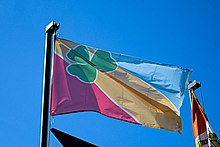 Municipal flag representing the community of El Trébol.
 - Monument to Workers and Workers: represents the importance of workers and women workers and their contributions to society. It is composed by a votive flame, the Trébol, a hexagon on the ground, a lawn space and three marble sculptures.
 Monument to workers and workers


News
Currently the city of El Trébol is one of the most beautiful cities in the entire region, every year it organizes a national and international exhibition of sculptors which brings together a large number of people at a regional, national and international level. It also has Regional Carnivals with great shows and famous groups of singers and bands.

Place of Memory
In 2011 the "Place of Memory for Truth and Justice" was inaugurated, to evoke the El Trébol activists murdered by the dictatorship: Alicia Raquel Burdisso Rolotti and Carlos Bosso Rovito, the latter together to his wife Isabel Salinas de Bosso. Later, the memory of Luis Alberto Tealdi, dairy unionist from El Trébol, prominent athlete and manager of Club Atlético El Expreso, was included. Tealdi, who was also a director of the local hospital, was kidnapped and disappeared in 1977 in Campana, where he worked as a metal worker in a Techint group company.
Parishes of the Catholic Church in El Trébol
| Archdiocese | Santa Fe de la Vera Cruz |
|---|---|
| Parish | San Lorenzo Mártir |
Contenido relacionado
Humanes of Madrid
Annex: Municipalities of the province of Huesca
Valdunciel Causeway