
Symbiodinium

Symbiodinium is a genus of unicellular dinoflagellate algae in the family Symbiodiniaceae, order Suessiales, and class Dinophyceae.
They can commonly be called zooxanthellae, from the Latin Zooxanthellae, meaning "little yellow animals", in reference to their golden-brown color. the presence of this microalga in free life in the ocean and in intracellular symbiotic relationships with corals, anemones, jellyfish, zoanthariums, nudibranchs, ciliophora, foraminifera and sponges or extracellular symbiosis with giant clams. Nowadays, this varies since under advances in molecular, morphological, physiological and ecological studies it has been proposed that the evolutionary divergence between the organisms that were considered Symbiodinium are sufficient for them to be considered as different genera. In such a way that what was previously defined as Symbiodinium today can vary in different clades of the Symbiodiniaceae family where Symbiodinium would be used exclusively for clade A.
Algae-coral relationship
Although there are corals that do not form a symbiotic relationship with these algae (such as deep-sea reef corals), the vast majority do. At the beginning of a coral-algal symbiotic relationship, these algae are generally integrated by coral nutrition mechanisms where they are detected and internalized. Corals are sessile organisms and thus manage to receive photosynthetic products from algae constantly while the algae receive nitrogen and phosphorous compounds from the coral. The population size of these organisms in the host tissues is limited by the amount of nutrients and light it receives, as well as the expulsion of excess cells. The breakdown of the coral-algae relationship is called bleaching, and in this occurs an abrupt decrease in the algae population within the tissue or an abrupt decrease in the pigment they contain. After bleaching, a coral can be reinfected by zooxanthellae and if it does not, it may be in danger of losing tissue, the ability to reproduce, or even death.
Ecology
The distributions of Symbiodinium species comprise different ecological guilds in a coral reef ecosystem.
A: Cnidarian hosts can expel millions of symbiotic cells (viable and necrotic) into the surrounding environment (a). In turn, these animals pass large amounts of water through their gastrovascular system, both for respiration and for the elimination of waste, a process that introduces numerous small particles, including food and other species of Symbiodinium (indicated by color differences in cells) (b).
B: The ecological niche, from the functional point of view of the groups, differs between Symbiodinium species. Several ecological guilds exist, including abundant species of specific hosts and generalist hosts (1), low-bottom and potentially opportunistic species (2), and non-symbiotic species closely related to the coral biome (3) and/or occupying unassociated habitats (4).
Symbiodinium are crucial species for coral reefs, as their impact on the community is extremely large relative to their fraction of the total community biomass. Hermatypic corals, those that build reefs with their skeletons, have Symbiodinium species, and are largely dependent on them, thus limiting their growth to the photic zone of the reef. This symbiotic relationship is probably responsible for the great success of corals as reef-building organisms in tropical waters. Therefore, it is also key to the survival of most coral species, and, consequently, of the reefs themselves. In fact, the increase in ocean water temperatures, produced by global climate change and phenomena such as El Niño, cause stress in the host animals that house Symbiodinium, with massive abandonment. of these from animal tissues, which is known as bleaching in the case of corals, and, the death of these, in many cases.

Pocillopora sp alive
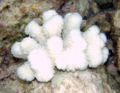
Pocillopora sp affected by laundering, without Symbiodinium
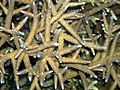
Cologne Acropora cervicornis healthy. Only growth tips are white
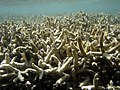
Cologne Acropora cervicornis at Reunion. The white branches have lost their Symbiodinium


Apart from "hard corals" of the order Scleractinia, also the "soft corals" of the order Alcyonacea and part of the gorgonians, obtain a large part of their nutrients from the symbiotic relationship with Symbiodinium species. Other organisms that may contain Symbiodinium include sponges, jellyfish, bivalve molluscs, "worms" marines and some protists, among others.
Species
The World Register of Marine Species accepts the following species in the genus:
The World Register of Marine Species accepts the following species in the genus:
- Symbiodinium bermudense R.K.Trench, 1993
- Symbiodinium californium A.T.Banaszak, R. Churches-Prieto & R.K.Trench, 1993
- Symbiodinium cariborum R.K.Trench, 1993
- Symbiodinium corculorum R.K.Trench, 1993
- Symbiodinium goreaui Trench & Blank, 2000
- Symbiodinium kawagutii Trench & Blank, 2000
- Symbiodinium meandrinae R.K.Trench, 1993
- Symbiodinium microadriaticum Freudenthal, 1962
- Symbiodinium minutum T.C.LaJeunesse, J.E. Parkinson & J.D.Reimer, 2012
- Symbiodinium pilosum Trench & Blank, 2000
- Symbiodinium psygmophilum LaJeunesse, T.C., Parkinson, J.E. & Reimer, J.D., 2012
- Symbiodinium pulchrorum R.K.Trench, 1993