
Stefan–Boltzmann law



The Stefan-Boltzmann law establishes that a black body emits thermal radiation with a total hemispherical emissive power proportional to the fourth power of its temperature.
The law is very precise only for ideal black objects, the perfect radiators, called black bodies; works as a good approximation for most greybodies.
History
The law was deduced in 1879 by the Austrian physicist Jožef Stefan (1835-1893) based on experimental measurements made by the Irish physicist John Tyndall. Stefan published this law in the article “Über die Beziehung zwischen der Wärmestrahlung und der Temperatur” (On the relationship between thermal radiation and temperature) in the Bulletin of the sessions of the Vienna Academy of Sciences.
The law was derived in 1884 from theoretical considerations by Ludwig Boltzmann (1844-1906) using thermodynamics. Boltzmann considered a certain ideal heat engine with light as the energy source instead of gas.
Symbols
| Symbol | Name | Value | Unit |
|---|---|---|---|
| E{displaystyle E} | Total hemispheric emissive power | W / m2 | |
| Te{displaystyle T_{e} | Effective temperature (absolute surface temperature) | K | |
| ε ε {displaystyle varepsilon } | Emissiveness | ||
| σ σ {displaystyle sigma } | Constant Stefan-Boltzmann | 5.67E-8 | W/(m)2 K4) |


Description
E=σ σ (Te)4{displaystyle E=sigma (T_{e})^{4}}

This emissive power of a black body (or ideal radiator) supposes an upper limit for the power emitted by real bodies.
The surface emissive power of a real surface is less than that of a black body at the same temperature and is given by:
E=ε ε σ σ (Te)4{displaystyle E=varepsilon sigma (T_{e})^{4}}}
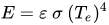
whereε ε {displaystyle varepsilon }) is a radioactive property of the surface called emissivity. With values in the range (0 ≤ ε ≤ 1), this property is the relationship between radiation emitted by a real surface and that emitted by the Black body at the same temperature. This depends markedly on the surface material and its finish, the wavelength, and the surface temperature.
Demo
Mathematical proof
This law is nothing more than the integration of the Planck distribution along all the wavelengths of the frequency spectrum:
| Planck Act | 2 | 3 | |
|---|---|---|---|
| Equations | q=C1λ λ 5[chuckles]e(C2λ λ T)− − 1]{displaystyle q={frac {C_{1}}{lambda ^{5 {Bigl} [e^{{Bigl (}{frac {C_{2}}}{lambda T}}{Bigr)}}}}{Bigr | C1=2π π h(c0)2{displaystyle C_{1}=2pi h (c_{0})^{2} | C2=hc0kB{displaystyle C_{2}={frac {h c_{0}}{k_{rm {b}}}}}}{frac {h c_{0}}}}}}{k_{rm {b}}}}}}}}}}{ |
| Integrating with limits | E=∫ ∫ 0∞ ∞ C1λ λ 5[chuckles]e(C2λ λ T)− − 1]dλ λ {displaystyle E=int _{0}^{infty }{frac {C_{1}}{lambda ^{5} {Bigl [}e{{Bigl (}{Bigl (}{frac {C_{2}}{lambda T}}{Bigr}}}}}}}}}}}}{ | ||
| E=[chuckles]π π 4C115(C2)4]T4{displaystyle E={Bigl}{frac {pi ^{4}{1}}{15 (C_{2})^{4}}{Bigr ]}T^{4}}}} | |||
| Replacement | E=[chuckles]π π 4(2π π h(c0)2)15((hc0)/kB)4]T4{displaystyle E={Bigl [}{frac {pi ^{4} (2pi h (c_{0})^{2})}{15(h c_{0})/k_{rm {B}}}}{4}}}}{Bigr ]}T^{4} | ||
| Simplifying | E=[chuckles]2π π 5(kB)415h3(c0)2]T4{displaystyle E={Bigl [}{frac {2pi ^{5} (k_{rm {B}}})^{4}{15 h^{3}(c_{0}){2}}}{Bigr ]}{Bigr}}}{# | ||
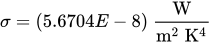
| Extracting | σ σ =[chuckles]2π π 5(kB)415h3(c0)2]{displaystyle sigma ={Bigl [}{frac {2pi ^{5} (k_{rm {B}})^{4}{15 h^{3}(c_{0})^{2}}{Bigr ]}}}}} | ||
| Evaluating | σ σ =[chuckles]2π π 5(1.380649E− − 23)415(6.62607015E− − 34)3(299792458)2]{displaystyle sigma ={Bigl [}{frac {2pi ^{5} (1.380649E-23)^{4}{15 (6.62607015E-34)^{3}(299792458)^{2}}}{Bigr ]}}}} | ||
| Operating | σ σ =(5.6704E− − 8)Wm2K4{displaystyle sigma =(5.6704E-8) {rm {frac {W}{m^{2} ♪ | ||
![{displaystyle q={frac {C_{1}}{lambda ^{5} {Bigl [}e^{{Bigl (}{frac {C_{2}}{lambda T}}{Bigr)}}-1{Bigr ]}}}}](https://wikimedia.org/api/rest_v1/media/math/render/svg/688c563951695d6bebbd591a1bb758f4be62661e)


![{displaystyle E=int _{0}^{infty }{frac {C_{1}}{lambda ^{5} {Bigl [}e^{{Bigl (}{frac {C_{2}}{lambda T}}{Bigr)}}-1{Bigr ]}}} dlambda }](https://wikimedia.org/api/rest_v1/media/math/render/svg/8b8a337e5c3b8a8b844f425c3b3e51aff17f01fe)
![{displaystyle E={Bigl [}{frac {pi ^{4} C_{1}}{15 (C_{2})^{4}}}{Bigr ]}T^{4}}](https://wikimedia.org/api/rest_v1/media/math/render/svg/6ec41cb359b1f8c547a044341e457d986efaa4f4)
![{displaystyle E={Bigl [}{frac {pi ^{4} (2pi h (c_{0})^{2})}{15 ((h c_{0})/k_{rm {B}})^{4}}}{Bigr ]}T^{4}}](https://wikimedia.org/api/rest_v1/media/math/render/svg/e55353d77efef4b9c9465765787ef647852ce8b1)
![{displaystyle E={Bigl [}{frac {2pi ^{5} (k_{rm {B}})^{4}}{15 h^{3}(c_{0})^{2}}}{Bigr ]}T^{4}}](https://wikimedia.org/api/rest_v1/media/math/render/svg/8ddbe0f5753fb599ddb54fb58cda7df48185a891)
![{displaystyle sigma ={Bigl [}{frac {2pi ^{5} (k_{rm {B}})^{4}}{15 h^{3}(c_{0})^{2}}}{Bigr ]}}](https://wikimedia.org/api/rest_v1/media/math/render/svg/fa1f603b80421c031d090f5b6cbf825828292e79)
![{displaystyle sigma ={Bigl [}{frac {2pi ^{5} (1.380649E-23)^{4}}{15 (6.62607015E-34)^{3}(299792458)^{2}}}{Bigr ]}}](https://wikimedia.org/api/rest_v1/media/math/render/svg/5b356408dda9bc8bcea6eea72f07c8dd29ad0f0b)
Leslie's Cube Experiment
The Stefan-Boltzmann law is made quite clear by the Leslie cube experiment:
In general, in the radiant emission at high temperatures, the effect of the temperature of the order of the ambient temperature at which the surrounding objects are found is neglected. However, we must bear in mind that this practice studies this law at low temperatures for which room temperature cannot be ignored. This shows that as the detector of the radiation sensor (a thermopile is not at (0 K) radiates radiant energy and an intensity proportional to this is what it measures, then if we neglect it we are falsifying the result. Its radiation can be quantified in proportional to its absolute temperature to the fourth power:
Rdet=σ σ (Tdet)4{displaystyle R_{det } =sigma (T_{det })^{4}

In this way we can know the net radiation that it measures from the voltage generated by the sensor, knowing that it is proportional to the difference in radiation between the absorbed and the emitted, that is:
Rnet=(Rrad− − Rdet)=σ σ (T4− − (Tdet)4){displaystyle R_{mathrm {net} }=(R_{mathrm {rad }}-R_{det })=sigma (T^{4}-(T_{det })}

Finally, making a series of assumptions, such as preventing the sensor from being influenced by the radiation from Leslie's cube when it is not necessary, taking measurements (we can move it away), and only then can we consider that the temperature of the detector is that of the environment. By moving it away when it is unnecessary, this hypothesis may be enough.
Examples
First determination of the Sun's temperature
Using its law Stefan determined the temperature of the Sun's surface. It took the data of Charles Soret (1854-1904) which determined that the density of the Sun's energy flow is (29 times) greater than the density of the energy flow of a thin hot metal plate. He put the metal plate at a distance from the measuring device that allowed to see it with the same angle that the Sun would look from Earth. Soret estimated that the plate temperature was approximately (1900 °C) to (2000 °C). Stefan thought that the Sun's energy flow is absorbed in part by the Earth's atmosphere, and took for the Sun's energy flow a higher value (3/2 times), namely (32)29=43,5{displaystyle {Bigl}{frac {3}{2}}{Bigr}}} 29=43.5}.
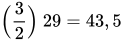
Precise measurements of atmospheric absorption were not made until 1888 and 1904. The temperature that Stefan obtained was an intermediate value of the previous ones, (1950 °C or 2223 K). Since (2.574 = 43.5), Stephan's law tells us that the temperature of the Sun is (2.57 times) greater than the temperature of a metal plate, so Stefan got a value for the temperature of the surface of the Sun of (5713 K), the modern value is (5780 K). This number was a closer approximation for the temperature of the Sun. Before this, values as small as (1800 °C) or as high as (13,000,000 °C) were obtained. The value of (1800 °C) was found by Claude Servais Mathias Pouillet (1790-1868) in 1838. If we concentrate the sunlight with a lens, we can heat a solid up to (1800 °C).,....
The temperatures and radii of the stars
The temperature of stars can be obtained by assuming that they emit radiation as a black body in a similar way than our Sun. La luminosity (L{displaystyle L}) of the star is equal to:

L=4π π (R2σ σ )T4{displaystyle L=4pi (R^{2} sigma) T^{4}

whereσ σ {displaystyle sigma }) is the constant of Stefan-Boltzmann, (R{displaystyle R}) is the star radio and (T{displaystyle T}) is the temperature of the star.


This same formula can be used to compute the approximate radius of a main sequence star and thus similar to the Sun:
RRΔ Δ ≈ ≈ (TΔ Δ T)2LLΔ Δ {displaystyle {frac {R}{R_{odot }}}}}approx left({frac {T_{odot }}{T}}}{T}}}right){2} {sqrt {frac {L}{L}{L{odot }}}}}}}}}}}}}}}}}
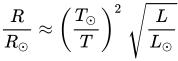
whereRΔ Δ {displaystyle R_{odot }) is the solar radio.

With Boltzmann's law, astronomers can easily infer the radii of stars. The law is also used in the thermodynamics of a black hole in the so-called Hawking radiation.
The Earth's temperature
We can calculate the temperature of the Earth (Te{displaystyle T_{e}matching the energy received from the Sun and the energy emitted by the Earth. The Sun emits an energy per unit of time and area that is proportional to the fourth power of its temperature (Ts{displaystyle T_{s}}). At the distance of the Earth (a0) (astronomical unit), this power has decreased in the relation between the surface of the Sun and the surface of a radio sphere a0. In addition, the Earth's disc intercepts that radiation but due to the rapid rotation of the Earth is the entire surface of the Earth that emits radiation at a temperature (Te{displaystyle T_{e}) with what that power is diminished in a factor 4. Therefore:

(TeTs)4=14(rsa0)2{displaystyle left({frac {T_{e}}{T_{s}}}{right)^{4={frac {1}{4}}{left({frac {r_{s}}}{a_{0}}}}}{right)^{2}}}
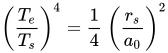
where rs{displaystyle r_{s},} It's the Sun radio. Therefore:

Te=TsrS2a0=(5780)K(696× × 106)m2(149,59787066× × 109)m=(278)K{displaystyle T_{e}=T_{s}{sqrt {frac {r_{s}}{2a_{0}}}}}=(5780) {rm {k}}}{sqrt {sqrt} {(696times 10^{6}{rm {m} {m}{2(1}{(1}}}}{(m}}}{(1}}}{cH00}}}{(1⁄2}}}{cd)}}{cd)}{cd)}}{cd)}{cd)}{cd)}{cd)}{cd)}{

The result is a temperature of (5 °C). The actual temperature is (15 °C).
Summarizing: The distance from the Sun to the Earth is (215 times) the radius of the Sun, reducing the energy per square meter by a factor that is the square of that quantity, that is to say (46 225). Taking into account that the section that interferes with the energy has an area that is (1/4) of its surface, we see that it decreases by (184,900 times). The relationship between the temperature of the Sun and the Earth is therefore (20.7), since (20.74 is 184,900 times).
This shows roughly why (T ≅ 278 K) is the temperature of our world. The slightest change in the distance from the Sun could change the Earth's average temperature.
There are two flaws in the above calculation. Part of the solar energy is reflected by the Earth, which is what is called albedo and this decreases the temperature of the Earth made by the previous calculation up to (–18 °C) and part of the energy radiated by the Earth that has a length long, between (3) and (80 microns), it is absorbed by certain gases called greenhouse effect, heating the atmosphere up to the current temperature. The so-called greenhouse effect is, then, vital for life on the planet.
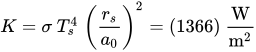
To calculate the solar constant or energy emitted by the Sun per unit of time and area at the distance from the Earth, it is enough to divide this energy by (46,225) results:
K=σ σ Ts4(rsa0)2=(1366)Wm2{displaystyle K=sigma T_{s}^{4} left({frac {r_{s}{a_{0}}}}}{2}=(1366) {rm {frac {W}{m^{2}}}}}}}}}}}
Radioactive exchanges between black bodies
The heat flux is obtained as follows:
q=AE=Aε ε σ σ (Te)4{displaystyle q=A E=A varepsilon sigma (T_{e)}^{4}

For the calculation of radioactive exchanges of two black bodies, it is necessary to affect the previous expression by the so-called form factor (F{displaystyle F}), which indicates that fraction of the total energy emitted by a surface is intercepted (absorbed, reflected or transmitted) by another surface, is a purely geometric concept. The final expression is of the form:

q(1− − 2)=A1F12σ σ (T1)4{displaystyle q_{(1-2)}=A_{1} F_{12} sigma (T_{1})^{4}}}

q(2− − 1)=A2F21σ σ (T2)4{displaystyle q_{(2-1)}=A_{2} F_{21} sigma (T_{2})^{4}}}

q12=q(1− − 2)− − q(2− − 1)=A1F12σ σ ((T1)4− − (T2)4){displaystyle q_{12}=q_{(1-2)}-q_{(2-1)}=A_{1} F_{12} sigma (T_{1})^{4}-(T_{2})^{4})}}

You have to keep in mind that it is fulfilled A1F12=A2F21♪♪

For real surfaces (with emissivity less than 1) it must be taken into account that in addition to emitting, the surface reflects energy, for this is defined (J{displaystyle J}) like radiosity, which is the sum of the energy emitted and reflected.

q(1− − 2)=A1F12J1{displaystyle q_{(1-2)}=A_{1} F_{12} J_{1}}}

q(2− − 1)=A2F21J2{displaystyle q_{(2-1)}=A_{2} F_{21} J_{2}}}}

q12=q(1− − 2)− − q(2− − 1)=A1F12(J1− − J2){displaystyle q_{12}=q_{(1-2)}-q_{(2-1)}=A_{1} F_{12} (J_{1}-J_{2})}}})}

In the particular case of a black body it is fulfilled (J=E{displaystyle J=E})

Example:
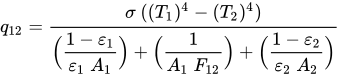
For a closed cavity composed of two real surfaces, the radioactive exchange is:
q12=σ σ ((T1)4− − (T2)4)(1− − ε ε 1ε ε 1A1)+(1A1F12)+(1− − ε ε 2ε ε 2A2){cHFFFFFF}{cH00FF00}{cH00FF00}{cHFFFF00}{cH00FF00}{cH00FF00}{cH00FF00}{cHFFFFFFFF00}{cHFFFFFF}{cH00}{cH00FFFFFF}{cH00}{cH00}{cH00}{cHFFFFFFFFFFFFFFFFFF00}{cH00}{cH00}{cH00}{cH00}{cHFFFFFFFFFFFFFFFFFFFFFFFFFFFFFFFFFFFFFFFF00}{cH00}{cH00}{cH00}{cH00}{cH00FFFFFFFFFFFFFFFFFFFFFFFFFFFFFFFF}{cH00}{cH00}{cH00}{cH00}{cH00}{cH00}{
Contenido relacionado
Calculation of water flow in pipes
Tidal force
Schottky diode