
Spanish Sahara
The Spanish Sahara or Spanish Sahara (in Arabic, الصحراء الإسبانية, al-ṣaḥrāʾ al-ʾisbānīyya) was a Spanish province and colony from 1884 until the Madrid agreements of November 14, 1975, which corresponds to the current disputed territory of Western Sahara.
Toponymy

Its name derives from the Sahara desert. From 1884 to 1958 its official name was Spanish Possessions in the Sahara. Between 1958 and 1976 it was officially called the Sahara province.
Symbols
The coat of arms of El Aaiún was created by order of October 25, 1955 Of sinople or green: the wavy band, representing water, of silver and azure; in chief, the palm tree, of its color; and, pointed, the camel's head, natural. Border, gules, four gold castles, masoned, alternating with four silver lions. That of Villa Cisneros was created on May 7, 1955. Pointed, unevenly cut, on the upper quarter, a silver swan, and on the neck, a crown on azure. In the lower one, a silver dolphin in a blue field, bordered with fifteen checkers of gold and gules, eight and seven.
- Escudos de El Aaiún y Villa Cisneros

The Aaiun Shield

Escudo de Villa Cisneros


Geography
Its territory is located in the northwestern part of the African continent, and in the area considered subtropical. The Tropic of Cancer cuts the territory at the height of Punta de la Sarga, on the Río de Oro peninsula. It bordered Morocco to the north, Algeria to the northeast, Mauritania to the east and south, and the ocean to the west. Atlantic, between the parallels 20º 45' and 27º 40' north latitude. It had an extension of 280,000 km² and its coastline, a length of 1,200 kilometers.
- Spanish Sahara

Topography of the Sahara

Arid landscape near Guerguerat
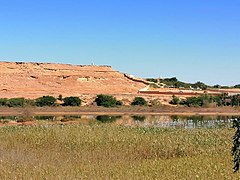
Intermittent Lake Dait Um Saad


History
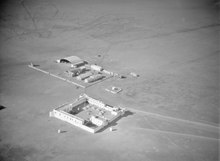
1884ː Foundation of Villa Cisneros
On October 15, 1884, the soldier Emilio Bonelli, as a representative of the Spanish Society of Africanists and Colonists and with the support of Antonio Cánovas del Castillo, undertook an expedition as a result of the fishing interests of Spain, especially the Canaries, in the area. He recognized the coast between Cape Bojador and Cape Blanco and on November 4 he founded Villa Cisneros, the first Spanish settlement in the Sahara. In addition, two more establishments were founded, one in Cabo Blanco, to which he gave the name of Medina Gatell; and another in Angra de Cintra, with the name of Puerto Badía. The place names were chosen in honor of the explorers Joaquín Gatell y Folch and Domingo Badía. Spain announced its sovereignty over the territory on December 26, 1884. Therefore, during the Berlin conference, the region located between Cape Bojador and Cape Blanco was claimed and granted to Spain in 1884.

La Güera was effectively occupied in 1920. Initially a separate colony, it was annexed to the Río de Oro in 1924. After the 1886 Adrar Expedition of Julio Cervera, Francisco Quiroga and Felipe Rizzo, Spain unsuccessfully claimed rights to the territory of Adrar, which after the Treaty of Paris came under the sovereignty of the French colony of Mauritania. In the Spanish-French agreement of 1904 both nations recognized Spanish sovereignty from the Massa River to the north and Cape Blanco to the south. In 1912 the Treaty of Fez between France and Spain recognized the limits and Spanish sovereignty of the Spanish Sahara colony, Ifni, and the Spanish protectorate of Morocco and the French sovereignty of the French protectorate of Morocco.
1938ː Foundation of El Ayoun
In 1934 Commander Antonio de Oro and Captain Galo Bullón Díaz reached the surveillance post of the Izarguien el Hamra, and in 1938 they founded the fixed military establishment of El Aaiún, which in 1940 was officially designated the capital city of Spanish Sahara to the detriment of Villa Cisneros.

1957ː Ifni-Sahara War
In 1958 the administrative system of the grouping of Spanish colonies in Spanish West Africa was abandoned. The Spanish Sahara became a Spanish province.
Until the Cintra agreements (April 2, 1958), the concrete and pragmatic limit of Western Sahara (and then Spanish Sahara) was given by the bed of the Draa river; that is to say, it included the Tarfaya strip, which at that time was handed over to the emirate of Morocco.
In 1962, the INI began prospecting in Bucraa for the exploitation of the fabulous phosphate deposit discovered in 1958 by the geologist Manuel Alía Medina. In addition, the construction of a kilometer conveyor belt was undertaken for the export of mineral by sea through the El Marsa loading dock.
In 1967 Basiri settled in Smara as a Koranic teacher, fleeing the Moroccan authorities for his Sahrawi nationalist speech in the newspaper Al-Shihab (The Torch), whose foundation had promoted. On December 11, 1969 he founded the clandestine nationalist and independence political party Advanced Organization for the Liberation of Saguia el Hamra and Río de Oro or Liberation Movement (Harakat Tahrir in Arabic). He was extrajudicially executed following the 1970 Zemla protests.
1973: Fos Bucraa and the Polisario Front
In 1973 the Spanish Sahara, especially El Aaiun, experienced an economic boom due to the start-up of the FosBucraa mine. That year Basiri's nationalist project was recovered, giving rise to the founding of the clandestine political party Frente Polisario in the mining town of Zouérate (Mauritania), whose first secretary general was Brahim Gali, from Smara.
.svg)
The Polisario Front initiated a series of terrorist attacks against the Armed Forces, the Administration of the Spanish Sahara and civilians, combats based on a guerrilla warfare strategy, the first in the world organized in a desert and on a large scale, such as the attack against the Government Post of Tifariti in August 1974 or the kidnapping of Antonio Martín in 1975.

At the end of 1974, a pro-Spanish legal party was promoted, the Saharawi National Union Party (PUNS), created to control the possibility of autonomy by drafting an autonomy statute. There was an assembly of notables, the Djema'a, with limited government capacities.
Lastly, Spain informed the UN of its intention to hold a referendum on self-determination in 1975, who so provided in its resolution 3458 B of December 10, 1975.
On October 16, 1975, the International Court of Justice issued a non-binding opinion on the status of the Spanish Sahara.[1] It indicated that the region was not terra nullius (no man's land) prior to Spanish colonization and ruled that "neither the internal nor the international acts on which Morocco relies indicate, in the relevant period, the existence or international recognition of legal ties of territorial sovereignty between Western Sahara and the Moroccan State. Even taking into account the specific structure of that State, they do not show that Morocco exercised any effective and exclusive state activity in Western Sahara". In the political context of the final crisis of Francoism, on October 21 the minister-secretary The general of the José Solís Movement negotiated with Hassan II in Morocco the resolution of the crisis with Morocco on account of the territory of the Spanish Sahara. Operation Golondrina began on October 28 for the evacuation of Mahbes, Edchera and Hausa, where in August had produced an FLU attack. The operation consisted of the departure from the Sahara of a total of 10,000 civilians, 7,000 soldiers and thousands of tons of equipment and vehicles.
Invasion of Moroccoː Green March of November 6, 1975
The prospects that, after the decolonization of Spain, an independent territory would be established did not satisfy Morocco, which skilfully took advantage of Spain's political weakness and made the US see the risks to Algeria's interests in the Sahara within the context of the Arab Cold War. Therefore, on November 6, 1975, Morocco invaded the northern border of Spanish Sahara through the Green March (organized by King Hassan II of Morocco with the effective but unofficial backing of USA), without reaching the positions of the Spanish military.
Days after the Green March, on November 14, 1975, Spain signed the Madrid Agreements. A temporary tripartite administration consisting of Spain, Morocco and Mauritania was then established. On November 27, the VII Banner of the Legion delivered Smara to Morocco.
Operation Swallowː February 26, 1976


After the Madrid Tripartite Agreement, Spain interrupted its decolonization process and abandoned the territory, but without transferring its sovereignty over it or its status as administering power. The Spanish Army definitively abandoned the Spanish Sahara on February 26, 1976 with the culmination of Operation Golondrina, which involved important logistical work to achieve the repatriation of civilians and soldiers in 160 days, as well as the quartermaster, belongings and belongings of all kinds. On February 28, 1976, the last time the Spanish flag in the building of the General Government of the Sahara of El Aaiún.
Since then, the territory occupied by the Spanish Sahara has been called Western Sahara and is a disputed territory. It is disputed by Morocco (El Aaiún-Saguia el-Hamra Region and Dakhla-Río de Oro Region), which effectively occupies the territory, and the Sahrawi Arab Democratic Republic.
Government

Governors General
| Name | Period |
|---|---|
| José Héctor Vázquez | 1958 |
| Mariano Alonso Alonso Alonso | 1958-1961 |
| Pedro Latorre Alcubierre | 1961-1964 |
| Joaquín Agulla Jiménez-Coronado | 1964-1965 |
| Angel Enríquez Larrondo | 1965-1967 |
| José María Pérez de Lema y Tejero | 1967-1971 |
| Fernando de Santiago y Díaz de Mendívil | 1971-1974 |
| Federico Gómez de Salazar y Nieto | 1974-1976 |
Spanish nationality
All the native inhabitants of the Sahara received the National Identity Document. Initially, the same design as the rest of the country was delivered, but later a second version was delivered that differed from the rest by its red color, and the Spanish passport, along with the family book, and all the corresponding documents. This fact It demonstrated the full Spanish nationality of its inhabitants and was used in the appeals made by Saharawi citizens in order to demonstrate that their loss was null, since no Spanish national can be deprived of it and this was recognized by the Supreme Court.
Vehicle registration
The province's license plate was "SH", and from 1971 it worked with an alphanumeric system, like the rest of the provinces. After the abandonment of the Saharawi territory in 1976, Spain established a brief transition period for vehicles with SH registration to change their registration for one from another Spanish province; After this period, Spain stopped recognizing all license plates beginning with SH as valid Spanish license plates.
Security Forces and Armed Forces
Saharan Thirds
In June 1956, the XIII Bandera was created to operate in what was then known as the territory of Spanish West Africa. The legionary presence began with the landing of this flag in Hasi Aotman (in the vicinity of El Aaiún) on July 1, 1956. The XIII Flag was created specifically to provide service in this province, remaining there until June 1969, when it will be dissolved and its components will serve in the Saharan Tercios.
In August 1958, the transfer from the protectorate of the 3rd and 4th Tercios to the Spanish Sahara was ordered and they added the name “Saharans” to their name. The 3rd Tercio “Don Juan de Austria” settles in Sidi Buya (El Aaiún) and the 4th Tercio “Alejandro Farnesio” in Villa Cisneros.
The Saharan Tercios had their own organization, framing each one of them, in addition to the Infantry Flags, a Light Cavalry Group (I in the 3rd and II in the 4th) and an Artillery Battery (the latter were dissolved in 1964). In addition, the 3rd Tercio had an AMX-30E Combat Tank Company, a company called "BAKALI" in memory of the legionnaire hero Daniel Gómez Pérez, precursor of the armored weapon in Spain.
After the withdrawal ordered by the Madrid government, which was carried out in stages, the II Light Cavalry Group was the last unit to leave the territory, embarking in Villa Cisneros on January 11, 1976; the 3rd Tercio being quartered in Puerto del Rosario (Fuerteventura) Fuerteventura and the 4th Tercio dissolved.
Group of Nomadic Troops
The first military-type unit to be created was the Mía de Policía a Pie in Cabo Juby in 1926, made up of natives and commanded by Spanish officers. Created for the control of the border with Morocco, as well as the maintenance of order and surveillance of its coasts.
On October 13, 1928, the Sahara Police Troops equipped with dromedaries were born with the main objective of ensuring the loyalty of tribal chiefs.
The two units are organized as follows:
- Command
- Three sections of shooters
- Support Arms Platoon
- Convoy Train
La Mía Montada is organized in ferrgas; consisting of his uniform:
- White shirt (aderraj) under another dark blue
- Wide (zero) trousers of white, garbanzo or dark blue
- Turbant (lesa) of the same color as the pants
During the Civil War (1936-39) the military deployment in the Sahara was reinforced with a tabor from the Ifni Shooters Group (1934-1969). After the provincialization (1959) the units were reorganized, creating the Group of Nomadic Troops in two groups formed by the Staff and three mine each group. In 1963 a third group would be added.
The unit was dissolved in 1976 with no other unit retaining its record.
Contenido relacionado
Philip III
Storm bog
Carpet