
Situla


A sítula or acetre (from the Andalusian Arabic assatl 'glass with a handle' and this from the Latin situla) is a vessel for drawing water from jars or wells, although it can also refer to the cauldron or small bucket where holy water is carried. Usually metallic or eburno, it has been used by various cultures from the Iron Age to the Middle Ages.
Iron Age bronze decorated situlae are a distinctive feature of Etruscan art in burials in the northern part of the Etruscan regions, from where the style spread northward to some cultures in Northern Italy, Slovenia and adjacent areas, where terms such as 'sítula culture' and 'situla art' .
Sítula is also the term for types of cube-shaped ancient Greek vases, some very finely painted. More utilitarian ceramic situlas are also found, and some in silver or other materials, such as two late-antique glass ones at San Marco in Venice. Ancient Egyptian and Near Eastern shapes tend to have a pointed bottom, so they should rest on a stand or on their side. The practical wider shape is a European invention, first seen in the European Bronze Age.
Etymology
Sítula derives from the Latin sitŭla «bucket»
European Iron Age
Typical Iron Age situlas are made of bronze, as in the types of libation vessels found as grave goods in Etruscan tombs, the Este culture (for example, the Benvenuti situla), and the neighboring Golasecca culture, and the eastern part of the Hallstatt culture of central and southeastern Europe. Here they are distinctively styled, often without a handle; Vače's sítula is a Slovene example. These usually have outward sloping sides, then a sharp inward turn at the shoulder, and, outside of Etruria, often a short, narrower neck. The shape bears similarities to the narrower-spouted Etruscan jug shape that was also copied to the north, such as in the Basse Yutz jugs of the century. V that are located in France. They are often decorated, in the most elaborate examples, with several bands of figures running the length of the vessel. They may or may not have handles, and sometimes have lids. Many are made of multiple sheets riveted together.
Etruscan examples are most characteristic in the VII century BCE. C., although they continue much later. They are in various materials from ceramic to bronze and sometimes silver. The Pania situla is an Etruscan example of unusual luxury in eburnum, and the Bocchoris vase a ceramic import from Egypt from an Etruscan burial. The Este and Hallstatt examples are later, with Slovene production reaching a peak of quality in the V century, up to about the 400 B.C. C., long after the Hallstatt period had ended in much of its area. Some were found to contain cremated ashes, but they were essentially fancy vessels used at parties.
Numerous Hallstatt situlas were found in Slovenia, mainly (19 of them) in the Novo Mesto area of Lower Carniola, which has been named "City of the situlas" because of this. The Japodian funerary urns made by the Japodes tribe of Illyrians are an extension of the V century BCE. C. to the modern Bosnia of this style.
Later Etruscan and Roman styles favored a simple shape that curves from the bottom and becomes vertical at the top, with a broad, shoulderless mouth, but sometimes with a protruding rim. These had a variety of uses, including for washing and bathing. Any decoration was often concentrated on the top of the sides.
Situla art
Situla art was an important means of transitioning Greek-derived motifs from the Etruscans through the northern regions to the emerging La Tène culture further west. According to Ruth and Vincent Megaw, &# 34;The art of the sítulas represents life seen from a masculine point of view, in which women are servants or sexual objects; most of the scenes that include humans are from festivals in which the situlas themselves figure, from hunting, or from war". Similar scenes are found on other vessel forms, as well as on bronze belt plaques The processions of animals, typical of previous examples, or humans derive from the Near East and the Mediterranean.
Except for the situla Benvenuti, the males are hairless, have "amusing hats, plump bodies, and big heads," though they are often portrayed as cheerful in an attractive manner. The Benevenuti situla is also unusual in that it seems to show a specific history.

Bronze imported from Hallstatt, 800-750 a.

Etrusca with geometric ornament, 700-550 BC.

Synthesis of the Etruscan origin Pania of the seventh century BC.

Etrusca, silver, Chiusi, c. 650 B.C.

Etrusca, with silver mounts, Cerveteri c. 650 BC.

Clearer reproduction of the etruscan bronze section at the top of the page.
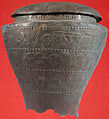
Situla Benvenuti, Eastern Culture, c. 600 BC

Bronze vases and armchairs, eastern area of Hallstatt D culture, Kleinklein

Culture Golasecca II A, end of the seventh century/VI a.C.

Vače, Slovenia, century V a.

Late Etruscan, 3rd century BC, Bronze

Late Etrusco, c. 300 BC, ceramics

,_700-550_ac_ca..JPG)


_med_drifna_ornament,_Nordisk_familjebok.jpg)


.jpg)


Attribute of Isis
According to Plutarch and other sources, the situla was a sign of Isis who appears to have represented carrying a container supposedly filled with water from the sacred Nile River). It is usually with a rounded bottom and, sometimes, with a lid. This rounded shape, often with a "nipple" at the bottom (like some examples from Luristan), evoking the corresponding feminine attribute. They were brought to the temples, filled with water and milk, as a votive offering.
Christian titles

Elaborate early medieval sítulas, sometimes called aspersoria (singular: aspersorium), were Christian liturgical objects used to hold holy water, also usually made of bronze, and straight-sided with a handle. An aspergillum was dipped into the situla to collect water with which to spray the congregation or other objects. Four richly carved examples of eburnum are known from the X century: the 920 Basilewsky situla at the Victoria & Albert Museum, decorated with twelve scenes from the life of Christ on two levels (contains one of the few depictions of Judas Iscariot showing remorse and throwing the thirty silver coins onto the floor of the Temple), the "Gotfrey Situla" 3. 4; of c. 980 in the Milan Cathedral, one in the Aachen Cathedral Treasury, and one in the Metropolitan Museum of Art in New York. All came from the background of the Ottonian court: an inscription says that Archbishop Gotfredus presented the Milan example in anticipation of a visit by the emperor, it is also mentioned on the London example that it was possibly from the same workshop. The last and most luxurious is the example of Aachen, which is adorned with jewels and shows an enthroned emperor, surrounded by a pope and archbishops. This was probably done in Trier around the year 1000.
Contenido relacionado
Theodosius Dobzhansky
Algar
Stockholm