
Silent


In Greek mythology, Silenos (in Greek Σειληνός or Σιληνός) was the adoptive father, tutor and loyal companion of Dionysus, the god of wine, at the time he was described as the oldest, wise and drunk of his followers (tíaso). He was a satyr, and a lesser god of drunkenness; his equivalent in Roman mythology was Silvanus, whose name means simply "of the woods," and in Etruscan mythology Selvans. Silenus is usually considered the son of Hermes, as is the case with most satyrs, but in other traditions he is made the son of Pan with a nymph, or Pan with Gaea. As with Dionysus, he placed his birthplace in Nisa (Asia).
Sileno is known for his excesses with alcohol, since his love for wine was his passion, for which he was often drunk and had to be supported by other satyrs or carried on a donkey; it was said that when he was drunk Silenus possessed special wisdom and the gift of prophecy. The Phrygian king Midas was eager to learn from Silenus and captured the old man pouring liquor into a fountain from which Silenus used to drink rivers. When he fell asleep, the king's servants seized him and took the lord from him. Silenus shared a pessimistic philosophy with the king: that the best thing for a man is not to be born, and that if he was born, he should die as soon as possible.
An alternative version tells that, after the death of Orpheus, Dionysus marched to Phrygia (some say on his way to India) followed by his usual retinue of satyrs and maenads, including Silenus. This, overwhelmed by Geras (old age) and wine, ended up getting lost and was captured by peasants, who took him to King Midas, who already knew him and was very happy to see him, because he thus had the opportunity to celebrate a joyous party. party. It is said that Silenus and the king (who also had a great experience with wine) spent ten days and ten nights celebrating, after which the old man was returned to Dionysus. He granted Midas a wish in gratitude for his hospitality towards his adoptive father. The king then asked for the gift of transforming everything he touched into gold. Another story is that Silenus had been captured by two shepherds, whom he regaled with amazing stories.
Silenus recounted (although he may have dreamed) that he protected the infant Dionysus from Hera's wrath, and later aided him during the Gigantomachy, killing the giant Enceladus, who is often believed to have annihilated Enceladus by throwing the island on him from Sicily. Later, pursuing the pirates who had attacked Dionysus, Silenus reached the island that Polyphemus inhabited. There he was captured by the Cyclopes and made their servant, and there he was still when Odysseus was blown by storms to the island, where he would end up blinding Polyphemus to escape.
He is credited, along with Marsyas, with the invention of the flute, as well as a particular dance, called the sileno in his honor.
In Euripides' satire The Cyclops, Silenus is left with the satyrs in Sicily, where they have been enslaved by the Cyclops. They are the comic elements of the story, which is basically a stage version of Book IX of Homer's Odyssey. Silenus refers to the satyrs as his sons during the play.
The three silenos
Some traditions consider Silenus the father of the satyr tribe. The three eldest of these, called Marón, Leneo and Astreo, were equal to their father and were also known as Silenos. According to some versions, they would have been the parents of the satyrs (of whom Silenus would then be his grandfather). All three were in Dionysus's entourage when he traveled to India, and in fact Astraeus was the driver of his chariot.
It is also said that Silenus fathered one of the melias (but not Melia) of Pholus, one of the Centaurs, and of Dolion, who lived in Ascania, north of Asia Minor.
Paposilene
Used as a generic name, the silenos are the old satyrs, also called paposilenos, as opposed to the young satyrs of the procession of Dionysus (tiaso). They appear in satirical dramas.
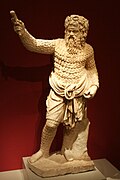
Actor like paposileno, century I, Antikensammlung Berlin.
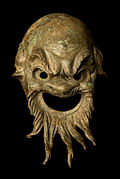
Paposilene mask, first half of the century I a. C.


Origins

Originally the Silenes were Hypotans (beings half horse half human, as opposed to normal satyrs, who were half goat half human) who were part of Dionysus' courtship when they reached old age. Silens were drunk and jovial, and looked much like other members of their race, except that they were usually ugly, bald, fat, and potbellied, with thick lips and noses, and had human legs but donkey ears. and the horse tail. Sometimes they were also represented crowned with ox horns.
Later, the silenos lost their plural character and references were only made to an individual named Sileno.
Socrates was considered to resemble a Silenus. So much so, that a famous bust is preserved in the Louvre museum in which he is represented with these characteristics.
For antonomasia, the name silenos is sometimes given to satyrs, and in Roman mythology, to fauns and sylvans.
Some specialists hypothesize that the origin of the legends about silenos, fauns and nymphs is the memory of encounters with ancient hominids.
Literary allusions
And more, that I will not dishonor such cavalry, because I remember reading that that good old Sileno, ayo and pedagogo of the joyful god of laughter, when he entered the city of the hundred gates went, very to his pleasure, knight on a very beautiful ass.Cervantes: Don Quixote de la ManchaPart one, chapter 15.
And keep yourselves from such things as the ass of Silene that Jupiter put among the starsQuevedo: prologue of Dreams and speeches, work also known as Dreams.
[...] he also told him of the summer, when the forests were green and the old Sileno mounted on his horny ass used to visit them.C. S. Lewis: The Chronicles of NarniaPart two: The lion, the witch and the closet, chap. 2.
To make the praise of Socrates, my friends, I'll use comparisons. Socrates will believe that I try to make a laugh, but my images will have the object of the truth and not the mockery. As soon as I say, Socrates looks like those silenos that are exposed in the workshops of the statueries, and that the artists represent with a flute or caramillo in the hand.Alcibíades in Plato's "The Banquet"
The praise of madness, as he continued, was elevated to philosophy, and philosophy itself becomes young, and, taking the crazy music of pleasure, one must imagine that he wears his suit stained with wine and crowned with ivy, dancing as a bass on the hills of life and mocking the slow Sileno for his sobriety.Oscar Wilde en The portrait of Dorian Gray, chap. 3.
And the face of the century - the face of the twentieth century, of the century of the confusion of the ages, appeared doubtful such a Silene.Witold Gombrowicz in "Ferdydurke", chap. 9.
Iconography
Drunk Silenus is a type of sculpture from Antiquity based on an original from the Hellenistic period. The composition is based on the Satyr pouring out by Praxiteles. In the Roman Forum there was a similar statue, which was known as Marsyas or Silenos.

Statue of Silene of the Archaeological Museum of Athens, ca. 540–530 a. C.

Tetradracma of Naxos, with the figure of Silene holding a kantharos, ca. 461-450 a. C.
![Paposilenos en una crátera de figuras rojas atribuida a Polion,[2] ca. 420 a. C.](https://upload.wikimedia.org/wikipedia/commons/thumb/c/ca/Papposilenoi_Met_25.78.66_n01.jpg/202px-Papposilenoi_Met_25.78.66_n01.jpg)
Paposilenos in a crater of red figures attributed to Polion, ca. 420 a. C.
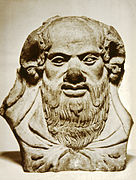
Etruscan antephyte with the head of Sileno, fourth century a. C.
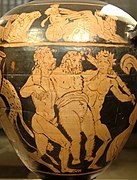
Stamnos etrusco decorated with the representation of Sileno ebrio accompanied by two young, ca. 300 a. C.

Bronze statuette Papposilenus Playing a aulosHellenistic period.

Litra Sicily's silver, with Sileno's face.

Windy silence, Roman copy of the second century, in marble of Paros, preserved at the Louvre Museum.
![Fulcra[3] romanos de bronce de los siglos I a. C. o I d. C., The Art Institute of Chicago.](https://upload.wikimedia.org/wikipedia/commons/thumb/0/04/2_Roman_bronze_fulcra_representing_Silenus.jpg/226px-2_Roman_bronze_fulcra_representing_Silenus.jpg)
FulcraBronze Romans from the I a.C. or I d.C., The Art Institute of Chicago.
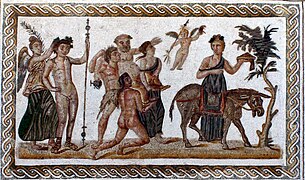
Roman Mosaic with Silene taken to his donkey.
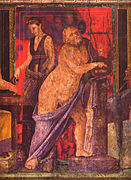
Detail of a fresco of the Villa of the Mysteries of Pompeii, which represents Sileno holding a lira, ca. 50 a. C.

Relieve from Latiumwhich represents Sileno and Eros, beginning of the 1st century.
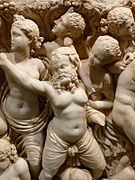
Detail of a Roman sarcophagus of the second century.

Bajorrelieve funeralerario roman, Museo regional renano Tréveris.

Silene taking Dionisio child, copy of an original from Lisipo School, Vatican Museums.
![Cabeza de Sileno en relieve, posiblemente utilizado como molde o troquel en cerámica, de época romana.[4]](https://upload.wikimedia.org/wikipedia/commons/thumb/2/2c/Head_of_Silenus_-_Project_Gutenberg_eText_19115.png/181px-Head_of_Silenus_-_Project_Gutenberg_eText_19115.png)
Silicone head in relief, possibly used as a ceramic mould or die, of Roman times.


![Paposilenos en una crátera de figuras rojas atribuida a Polion,[2] ca. 420 a. C.](https://en.wikipedia.org/wiki/Archivo:Papposilenoi_Met_25.78.66_n01.jpg)


![Fulcra[3] romanos de bronce de los siglos I a. C. o I d. C., The Art Institute of Chicago.](https://en.wikipedia.org/wiki/Archivo:2_Roman_bronze_fulcra_representing_Silenus.jpg)


![Cabeza de Sileno en relieve, posiblemente utilizado como molde o troquel en cerámica, de época romana.[4]](https://en.wikipedia.org/wiki/Archivo:Head_of_Silenus_-_Project_Gutenberg_eText_19115.png)
Modern pictorial representations of the subject include works by Ribera, Rubens, and Van Dyck; Thematically farther away, La bacchanalia by Titian or Los borrachos by Velázquez.

Sileno's inventionsPiero di Cosimo, ca. 1500, Fogg Art Museum.
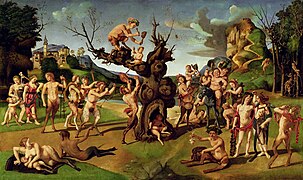
The discovery of honeySame series as the previous one.
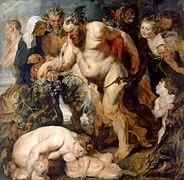
Rubens, 1616-1617, Alte Pinakothek.

Van Dyck, ca. 1620, National Gallery (London)
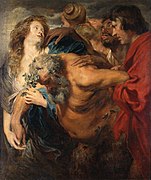
Van Dyck

Silene and bakeryor Flora, Silene and CéfiroJacob Jordaens.

Silene TriompheGerrit van Honthorst, ca. 1623-1630, Palais des beaux-arts de Lille.

Ribera, 1626, Capodimonte Museum.


;Contemporary Age
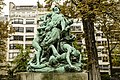
Silene TriompheJules Dalou, 1898, Jardines de Luxemburg.
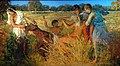
Old sileno on an assKer-Xavier Roussel, 1925-1927, Musée d'Orsay.

.jpg)
Notes and references
- MARCH, Jenny: Cassell's Dictionary Of Classical Mythology. London. 1999. ISBN 0-304-35161-X
- Cassell: British publishing house founded in 1848 by John Cassell (1817 - 1865).