
Shield of the Region of Murcia
The coat of arms of the Region of Murcia was made official in the fourth article of the Statute of Autonomy of the Region of Murcia, approved by organic law in 1982.
Blazon
The design of the shield started from its first official description, which referred to that of the flag and established the following:
Statute of Autonomy of the Region of Murcia:«Article 4.o
One. The flag of the Region of Murcia is rectangular and contains four castles enlarged in gold, at the top left angle distributed from two to two, and seven royal crowns at the bottom right angle, arranged in four rows, with one, three, two and one elements, respectively, all on the bottom of the Carmesi or Cartegena.
Two. The shield will have the same symbols and distribution as the flag, with the royal crown. »
Given the imprecision of some details for the correct heraldic emblazonment, the following Decree was approved on June 8, 1983:
Decree 34/1983:«Article 1.o
The Region of Murcia has its own shield, in accordance with Article 4.2 of the Statute of Autonomy, whose description in heraldic terms is as follows:
Sculpture, Spanish profile.
Red or Gules field.
In the head's rightful canton, four golden castles formed from two in two, squarely.
In the left canton of the tip, seven golden crowns arranged in four horizontal rows, one, three, two and one, respectively.
About the Escudo, Corona Real, for being Murcia formerly Kingdom. »
There are four castles, symbolizing the border character of the old Kingdom of Murcia and the four borders it had at some point in its history. The seven crowns constitute the historical coat of arms of the Kingdom of Murcia, arranged in four rows, with one, three, two and one elements, respectively; all on a crimson or Cartagena red background.
Official Design
The official design is the one commonly used by Murcian autonomous institutions, although it coexists with a simplified design used by the regional government within its corporate identity.
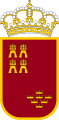
Official design of the shield of the Region of Murcia.

Simplified or logotype.

.svg)
Heraldic design
The official design does not fully conform to the official coat of arms, which in turn makes some errors in the correctness of the heraldic description.
The emblazonment does not specify that castles are open, in which case the door and windows are a different glaze, usually azure, and their design should include at least a couple of windows.
The proportions of the elements are wrong, while it is specified that the heraldic furniture is registered in cantons and not in four quarters; that is, that the field of the shield must be subdivided into nine proportional sectors, and that they should also be specified as sewn .
The emblazoned specifies a Spanish profile of the shield, which means a lower closure of the profile of the shield in a semicircular shape. In addition, the official design shows a gold filiera that is not defined in the description of the coat of arms.
Finally, the design of the royal (closed) crown forgets an important element: the bonnet gules, usually represented in Spanish heraldry.
The simplified design approved in 2008 conforms a bit more to the official coat of arms.

The most correct heraldic design of the shield, according to the official blasonate.

Shield of the Provincial Council
The Provincial Council of Murcia officially approved the use of a shield, which it had been using previously, since July 12, 1976. At the same time as the shield, a cobalt blue flag was approved, which showed in its center the provincial shield, which was made up of nine quarters, representative of the coats of arms of Caravaca de la Cruz, Cartagena, Cieza, Lorca, Murcia, Mula, Totana, La Unión and Yecla, being crowned with a closed royal crown. Said shield was official until the approval of the new territorial symbols as an autonomous community, on August 9, 1982.

Reconstruction of the shield of the former Provincial Council.

Historicals
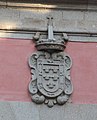
Escudo del Reino de Murcia, labrado en stone en el actual Museo de Historia de Madrid (Spain)

Map of the Kingdom of Murcia (1659). In the upper left quadrant appears the softness of the kingdom in blue background

_(cropped).jpg)