
Segovia Province
Segovia is a Spanish province belonging to the autonomous community of Castilla y León, located to the north of the Central system that divides the high plateau of the center of the Iberian Peninsula in two. Its capital is the homonymous city of Segovia. It has an area of 6,920.65 km², being the smallest province in Castilla y León, and has a population of 153,803 inhabitants (INE 2022).
It consists of 209 municipalities and 17 smaller local entities. In judicial matters, the province is divided into five judicial districts: Cuéllar, Riaza, Santa María la Real de Nieva, Segovia and Sepúlveda. Together they elect the deputies that form the plenary session of the Provincial Council.
Symbols

Shield
The heraldic shield of the council includes in its barracks the arms of the party heads of the judicial districts of Sepúlveda, Cuéllar, Riaza, Santa María la Real de Nieva and an escutcheon in the abyss with the arms of the city of Segovia. The Provincial shield of Segovia, was provisionally approved by the Royal Academy of History, on November 22, 1951, and after some slight modifications, it was definitively approved by the Provincial Council of Segovia, on July 22, 1955. Information that Jesús Fuentetaja Sanz gives us, in an article published in the newspaper El Adelantado de Segovia, on October 5, 2013, under the heading of the Institute of Traditional Segovian Culture.
Flag
The provincial flag of Segovia, was approved by Decree 75/1986 of June 12 of the Ministry of the Presidency and Territorial Administration of Castilla y León, and published in the Official Gazette of Castilla y León, on June 25, 1986.
It is a traditional crimson red color of clarity L*30, Chroma: C*25 and Hue: H*14.
Geography
The province, which has an area of 6,920.65 km², borders to the north with the provinces of Valladolid and Burgos, to the east with Soria and Guadalajara, to the south with the Community of Madrid, and to the west with Ávila.
| Northwest: Valladolid | North: Burgos Valladolid | Northeast: Soria |
| West: Avila |  | This: Soria |
| Southwest: Avila | South: Madrid | Sureste: Madrid Guadalajara |

Hydrography


The province is furrowed by different water courses that are born in the heights of the Sierra de Guadarrama and that, with the exception of a few streams that run in a southwesterly direction belonging to the Tagus hydrographic basin, run in a southeasterly direction- northeast by the plain of the Meseta Norte, all of them belonging to the Duero hydrographic basin. Among them are the Eresma river, which passes through the provincial capital, and the Duratón with its well-known "sickles", as well as the Cega, Riaza and Voltoya.
The Aguisejo (also called Grado or Ayllón), the Riaguas and the other streams that bathe the district of its name drain into the Riaza river, leaving the province through the municipality of Montejo de la Vega de Serrezuela and entering the Duero near Roa. Among the tributaries of the Duratón are the Serrano, Castilla, Prádena and the other streams of the Sepúlveda district; It leaves through the term of Laguna de Contreras, and enters the Duero near Peñafiel. The Cega receives the waters of the Cerquilla and a multitude of streams from Cuéllar and Segovia; It leaves through the Mata de Cuéllar terminus and enters the Duero, near Puente Duero. The Pirón has as a tributary the Polendos stream, the Maluca and others in the same parties of Segovia and Cuéllar, meeting with the Cega when leaving the east of the province. The Riofrío, Milanillos, Moros, Ciguiñuela, Cambrones and the Voltoya rivers belong to the Eresma basin, along with all the streams of the district of Santa María la Real de Nieva and many others of the district of Segovia; it leaves the province, being the dividing line between the party of Santa María and Cuéllar. This river enters the province of Valladolid and flows into the Adaja.
Climate
The climate is continental Mediterranean, with long, dry and cold winters, and hot but short summers.
History
Territorial organization
Municipalities

The basic administrative unit into which the province is divided are the municipalities. There are 234 today. The municipality with the most inhabitants is the provincial capital. The rest of the municipalities do not reach the figure of 10,000 registered citizens. It is remarkable a high number of them with populations below 500 inhabitants. The average extension of the municipality in the province is 33.11 km². Among the towns in the northwestern part of the province, Cuéllar —the third largest municipality in population in the province—, Coca, Navas de Oro or Nava de la Asunción stand out in terms of population. In the south of the province, on the northwestern slope of the Sierra de Guadarrama, the municipalities with the most inhabitants are, together with the city of Segovia itself (which has neighboring municipalities of relative importance such as Palazuelos de Eresma, La Lastrilla, Hontanares de Eresma or San Cristóbal de Segovia), those of El Espinar, Royal Site of San Ildefonso (La Granja) or Villacastín.
The center of the province includes the municipalities of Cantalejo, Carbonero el Mayor and Turégano. In the sparsely populated northeastern part of the province, the municipalities with the largest populations are Sepúlveda, Riaza and Ayllón.
In the province of Segovia, (INE, revision of the municipal register on 1-1-2016) are counted:
- 1 municipality over 50 000 inhabitants
- 4 municipalities from 5001 to 10 000 inhabitants
- 6 municipalities from 2001 to 5000 inhabitants
- 14 municipalities from 1001 to 2000
- 22 municipalities from 501 to 1000 inhabitants
- 29 municipalities from 251 to 500 inhabitants
- 62 municipalities from 101 to 250 inhabitants
- 70 municipalities that do not exceed 100 inhabitants
The twenty-five most populated municipalities in the province of Segovia are the following (INE of January 1, 2022):
 Sta. Ma de Nieva Segovia Rise Sepúlveda ♪ |
- The five judicial parties in the province.
Judicial parties
Country
The province of Segovia is divided, although unofficially, into different historical regions that encompass various municipalities and districts, the so-called Communities of Villa and Tierra that arose to carry out the medieval Repopulation. These communities are:
- Community of City and Land of Segovia.
- Community of Villa and Tierra de Ayllón
- Community of Villa and Land of Coca
- Community of Villa and Tierra de Cuéllar.
- Community of Villa and Land of Fresno of Cantespino
- Community of Villa and Land of Fuentidueña
- Community of Villa and Land of Wood
- Community of Villa and Tierra de Montejo
- Community of Villa and Tierra de Pedraza
- Community of Villa and Land of Sepúlveda
- Community of Villa and Tierra de Árevalo
- Community of Villa and Tierra de Íscar
Several of these communities of Villa y Tierra are still in force today as mancomunidades. In addition, there are other counties and associations in the province that have been created for the management of services or use of common goods.
Demographics

The estimated population (INE 2020) of the province of Segovia amounted to 153,478 people. Between 2000 and 2009, the province recovered its population, possibly due to the economic boost of being close to the Community of Madrid, and in the years 2010 to 2017, it has gone into a phase of stagnation due to the economic crisis and The aging of the population. Segovia continues to be a very sparsely populated province, with a very low demographic density of just over 22 inhab./km². In all the Spanish provinces, only Soria (88,903 inhabitants) and Teruel (135,562 inhabitants) have less absolute population (INE, 2018). In the context of Castilla y León, in the last fifteen years the population differential with respect to the provinces of Ávila (160,700 inhabitants) and Palencia (163,390 inhabitants) has been significantly reduced.

The main population centers of the province of Segovia are: the provincial capital Segovia, Cuéllar, El Espinar, La Granja de San Ildefonso, Cantalejo, San Rafael, Nava de la Asunción, Carbonero el Mayor, Riaza, Coca, Villacastín, Navas de Oro, Ayllón, Cantimpalos and Turégano. More than half of the municipalities have less than 200 inhabitants. The most dynamic demographic growth in the province has been experienced by the twenty municipalities that make up the so-called alfoz de Segovia, that is to say, those that are located a relatively short distance from the provincial capital while being within its area of influence, and that, for Therefore, they preferentially receive the migration of the population that seeks less expensive housing without moving too far from the urban center and sources of work.
According to INE data, the district of Segovia has grown steadily in the last two decades, increasing its population by more than 100%, between 2000 and 2010, reaching 20,000 inhabitants. The provincial capital grew only 0.7% in said period, and even reduced its population by 466 individuals (0.8%) between 2005 and 2006 (INE). In contrast, the most marked demographic increases in the same period have occurred in several municipalities of the alfoz, highlighting a first belt distant up to 10 km with: Espirdo, La Lastrilla, San Cristóbal de Segovia, Palazuelos de Eresma, Trescasas and Torrecaballeros, as well as a second belt of municipalities, distant between 10 and 20 km with: Hontanares de Eresma, Valverde del Majano, Garcillán, Abades, Real Sitio de San Ildefonso, Bernuy de Porreros, Encinillas and Roda de Eresma among others.
The municipality of El Espinar is a special case in the province. Due to its status as the closest Segovian municipality and best connected to Madrid, it is experiencing notable demographic growth that has been occurring during the XXI century (approximately 5% per year). Population increases caused by this proximity to Madrid are also detected in other municipalities in the southwest of the province, such as Ituero y Lama, Otero de Herreros, Navas de San Antonio, Zarzuela del Monte or Marugán. Despite the fact that Cuellar has historically and traditionally been the second municipality in the province by population, the INE census of January 1, 2022 has meant for the first time in history that El Espinar has surpassed the town of Cuellar, thus establishing El Espinar as the second most populous provincial municipality after the Segovian capital.
The municipality of Cuéllar is another special case in the province, since it is located in the area called El Carracillo, a place where there are large extensions of cultivated surface, thanks to the aquifer that takes the same name. It is an area that attracts population, and the city of Cuéllar itself is a beneficiary of this. Another reason is that it is located halfway between Segovia and Valladolid and the only one with a population of 10,000, which is why it is a regional reference center. It currently has around 10,000 inhabitants.
The 2020 and 2021 pandemic, caused by the Covid-19, has caused a new phenomenon in the province of Segovia (as in Ávila), the exodus of the population coming mainly from Madrid to the neighboring municipalities, registering themselves many of them in second homes. This population movement has not only offset the excess mortality directly and indirectly related to the pandemic, but has reversed the downward trend of the last decade. Of course, the municipalities of the North and Northeast of the Province, with few exceptions, have continued to lose population.
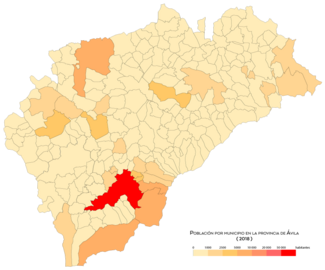
Population by municipality in 2018
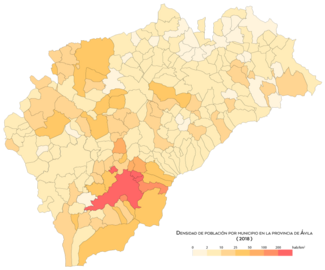
Population density by municipality in 2018

Population growth from 1998 to 2008

Population growth between 2008 and 2018


| Demographic developments in the province of Segovia | |||||||||||||||||
|---|---|---|---|---|---|---|---|---|---|---|---|---|---|---|---|---|---|
| Year | 1994 | 1996 | 1998 | 2000 | 2002 | 2004 | 2006 | 2008 | 2010 | 2012 | 2014 | 2016 | 2018 | 2019 | 2020 | 2021 | 2022 |
| Population | 149. 139 | 147 770 | 146 755 | 146 613 | 149 286 | 152 640 | 156 322 | 163 899 | 164 268 | 163 701 | 159 303 | 155 652 | 153 342 | 153 129 | 153 478 | 153 663 | 153 803 |
| Graphic of demographic evolution of the province of Segovia between 1990 and 2022 |
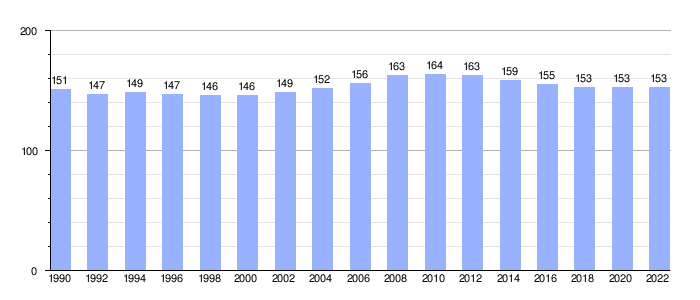 |
Source: Spanish National Statistical Institute - Graphical development by Wikipedia. Units: thousands |
- Immigration
The sustained growth of the resident population in the province of Segovia from 2000 to 2008 is related to the strong increase in immigration, which currently represents more than 10% of the population. The Bulgarian community stands out with more than 7,000 residents. The settlement poles of the emigrants are the capital and its suburbs, Tierra de Pinares and El Carracillo, as well as the municipalities bordering the province of Madrid. In 2009 and 2010, the economic crisis has caused a drastic reduction in new foreign registrants, and as a consequence of this, the current population stagnation.
Economy
.jpg)
Its economy is currently based fundamentally on the service sector, highlighting tourism since the province has important cultural resources, the result of a very important past, and the primary sector, especially pig farms.
Politics
Since the 2019 Municipal Elections, the PP has an absolute majority in the Provincial Council.
- Since 2019 the president of the delegation is Miguel Angel of Vicente Martín.
Services
Education
The province of Segovia has a large number of primary and secondary schools, the first of which, the Instituto Mariano Quintanilla and the Instituto Andrés Laguna, founded as one in 1845, have been declared of interest culture. Similarly, in Segovia there are four subsidized schools, three of which are of a religious nature, which are the Centro Madres Concepcionistas, the Centro Claret and the Centro Nuestra Sseñora de la Fuencisla.
Regarding higher education, in Segovia there was the Domingo de Soto University College of Segovia, a center attached to the Complutense University of Madrid created in 1969 by the Social and Cultural Work of Caja Segovia. The center was integrated into the University of Valladolid in 2007. In this center the careers of Law, Business Administration and Management, Advertising and Public Relations and Technical Engineering in Management Information Technology could be studied.
There is currently a campus of the University of Valladolid in Segovia, where you can study careers such as Computer Engineering, Law, Business Administration and Management, Labor Relations, Advertising, Public Relations, Tourism and Teaching. In the city is IE University, a private university dedicated mainly to business school, with a Master of Business Administration program.
Transportation
Its communications with the capital of Spain are quite good: by road through the AP-61 motorway, and by rail through the Renfe Media Distancia Segovia-Madrid line 53 and the Madrid-Madrid high-speed line. Segovia-Valladolid.
Connections with other places are somewhat precarious, either through national highways, or through regional highways both from the Junta de Castilla y León as well as from the Diputación de Segovia. In 2008, an autonomous highway that connects Segovia with Valladolid, through Cuéllar, was put into service.
- High-capacity roads

| Identifier | Name | From/ | Important locations in Segovia where it passes |
|---|---|---|---|
 | Northern motorway | Madrid-Irún | Underground cherry, Boceguillas, Fresno de la Fuente |
 | Northwest motorway | Madrid-La Coruña | Martin Muñoz de la Dehesa |
 | Northwest Highway | Madrid-Adanero | San Rafael |
 | Autopista Segovia-San Rafael | San Rafael-Segovia | Segovia |
 | Movement of Segovia | Butgordo-La Lastrilla | Segovia, La Lastrilla, San Cristóbal de Segovia |
 | Autovía de Pinares | Valladolid-Segovia | Collar, Navalmanzano, Carbonero el Mayor, Segovia |
| Name | From/ | Important locations in Segovia where it passes |
|---|---|---|
| N-6 | Madrid-La Coruña | San Rafael, El Espinar, Navas de San Antonio, Labajos |
| N-110 | San Esteban de Gormaz-Plassencia | Riaza, Segovia, Villacastín |
| N-603 | San Rafael-Segovia | Segovia |
| N-601 | Madrid-Gijón | Martín Muñoz de las Posadas |
| N-403 | Toledo-Martín Muñoz de las Posadas | Martín Muñoz de las Posadas |
| Name | From/ | Important locations in Segovia where it passes |
|---|---|---|
| E-05 | Greenock-Algeciras | Underground cherry, Boceguillas, Fresno de la Fuente |
Culture
Historical heritage

The historical heritage of the province is very rich and varied. In the capital there are Roman jewels such as the Segovia aqueduct, unique in the province since only the mosaics of some villas excavated in Aguilafuente or Paradinas are known from the same period.
.JPG)
Many buildings remain from the medieval Gothic, although altered and even in ruins; in its initial moment it left its traces in the monasteries of Sacramenia and San Pedro de las Dueñas, but the late Gothic, more powerful, built a cathedral, the convents of Santa María la Real de Nieva and San Francisco de Cuéllar and Santa Cruz, El Parral and San Francisco de Segovia, as well as notable parish churches, sometimes incomplete, in El Espinar, Villacastín, La Losa, Martín Muñoz de las Posadas, Coca, Carbonero el Mayor or Cantimpalos. Also highlights [citation required]the picturesque chapel of Santo Cristo de la Moralejilla in Rapariegos from the VI century, declared a Historic-Artistic Monument in 1994, and in the same town the Immaculate Conception Convent of Rapariegos and the Church of late Mudejar architecture.
The castles of Turégano, Pedraza and Cuellar, the fortress of Segovia and the tower-fortresses of Lastras del Pozo and Valdeprados have been preserved from the military architecture of the same style. Regarding civil architecture, there are numerous palaces and mansions with emblazoned facades in towns such as Ayllón, Sebúlcor, Sauquillo de Cabezas, Pedraza, La Armuña, Segovia and Villacastín.
Segovian architectural heritage cannot be understood without the complex that the Bourbons built in San Ildefonso, made up of the La Granja palace and gardens, the Riofrío palace and the Trescasas parish church declared BIC.
Gastronomy

The province of Segovia stands out mainly for its roasts, both lamb and suckling pig from Segovia. Other typical dishes are chorizo from Cantimpalos, beans from La Granja, garlic soups, and for dessert the famous Segovian punch. The best known Segovian horticultural product is the pea.
As for beverages, in the province of Segovia, there are municipalities belonging to two Denominations of Origin: Denomination of Origin of Rueda, and Denomination of Origin Ribera del Duero; In addition, it has quality wine from Valtiendas.
Cinema
- The love of Captain Brando
- The spirit of the hive
- Furniture
- Mr. Arkadin
Notable people
Contenido relacionado
Sri Lanka
Chihuahua
Castanea seguinii