
River of gold
.svg)
Río de Oro (Arabic: وادي الذهب wādī-að-ðahab and often transcribed as: Oued Edhahab) was one of the two territorial divisions of Spanish Sahara, with its capital at Villa Cisneros.

It covered an area of 184,000 km².
Geography
It was limited to the north by Saguía El Hamra, with the 26th parallel as the dividing line. To the south, the limit was at Cabo Blanco, where La Güera was located, limiting to the south and east with the French colony of Mauritania until 1960 and, since then, with Mauritania until 1976.
Toponymy
The original name of the territory is due to the fact that in 1442 some Portuguese seem to have obtained a little gold dust in exchange for their merchandise, and they believed they had discovered a rich gold-bearing country. In some old maps, such as one by Diego Ribera published in 1529, it appears coming from Central Africa and empties into the Atlantic while, in more modern maps, a much shorter course appears, which empties into the gulf in question with the name of Wadi. Meguetha Mersug, a Spanish expedition already arriving in the years 1885 and 1886 to declare that there was no river that flowed into the gulf, being able to lead to a possible mistake the long and narrow shape of the gulf that the Portuguese discoverers took for the estuary of a river.
History
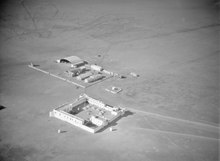
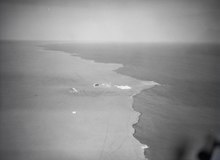

"River of Gold" It was the name given to it by the Portuguese, the first Europeans to arrive in these lands, due to the abundance of gold that the caravans brought from the Gulf of Guinea. It was the first decisive achievement of Enrique the Navigator, of his Sagres Navigation School, and of the caravel. The discovery of this vital trade route made Portugal rich and gave impetus to ocean exploration, which became financially sustainable (already paying for itself). For the kingdom of Morocco, it represented a harsh crisis, since the camel caravans that arrived in Ceuta and Tangier with gold and black slaves, stayed in Río de Oro to trade with the Portuguese.
The discovery was made after passing Cape Bojador, where legends spoke of sea monsters, and a sea that was beginning to boil. He arrived at Río de Oro in 1441.
In the First World War, the battle of Río de Oro (August 26, 1914) took place, in which the British protected cruiser HMS Highflyer detected and attacked the German liner converted into an auxiliary cruiser SS Kaiser Wilhelm der Grosse, finishing with the German ship sunk and the English damaged.