
Reticle (mathematics)

In mathematics, specifically in algebra and order theory, a revolving is an algebraic structure in a set: A{displaystyle A,} with a binary relationship: R{displaystyle {mathcal {R}}} which is partially ordained joint and two binary operations, with the fundamental property of every couple a,b한 한 A{displaystyle a,bin A} of elements has a single supreme (or higher) A,sup(a,b)한 한 A{displaystyle A,;sup(a,b)in A} and a single infim (or lower end) in A,inf(a,b)한 한 A{displaystyle A,;inf(a,b)in A}.


The term «lattice» comes from the form of the Hasse diagrams of such orders.
An example of a lattice is the set of partitions of a finite set, ordered by the inclusion relation.
Definition as an ordered set
In set theory, a lattice is a partially ordered set in which, for each pair of elements, there is a supremum and an infimum, that is:
A partially ordered set (L, ≤) is called a lattice if it satisfies the following properties:
- Existence of the supreme by pairs
- For any two elements a and b of L, the set {a, bHe has a supreme: a b{displaystyle alor b} (also known as a minimum upper cot, or join English).
- Existence of infim by pairs
- For any two elements a and b of L, the set {a, bHe has a infimo: a∧ ∧ b{displaystyle aland b} (also known as maximum lower cot, or meet English).


The Supreme and the Infim of a and b they denote by a b{displaystyle alor b} and a∧ ∧ b{displaystyle aland b}, respectively, what defines {displaystyle lor } and ∧ ∧ {displaystyle land } as binary operations. The first axiom says L is a higher semi-reticle; the second is L It's a lower semiracle. Both operations are monotonous with respect to order: a1≤a2 and b1≤b2 implies that1 {displaystyle lor } b1 ≤ to2 {displaystyle lor } b2 and1∧ ∧ {displaystyle land }b1 ≤ to2∧ ∧ {displaystyle land }b2.


It follows by mathematical induction that for every non-empty finite subset of a lattice there exists a supremum and an infimum.
Note that even in an arbitrary partially ordered set (L, ≤), the existence of some supremacy (or infima) z for a non-empty finite subset S of L implies that this supreme (or smallest) z is unique, since if there are two or more upper (or lower) bounds of If they are incomparable to each other, the highest (or lowest) by definition does not exist.
Algebraic definition
In algebra, in the reverse sense, a reticle is a set Lprovided with two binary operations ∧ ∧ {displaystyle wedge } and {displaystyle vee }such as for any a, b, c in L met


| a b=b a{displaystyle avee b=bvee a} | a∧ ∧ b=b∧ ∧ a{displaystyle awedge b=bwedge a} | the laws of conmutativity |
| a (b c)=(a b) c{displaystyle avee (bvee c)=(avee b)vee c} | a∧ ∧ (b∧ ∧ c)=(a∧ ∧ b)∧ ∧ c{displaystyle awedge (bwedge c)=(awedge b)wedge c} | the laws of association |
| a (a∧ ∧ b)=a{displaystyle avee (awedge b)=a} | a∧ ∧ (a b)=a{displaystyle awedge (avee b)=a} | the laws of absorption |
| conditions of which | ||
| a a=a{displaystyle avee a=a} | a∧ ∧ a=a{displaystyle awedge a=a} | the laws of idempotence |








If the two operations satisfy these algebraic rules, then in turn define a partial order ≤ in L by the following rule: a ≤ b Yes and only if a {displaystyle vee } b = bor, equivalently, a ∧ ∧ {displaystyle wedge } b = a.
L, together with the partial order ≤ thus defined, would then be a lattice in the aforementioned sense of order theory.
Conversely, if you give a reticle (L, ≤) in terms of order theory, and we write a {displaystyle vee } b for the supreme {a, band a ∧ ∧ {displaystyle wedge } b for the infim of {a, b}, then (L, ∧ ∧ ; {displaystyle wedge;vee }) satisfies all axioms of a reticle defined algebraically.

Therefore L is a semilattice with respect to each operation separately, that is, a commutative semigroup, with idempotency of each of its elements. The operations interact through absorption laws.
Permuting the operations yields the dual lattice of L.
Homomorphisms
The class of all reticles forms a category if we define a homomorphism between two reticles (L, ∧ ∧ ; {displaystyle wedge;vee }) and (N, ∧ ∧ ; {displaystyle wedge;vee }) as a function f: L → → {displaystyle rightarrow } N such that:

- f(a∧ ∧ b)=f(a)∧ ∧ f(b){displaystyle f(awedge b)=f(a)wedge f(b)};
- f(a b)=f(a) f(b){displaystyle f(avee b)=f(a)vee f(b)};


for all a and b in L. If it is a bijective homomorphism, then its inverse is also a homomorphism, and it is called a lattice isomorphism. The two lattices involved are then isomorphic; for all practical purposes, they are the same, differing only in the notation of their elements.
Every homomorphism is a monotonic function between the two lattices, but not every monotonic function gives a lattice homomorphism: we also need compatibility with finite suprem and infima.
Particular crosshairs
In what follows, by "reticle" L"we will always refer to (L, ∧ ∧ {displaystyle wedge }, {displaystyle vee }).
- Distribution profile
A lattice L is called distributive, if its operations are doubly distributive:
- a (b∧ ∧ c)=(a b)∧ ∧ (a c),Русский Русский a,b,c한 한 L{displaystyle avee (bwedge c)=(avee b)wedge (avee c);,quad forall a,b,cin L} and
- a∧ ∧ (b c)=(a∧ ∧ b) (a∧ ∧ c),Русский Русский a,b,c한 한 L{displaystyle awedge (bvee c)=(awedge b)vee (awedge c);,quad forall a,b,cin L}.


Since these two judgments are equivalent to each other, it is enough to require compliance with one of the two distributive laws.
- Modular module
An L lattice is called modular if:
- a≤ ≤ c a (b∧ ∧ c)=(a b)∧ ∧ c,Русский Русский a,b,c한 한 L{displaystyle aleq cLongrightarrow avee (bwedge c)=(avee b)wedge c;,quad forall a,b,cin L}.

For a lattice L in turn they are equivalent:
- L It's modular.
- a≥ ≥ c a∧ ∧ (b c)=(a∧ ∧ b) c,Русский Русский a,b,c한 한 L{displaystyle ageq cLongrightarrow awedge (bvee c)=(awedge b)vee c;,quad forall a,b,cin L}.
- a (b∧ ∧ (a c))=(a b)∧ ∧ (a c),Русский Русский a,b,c한 한 L{displaystyle avee (bwedge (avee c))=(avee b)wedge (avee c);,quad forall a,b,cin L}.
- a∧ ∧ (b (a∧ ∧ c))=(a∧ ∧ b) (a∧ ∧ c),Русский Русский a,b,c한 한 L{displaystyle awedge (bvee (awedge c))=(awedge b)vee (awedge c);,quad forall a,b,cin L}.



All distribution reticulous is modular, but the reverse judgment is not fulfilled. A non-modular reticle always contains the reticle N5{displaystyle N_{5}} as a subreticle.

In case the operation {displaystyle vee } have a neutral element 0,
- a 0=a,{displaystyle avee 0=a,}

This is called the 'zero element' of the lattice, is unique and is the minor element with respect to the natural order of the lattice:
- a∧ ∧ 0=0and0= V.{displaystyle awedge 0=0quad yquad 0=bigwedge V.}

The lattice is then called a lattice with lower bounds.
In case the operation ∧ ∧ {displaystyle wedge } have a neutral element 1,
- a∧ ∧ 1=a,{displaystyle awedge 1=a,}

This is called the 'element one' of the reticle. It is unique and is the largest element with respect to the natural order of the lattice:
- a 1=1,and{displaystyle avee 1=1,quad y}
- 1= V.{displaystyle 1=bigvee V.}


The lattice is then called a lattice with upper bounds.
The neutral element of one of the operations is then an absorbing element of the other. A lattice is called bounded if it has an upper and a lower bound, that is, if both operations have a neutral element.
For a given element a of a bounded lattice, the element b with the property
- a∧ ∧ b=0,and{displaystyle awedge b=0,quad y}
- a b=1{displaystyle avee b=1}


is called the complement of a. A bounded lattice, in which each of its elements has a complement, is called complemented.
A complemented distributive lattice is called a Boolean algebra or a Boolean lattice; When there is only a so-called relative pseudo-complement instead of the complement, we speak of a Heyting algebra.
- Complete
A lattice L is called complete if every subset (including empty subsets or possibly infinite subsets) has a supremum and an infima.
For each subset M it is enough to require the existence of the supreme, since
- M= {x한 한 L:(Русский Русский and한 한 M:x≤ ≤ and)!.{displaystyle bigwedge M=bigvee {xin L:(forall ,yin M:xleq y)}. !

An element a of a complete lattice L is called compact (according to a similar property in topology), if every subset M of L with
- a≤ ≤ M{displaystyle aleq bigvee M}

contains a finite subset E such that
- a≤ ≤ E{displaystyle aleq bigvee E}.

A lattice L is called algebraic, if it is complete and if every element of L is a supremum of compact elements.
Properties
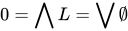
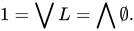
Every complete lattice L is bounded, with
- 0= L= ∅ ∅ {displaystyle 0=bigwedge L=bigvee emptyset } and
- 1= L= ∅ ∅ .{displaystyle 1=bigvee L=bigwedge emptyset. !
Every finite, non-empty lattice L is complete, so it is also bounded.
In a bounded distributive lattice, the complement of an a element is unique if it exists, often denoted as ac (particularly in the case of lattices of subsets) or ¬a (particularly in applications of logic).
- Demonstration: Sean. b and c accessories aWe want to show that b = c. Now it's fulfilled that b = b ∧ ∧ {displaystyle wedge } 1 = b ∧ ∧ {displaystyle wedge } (a {displaystyle vee }c) = (b ∧ ∧ {displaystyle wedge } a) {displaystyle vee } (b ∧ ∧ {displaystyle wedge } c) = b ∧ ∧ {displaystyle wedge } c. Similarly it is shown that c = b ∧ ∧ {displaystyle wedge } c, so b = c.
However, if the lattice is non-distributive, various complements may exist; there is an example later.
In a bounded distributive lattice it is verified
- ¬0 = 1, ¬1 = 0.
If a has a complement ¬a, then also ¬a has a complement, which is:
- ¬a) = a.
For other properties of Boolean lattices see that article.
Examples of crosshairs

- The subsets of a given set, ordered by inclusion. The supreme is given by union and infim by the intersection of subsets.
- The unit interval [0, 1] and the extended royal straight, with the total family order and the usual supreme and infimous.
- Non-negative integers, ordered by divisibility. The supreme is given by the minimum common multiple and the minimum by the maximum common divider.
- The subgroups of a group, ordered by inclusion. The supreme is given by the subgroup generated by the union of the groups and the infim is given by the intersection.
- Submodules of a module, ordered by inclusion. The supreme is given by the sum of submodules and the infim by intersection.
- The ideals of a ring, ordered by inclusion. The supreme is given by the sum of ideals and the slightest by intersection.
- Open sets of a topological space, ordered by inclusion. The supreme is given by the union of open assemblies and the infim by the interior of the intersection.
- the convex subsets of a real or complex vector space, ordered by inclusion. The infim is given by the intersection of convex assemblies and the supreme by the convex closure of the union.
- Topologies in a set, ordered by inclusion. The infim is given by the intersection of topologies, and the supreme by the topology generated by the union of topologies.
- The reticle of all transient binary relationships in a set.
- The reticle of all equivalence relationships in a set; the equivalence ratio ~ is considered to be smaller (or " finer") than ≈ if x~and always. x≈and.
The Knaster-Tarski theorem states that the set of fixed points of a monotonic function on a complete lattice is also a complete lattice.
The submodulum reticle of a module and the reticle of the normal subgroups of a group have the special property that x {displaystyle vee } (and ∧ ∧ {displaystyle wedge } (x {displaystyle vee } z) = (x {displaystyle vee } and) ∧ ∧ {displaystyle wedge } (x {displaystyle vee } z) for everything x, and and z in the reticle. A reticle with this property is called a reticle modular. The modularity condition can also be established as follows: Yes x ≤ z Then for everything and We have the identity x {displaystyle vee } (and ∧ ∧ {displaystyle wedge } z) = (x {displaystyle vee } and) ∧ ∧ {displaystyle wedge } z.
Distributivity


A reticle is called distribution Yeah. ∧ ∧ {displaystyle wedge } distribution to {displaystyle vee }I mean, x ∧ ∧ {displaystyle wedge } (and {displaystyle vee } z) = (x ∧ ∧ {displaystyle wedge } and) {displaystyle vee } (x ∧ ∧ {displaystyle wedge } zequivalent, {displaystyle vee } distribution ∧ ∧ {displaystyle wedge }. All distribution reticles are modular. Two major types of distributive reticles are the totally ordained assemblies and the booleaan algebras (such as the reticule of all the subsets of a given set). The reticle of natural numbers, ordered by divisibility, is also distributed. Other common distribution laws (especially the law of full distribution) are given in the article on distribution in theory of order.
Two key examples of non-distributive reticles are pentagon, N5{displaystyle N_{5}} and M3{displaystyle M_{3}} which is obtained from adding a minimum element and a maximum to the antichain of three elements. Obviously if we do this with an anti-chain n elements, we'll get the reticle. Mn{displaystyle M_{n}} which is not distributional either. The above examples are fundamental to the extent that any non-distributive reticulous is characterized by containing a copy of a subreticle M3{displaystyle M_{3}} or N5{displaystyle N_{5}}.


Important notions of lattice theory
In the following, let L be a lattice. We define some order-theoretic notions that are of particular importance in lattice theory.
An element x of L is called supreme-irreducible if and only if
- x = a {displaystyle vee } b implies x = a or x = b for any a, b in L,
- Yeah. L He has a 0Of x is sometimes required to be different from 0.
When the first condition is generalized to supreme arbitrary Vai, x It's called fully supreme-irreducible. dual notion is called infimo-irreducibility. Sometimes one also uses the terms {displaystyle vee }-irreducible and ∧ ∧ {displaystyle wedge }-irreducible, respectively.
An element x of L is called supreme-prime if and only if
- x ≤ a {displaystyle vee } b implies x ≤ a or x ≤ b,
- Yeah. L It has 0Of x is sometimes required to be different from 0.
Once again this can be generalized to obtain the notion fully supreme-prime and dualized to nearest-prime. Any supreme-prime element is also supreme-irreducible, and any least-prime element is also least-irreducible. If the lattice is distributive the converse is also true.
Other important notions in lattice theory are ideal and its dual notion filter. Both terms describe special subsets of a lattice (or of any partially ordered set in general). Details can be found in the respective articles.
Contenido relacionado
Mertens conjecture
Cauchy distribution
Haskell curry