
Ranunculaceae
Ranunculaceae, the ranunculaceae, is the largest family of the Order Ranunculales, with 2,377 accepted species in 65 genera. Its members are generally herbaceous perennials or annuals, are distributed throughout all temperate and subtropical regions, mainly in the northern hemisphere. Its presence in the tropics, although rarer, is also represented by some species of Thalictrum and Oreithales, for example.
Many of the species are widely cultivated in gardens for their ornamental value; among them those of the type genus: Ranunculus; the very diverse climbers of Clematis, or those of Aquilegia, due to the peculiar shape of their flowers.
Other genera were used in antiquity as natural remedies for their beneficial effects to alleviate some ailments, both in the Old and in the New World. The native peoples of North America used around 20 species. Their harmful effects were also known, as in the case of monkshood, one of the most potent toxins in the plant kingdom.
Features
Most species are herbaceous perennials, often with a developed rhizome (or with tubers), sympodous or rarely monopodous, sometimes annual or biennial, or subshrubs (eg Xanthorhiza) or climbers (Clematis), without latex or colored sap or essential oils.
They have adventitious roots, sometimes with a main root developed in annual or biennial species.
They are hermaphroditic plants, although many of the Thalictrum species are dioecious. Other species are polygamous.
The leaves are simple or compound, normally petiolate and sheathing at the base, distichous, spiral. They can be alternate or opposite (Clematis); decussate or fasciculate, with or without visible intrapetiolar stipules. The limbs can be chordate, truncated or cuneate at the base, divided or undivided, incised, dentate, sometimes entire, heterophilous in aquatics, venation pinnatinervia to palmatinervia. Anomocytic or paracytic stomata.
Stems with vascular bundles in which the xylem totally or partially surrounds (V-shaped) the phloem and arranged more or less irregularly, or in 1-2 rings, with narrow medullary rays, 3-5-lacunar nodes with 3-8 traces. foliar (rarely unilacunar with one track or bilacunar with two).
Species with solitary flowers, often pedunculated (Glaucidium) or with terminal inflorescences, rarely axillary; usually in a cluster, panicle or cyme, sometimes the bracts form an involucre or calculus under the flower (Anemone).
Flowers are normally medium to large, hypogynous, perfect, rarely unisexual, actinomorphic to zygomorphic (vertically monosymmetrical), cyclic to whorled parts, not opposite each other. Receptacle well developed, convex, sometimes much longer than wide, not hollowed out. Absent hypogynous disc. Perianth normally with separate calyx and corolla, or intergrading. Sepals (2-)3-8(-more), free, frequently petaloid, sometimes partially or completely gamosepalous, sometimes with spurs, imbricate, rarely valvate, deciduous or persistent. Petals (0-)1-13(-50), free, cupped or flat, frequently the 2-3 inner whorls with nectaries and interpreted as of staminodial origin, partially or totally gamopetalous, imbricate, sometimes with spurs, green, white, yellow, red, purple or blue. Androecium of (5-)15-500 stamens, spiral or in 1-13 whorls, free, phylanterous, extrastaminal staminodes (if "nectariferous petals" are considered as such), anthers not versatile, basifix, tetrasporangiate, extrorse or introrse, dehiscence by longitudinal slits (rarely by elongated valves in Trautvetteria). Upper gynoecium, with 1-100(-10,000) carpels, apocarpic, semicarpic, or syncarpic with 3-5 locules, style present or absent, apical stigma, dry, papillose or not, ovules 1-100 per carpel, anatropous or hemianatropous, apotropes, unitegmic and tenuinucelled or bitegmic and crassinucellated, if there is one, it is the basal of the series and is usually unitegmic, erect, horizontal or pendulous, marginal to basal placentation in apocarpic ovaries or axial in syncarpic ovaries.

The fruit can be in the form of an aggregate of follicles (sometimes dehiscent dorsally and ventrally, if it is a legume); or achenes, rarely fleshy in berry or drupe, or capsule, rarely simple; in capsule if syncarpic (Nigella).
A fruit can contain from 1 to many seeds per carpel, with abundant, starchy or oily endosperm, rarely absent, sometimes compressed and winged (Glaucidium). The embryo is normally rudimentary with 2 cotyledons of petioles more or less fused, rarely a single one, sometimes the embryo is long and developed, straight.
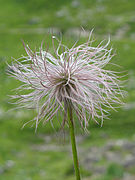
In aquenio: Alpine bracelet
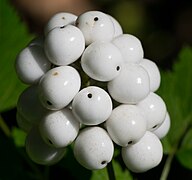
In berry: Actaea pachypoda

In follicles: Nigella arvensis

1.jpg)

Ecology
Palynology

Pollen can be tricolpate, pantocolpate, or pantoporate, sometimes variable within the same genus (as in Clematis). Tectum normally spinulous-perforated, with endexin of considerable thickness; columellae often large, scattered, or reduced so that the tectum and basal layer are closely separated.
Cytology
Chromosome number: Chromosomes of two types: long and curved several times (type R) or small and with at most one curve (type T); usually R-type species have x = 8, reducing to 7 or 6, rarely increasing to 9 or 10; species with type T have x = 7, but it is 6 in Dichocarpum, 8 in Asteropyrum, 9 in Coptis and Xanthorhiza, and 13 in Hydrastis. Anemone, Ranunculus and Thalictrum exhibit numerous ploidy changes. Aneuploid changes appear in Caltha, Ranunculus, etc., due to the presence of B chromosomes.
Phytochemistry
Perianth colored by yellow, or purple, blue and scarlet carotenoids (anthocyanins), dependent on soil minerals in Anemone coronaria. Accumulation of alkaloids of various kinds, e.g. eg isoquinoline derivatives (magnoflorine, berberine, etc.), diterpenes (aconitine) or quinolizine derivatives (N-methyl-cytisine), although benzylisoquinoline derivatives are restricted to the genera Coptis and Isopyrum. Ranunculin glycoside is common in the family and once ingested, releases a digestive tract irritant, protoanemonin, which can cause a variety of injuries to livestock and domestic animals, including narcosis, muscle paralysis, cardiac arrest, respiratory failure, chilling of limbs, tremors, hypertension and even death; once the plant is dry, the protoanemonin decomposes giving anemonin, which is harmless. Other species have cyanogenic compounds derived from tyrosine (eg triglokinin) and their ingestion can be fatal, releasing hydrocyanic acid. Proanthocyanidins usually absent (present as cyanidin in Clematis). Flavonols present (usually kaempferol or quercetin) or absent, ellagic acid absent. Saponins and sapogenins present or absent. Physiology C3 in some genera.
Pollination

The flowers, fundamentally entomophilous, with the exception of some species of Thalictrum, which are anemophilous, have showy perianths (more than 6 cm in diameter) or colored staminal filaments, if the perianths are poor or expired Nectar guides are visible under ordinary ultraviolet radiation. The flowers have nectaries on the "petals" which produce nectar rich in sucrose, except in Caltha, where nectar is produced by carpel trichomes on both sides of each carpel. The anthers have mechanisms that allow them to come into contact with the back or belly of visiting insects. Most species are protogynous (proterandry occurs in some Clematis and Anemone). Some species are autogamous, apomixis occurring very sporadically. Entomogamy has favored the appearance of zygomorphic flowers with very complex structures, such as hidden nectaries in hooded tepals or spurred petals. Pollinating insects are normally bees and bumblebees, but in some groups a relationship with sphincter moths (sphingophilia) or birds (ornithophilia) has been established, even within the same genus (eg, Delphinium, Aquilegia). However, Xanthorhiza exhibits a sapromyophilic pollination syndrome. The relationship between the pollinating insect and the plant can be very close and completely dependent.
Distribution and habitat


The family is distributed throughout almost the entire world, although it is scarcer in the tropics, with only 12 genera, including the endemic Naravelia (tropical Asia), Krapfia, Laccopetalum, and Oreithales (tropical America). Many of the genera are distributed only in the northern hemisphere, others in both hemispheres, such as Anemone, Clematis, Caltha, Myosurus, ranunculus and Thalictrum. Only 6 are found in the southern hemisphere: Knowltonia and Peltocalathos in South Africa and Aphanostemma, Barneoudia, < i>Callianthemoides and Hamadryas.
They prefer temperate to cool climates, with moist habitats. Some of the Caltha and Ranunculus species are adapted to aquatic life. Many are present in deciduous forests, understory, and alpine meadows in warmer climates.
Taxonomy

Systematic position
Ranunculaceae are a group of angiosperms that are included in the eudicot clade. They have usually been related to the Lardizabaláceas, which differ by important characters such as placentation, or with the Berberidaceae. Based on molecular and morphological data, the APW (Angiosperm Phylogeny Website) considers it to be part of the Order Ranunculales, being the sister group to the Berberids in a moderately advanced clade of the order.

Taxa
For a long time, genera that had little to do with the family, but coincided in characters currently considered plesiomorphic, such as Paeonia (Paeoniaceae), Circaeaster or Kingdonia (Circaeasteraceae). On the other hand, until very recently, it has not been recognized that the genus Glaucidium is a primitive representative of this family, having even been placed in its own family (Glaucidiaceae). The systematics proposed by Tamura (1993), recognized five subfamilies based mainly on chromosomal and floral characters: three with T-type chromosomes: Hydrastidoideae (x = 13), Thalictroideae (x = 7) and Isopyroideae (three tribes: Isopyreae, x = 7, Dichocarpeae, x = 6, Coptideae, x = 9 (rarely 8)), and two with R-type chromosomes: Ranunculoideae (with three tribes: Adonideae, x = 8, Anemoneae, x = (7-)8(-9), Ranunculeae, x = 8 (rarely 7) and Helleboroideae (4 tribes: Helleboreae, x = 8, Cimicifugeae, x = 8, Nigelleae, x = 6 (rarely 7), Delphinieae, x = 8) Recent studies of molecular phylogeny have confirmed the basal position of Hydrastidoideae, which would be the sister group of Glaucidoideae, and this branch would be basal with respect to the rest of the family.The next branch would be formed by the subfamily Coptoideae, which would be the sister group of the clade formed by the Thalic subfamilies troideae and Ranunculoideae, in turn sister groups (Ro et al., 1997,). The currently recognized system would be as follows:


- Subfamily Hydrastidoideae Raf., (1815) x = 13, type T.
- One gender: Hydrastis L.1759. Central and Eastern America.
- Subfamily GlaucidioideaeTamura, 1972) Loconte(1995). x = 10, type T.
- One gender: Glaucidium Siebold & Zucc., (1845). Japan.
- Subfamily Coptoideae Tamura. x = 8 or 9, type T.
- Gender Asteropyrum J.R. Drumm. & Hutch.(1920). China, Bhutan, Burma.
- Gender Coptis Salisb., (1807). East Asia, West North America.
- Gender Xanthorhiza Marshall., (1785). Eastern America.
- Subfamily Thalictroideae Raf., (1815) x = 7 or 6, type T.
- Thalictreae Tribe T. Duncan & Keener(1991). x = 7.
- One gender: Thalictrum L.(1753). North and South America, Southern Europe, Africa and East Asia.
- Isopyreae tribe Schrödinger(1909). x = 7.
- Gender Achilles L., (175). Holártico.
- Gender Enemion Raf., (1820). North-East Asia and West America.
- Gender Isopyrum L.(1753). Eurasia.
- Gender Leptopyrum Rchb., (1828). Asia, naturalized in Europe.
- Gender Paraquilegia J.R. Drumm. & Hutch.(1920). Himalayas.
- Gender Semiaquilegia Makino(1902). China, Korea and Japan.
- Gender Urophysa Ulbr.(1929). China.
- Tribu SaidcarpeaeTamura " K. Kosuge1989) W.T. Wang & D.Z. Fu(1990). x = 6.
- One gender: Saidcarpum W.T. Wang & P.K. Hsiao(1964). From Himalaya to Japan.
- Subfamily Ranunculoideae Arn., (1832). x = 8, 7 or 6, rarely 9, type R.
- Tribe Helleboreae DC., (1817). x = 8.
- Gender Calathodes Hook.f. & Thomson, (1855). India, Tibet, Bhutan, Nepal, China, Taiwan.
- Gender Caltha L.(1753). Eurasia, South American Andes, Australia and New Zealand.
- Gender Helleborus L.(1753). Europe, Asia.
- Gender Megaleranthis Ohwi(1935). South Korea.
- Gender Trollius L.(1753). Holártico.
- Tribu Actaeeae Bercht. " J. Presl, (1823). x = 8.
- Gender Actaea L.(includes) Cimicifuga Wernisch.(1763) and Souliea Franch.1898).
- Gender Anemonopsis Siebold & Zucc.1846. Japan.
- Gender Beesia Balf.f. & W.W. Sm.(1915). China, Burma, Tibet.
- Gender Eranthis Salisb., (1808). Europe, Asia.
- Nigelleae Tribe Tamura(1990). x = 6 or 7.
- Gender Garidella L.(1753). Southern Europe, Southwest and Central Asia.
- Gender Komaroffia Kuntze, (1887). Central Asia, Iran.
- Gender Nigella L.(1753). Central and southern Europe, North Africa, Southwest and Central Asia.
- Tribu Delphinieae Warm., (1884). x = 8.
- Gender Aconitum L.(1753). Eurasia, North Africa and North America.
- Gender Consolidation (DC.1817) Gray., (1821). Eurasia.
- Gender Delphinium L.(1753). Eurasia, Africa and North America.
- Adonideae Tribe Kunth, (1838). x = 8.
- Gender Adonis L.(1753). Eurasia.
- Gender Callianthemum C.A. Meyer, (1830). Eurasia.
- Tribu Anemoneae DC., (1817). x = 8 or 7, rarely 9.
- Gender Anemoclema (Franch.1886) W.T. Wang(1964). China.
- Gender Anemone L.(1753). Eurasia to Sumatra, North and South America, Africa (includes Hepatica Mill., (1754), Knowltonia Salisb., (1796), Pulse Mill., (1754) and Miyakea Miyabe & Tatew.1935.
- Gender Barneoudia Gay, (1844). Chile, Argentina (probably synonymous with Anemone).
- Gender Clematis L.(1753). Eurasia, North and South America, Africa, Madagascar, Oceania (includes Archiclematis (Tamura1954) Tamura1968).
- Gender Metanemone W.T. Wang(1980). China.
- Gender Naravelia DC., (1817). South and Southeast Asia.
- Gender Oreithales Schldtl., (1856). Andes, from Ecuador to Bolivia (probably synonymous with Anemone).
- Ranunculeae Tribe DC., (1817). x = 8 or 7.
- Gender Arcteranthis Greene, (1897). Canada.
- Gender Beckwithia Jeps., (1898). Western United States.
- Gender Callianthemoides Tamura(1992). South America (South Argentina and Chile).
- Gender Coptidium (Prantl1888) N.N. Tzvelev(1994). Northern Antarctica.
- Gender Cyrtorhyncha Nutt. in Torr. " A. Gray, (1838). Western America.
- Gender Halerpestes Greene, (1900). Asia, North and South America; naturalized in Europe.
- Gender Hamadryas Comm. ex Juss.(1789). South America.
- Gender Krapfia DC., (1817). You're from South America.
- Gender Kumlienia Greene, (1886). California.
- Gender Laccopetalum Ulbr.(1906). Peru.
- Gender Oxygraphis Bunge, (1836). Central, South and Eastern Asia, Alaska.
- Gender Paroxygraphis W.W. Sm.(1913). Himalayas.
- Gender Peltocalathos Tamura(1992). Southern Africa.
- Gender Ranunculus L.(1753). Cosmopolita (includes Aphanostemma A. St.-Hil., (1825), Ceratocephala Moench(1794) and Myosurus L.see Hörandl et al.., 2005,).
- Gender Trautvetteria Fisch. " C.A. Meyer ", (1835). Northeast Asia, East and West America.
Identification key


.jpg)
Genra currently considered valid can be separated with the following key:
- Hydrastis
- Fruit in berry, with 1-2 seeds. Terminal lone flower. Sepals 3. x = 13, type T.
- Glaucidium
- Flowers 4-meras, sepals 4, petaloids. Numerous stamens.
- Fruit in follicle. Many seeds, flattened, winged. x = 10, type T.
Coptoideae
- 5-shirt flowers. Stames less than 150. Fruit in capsule, follicle, aquenio or berry. Normal seeds. x 10, type T or R.
- Fruits in follicle without net transverse nerve. Actinomorphous flowers. x = 8 or 9, type T.
- Xanthorhiza
- Burns with woody stems. Abaxial follicle style, applied to fruit, strongly curved.
- Coptis
- Herbal stalks, at most something woody at the base. Style of the terminal follicle, straight or ganchudo apically.
- Netly studded leaflets. Put them on a nail.
- Asteropyrum
- Sesile leaflets. Pétalos with a long nail.
Thalictroideae-Ranunculoideae
- Fruits in berry, aquenio or capsule, if in follicle, with transverse nerve more or less net, if not, zigomorfa flowers. x 8, if not, type R.
- Actaea (part)
- Fruit in berry.
- Simple fruit, polysperm.
- Anemone (part)
- Aquenio fruit, each with 1-2 seeds.
- Consolidation
- Fruit in simple follicle, sesile.
- Zigomorfa flowers.
- Poisoned petal 2. Paper 1.
- Zigomorfa flowers.
- Delphinium
- Stuffed petals 2. Carpets 3 or more.
- Pétalos 4, the 2 superiors sprinkled, sesile. Upper sepal with spur.
- Aconitum
- Pétalos 2, sprinkled, nailed. Upper blade in helmet.
- Caltha
- Actinomorphous or slightly irregular flowers.
- Missing petals.
- Simple leaves, indivises.
- Miscellaneous letters. Lax inflorescence, corimbiform, or lone flower.
- Simple leaves, indivises.
- Missing petals.
- Beesia (part)
- Paper 1. Cluster or particle inflorescence.
- Calathodes
- Split or composite leaves.
- Palmie leaves or pedatisects.
- Enemion
- Sheets 1-2-ternate.
- Missing petals.
- Komaroffia
- Present petals.
- Semicarpal gineceum to sync. Annual.
- Indivised leaves at 3-5-palmatipartite.
- Semicarpal gineceum to sync. Annual.
- Nigella
- Shorter petals than sepals.
- Sheets 2-3-pinning.
- Garidella
- Pétalos longer than sepals.
- Beesia (part)
- Apocalypse gineceus, if not, perennial.
- Multiflower inflorescence, on composite peaks, particles or clusters.
- Simple leaves, indivises. Pétalos and staminodios absent.
- Multiflower inflorescence, on composite peaks, particles or clusters.
- Actaea (part)
- Leafs or pinnaticompuestas once or more. Pétalos or estaminodios present.
- Sepals 3-5, greenish white. Inflorescence with more than 8 flowers.
- Anemonopsis
- 7-10, red purple. Inflorescence at most with 8 flowers.
- Eranthis
- Hojas caulinares forming a univerticilate involucre.
- Pauciflower inflorescence in monocasio or solitary flower, terminal.
- Megaleranthis
- Hojas caulinares alternating or opposite, not involved.
- Simple leaves.
- Hoja caulinar 1, near the flower.
- Simple leaves.
- Trollius
- Sheets caulinear several, distant from the flower, or absent.
- Helleborus
- Composite sheets.
- Persistent sepals.
- Semiaquilegia
- Deciduous sepals.
- Squamiforms present between stamens and carpals.
- Piping rizoma. White sepals. Stamens 8-14.
- Squamiforms present between stamens and carpals.
- Urophysa
- Rizoma no tuberoso. Blue or purpurple sepals. Numerous stamens.
- Shorter petals than half the length of a sepal, navicular. Styles almost 2 × as long as the body of the follicle. All basal, simple, trisect or tender leaves.
- Achilles
- Pétalos longer than half the length of a sepal, petaloids. Styles at most as long as half the body of the follicle. Basal leaves or caplinars, bent 2 or more times.
- Saidcarpum
- Absent stencils.
- Folicles 2, with a net longitudinal nerve, soldiers basely. Pétalos with a long nail.
- Paraquilegia
- Folicles without longitudinal nerve, free. Put them without a fingernail or with this cut.
- Sesile petals. Simple stalk, all basal leaves, the remains of the papuled pecilli. Lonely flowers.
- Leptopyrum
- Put them on a short nail. Smallly branched stem, basal leaves and caplinars. Flowers in pauciflorus monocasium.
- Annual. Carpets usually 6 or more.
- Isopyrum
- Perennials. Folders usually 2-6, occasionally more.
- Clematis
- Fruit composed of aqueniums (rarely utricles).
- Very diverse morphology.
- Thalictrum
- Imbricated sepals.
- Missing petals. Pendulum ovule. Aquenio with net longitudinal nerves on each side face.
- Metanemone
- Pétalos present, if absent, erect egg or aquenios without longitudinal nerves on each side.
- Missing petals.
- Frosty stalk, no rubber leaves.
- Full base sheets, lobed or departures, net shorter than escapo.
- Involvement absent. Elliptical, obovate, subreniform, whole, trilobulate or tripartite basal leaves. Seventeen. Lonely flower.
- Full base sheets, lobed or departures, net shorter than escapo.
- Frosty stalk, no rubber leaves.
- Missing petals.
- Anemoclema
- Involvement present. Pinnatipartite basal leaves. Sepals 5. Inflorescence of 2-4 flowers.
- Oreithales
- Full basal leaves, as long as the escape.
- Trautvetteria
- Heel with rubber leaves.
- Ovules (and seeds) erect. Inflorescence in corymbo or subpanic. Aquenio with a longitudinal nerve on each side face.
- Barneoudia
- Oils (and seeds) pendulums. Inflorescence on tops or umbelas, or lone flower. Aquenio without longitudinal nerves on the side faces.
- Aquenios with long basal hairs.
- Anemone (part)
- Puescent acheniums to glabros.
- Paroxygraphis
- Present petals.
- Unisexual flowers.
- Persistent sepals, so or longer than petals. Pétalos 5.
- Unisexual flowers.
- Hamadryas
- Cadual sepals, shorter than petals. Pétalos 7-20.
- Naravelia
- Perfect flowers (bisexuals).
- Tiny wrapper. Opposite leaves. Long, plumy or pubescent style.
- Callianthemum
- Annual or perennial herb. Alternate or all basal leaves. Different style.
- Oil (and seed) pendulum, bitégmic.
- Pétalos con nectario basal.
- Oil (and seed) pendulum, bitégmic.
- Adonis
- Pétalos sin nectario basal.
- Krapfia
- Ovulus (and seed) erect, unitégmic.
- Androceo and gin separated in the receptacle by a zone free of structures.
- Pétalos with 1-3 nectarios.
- Androceo and gin separated in the receptacle by a zone free of structures.
- Laccopetalum
- Pétalos with numerous nectarios. Androgynophorus present.
- Numerous small achenes.
- Callianthemoides
- Androceo and gin continue in the receptacle.
- Aquenios with longitudinal veins on the side faces, not reticulated.
- Aquenios with a wing along a longitudinal nerve in each side face.
- Aquenios with longitudinal veins on the side faces, not reticulated.
- Peltocalathos
- Not winged, rough.
- Simple basal leaves, peeled.
- Cyrtorhyncha
- Leaves or foliolos not peeled.
- Sheets 1-2-ternate. Inflorescence in corymbo or subpanic.
- Oxygraphis
- Simple or trisect basal leaves. Lonely flowers, terminals.
- Persistent sepals.
- Kumlienia
- Deciduous sepals.
- White sepals. Cut them shorter than half a sepal.
- Halerpestes
- Yellow sepals. Pétalos little shorter or longer than a sepal.
- Stalls present.
- Arcteranthis
- All basal sheets or sometimes 1 cauliner.
- Deciduous sepals.
- Absent stungs.
- Deciduous sepals.
- Coptidium
- Single sheets of whole or trilobed edge, 3-5-shared to 3-5-sec, dented edge. Aquenios with spongy, floating tissue at the top.
- Beckwithia
- Sepals 5, persistent. Red petals.
- Fruit in papillary utricle.
- Ranunculus
- Fruit in aquenio, rarely utricle.
- Usually yellow petals, rarely white.
Fossil Records
Fossil remains of fruits, leaves and seeds have been found in different places, both in the New and Old Worlds. Unlike other families, such as Menispermaceae and Berberidaceae, there are very few fossil records of the Ranunculaceae before the Neogene. The causes, according to scholars (Ziman and Keener, 1989), could be the herbaceous habit of the family; the lower production of plant parts, such as leaves, flowers or fruits, makes it difficult to find remains, as well as the area of distribution of many of the taxa, alpine environments, for example.
The oldest remains date from the lower Cretaceous, small fruits that resemble those of the current genus Thalictrum. The characteristics of the seeds of Eocaltha zoophilia, dated to the Late Cretaceous, allow us to assume that the ancestor of the current Caltha also had aquatic habits. There is also evidence of some species of Paleoactaea from different periods of the Neogene, which, due to the similarity of their characteristics, correspond to the current Actaea.
Uses
In gardening, many species of the genera Aconitum, Actaea, Adonis, Anemone< are popular for the beauty of their flowers. /i>, Aquilegia, Callianthemum, Caltha, Clematis, Consolida, < i>Delphinium, Eranthis, Helleborus, Nigella, Ranunculus, Thalictrum i> and Trollius, and their numerous cultivars obtained by artificial selection.
- In medicine
Other genera are of pharmacological interest due to their therapeutic potential. Although its effects in pharmacology have not yet been demonstrated.
In ancient times, many species were used in traditional medicine in the form of aqueous solutions and decoctions. The genus Ranunculus against rheumatism, intermittent fevers and flushing, among other conditions. Some species of Pulsatilla and Anemone for rheumatic pains, ailments of the eyes. Delphinium consolida as a vermifuge and diuretic. The action of some of these plants "taken internally was considered to be among the most energetic and remarkable".
They also benefited from its toxicity. The juice extracted from monkshood and black hellebore was used to poison arrows, a practice used in India and also by the Arabs during the Reconquest. At the beginning of the 19th century the Nepali Gurkhas annihilated their enemies by poisoning their water wells.
Clematis vitalba was called "beggars weed" because the needy used the crushed leaves for their irritating effect. They applied them to the skin until ulcers developed, thus arousing people's pity.
Contenido relacionado
Orthocoronavirinae
Bituminous bitumen
Bocageopsis