
Projective geometry

The branch of mathematics that studies the properties of incidence of geometric figures is called projective geometry, but completely abstracting from the concept of measurement. This word is often also used to talk about the projection theory called descriptive geometry.
Brief historical review

Gérard Desargues was the initiator of projective geometry, as he mathematically founded the perspective methods that Renaissance artists had developed. And, although his work was published in 1639, it went unnoticed for two centuries (except for two theorems), overshadowed by the influential work of Descartes. [ citation needed ]
In the 19th century, projective geometry and hyperbolic geometry were established within mathematics, but what possibly finally rooted them was finding an analytical model. Within the context of Euclidean-Cartesian geometry, projective geometry can be constructed and, if the first is accepted, the second must be accepted.[citation required]
This process was definitively implemented at the beginning of the XX century, since Albert Einstein, relying on the exhaustive geometric developments of the mathematicians of the 19th century, managed to demonstrate that, on a large scale, the universe can be better interpreted with these new geometries than with the rigid Euclidean space.[citation required]
Synthetic point of view
From a synthetic point of view, projective geometry is based on the following principles:
- Two points define a straight line.
- All pairs of straights are cut at a point (when two straights are parallel, they are said to be cut at a point of infinity known as improper point).[chuckles]required]
Euclid's fifth postulate, that of parallel lines, is implicit in these two principles since, given a line and an exterior point, there will be a single parallel line defined by the given point and that of infinity by the first axiom.[citation required]
As the axioms from which we start are symmetrical, if in any projective theorem the words straight and point are interchanged, another equally valid theorem is obtained. These theorems are called dual theorems.[citation required]
The principle stated above is known as the principle of duality and was stated by Jean-Victor Poncelet in the 19th century. Many earlier theorems, such as those of Blaise Pascal and Brianchon, are dual, although no mathematician had noticed this until then.[citation needed]
The theorems of Pascal and Brianchon, although completely valid, were initially proven in Euclidean geometry, based on the theorems of Pappus of Alexandria and Menelaus, which use a metric and are therefore not valid in incidence geometries, such as projective.[citation required]
In principle, an attempt was made to find alternative proofs of these theorems without using segment congruence. David Hilbert demonstrated, in 1899, that such a thing is impossible, and since then the Pappus hexagon theorem is usually included as an axiom of projective geometry. This allows us to demonstrate projectively everything that can be demonstrated in Euclidean geometry without having to resort to a metric.[citation required]
Due to the fact that it does not use metrics in its statements, projective geometry is said to be a geometry of incidence.[citation required]
Finally, it should be noted that from the synthetic point of view, a projective space consists of an affine space to which a set of infinite points have been added, so that each pair of parallel lines intersect at one of these points..
Applications
When the Euclidean parallels become isomorphic with the projective lines that intersect “at infinity”, it is possible to extrapolate everything that is demonstrated in projective to Euclidean geometry. Projective geometry, more flexible than Euclidean, thus becomes a useful tool to state many classical theorems more simply, even to simplify demonstrations, although it does not allow us to prove anything that cannot be proven in Euclidean geometry. [citation required]
Projective geometry can be understood, informally, as the geometry that is obtained when the observer stands at a point, looking from that point. That is, any line that affects the "eye" it appears to be just a point, on the projective plane, since the eye cannot "see" the points behind it.[citation required]
In this way, projective geometry is also equivalent to the projection onto a plane of a subset of space in three-dimensional Euclidean geometry. The lines that reach the observer's eye are projected into points. The planes defined by each pair of them are projected into straight lines.[citation required]
This is useful because sometimes the theorems of projective geometry cannot be proven solely with the axioms of incidence explained above (Hilbert, 1899), and it is necessary to prove them in Euclidean geometry and then project, such as Desargues' theorem (or well admit the previously mentioned Pappus theorem as an axiom).[citation required]
Vector point of view
Projective geometry is the study of the group of projectivities between projective spaces.[citation required]
Axioms
Sea a body and One - vector space (not trivial).[chuckles]required]


Defined in the following equivalence ratio:


It will be called projective space on V to the quotient set for the previous equivalence ratio:


Vector straights are sets formed by the multiple scales of non-numerable vectors, that is, if , , the vector straight determined by is the whole . The vector straight determined by is then nothing other than the vector subspace generated by I mean, . The projective space associated with will be the set of all vector straights .[chuckles]required]





It's obvious, if , So for any such as with , it is fulfilled that the vector straights determined by and They match, this is, = . There lies the essence of a projective space: addresses are considered only, not concrete vectors. In view of this fact, to work only with vectors and not with vector straights, the following relationship is established, which turns out to be an equivalence relationship: if , you will consider that is related to (expressed as ) if there is a , so that . By taking the quotient set , you get another way to define .[chuckles]required]


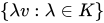
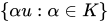
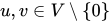


The elements of the projective space would then be the equivalence classes of the vectors by the equivalence ratio .[chuckles]required]

Another step can still be taken to better understand this type of space: if you take a base , like taking the vector line generated by it is necessary One of the coordinates regarding the base taken has to be necessarily not null. By multiplying the non-none vector by the reverse of that non-none coordinate, you will get another vector of the same vector line, in which now the no-none coordinate chosen will be worth 1. As the new vector is in the same vector line, its kind of equivalence is the same as that of the old vector, that is, it represents the same element of the projective space.[chuckles]required]
To understand the meaning of the above, see this example:
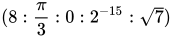
Consider the real vector space (with the canonical base) and the non-null vector .

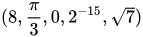
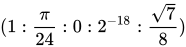
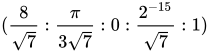
It will be denoted to its kind of equivalence through the relationship . Four of the five coordinates are not null, so there are four possible ways to perform the previous process: in the first case (dividing between the first coordinate, the 8), it would be obtained . If, instead of taking the first coordinate, it is taken, for example, the fifth (), it would be obtained . We could split the coordinates of the initial vector. between the other two coordinates not null, or , but in all cases the same kind of equivalence would be obtained, although the coordinates are not numerically the same. In this situation, it will be said that is the representation of the vector class at homogeneous coordinates. It must be clear that , and are homogeneous coordinates of the same projective point.[chuckles]required]
![[ (8, frac{pi}{3},0,2^{-15},sqrt{7}) ]](https://wikimedia.org/api/rest_v1/media/math/render/svg/04262be6be11f68257e0dd89f45026bba3dcef03)
![[(1,frac{pi}{24}, 0, 2^{-18},frac{sqrt{7}}{8})]](https://wikimedia.org/api/rest_v1/media/math/render/svg/d67cab9825d7c34e3671373f20e7b5e0b92fee66)

![[ (frac{8}{sqrt{7}}, frac{pi}{3 sqrt{7}},0,frac{2^{-15}}{sqrt{7}}1) ]](https://wikimedia.org/api/rest_v1/media/math/render/svg/551062d88cc3c9486f1f5c7d2cba25507bce453c)


Sources
- Geometry books (Carlos Ivorra)
- The Principle of Duality: the Theorems of Pascal and Brianchon
- A Reflection on the Basic Concepts of Projective Geometry - Pablo Perdomo Rivero
- Review of Poncelet
Contenido relacionado
Accuracy and Precision
Chaitin's constant
Dragon curve
Inferential Statistics
Decimal separator