
Prime number theorem
In number theory, the prime number theorem is a statement that describes the asymptotic distribution of prime numbers. This theorem gives a general description of how the prime numbers are distributed in the set of natural numbers. This formalizes the intuitive idea that primes are less common the larger they are. It is one of the most important theorems in the history of mathematics, not only because of its beauty but also because of its influence on the subsequent development of prime number research.
The theorem is also known as the prime number theorem or prime number theorem.
Expression of the theorem

Sea π π (x){displaystyle pi (x),}the counting function of prime numbers, which denotes the number of cousins that do not exceed x{displaystyle x,}. Theorem states that:


|
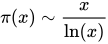


This expression does not imply that the difference between the two parts of the same for values of x{displaystyle x} very large is zero; it only implies that the quotient of these for values of x{displaystyle x,}Very large is almost equal to 1.
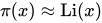
A better approximation than the previous one is given by the shifted logarithmic integral:
|

History
In 1792 or 1793, while still at the Collegium Carolinum, and always according to Gauss himself ("ins Jahr 1792 oder 1793"), he noted in his notebook:
- «Number minor cousins a (= ∞) a/la», which in modern language means π(a) for growing values approaches the quotient a/lna) and is considered as "the first conjecture of the theorem of the prime numbers". In addition the function π(x), which indicates the number of prime numbers that do not exceed x, was defined by Gauss.
The prime number theorem was also conjectured by Adrien-Marie Legendre in 1798, indicating that π(x) seemed to have the form a/( A ln(a) + B), where A and B are unspecified constants. In the second edition of his book on number theory (1808) he made a more precise conjecture, stating that A = 1 and B = −1.08366. The conjecture was later refined by Gauss with the expression that is currently most frequently associated with the theorem. Significant contributions to this proposition were made by Legendre, Gauss, Dirichlet, Chebychev, and Riemann.
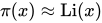
The formal demonstration of the theorem was made independently by both Jacques Hadamard and Charles-Jean de la Vallée Poussin in 1896. Both demonstrations were based on the result that the Riemann zeta function γ γ (z){displaystyle zeta (z),}It doesn't have zeros of shape 1 + it with ▪. In fact, the demonstration was made on a somewhat stricter expression of what is indicated in the earlier definition of the theorem, the expression shown by Hadamard and Poussin the following:

π π (x)≈ ≈ Li(x){displaystyle pi (x)approx {mbox{Li}}(x)}
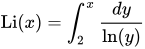
where
Li(x)=∫ ∫ 2xdandln (and){displaystyle {mbox{Li}}(x)=int _{2}^{x}{frac {dy}{ln(y)}}}}}}.
Since 1896, the expression associated with the prime number theorem has been successively improved, the current best approximation being that given by:
π π (x)=Li(x)+O(xExp (− − A(ln x)3/5(ln ln x)1/5)){displaystyle pi (x)={rm {Li}}(x)+Oleft(x,exp left(-{frac {A(ln x)^{3/5}}}{(ln ln x)^{1/5}}}}}{right)}

where O(f(x)){displaystyle O(f(x)}defined as the asymptotic function to f(x){displaystyle f(x),}and A{displaystyle A,}It's an undetermined constant.


For values x{displaystyle x,}small ones had been shown to <math alttext="{displaystyle pi (x)π π (x).Li(x){displaystyle pi (x)}{mbox{Li}}(x),}<img alt="pi(x), which led to conjecture several mathematicians at the time of Gauss Li(x){displaystyle {mbox{Li}(x),}It was a strict top-down π π (x){displaystyle pi (x),}(this is the equation π π (x)− − Li(x)=0{displaystyle pi (x)-{mbox{Li}}(x)=0,}does not have real solutions). However, in 1912 J. E. Littlewood showed that such a quote is crossed for values of x{displaystyle x,}Big enough. The first is known as the first number of Skewes, and it is now known that it is less than 10317{displaystyle scriptstyle 10^{317},}, although it is thought to be inferior even 10176{displaystyle scriptstyle 10^{176},}. In 1914 Littlewood expanded its demonstration with the inclusion of multiple solutions to the equation π π (x)− − Li(x)=0{displaystyle pi (x)-{mbox{Li}}(x)=0,}. Many of these values and findings are associated with the validity of Riemann's hypothesis.




Relation to the Riemann hypothesis
Given the connection between the Riemann zeta function ζ(s) and π(x), the Riemann hypothesis is very important in number theory, and of course, in the theorem of the prime numbers.
If the Riemann hypothesis holds, then the error term that appears in the prime number theorem can be bounded in the best possible way. Specifically, Helge von Koch showed in 1901 that
- π π (x)=Li(x)+O(xln x).{displaystyle pi (x)={rm {Li}}(x)+Oleft({sqrt {x}ln xright). !

if and only if the Riemann hypothesis holds. A refined variant of Koch's result, given by Lowel Schoenfeld in 1976, states that the Riemann hypothesis is equivalent to the following result:
- <math alttext="{displaystyle |pi (x)-operatorname {Li} (x)|日本語π π (x)− − Li (x)日本語.18π π xln (x),for everythingx≥ ≥ 2657.{displaystyle ёpi (x)-operatorname {Li} (x) implied{frac {1}{8pi }}{sqrt {x},ln(x),qquad {text{for all}xgeq 2657. !<img alt="|pi(x) - operatorname{Li}(x)|
Approximations for the nth prime number
As a consequence of the prime number theorem, we obtain an asymptotic expression for the nth prime number, denoted by pn:
- pn≈ ≈ nln n.{displaystyle p_{n}approx nln n. !

A better approximation is:
- pn=nln n+nln ln n+nln n(ln ln n− − ln n− − 2)+O(n(ln ln n)2(ln n)2).{displaystyle p_{n}=nln n+nln ln n+{frac {n}{ln n}}{big (}lnln n-ln n-2{big)}} +Oleft({frac {n(lnlnln n){2}{ln}{2right}{ln}{2 !

Prime number theorem for arithmetic progressions
Sea π π n,a(x){displaystyle pi _{n,a}(x)} the function that denotes the number of cousins in an arithmetic progression a, a + n, a + 2n, a +3n... less than x. Dirichlet and Legendre conjectured, and Vallée-Poussin proved, that if a and n They're coprimos, then

- π π n,a(x)♥ ♥ 1φ φ (n)Li(x),{displaystyle pi _{n,a}(x)sim {frac {1}{varphi (n)}}}mathrm {Li} (x),}
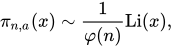
where φ(·) is the Euler function φ. In other words, the primes are evenly distributed among the residues of classes [a] modulo n with gcd(a, n ) = 1. This can be proved using similar methods used by Newman in his proof of the Prime Number Theorem.
The Siegel–Walfisz theorem gives a good estimate of the distribution of prime numbers in the class residues.
Race of Prime Numbers
Although we have, in particular, that
- π π 4,1(x)♥ ♥ π π 4,3(x),{displaystyle pi _{4,1}(x)sim pi _{4,3}(x),,}

empirically the 3-congruent primes are more numerous and are almost always ahead in this "prime number race", the first inversion occurs at x = 26,861. However, Littlewood showed in 1914 that there are an infinite number of sign changes of the function
- π π 4,1(x)− − π π 4,3(x),{displaystyle pi _{4,1}(x)-pi _{4,3}(x),,}

so the lead in this race changes successively infinitely many times. The phenomenon that π4,3(x) is ahead most of the time is called Chebyshov polarization. The race of prime numbers generalized to other modules is the subject of numerous investigations; Pál Turán asked if it is always the case that π(x;a,c) and π(x;b,c) switch positions when a and b are coprime with c >. Granville and Martin give a full and studied exposition.
Contenido relacionado
Accuracy and Precision
Chaitin's constant
Dragon curve
Inferential Statistics
Decimal separator