
Poti
Poti (Georgian: ფოთი; Megrelian: ფუთი, romanized: Puti) is a city in Georgia located in the southwest of the Mingrelia-Upper Svaneti region, being autonomously administered. The city has become an important port city and industrial center since the beginning of the 20th century. It is also home to a main naval base and the headquarters of the Georgian Navy.
Toponymy
The name Poti is linked to Phasis, but the etymology is a matter of controversy among scholars. Phasis (Greek: Φάσις) is first recorded in Hesiod's Theogony (c. 700 BC) as the name of the river, not of a city. Since Erich Diehl, 1938, first suggested a non-Hellenic origin of the name and claimed that Fasis could have been a derivative of a local hydronym, several explanations have been proposed linking the name with the Proto-Georgian-Zan Poti, the Svanian Pasid, and even a Semitic word, which means "a river of gold".
Geography
Poti is located on the eastern coast of the Black Sea and serves as one of two Georgian ports on that sea. Near the city is the swampy mouth of the Rioni River, which forms the Kojeti National Park.
Climate
The city's climate is humid subtropical with cool winters and warm summers. The average annual temperature is 14.3 °C, 5.6 °C in January and 22.8 °C in July. The average annual precipitation is 1,685 mm.
 Average climate parameters of Poti (1981-2010) Average climate parameters of Poti (1981-2010) | |||||||||||||
|---|---|---|---|---|---|---|---|---|---|---|---|---|---|
| Month | Ene. | Feb. | Mar. | Open up. | May. | Jun. | Jul. | Ago. | Sep. | Oct. | Nov. | Dec. | Annual |
| Temp. max. abs. (°C) | 21.4 | 23.4 | 28.7 | 34.4 | 39.9 | 35.9 | 45.2 | 37.4 | 38.3 | 33.6 | 27.3 | 24.5 | 45.2 |
| Average temperature (°C) | 10.3 | 10.9 | 13.8 | 18.5 | 21.5 | 25.1 | 27.3 | 27.8 | 25.3 | 21.5 | 16.2 | 12.3 | 19.3 |
| Average temperature (°C) | 6.2 | 6.4 | 8.8 | 12.7 | 16.4 | 20.7 | 23.5 | 23.8 | 20.4 | 16.4 | 11.4 | 8.1 | 14.7 |
| Temp. medium (°C) | 3.4 | 3.4 | 5.5 | 9.0 | 12.8 | 17.2 | 20.3 | 20.4 | 16.6 | 12.7 | 8.0 | 5.1 | 11.3 |
| Temp. min. abs. (°C) | -6.2 | -10.0 | -6.8 | -1.0 | 3.5 | 9.0 | 13.4 | 12.2 | 8.0 | 2.7 | 0.0 | -4.7 | -10.0 |
| Total precipitation (mm) | 155.0 | 126.9 | 121.6 | 81.7 | 87.4 | 160.4 | 214.6 | 241.5 | 262.0 | 232.0 | 183.8 | 156.0 | 2040.0 |
| Source: World Meteorological Organization | |||||||||||||
History
Ancient and Middle Ages
It has been suggested that Poti is built on the site of an ancient Greek colony from the 7th century 7th century a. C. which had the name of Phasis and was established by the colonists of Miletus led by a certain Themistagoras. The Greek legend about the Golden Fleece (which relates the Argonauts, Jason and Medea) located the place where King Aeetes ruled the country of Colchis at the mouth of the Phasis River, where sources mention that this ancient Greek colony was located.. After many years of uncertainty and academic debate, the site of this settlement now appears to be established, thanks to underwater archeology under difficult conditions. Apparently, the lake that the well-informed ancient Greek author Strabo reported bounded one side of Phasis has now engulfed it, or part of it. Phasis appears to have been an important center of trade and culture in Colchis throughout the classical period. The section along the River Phasis was a vital component of the supposed trade route from India to the Black Sea, attested by Strabo and Pliny.
Between the centuries VI and II a. C., the city had an active role in these contacts. During the Third Mithridatic War, Phasis came under Roman control. It was where the Roman commander-in-chief Pompey, after crossing to Colchis from Iberia, met the legate Servilius, the admiral of his Euxine fleet in 65 BC. After the introduction of Christianity, Phasis was the seat of a Greek diocese, one of whose bishops, Cyrus, became patriarch of Alexandria between 630 and 641 AD. C. During the Lazic War between the Eastern Roman and Sassanian Empires (542-562), Phasis was attacked, unsuccessfully, by Iranian soldiers.
In the 8th century, the name Poti entered Georgian written sources. It remained a place of maritime trade within the kingdom of Georgia and was known to medieval European travelers as Fasso. In the 14th century, the Genoese established a commercial factory, which turned out to be short-lived.
Modern Age
In 1578, Poti was conquered by the Ottoman Empire. The Turks, who knew the city as Faş, fortified it heavily and turned it into one of their Caucasian outposts, which also housed a large slave market. A combined army of Western Georgian princes recaptured Poti in 1640, but the city fell back to Ottoman rule in 1723. Russo-Georgian forces made another futile attempt to dispossess the Ottomans of Poti in 1770 and 1771.
Contemporary Age
Once Russia took control of most of the major Georgian lands in the 19th century, it tried again to dislodge the Turkish garrison from Poti and managed to do so with the help of Georgian auxiliaries under Nino, Princess of Mingrelia in 1809, but was forced to return the fortress to the Ottomans in the Treaty of Bucharest. The following Russo-Turkish War resulted in the capture of Poti by Russia in 1828. The city was subordinate to the Kutaisi Governorate and was granted port city status in 1858. The seaport was rebuilt between 1863 and 1905. In 1872, the city became the terminus of the Caucasus Railway, from where the line led directly to Tiflis.
Poti particularly grew in size and importance during Niko Nikoladze's mayoralty between 1894 and 1912. Considered the founding father of modern Poti, Nikoladze presided over a series of modernization and construction projects, including a theatre, a large cathedral, two gyms, a power plant, an oil refinery, etc. By 1900, Poti had become one of the major Black Sea ports and exported most of Georgia's manganese and coal. During the Russian Revolution of 1905, Poti became the scene of workers' strikes and roadblocks in December. 1905. At the beginning of the First World War, on November 7, 1914, the Ottoman SMS Breslau appeared in front of the port of Poti and subjected the railways to a bombardment that lasted three quarters of an hour, without direct results.
During a brief period of independence in 1918-1921, Poti was Georgia's main window to Europe, and also served as a gateway for successive German and British expeditionary forces. On May 28, 1918, a preliminary German-Georgian alliance treaty was signed in Poti. On March 14, 1921, Poti was occupied by the Red Army of Soviet Russia who installed a Soviet government in Georgia. During the Soviet era, Poti retained its primary function as a seaport and the city was further industrialized and militarized.
During the 2008 Russo-Georgian War, Russian warplanes attacked the port. Although a ceasefire was declared on August 12, Russian troops continued to occupy the area around the city until they were withdrawn the following month.
Demography
The demographic evolution of Poti between 1959 and 2021 was as follows:
Its population was 41,465 in 2014, with 97% of the population being Georgians.
| 1939 | 1959 | 2002 | 2014 | |||||
|---|---|---|---|---|---|---|---|---|
| Ethnic group | Population | Percentage | Population | Percentage | Population | Percentage | Population | Percentage |
| Georgian | 15 895 | 62.4% | 24 146 | 57.4% | 44 414 | 94.20% | 40 446 | 97.54% |
| Russian | 8070 | 31.7 per cent | 12 550 | 29.8 per cent | 1884 | 4.00% | 604 | 1.46% |
| Ukraine | 2326 | 5.5 per cent | 265 | 0.56% | 143 | 0.34% | ||
| Armenians | 312 | 1.2% | 520 | 1.2% | 194 | 0.41% | 65 | 0.16% |
| Azeri | 3 | 0.1 per cent | 26 | 0.1 per cent | 43 | 0.09% | 40 | 0.10% |
| Greeks | 123 | 0.5% | 147 | 0.3% | 53 | 0.11% | 28 | 0.07% |
| Ossetians | 15 | 0.1 per cent | 107 | 0.3% | 62 | 0.13% | 23 | 0.05% |
| Jews | 477 | 1.9% | 254 | 0.6% | - | - | 9 | 0.02% |
| Loms | - | - | - | - | - | - | 32 | 0.08% |
| Abkhaz | - | - | - | - | 27 | 0.06% | 6 | 0.01% |
| Attendance | 2 | 0.1 per cent | - | - | - | - | 2 | 0.01% |
| Yazidi | - | - | - | - | 2 | 0.01% | - | - |
| Kurds | - | - | 2 | 0.1 per cent | - | - | - | - |
| Tartars | 118 | 0.5% | - | - | - | - | - | - |
| Germans | 69 | 0.3% | - | - | - | - | - | - |
| Lezguinos | 4 | 0.1 per cent | - | - | - | - | - | - |
| Chechnos ykists | 1 | 0.1 per cent | - | - | - | - | - | - |
| Total | 25 464 | 100% | 42 068 | 100% | 47 149 | 100% | 41 465 | 100% |
Administrative division
Poti is divided into four municipalities: center, Nabada, Island and Maltakva, known for its tourist capacity, and for its important sporting events.
Politics
The Municipal Assembly of Poti (Georgian: ფოთის საკრებულო) is a representative body in Poti, consisting of 35 members who are elected each four years. The last election was held in October 2021 and was won by Beka Vacharadze of the Georgian Dream in the second round, against the United National Movement.
| Political party | 2017 | 2021 | |
|---|---|---|---|
| Georgian dream | 18 | 20 | |
| United National Movement | 2 | 11 | |
| For Georgia | 4 | ||
| European Union | 2 | ||
| Alliance of the Patriots of Georgia | 1 | ||
| Georgian Labour Party | 1 | ||
| Georgia Development Movement | 1 | ||
| Total | 25 | 35 | |
Economy
The service and food industries represent the most important sectors of the economy. The Poti seaport (7.7 million tons per year) is operational. The railway to Tbilisi makes this a more useful port than the natural port of Batumi. Additionally Armenia, which does not have its own access to the sea, has much of the trade to and from the port of Poti and the Georgian Railway.
In April 2008, Georgia sold a 51% stake in the Port of Poti to the Investment Authority of the Ras Al Khaimah Emirate of the United Arab Emirates to develop a free industrial zone (FIZ) in a management concession. 49 years and manage a new port terminal. The creation of a new FIZ was officially inaugurated by the President of Georgia Mikheil Saakashvili on April 15, 2008.
Infrastructure
Communications
During July 2008, a long-distance underwater communications cable stretching from Varna, Bulgaria, across the Black Sea to Poti, Georgia, was laid aboard the US cable ship CS Tyco Decisive, just a couple of weeks before the Russo-Georgian War. This cable system will be Georgia's first privately owned fiber optic system for Georgian citizens.
Education
There is an art academy in Poti.
Military
The Poti naval base was organized by the Soviet government in July 1941, a month after the German invasion during World War II. The base operated, commanded by Major General Mikhail Kumanin, as part of the Black Sea Fleet and included two submarine divisions, one torpedo boat division, one coast guard boat division, two minesweepers, four coastal batteries and six missiles, etc. After the German capture of Sevastopol and Novorossiysk in 1942, several destroyers were transferred to be based at Poti which, along with Batumi, functioned as a secondary port in the Black Sea campaigns (1941-1944). In the early 1990s, the Poti base had hosted several smaller units of the Soviet Black Sea Fleet, but virtually disappeared after the dissolution of the Soviet Union. In December 1992, Russia withdrew all its vessels and ammunition from the Poti naval base, but an ethnic Georgian commander of a landing ship refused to obey Moscow's order and displayed a Georgian flag. Around the same time, the Georgian government created a naval brigade (composed of several ships, a marine battalion, an artillery division and a communications detachment) and since then, the brigade has been expanded and re-equipped with the help of NATO member states. On October 9, 1993, war-torn Georgia had to legalize the Russian military presence in the country. In September 1998, Russian military personnel withdrew from Poti to the Russian base in Batumi under a Russian agreement. -Georgian signed at the beginning of that year.
Currently, Poti is a military installation assigned to several of Georgia's units. These are the headquarters and main base of the Georgian Navy, a main naval logistics support base, a naval squadron station and barracks for a separate light infantry battalion of the Georgian Armed Forces.
Transportation
Poti is the beginning of the European route E-70, which connects Poti with La Coruña (Spain).
The port and the city are the western departure point of the Poti-Baku railway line, the oldest railway line in Georgia, through which crude oil and petroleum products from Azerbaijan in particular reach Poti for shipping.
In November 2009, there were plans for a Kerch-Poti ferry route.
Culture
Sports
The city team is FC Koljeti-1913 Poti, which is part of the Erovnuli Liga and plays its home games at the Fazisi stadium.
Illustrious people
- David Tsimakuridze (1925-2006): Georgian Soviet sportsman who was Olympic champion in Helsinki 1952 in free struggle.
- Nana Alexandria (1949): Great Master of Georgian chess, winner of the Soviet Union's female chess Championship three times.
- Viktor Kratasiuk (1949-2003): Georgian Soviet Penagüist who won a gold medal at the Olympic Games in Munich 1972.
- Davit Gabunia (1982): playwright, novelist and Georgian translator.
Gallery
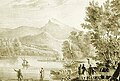
View of the Fasis River in the CenturyXIX

Port of Poti
.jpg)

Twinning cities
Poti is twinned with the following cities:
 Aktau, Kazakhstan.
 Burgas, Bulgaria.
 Shanwei, China.
 Larnaca, Cyprus.
 LaGrange, Georgia, United States.
 Naphplio, Greece.
 Kiryat Yam, Israel.
 Östhammar, Sweden.
 Berdiansk and Chornomorsk and Sevastopol, Ukraine.


Contenido relacionado
Sorihuela
Navamorales
Mozárbez