
Polygon

In geometry, a polygon is a plane geometric figure composed of a finite sequence of consecutive line segments enclosing a region in the plane. These segments are called sides, and the points at which they meet intersect are called vertices. The polygon is the two-dimensional case of the polytope.
Etymology
The word polygon derives from the ancient Greek πολύγωνος (polúgōnos), in turn formed by πολύ (polú) 'many' and γωνία (gōnía) 'angle', although nowadays polygons are usually understood by the number of their sides.
The notion of elementary geometry has been adapted in various ways to serve specific purposes. Mathematicians are often interested in only closed line strings and simple polygons (those whose sides only intersect at vertices), and can define a polygon accordingly. It is a geometric requirement that two sides that intersect at a vertex form a non-flat angle (other than 180°), since otherwise the segments would be considered parts of a single side; however, those vertices might sometimes be allowed for practical reasons. In the field of computing, the definition of a polygon has been slightly altered due to the way in which figures are stored and manipulated in computer graphics for the generation of images.
Definitions
The definition of the polygon depends on the use that you want to give it, so for example to refer to a region of the plane you have:
- We will call the polygon to the portion of the plane delimited and enclosed by a polygonal line.
To refer to the Euclidean study of the lengths of the sides of a polygon, we have:
- We will call a polygon to a flat geometric figure defined by a polygonal line of which its two ends coincide.
Traverse line
It is called polygonal line or broken line to the set of segments, s1,...... ,sn{displaystyle s_{1},dotss_{n}}, attached successively by its ends where the end of each is originating from the following, such that two successive segments are not aligned, in such case both are considered as a single segment.

- Lı ı ♪ ♪ neaporligornal= 1≤ ≤ i≤ ≤ nsi{displaystyle L{acute {imath }nea;poligonal=bigcup _{1leq ileq n}s_{i}}}}
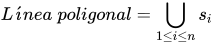
Sean. Pi{displaystyle P_{i}} and Pi+1{displaystyle P_{i+1}} extremes si{displaystyle s_{i}}, then:


- If the two free ends, P1{displaystyle P_{1}} and Pn+1{displaystyle P_{n+1}}, they don't match it is said that the polygonal line is open.
- We'll say the polygonal line is closed if it's not open.


Example of a six segment line string:

See also
The definition and its application of the Grapho concept of graph theory.
The definition of a simplex used in algebraic topology.
Properties
- Interior of a polygon is the set of all the points that are within the region that delimits the polygon.
- Exterior of a polygon is the set of points that are not in the polygonal line (border) or inside.
Elements of a polygon

The following geometric elements can be distinguished in a polygon:
- Polygon sides: are each of the segments that make up the polygon.
- Vertices of a polygon: are the intersection points or points of union between consecutive sides.
- Polygonal diagonals: are segments that bind two non-consecutive vertices of the polygon.
- Inner angle of the polygon: it is the angle formed, internally to the polygon, for two consecutive sides.
- Outer angle of the polygon: it is the angle formed, externally to the polygon, on one side and the prolongation of the consecutive side.
- Incoming angles of the polygon: it is the inner angle to the polygon that measures more than 180o.
- Outgoing angles of the polygon: it is the inner angle to the polygon measuring less than 180o.

In a regular polygon we can also distinguish:
- Center (C): is the equidistant point of all the vertices and sides.
- Central angle (AC): is the angle formed by two straight segments that leave the center to the ends on one side.
- Apotheme (a): it is the segment that unites the center of the polygon with the center of one side; it is perpendicular to that side.
- Diagonal (di{displaystyle d_{i}}): are the segments that unite the vertices of the polygon not consecutively.

Form
- Perimeter (P): is the sum of the lengths of all sides of the polygon.
- Semiperimeter (SP): is half the perimeter.
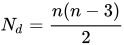
- Total diagonals
| Nd=n(n− − 3)2{displaystyle N_{d}={frac {n(n-3)}{2}}}}}in a polygon n{displaystyle n} sides. |
| The diagonals for each vertex are n− − 3{displaystyle n-3} The vertices are n{displaystyle n} As every diagonal is counted twice, the number of diagonals comes from:
|


- Diagonal Intersections NI=n(n− − 1)(n− − 2)(n− − 3)24{displaystyle N_{I}={frac {n(n-1)(n-2)(n-3)}{24}}}}}}in a polygon n{displaystyle n} Vertices.
- Any regular polygon of n sides can be broken down into an orderly set of n-2 triangles, with a common vertice and the sum of the areas of the triangles is equal to the area of the polygon.

Classification
There are several possible classifications of polygons. To see a ranking based on its number of sides, see the table below.
Classification of polygons according to their shape
| Classification of polygons according to the shape of your contour. | ||||||||||||||||||||||||
|---|---|---|---|---|---|---|---|---|---|---|---|---|---|---|---|---|---|---|---|---|---|---|---|---|
|

According to the properties that the outline of the polygon fulfills, it is possible to carry out the following classifications.
- SimpleIf no pair of non-consequential edges are cut. Equivalently, your border has only one contour.
- Complex or Crusade, if two of their non-consequential edges are interested.
- Convexo, if any segment that binds two points any of the polygon contour lies inside it. All simple polygon and with all its internal angles, less than 180o is convex.
- No convex, if there is a segment between two points of the border of the polygon that goes outside it. Or if there is a straight line capable of cutting the polygon in more than two points.
- Concavo, if it is a simple polygon and not convex.
- EquilateralIf it has all its sides of the same length.
- BaggageIf you have all your inner angles equal.
- RegularIf he's a horseman and a horse at the same time.
- IrregularIf it's not regular. I mean, if it's not a equilateral or a mistake.
- CyclicIf there is a circumference that passes through all the vertices of the polygon. All regular polygons are cyclic.
- Ortogonal or Isotéticoif all its sides are parallel to the Cartesian axles x{displaystyle x} or and{displaystyle and}.
- AlabeadoIf your sides are not on the same plane.
- Starry, if built from drawing diagonals in regular polygons. Different buildings are obtained depending on the union of the vertices: two in two, three in three, etc.
- Reticular It is simple and, by representing it in a reticulate, each vertex lies exactly in a single square vertex of the reticulate (in this case the Pick formula works).
- Monótono, if there is any direction of the plane in which all the polygon cuts in that direction consist of a point or a segment.



Simple polygon, concave and irregular.

Complex polygon, not convex and irregular.

Convex and regular polygon (equilateral and equiangle).

Polígono crashed.


Names of polygons according to their number of sides
Polygons have a special name to designate the number of sides of the polygon. The most common names are in the following table:
|
|
|
Classification by types
| ||||||||
| ||||||||
| ||||||||
| ||||||||
| ||||||||
| ||||||||
|
Contenido relacionado
Lambert azimuthal projection
George Cantor
Neutron (game)