
Pluviometer

The rain gauge is an instrument used in weather stations to collect and measure precipitation. It is used to measure the amount of precipitation that has fallen in a place during a certain time.
The amount of water falling is expressed in millimeters of height (or equivalently in liters per square meter). The basic design of a rain gauge consists of an upper opening (of known area) for the entry of water into the container, which is then directed through a funnel towards a collector where it is collected and can be measured visually with a graduated ruler or by weight. of the deposited water. Normally the reading is done every 12 hours. A liter dropped in a square meter would reach a height of 1 millimeter. For the measurement of snow, it is considered that the thickness of snow is equivalent to approximately ten times the equivalent of water.
Until about 10-21 years ago [please clarify counting from which date] rain gauges could not really record the temporal evolution of rainfall and were checked twice a day. Unlike the rain gauge, which is an instrument that could, by means of a mechanical recording system, graphically record the amount of rain in a certain time interval (daily, weekly, etc.) on a strip special graph paper. With these tools it was possible to reach temporal resolutions of the order of five minutes, although in most cases the resolution used was of the order of half an hour. Obviously, the recording of a rain event with this system includes a series of maintenance problems, the reliability of the instruments, reading and discussion of the data that must be done by hand anyway is controversial. With the development of electronics first, and then of the computer, rain gauges evolved significantly, moving from a mechanical record to electronic devices with the ability to store digital data. Today the distinction between two types of instruments has practically disappeared and only makes sense when considering the older instruments, which do not have a recording capability, for the measurement of 24-hour precipitation. The water in this instrument is measured by mm. These instruments are usually found among those of a common weather station. In all cases, it is very important that it is installed in an open space, free of obstacles. The data received from the rain stations are collected and classified in the hydrological records.
History
The first measurements of rainfall were made known by the Greeks 500 years before Christ. One hundred years later in India, people use containers to collect rainwater and measure it.
In both cases, rainfall measurement helped assess future crop yields. In the book Artha-shastra which was used in the kingdom of Magadha, the rules were set for each grain and the State granary had an indicator for tax purposes.
In Palestine, from the 2nd century B.C. C. religious writings refer to the measurement of rainfall for agricultural needs.
In 1441 in Korea, the first standard aperture bronze rain gauge or alluvium gauge, called Cheugugi, was developed by the scientist Jang Yeong-sil for use through a network that covers the entire globe. country.
In 1639, Benedetto Castelli, a disciple of Galileo, carried out the first precipitation measurements in Europe, to know the contribution of water from a rain event to Lake Trasimeno. There was a calibrated cylindrical glass container with a known amount of water, and he saw the corresponding level in the bottle. Next, he put the container in the rain, every hour marked by a marker, the level reached by the water.
In 1662, the Englishman Christopher Wren devised the first tipping bucket rain gauge, which he associated, the following year, with a device that recorded various meteorological parameters such as air temperature, wind direction and precipitation.
In 1670 Robert Hooke also used a tipping bucket rain gauge. With the development of meteorology, the measurement of the different parameters of the atmosphere is resumed. Rain gauges are refined but the basic principles remain the same. In France, the meteorological association created by Urbain Le Verrier popularizes the rain gauges known as: "Association".
Several rain gauges and rain gauges have followed the tipping bucket ones. We mention the float-recording rain gauges, used from the 19th century, and the balance rain gauges.
Manual rain gauge
It is a simple indicator of the rain that has fallen, it consists of a special cylindrical container, usually made of plastic, with a graduated scale. The height of the water that fills the jug is equivalent to the precipitation and is measured in mm.
Total rain gauges
They consist of a funnel, which improves precision and collects the water in a graduated container, the instrument is placed at a certain height from the ground and an operator records the water that falls every 12 hours. With this type of instrument it is not possible to define the approximate hours when it rained.
Siphon rain gauge
It consists of a revolving drum that rotates with constant speed, this drum drags a graduated paper, in the abscissa is the time and in the ordinate the height of the pluvial precipitation, which is recorded by a feather that moves vertically, powered by a float, marking on the paper the height of the rain. If it does not rain, the water level in the container remains constant and therefore the pen marks a horizontal straight line. When it starts to rain, the water that falls inside the funnel, while the drum rotates, reaches the container and raises the float, the pen will therefore mark a vertical elevation.
With this tool you can know the precipitation over time. When the pen reaches the upper edge of the paper strip, it means that the level in the reservoir corresponds to the tip of the cannula, then an operation is activated to empty the container by lowering the float rapidly, which corresponds to a vertical line on the graph.
This tool allows you to measure the average intensity of precipitation in a certain time interval:
- h(Δ Δ T)Δ Δ T=i{displaystyle {frac {h(Delta {mathit {T}}}}{Delta {mathit {T}}}}}}{mathit {i}}}}}}{,}

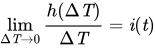
In reality, the intensity of the rain is not constant, but rather varies over time, therefore it can be defined as the instantaneous intensity of the rain:
- limΔ Δ T→ → 0h(Δ Δ T)Δ Δ T=i(t){displaystyle lim _{Delta {mathit {T}}rightarrow 0{frac {h(Delta {mathit {T}}}{Delta {mathit {T}}}}}}}}{{{{mathit {i}}({mathit {t}}}}}}
Double tilting bucket rain gauge

The funnel conducts the collected water into a small double triangular bucket, made of metal or plastic, with a hinge at its midpoint. It is a system whose balance varies depending on the amount of water in the buckets. The inversion usually occurs at 0.2mm of precipitation, so every time 0.2mm of rain falls the scale swings, emptying the full bucket, while the other begins to fill. Each time the double bucket moves, this movement is recorded on the paper band that advances at a constant speed, at the end of the day counting the number of times the bucket has moved, and multiplying it by the precipitation caused by its movement, the precipitation that fell during the day or in a shorter time interval will be obtained, with a precision of 0.2 mm.
Recently, the rain gauges available on the market are digital, recording the movement of the buckets by means of electronic systems that can be connected, for example, via radio, with a central server that stores all the data collected in various rain gauges.
With these modern tools, the measurement can be carried out, even in case of snow: if the funnel is equipped with a thermal resistance, which dissolves the snow.