
Plaza de la Constitución (Mexico City)
The Plaza de la Constitución, informally known as the Zócalo, is the main square of Mexico City. Together with the surrounding streets, it occupies a nearly rectangular area of approximately 46,800 m² (195 m × 240 m). It was named in honor of the Constitution of Cádiz promulgated in 1812. This is the second largest square in the world and the first among Spanish-speaking countries.
El Zócalo is located in the heart of the area known as the historic center of Mexico City, in the Cuauhtémoc district. Its location was chosen by the Spanish conquerors to be established right next to what was previously the political and religious center of Mexico-Tenochtitlan, capital of the Mexica.
It is surrounded by the Metropolitan Cathedral of Mexico City to the north, the National Palace (seat of the Federal Executive Branch) to the east, the Old City Hall Palace and the Government Building (replica of the previous one, both of the City Government of Mexico, headquarters of the local Executive Branch) to the south, and to the west by commercial buildings (such as the Portal de Mercaderes), administrative buildings and hotels. In the northeast corner of the square are the Templo Mayor Museum and Manuel Gamio Square, as well as the Zócalo station on Metro Line 2.
Since Mesoamerican times, it has been the site of important events in the various stages of Mexican history, as well as a site of concentration and social and cultural demonstrations. During five centuries of history, it has undergone changes in the elements and buildings that surround and constitute it; Gardens, monuments, circuses, markets, tram routes, fountains and other ornaments were installed and removed on numerous occasions. The current physiognomy dates back to 1958.
The Zócalo, beyond being the seat of political, economic and religious power in Mexico, as well as being a space where the indigenous and viceregal past mix, with almost five centuries of history, is also the place where the people of Mexico gathers to celebrate festivals or demonstrations, and important historical events have occurred. In the viceroyalty, proclamations by viceroys or uprisings such as the Mutiny of 1692 were made; The square was the meeting point for the triumphal entry of the Trigarante Army that achieved independence in 1821; In the independent era, Independence Day celebrations were held; the space was taken by the armies of the United States in 1847 and France in 1863. The XX century witnessed events such as the celebration of the centenary of independence in 1910, the taking of the square within the Tragic Decade, multiple political demonstrations, celebrations of presidential inaugurations, massive annual events such as the Grito de Dolores and the commemorative parades of the independence of Mexico, the Mexican Revolution and the Labor Day, as well as relevant events of the student movement of 1968.
Starting in 1997, the square gave way to a greater number of popular cultural, sports and entertainment celebrations, mainly massive concerts. However, in the century XXI continues to be the scene of the aforementioned festivities and social demonstrations. In 2010 it was the main scene of the celebrations of the bicentennial of the beginning of independence and eleven years later, in 2021, of the bicentennial of its consummation. The square, being part of the historic center, is considered Cultural Heritage of Humanity since 1987.
Origin of the name
Throughout its history, the square has had other official names, including Plaza de Armas, Plaza Principal, Plaza Mayor and Plaza del Palacio. It received its current name during the viceroyalty, in 1813, because it was there where the Spanish Constitution, promulgated in Cádiz the previous year, was sworn in New Spain.
However, it is commonly known as Zócalo, because in 1843, Antonio López de Santa Anna called a competition to make a commemorative monument for the Independence of Mexico, with Lorenzo de la Hidalga winning, who planned the construction of a column in the center of the square. Of this, only the plinth or base was placed, since the monument was never concrete; The socket remained in place for several years. Since then, the square also colloquially adopted the name Zócalo.
History
Mexico-Tenochtitlan

The area that the plaza occupies today was built within the original islet of the Mexica city of Mexico-Tenochtitlan and was part of its Templo Mayor, a religious precinct mainly in its southern part. It was limited to the east by the so-called "New Houses" of Moctezuma immediate predecessor, also lived.
New Spain Period

The first layout of the main square was made by the builder Alonso García Bravo, shortly after the Fall of Mexico-Tenochtitlan. After the destruction of the Mexica city, Hernán Cortés and Alonso García Bravo maintained the four original calpullis (sectors of the city), but they arranged a rectangular layout in the European style, laying out rectangular streets and avenues, with the headquarters of the main powers around the square.
With the Templo Mayor completely razed, the Spanish builders used the stones from it and other buildings in the teocalli to prepare the new Plaza Mayor in the year 1524. The first Spanish layout placed the new esplanade at the southern end of the enclosure. ceremonial (the southern edge of the coatepantli or temple wall would be located in the atrium of the current Metropolitan Cathedral) and they reoriented the space from north to south, since the great Mexica Teocalli "looked" towards the west, as well as the main gate of the enclosure, Cuauhquiáhuac, and from which the Tlacopan Causeway, today Mexico-Tacuba, began.
The Templo Mayor and the Mexica buildings were demolished, and in their place the Cathedral and the Viceregal Palace were erected, to symbolize the change of religious and political powers that was operating in what would be the Viceroyalty of New Spain. On the west side, several businesses were established, which gave rise to the Portal de Mercaderes.

During early colonial times, the plaza was surrounded to the north by the new church, and to the east by the new palace of Cortés, built on and with the ruins of Moctezuma's palace. On the west side of the plaza, the Portales de Mercaderes were built, to the south of Cortés, another palace, the Palace of the Marquis of the Valley of Oaxaca. On the south side the Portal of Flowers was made. Next to this portal was the City Hall Palace, the seat of the city government since then. Both were behind the Acequia Real in Mexico City.
Floods have always been a problem for the square and the city in general. One of the most serious was during the Flood of 1629, when the waters reached two meters high, destroying many of the businesses located there and requiring reconstruction.
After the construction of the new cathedral began in 1576, the appearance of the square changed. The old church was facing east and not towards the Plaza itself. The new cathedral, completed around 1657 and with three naves, rose towards the south over the square and gave the area a north-south orientation, which exists to this day.
For much of the 17th century, the square was filled with merchants. After a mob burned down the viceregal palace in the riot of 1692, the square was completely cleared to make way for the Mercado del Parián, a set of shops located in the southwest corner of the square used for the storage and sale of products brought by the galleons of Europe and Asia. This was inaugurated in 1703.
However, this did not prevent the rest of the Plaza from being filled again with improvised stands such as the group known as "San José", located next to Parián itself. This made historian Francisco Sedano comment that it was ugly and unsightly, as well as difficult to walk on due to its uneven mud pavement in the rainy season, aggressive street dogs, and piles of garbage in the streets. shops and human excrement, among other waste.
Reforms of 1790


With the arrival of the new viceroy Juan Vicente de Güemes, Count of Revilla Gigedo, and by the proclamation of Carlos IV in December 1789, reforms were carried out throughout the square: the repaving and releveling of the space and the Acequia Real was covered with stone blocks; A fountain was also installed in each corner. During these works, the Sun Stone and a sculpture of the goddess Coatlicue were found. The stone was put on display on the west side of the Cathedral, where it remained until 1890, when it was moved to the old Archaeological Museum on Moneda Street. The old merchants of the square moved to a new building called the Mercado de Volador, located southeast of the square, where the Supreme Court of Justice of the Nation is currently located.
The square became a public space with 64 lamps; The Cathedral was separated from the plaza with a set of pillars joined by chains, 124 stone benches were placed and the perimeter was delimited with iron posts joined by a chain of the same material. The main feature of the square was the placement of an equestrian statue of Charles IV made by Manuel Tolsá, which was inaugurated in December 1803; this was placed in the southeast corner on a gilded wooden base. However, when the monument was completely finished, the wooden base was replaced by an oval stone one; The gazebo around it, also oval in shape, measures 113 meters by 95.5 meters, with its own balustrade and fountains in the corners created by José del Mazo.
This was the backdrop, when Viceroy Félix María Calleja, other authorities and the assembled people swore allegiance to the Constitution of Cádiz, and loyalty to the Spanish Crown on May 22, 1813 in response to the beginning of the later Independence of Mexico. This event also resulted in the square being renamed “Constitution Square.” The last changes to the plaza before independence were made by Manuel Tolsá by placing the Mañozca Cross in the southeast corner and placing another, similar cross to the northwest. Both were established on a neoclassical stone pedestal.
Independent Mexico

On September 27, 1821, Vicente Filisola's division left Chapultepec to meet with the bulk of the Trigarante Army troops in Tacuba. At ten in the morning, the maximum leader led the parade into the capital, advancing along Paseo Nuevo to Corpus Christi Avenue, where he stopped at the corner of the San Francisco convent under a triumphal arch. The dean mayor José Ignacio Ormachea gave him the keys to the city. 16,134 troops paraded, of which 7,416 were infantry, 7,955 cavalry dragoons, and 763 artillerymen, who carried 68 cannons of different calibers. Among their main officers were Agustín de Iturbide, Vicente Guerrero, Domingo Estanislao de Luaces, Pedro Celestino Negrete, Melchor Álvarez, Epitacio Sánchez, José Morán, Nicolás Bravo, Anastasio Bustamante, José Joaquín Parrés, José Antonio de Echávarri, José Joaquín de Herrera, Luis Quintanar, Miguel Barragán, Vicente Filisola, José Antonio Andrade, Felipe de la Garza, Manuel de Iruela, Antonio López de Santa Anna, Gaspar López, Mariano Laris, and Juan Zenón Fernández. Once the parade was over, a mass was celebrated in the Cathedral of Mexico in which the Te Deum, then Iturbide gave a speech to the population. This symbolic act in the Plaza concluded the war of independence.

After Independence, the monument to Carlos IV was dismantled and removed from the Plaza, it was moved to the cloister of the University, near the Plaza del Volador; This left it naked, unlike the Plaza del Parián. On December 4 and 5, 1826, Lorenzo de Zavala and General José María Lobato led a group of soldiers, artisans and "pelados" attacking the Parian. They stole and burned shouting 'Death to the gachupines!' "Long live Lobato and those with fury!"; A group of merchants died and most of the businesses were destroyed.
In the year 1842, Antonio López de Santa Anna, then provisional president, issued an order by which the demolition of the Pariah Market was ordered, among other reasons considering that:
«...the deformity of the building called Parián, located in the main square of this capital, which so much for its no architecture, as for its miscalculated position, prevents and shaves the beauty and surprising view that it must present such main square...»"
This exposed the Plaza again, except for some ash trees and flower gardens that were planted and are protected by stone borders. Santa Anna wanted to build a monument to the Independence of Mexico in the center of the Plaza, but due to the instability of the country, the project commissioned to Lorenzo de Hidalga only completed the base (zócalo), which remained there for decades and this gave to the square its common name and current popular use. It remained this way until 1866, when the Paseo (route) of the Zócalo was created in response to the number of people who used the plaza for walks. A garden with paths was created and fountains were placed in each corner, 72 iron benches were installed and the area was illuminated by hydrogen gas lamps. The Santa Anna base, however, was not removed.

On September 14, 1847, within the framework of the United States invasion and at the end of the battles of the Belén and San Cosme sentry boxes, the American army was finally stationed in the main square of the capital, where Sergeant Benjamin S. Roberts lowered the Mexican labarum and raised the Stars and Stripes. On September 16, the US army organized a military parade along Alameda and Plateros Street. Many of the civilians threw stones and insults at the invading army.

Having just arrived in 1864, Emperor Maximilian took up the project of the monument to the Heroes of Independence that Santa Anna had left unfinished and for this he commissioned Ramón Rodríguez Arangoity to completely remodel the Zócalo, a work in which the element The main feature was the monumental column of the original project by architect De la Hidalga. The column would be surrounded with sculptures of the heroes of Independence and crowned with a large winged figure. Maximilian then proposed an imperial eagle as a finishing touch, breaking a chain and taking flight. In the absence of Maximilian on September 16, 1864, he saw fit to commission the Empress Charlotte to officially begin the construction of the monument in her name. She went to the center of the plinth, where an attractive shop had been placed, to place the first stone of the monument, although this work would once again remain unfinished, after the fall of the empire and the execution of Maximilian in 1867.
_(14782719645).jpg)
In 1875 two tram stations were built on the limits of the square. In 1878, Antonio Escandón donated a kiosk to the city, at the top of the base of Santa Anna. It was illuminated with four large iron chandeliers and designed similar to one in the Bois de Boulogne in Paris; This construction disappeared in the 20th century. Shortly after, the Ferrocarriles del Distrito Federal company converted part of the Zócalo into a tram station with a ticket office and a platform. The trams and lighting were converted to electric power in 1894, and the streets of the Zócalo were paved with asphalt in 1891.
From the second half of the 19th century to the beginning of the XX, the Zócalo was once again filled with market stalls, including the "Centro Mercantil", which sold Art Nouveau fabric, clothing and fashion.
20th century

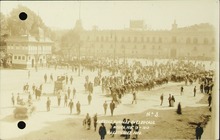


In 1910 the Zócalo was the main scene of the celebrations of the Centennial of Mexican Independence, the culminating moment of the beautification process that had been experienced as the main square throughout the Porfiriato. During the Tragic Decade, within the framework of the Mexican Revolution, the National Palace was bombed from a nearby military fort, also damaging the Zócalo, which was the scene of various clashes during that period.
In 1914, the ash trees planted in the previous century (which had grown considerably) were removed, new paths were laid out, green areas were outlined, the garden space was created, the kiosk was removed, and palm trees were planted in each corner of the square. This is following the proposal of the architect Alberto Pani to allow visibility that would give shine to the buildings that surround the place. That same year, on December 6, he would witness the arrival of the Villista and Zapatista troops who occupied the National Palace.
In 1921 a new garden layout was made, including four fountains, but the most significant change was the installation in the four corners of the perimeter of the bronze pegasi, which were originally intended to frame the main room of the then unfinished Palace of Fine arts. Although they did not remain there for long, since they were removed in 1934 when the aforementioned cultural venue was inaugurated and placed on its esplanade.
On March 23, 1938, approximately one hundred thousand people from all social classes spontaneously gathered in a huge demonstration in support of oil expropriation.
In 1958 the square acquired its current austere appearance, making a rectangular outline of a concrete slab, where only the flagpole was preserved; tram tracks were removed and car parking was prohibited. For the first time in four hundred years, the square took on a clear appearance. Few modifications were made later, almost all of them corrective to the unevenness of the plank due to the characteristics of the subsoil or the subway works, on some occasions small trees covered with bars and public lighting poles were installed, all of these elements did not last very long..
The Zócalo was the starting point of the marathon of the 1968 Olympic Games.
One of the main contributions of the student movement of 1968 (discussed in detail later), would be the beginning of the massive protests and citizen demonstrations that, parading through the main streets of Mexico City, found as their final meeting point the Plinth. Although it is true that there have been demonstrations of discontent in the square for a long time, these were basically sectoral, that is, from workers, peasants or opponents that normally ended in repression; Now the new paradigm marked numerous concentrations with more diverse members that on rare occasions (after 1968) ended in violent evictions.
Independent and official unions, peasant and popular organizations, members of opposition political parties from both the left and the right and closures of presidential campaigns were part of the constant demonstrations in the Zócalo after 1968. Fourteen years later, contravening the instructions of the regent, a crowd led by Arnoldo Martínez Verdugo, reopened the plaza waving thousands of red flags in a packed Zócalo. Faced with the tragedy of the earthquake of September 19, 1985, the Zócalo was a space for spontaneous meetings, a refuge and a center for the collection and distribution of food, clothing and medicine. There, as in many other parts of the city, a spontaneous and unprecedented citizen organization was born that also extensively and actively used public space. The students would reopen the Zócalo until 1987, in the first student movement that won a victory against neoliberal reforms in education, this within the framework of the UNAM Strike. The most relevant of the concentrations would be in support of the presidential candidate Cuauhtémoc Cárdenas and the complaints of possible electoral fraud in the 1988 presidential elections. On January 12, 1994, a full Zócalo stopped the war in Chiapas; In 1997 he spontaneously celebrated the democratic triumph after decades without an elected government in Mexico City; and until 1999, the Gay Pride March entered the Zócalo for the first time.
It was the scene of the celebration for the arrival of the year 2000, where the Mexican tenor Fernando de la Mora welcomed the change of millennium singing the mañanitas, accompanied by the music of 200 mariachis just below the flagpole.
Student movement of 1968
.JPG)
During the student movement of 1968, the Zócalo was the site of massive demonstrations called for the first time in many decades by a social movement opposed to the government. On August 13, 1968, the first one occurred, which brought together between 250 and 300 a thousand people. The crowd chanted during that event so that the then president Gustavo Diaz Ordaz would come out to the balcony for a public dialogue.
HE'S GOING TO THE BALCON, MAN. HE'S GOING TO THE BALCON, MAN. HE'S GOING TO THE BALCON, MAN. HE'S AL BALCÓN, BOCÓNConsigna that chanted the crowd on September 13, 1968, quoted in Poniatowska, Elena. The night of Tlatelolco.

But it was on September 27, one month after the movement, when a greater number of people gathered, close to 400 thousand. At five in the afternoon the march left the Museum of Anthropology towards the square, in where there were already 15 thousand people waiting. At 6:50 p.m. the students went up to the bell tower of the Metropolitan Cathedral with the permission of the priest Jesús López and rang the bells. At 7:20 p.m. a more group of protesters lowered the Mexico's national flag from the flagpole and in its place they raised a red-black strike flag, which was considered by the government as a provocation. Student leader Sócrates Campos Lemus told the crowd that, because the government did not had responded to a public dialogue called by the movement days before, student brigades would remain in the Zócalo. After singing the National Anthem, the students began to set up tents and light torches. At 1:20 a.m. on September 28, after an exhortation, the army arrived at the Zócalo with the 43rd battalions. and the 44th. of Infantry and the 1st Parachute Rifles, as well as 12 armored cars of presidential guards and 200 patrols of the DF police. During the night, another red-and-black flag was raised, different from the one the students had placed. In the first hours in the morning, the government called for an "act of redress for the flag", in which dozens of public servants participated, some of whom shouted "we're not going, they're taking us." At 1:25 p.m., officials from the Department of the Federal District lowered the red-and-black flag and placed the Mexican flag in its place. The mechanism that allowed it to be raised failed, so it was left at half-mast and it was necessary for a fire truck to complete the action surrounded by police from the Grenadier Corps. After a last warning, clashes began between protesters and soldiers, who showed bayonets on their rifles for action. Around four in the afternoon, they managed to disperse almost all the protesters, extending the persecution and clashes to the surrounding streets, with 35 injured in the scuffles. At 10:57 p.m., the Army had complete control of the square.
21st century

In the framework of the series of events that preceded the 2006 presidential elections and the political crisis derived from accusations of possible electoral fraud, the Zócalo was the frequent meeting center for supporters of the Head of Government of Mexico City and later presidential candidate Andrés Manuel López Obrador. The rallies that took place to support this character in the period 2005-2006 were preceded by several of the largest marches in the history of Mexico. The most notable were the so-called march of silence on April 24, 2005, which protested in rejection of the process of removal of immunity initiated against López Obrador, the demonstrations denouncing possible electoral fraud, which took place in the months of July, August and September, which ended with the so-called sit-in on Paseo de la Reforma starting on July 30, and in which the zócalo was the base of the organizers of the demonstration, with the square remaining occupied until September 15. It would also be the meeting point for the formation of the so-called National Democratic Convention and the Legitimate Government. Its use by supporters of Andrés Manuel López Obrador has spread over recent years, as it was for the concentrations that protested against the energy reform of 2008, which called for the creation of the National Regeneration Movement in 2011., for the closing events of the 2012 campaign, as well as for the celebrations and speeches on the occasion of his victory in the presidential elections on July 1, 2018, and his inauguration on December 1 of the same year.
In recent years, beyond the organizers or proposed positions of thought, citizen marches have gone beyond political interests; The most representative were the White March of June 27, 2004 in rejection of the insecurity experienced in the city and the country; the so-called let's light up Mexico march on August 30, 2008, which protested the high rates of violence and crime that spread throughout the country as a result of the war on drug trafficking. Other highlights have been the demonstrations for peace with justice and dignity on May 8, 2011; against the presidential candidacy of Enrique Peña Nieto promoted by the Soy132 movement on May 23, 2012; the mobilizations for the forced disappearance of Ayotzinapa in December 2014; and the CNTE sit-in against the educational reform in 2013. Between September 17 and 18, 2013, it occupied the space for a large collection center due to Hurricane Manuel.
In 2010, a replica of the Angel of Independence was brought to the Zócalo for the festivities of the Bicentennial of Mexican Independence and the Centennial of the Mexican Revolution. From there it became the main scene of the celebrations that began on September 15. Around 10:00 p.m. the Bicentennial Parade arrived at the Zócalo, and around 10:30 p.m. the presentation of the massive choreography “México Unidos” took place, the shows of El Tree of Life, El Coloso, Vuela México and the Flames Concert at the National Palace. Around 11:00 p.m. the traditional Cry of Independence was carried out by President Felipe Calderón Hinojosa. This is followed by fireworks in the Zócalo and a show of lights in the Metropolitan Cathedral of Mexico City.
On March 29, 2017, remodeling work began on the square's plank, the first large-scale project carried out since the 1960s; The plaza was expanded by 10% and improved to favor pedestrians, as well as the safe assembly, that does not damage the plank, of structures for different events. The work was carried out from March 29 to August 26, 2000 m² were added to the total surface, one vehicular lane was eliminated, eight safe crossings were enabled with greater pedestrian flow, architectural hydraulic concrete was placed in two-by-slabs. two meters for a mosaic-type view, an anchoring system was installed with specific and discreet lifting points to take care of the image of the site and avoid future damage due to the assembly of stages or tents, staff from the National Institute of Anthropology and History accompanied each task to To ensure the protection of the historical heritage, at the beginning five coves (50 centimeter excavations) were carried out together with INAH workers to ensure that no damage was caused to the heritage. During these works, the remains of the original plinth by Lorenzo de were excavated and consolidated. the Hidalga of 1842. In a commemorative manner, its perimeter was highlighted in the square with a steel ring that records its existence.
In 2021 it was the center of the commemorations and celebrations initiated by the government of Andrés Manuel López Obrador, on the occasion of the 500 years of the Siege of Tenochtitlan, and called 500 years of indigenous resistance, as well as the bicentennial of the consummation of independence. The first included a ceremonial act by various indigenous groups at the foot of a replica of the Templo Mayor. The second, which was attended by representatives from abroad, consisted of a representation of the historical process between the fall of the Mexica Empire and the signing of the Act of Independence of the Mexican Empire, emphasizing the period prior to the end of the armed struggle. with the agreements and final fights led by Agustín de Iturbide and Vicente Guerrero; Then a set of folk dances and typical music gave way to the traditional fireworks display; all of the above accompanied by projections on mounted stages, including the archaeological replica mentioned above.
Celebrations and mass gatherings
Ceremony of the Cry of Sorrows
.jpg)
In the year 1845, President Antonio López de Santa Anna officially established the Scream Ceremony to remember the priest Miguel Hidalgo and the heroes who fought for independence. Establishing that this will take place every September 15 at 11:00 p.m. It is also important to mention that although The Cry of Independence took place until the early hours of September 16, and as described by Artemio del Valle Arizpe in his book The National Palace of Mexico, Santa Anna established that the commemoration would take place on the night of September 15 to avoid the fatigue of waking up early to celebrate the event.
Civil-military parade of September 16
On September 27, 1821, the Trigarante Army, with Agustín de Iturbide at its head, entered Mexico City and with this the independence joust came to an end. This episode gave rise to the military parade with which the national holidays are commemorated. The parade route – along Paseo de la Reforma to the National Palace – was the one followed by the aforementioned army when it entered the country's capital.
.jpg)
In 1825 was the first time that September 16 took the form of a national holiday. The authorities of Mexico City published a notice in which citizens were asked to illuminate their houses, windows and balconies with curtains, streamers and pennants. The President of the Republic, Guadalupe Victoria, received congratulations from diplomats and ecclesiastical and civil corporations. Afterwards, a parade took place that reached the National Palace.
In 1915, Venustiano Carranza created the Military Aviation Weapon, this weapon paraded for the first time in a military parade on September 16, 1917, and is the historical precedent for the participation of the Mexican Air Force in military parades.
Álvaro Obregón celebrated September 16 with a ceremony at the Balbuena military field and changed the military parade to September 27, 1921, to celebrate the centenary of the consummation of Independence. In 1930, more than 25 thousand troops participated, there was an air stop, which meant the participation of the Mexican Air Force. In 1931 and 1934, the traditional parade became a ceremony where the Secretary of War and Navy decorated the historic flags of Mexico. In 1935, President Lázaro Cárdenas ordered that military parades be held again on September 16 without interruption, until they became a tradition in Mexico.
Civic-military-athletic parade (formerly sports parade) on November 20
On November 20, 1930, a civic sports parade was held for the first time, although informally, through the streets of Mexico City to commemorate the anniversary of the Mexican Revolution. In 1936 the event was made official after the holiday was decreed by the Senate of the Republic. Starting in 1941, the President of the Republic, who at that time was Manuel Ávila Camacho, was present on the central balcony of the National Palace. In addition to the elements of the army and federal agencies who paraded in sports attire and performing athletic demonstrations or rhythmic tables, amateur and professional athletes who had had some outstanding performance abroad participated during the celebration, as was the case of Olympic medalists or some of the national representatives of sports such as football, baseball, racquetball, etc.
Given the tensions experienced by the political crisis of 2006, then-president Vicente Fox canceled the parade; although it was reinstated during the six-year term of Felipe Calderón. In 2013, the traditional parade became a ceremony for promotions and decorations for elements of the Armed Forces; Following the mass kidnapping of Iguala in 2014, the celebrations took place in Campo Marte during the six-year term of Enrique Peña Nieto. In 2019, the traditional civic-military-athletic parade was finally reestablished by President Andrés Manuel López Obrador.
Labor Day Parade
Although some symbolic demonstrations had been held since 1913 to commemorate International Workers' Day in the Zócalo, it was not until its officialization in 1922 that labor organizations such as the CGT and the CROM participated formally. In 1925, a celebration organized by the main union groups was coordinated, in which the then president Plutarco Elías Calles participated as a spectator from the central balcony of the National Palace. The mechanics of the event consisted of a kind of greeting to the president of the republic, accompanying the steps with songs and slogans of the labor movement; All the official unions, peasant and popular organizations paraded before him, and the so-called independent unions closed the parade. The consolidation of the Confederation of Mexican Workers in the 1940s and its leader Fidel Velázquez led his organization to be the main participant, and him, a permanent companion of the president in office on the central balcony. The official parade that included the participation of the president was definitively canceled in 1995.
The Zócalo and Mexican presidentialism
With the transformation of the presidential figure into the axis of the country's political life starting in the 1920s, the symbols of its power (the presidential chair and sash; the Pines, etc.) became actors of the rituals that gave meaning and image to the exercise of power.
Of course the Zócalo, because it contained the National Palace, was part of these symbolic elements, especially because it was important in ceremonies such as the inauguration, where the president, after the massive parade that took him from the Congress headquarters, He had a festive reception in the Zócalo and towards his entrance to the National Palace; place where he performed his first acts as chief executive, on some occasions including a greeting from the central balcony to the crowd. At the presidential report ceremony, the president attended the Palace to put on the presidential sash and begin the journey to the headquarters of the congress, all within the framework of a massive parade. While the Central Balcony became the tribune of honor from where the Supreme Commander led the commemorative parades on May 1, September 16 and November 20.
The last popular gathering in the square to celebrate a president's assumption of power had occurred on the occasion of the inauguration of Vicente Fox on December 1, 2000. One would take place again on the occasion of the investiture of Andrés Manuel López Obrador on December 1, 2018, to close the events related to his inauguration, a popular support event and artistic festival was held, in which representatives of 68 indigenous groups symbolically presented him with the so-called < i>staff of command, an unprecedented act in the relationship between the native authorities and the presidency of the republic; To conclude the event he gave a speech to 150 thousand attendees.
It was also the meeting point in demonstrations of popular support for the first president, as occurred in the aforementioned inauguration or in one of the multiple demonstrations of loyalty of peasant, worker and popular organizations affiliated with the official PRI party. Just as it happened on March 23, 1938 to support the oil expropriation carried out by Lázaro Cárdenas, carried out five days before; on September 15, 1942 to encourage and defend the policy of National Unity of Manuel Ávila Camacho within the framework of Mexico's participation in the Second World War, an event in which he was accompanied by six of the eight living former presidents from that time: Adolfo de la Huerta, Plutarco Elías Calles, Emilio Portes Gil, Pascual Ortiz Rubio, Abelardo L. Rodríguez and Lázaro Cárdenas (Pedro Lascurain and Roque González Garza were not present); and on September 3, 1982 to support the nationalization of the banks by José López Portillo.
Concerts
- Juan Gabriel with 350 000 attendees on January 1, 2000, this is the record of greater assistance to the socket
- OV7 fired in April 2003 with 175 000 attendees
- Café Tacuba with 170 000 attendees on June 5, 2005
- Vicente Fernández with 217 000 attendees on 14 February 2009
- Shakira with 210 000 attendees on 27 May 2010
- Paul McCartney sings on May 10, 2012 before 200,000 attendees
- Justin Bieber who sang to 210 000 people.
- Roger Waters gives a show on October 1, 2016 to over 200,000 people.
- Concert We are United Mexicans on 8 October 2017 with 170 000 spectators; in commemoration and support to the victims by the earthquakes of 7 and 19 September.
- Caifanes with 120 000 attendees on November 10, 2017 as part of the Youth Week 2017
- Rosary with 160 000 attendees on April 27, 2023
- The Fabulous Cadillacs with 300 000 attendees on June 3, 2023
Honors ceremonies and raising of the monumental flag
.JPG)
- February 24 (Día de la Bandera Mexicana).
- 15-16 September (Anniversary of the Independence of Mexico).
- November 20 (Anniversary of the Mexican Revolution).
- 14 February. Death of Vicente Guerrero
- February 22nd. Death of Francisco I. Madero
- February 28th. Death of Cuauhtémoc
- April 10th. Death of Emiliano Zapata
- May 21. Death of Venustiano Carranza
- 17 July. Death of Alvaro Obregón
- July 18th. Death of Benito Juárez
- July 30th. Death of Miguel Hidalgo and Costilla
- September 19th. Commemoration for the victims of the 1985 and 2017 earthquakes
- 2 October. Anniversary of the fallen in the struggle for democracy of the Plaza de las Tres Culturas in Tlatelolco in 1968.
- 7 October. Commemoration of the sacrifice of Senator Belisario Domínguez in 1913.
- December 22nd. Anniversary of the death of José María Morelos, in 1815.
Popular culture
Cinema
- In the plot of the film Rio Escondido (1947) by Emilio Fernández, María Félix hears the apparent voice of the Dolores Bell at the National Palace.
- A night shot of the square appears in Mexico Chamber (1948) by Emilio Fernández.
- At the end of the film introduction sequence Spectre (2015), James Bond fights against a Spectre agent named Marco Sciarra in a helicopter on the Plaza.
Panoramas

Zócalo from Mexico City in 1948. 
Panoramic view of the Plaza del Zócalo with National Palace (from the federal executive branch) and flanked by the Metropolitan Cathedral, the Government Building and the Old Town Hall; both headquarters of the Government of Mexico City. 
Looking south of the buildings of the Federal District. The extreme right is the old Portal de Mercaderes. These buildings were decorated for the Bicentennial celebration of Mexico 2010. 
360° panoramic photo of Mexico City Zócalo. 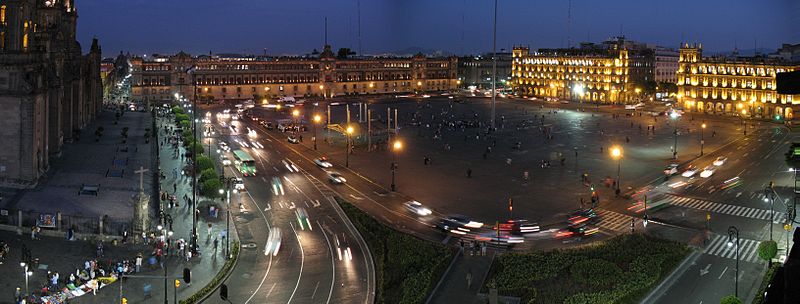
Night view of the Zócalo.


