
Planck time
The Planck time or chronon (term coined in 1926 by Robert Lévi) is a unit of time, considered as the smallest temporal interval that can be measured. It is denoted by the symbol tP. In cosmology, Planck time represents the smallest instant of time at which the laws of physics could be used to study the nature and evolution of the Universe. It is determined as a combination of other physical constants in the following way:
| Symbol | Name | Value | Unit |
|---|---|---|---|
| Time of Planck | 5.39106(32)E-44 | s | |
| Constant of Planck reduced | 1.054571817E- 34 | J s | |
| Constant universal gravitation | 6.674E-11 | N m2 / kg2 | |
| Speed of light in the vacuum | 299792458 | m/s |


The numbers in parentheses show the standard deviation.
History and definition
The concept of natural units was introduced in 1874, when George Johnstone Stoney, observing that electric charge is quantized, derived units of length, time and mass, now called Stoney units in his honor. Stoney chose his units so that G, c, and the electron charge e were numerically equal to 1. In 1899, a year before Following the advent of quantum theory, Max Planck introduced what would later be known as Planck's constant. At the end of the article, he proposed the basic units that were later named in his honor. Planck units are based on the action quantum, now commonly known as Planck's constant, which appeared in the Wien approximation for blackbody radiation. Planck stressed the universality of the new system of units, writing:
- ... die Möglichkeit gegeben ist, Einheiten für Länge, Masse, Zeit und Temperatur aufzustellen, welche, unabhängig von speciellen Körpern oder Substanzen, ihre Bedeutung für alle Zeiten und für alle, auchmen außerirdische.
... it is possible to establish units for length, mass, time and temperature, which are independent of special bodies or substances, necessarily retaining their meaning for all times and for all civilizations, including the extraterrestrials and the non-human ones, which can be called "natural units of measurement".
Planck considered only units based on universal constants , , and to reach the natural units of length, time, mass, and temperature. Their definitions differ from modern ones in a factor of because modern definitions use instead of .


| Name | Dimension | Expression | Value (SI units) |
|---|---|---|---|
| Longitude Planck | length (L) | 1.616255(18)×10−35 m | |
| Planck Mass | mass (M) | 2.176434(24)×10−8 kg | |
| Time of Planck | time (T) | 5.391247(60)×10−44 s | |
| Planck temperature | temperature (rice) | 1.416784(16)×1032 K |


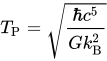
Unlike the International Unit System, there is no official entity establishing a Planck Unit System definition. Some authors define as base units of Planck those of mass, length and time, considering redundant an additional unit for temperature.(For example, both Frank Wilczek and Barton Zwiebach do, as well as the text book. Gravitation.) Other tabulations add, in addition to a unit for temperature, a unit for the electric charge, so that the vacuum allows also normalizes to 1. Some of these tabulations also substitute mass for energy by doing so. Depending on the author's choice, this cargo unit is given by


or

The Planck charge, and other electromagnetic units that can be defined such as resistance and magnetic flux, are more difficult to interpret than the original Planck units and are used less frequently.
In SI units, the values of c, h, e, and kB< /sub> are exact and the values of ε0 and G in SI units respectively have relative uncertainties of 1.5×10⁻¹⁰ and 2.2×10⁻⁵. Therefore, the uncertainties in the SI values of Planck units arise almost entirely from the uncertainty in the SI value of G.
Features
The Planck time represents the time it takes for a photon traveling at the speed of light to travel a distance equal to the Planck length. From the perspective of quantum mechanics, the Planck time has traditionally been considered to represent the minimum unit that could in principle be measured; That is, it would not be possible to measure or discern any difference between the universe at a specific instant in time and at any instant separated by less than 1 Planck time. However, deep-field images taken by the Hubble Space Telescope in 2003 have cast doubt on this theory. The prediction was that images of objects located at very long distances should be blurry. This would be because the discontinuous structure of space-time at the Planck scale would distort the path of photons, in the same way that the Earth's atmosphere distorts the images of objects located outside it. However, these images are sharper than expected, which has been interpreted as an indication that Planck time is not the shortest interval in the universe.
The estimated age of the universe (4.3 × 10¹⁷ s) is approximately 8.1 × 1060 Planck times. In Planck time, light in a vacuum travels approximately 1.62 × 10⁻³⁵ m.
Contenido relacionado
(8744)
(119) Althaea
Half life