
Perissodactyla
The perissodactyls, Perissodactyla or odd-toed ungulates (from the ancient Greek περισσός perissós, "odd"; and δάκτυλος dáktylos, "finger"), are an order of placental mammals. They are ungulate mammals that are characterized by the possession of limbs with an odd number of toes ending in hooves, and with the central toe, which serves as a support, more developed than the others. They are herbivores. Currently it only includes horses, donkeys, zebras (Hippomorpha suborder), tapirs and rhinos (Ceratomorpha suborder).
Features

Early perissodactyls were very similar to other primitive ungulates. The legs develop the mesaxonic condition, that is, the central (third) toe becomes larger and the others are reduced, at the same time that the lower region of the extremities lengthens and the upper one shortens, with reduction of the ulna (ulna) and fibula (fibula).
A distinctive feature of perissodactyls is the organization of the carpus and tarsus. In the forelegs (sometimes referred to as "hands" in popular parlance), a distal carpal, the large bone, flares and articulates with the proximal carpals, while that in the foot, the ectocuneiform transforms into a large flat bone that transmits the thrust of the talus through a flattened navicular; the talus has a flattened undersurface and is not trochlea-like as in artiodactyls.
The digestive system is less specialized than in artiodactyls. The incisors are preserved and used to mow the grass, the canines are reduced or absent, and there is often a gap. The molars of primitive forms remained bunodont and low-crowned, but in modern rhinos and horses they have an elaborate grinding surface; the premolars are molarized, thus achieving a large grinding surface.
The alimentary canal is simpler than that of artiodactyls. The stomach has no chambers. Cellulose digestion takes place in the cecum and large intestine, which can be highly developed.
Perissodactyls are macrosmatic, that is, the sense of smell predominates, with the sensory portion of the nose highly developed.
Evolutionary history
The most primitive perissodactyls had separated very little from the condylarthros. Hyracotherium, from the Eocene was about the size of a small dog and resembled the condylarthro Phenacodus; it had a complete dentition, with trituberculate premolars and bunodont square molars with two transverse ridges. Locomotion was digitigrade in primitive forms.
The earliest known perissodactyls date from the Eocene, although they possibly arose in Asia during the Late Paleocene, less than 10 million years after the Cretaceous-Tertiary mass extinction in which the dinosaurs and many other organisms became extinct. A early Eocene, 55 million years ago, they were already diversified and occupied several continents.
Horses and tapirs evolved in North America while rhinos appear to have evolved in Asia from tapir-like animals and then recolonized the Americas during the Middle Eocene (about 45 million years ago). There were 15 or 16 families, of which only three survive today.
These families were highly diverse in appearance and size; some included gigantic (Brontotheriidae) and strange (Chalicotheriidae) animals. The largest perissodactyl was an Asian rhinoceros (Paraceratherium) which, at 11 tons, was more than twice the size of living elephants.
Perissodactyls were the dominant group of large herbivorous mammals during the Oligocene. However, the expansion of the grasslands during the Miocene (about 20 million years ago) favored the artiodactyls which, with their chambered stomachs, were better adapted to such a nutrient-poor diet and soon wrested supremacy from them. Despite this, many perissodactyl species survived and thrived until the end of the Pleistocene (only 10,000 years ago), when they could not withstand the pressure of human hunters or the new habitat.
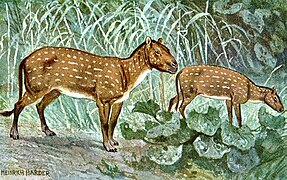
Hyracotherium

Paraceratherium

A Californian

Brontoterior skeleton


Taxonomy

The following classification (down to the family level) is based on the McKenna & Bell (1997)
Order Perissodactyla
- Suborden Hippomorpha
- Superfamily Pachynolophoidea †
- Family Pachynolophidae †
- Superfamily Equoidea
- Family Palaeotheriidae †
- Indolophidae Family †
- Equidae family
- Superfamily Pachynolophoidea †
- Suborden Ceratomorpha
- Class Selenida
- Superfamily Brontotheroida †
- Anchilophidae Family †
- Lambdotheriidae †
- Family Brontotheriidae †
- Superfamily Chalicotheroida †
- Family Chalicotheriidae †
- Superfamily Brontotheroida †
- Class Selenida
- Class Tapiromorpha
- Superfamily Rhinocerotoidea
- Family Amynodontidae †
- Hyrachyidae Family †
- Hyracodontidae Family †
- Family Rhinocerotidae
- Superfamily Tapiroida
- Family Isectolophidae †
- Helaletidae Family †
- Lophiodontidae Family †
- Family Deperetelidae †
- Bahinolophus Gender †
- Genre Deperetella †
- Family Lophialetidae †
- Family Tapiridae
- Superfamily Rhinocerotoidea
- Class Tapiromorpha

Cladogram according to Hooker and Dashzeveg from 2004:
| Perissodactyla |
| ||||||||||||||||||||||||||||||||||||||||||||||||
Contenido relacionado
Acroceras
Aristida
Agropyron