
Pazuzu

Pazuzu (Akkadian: pà.zu.zu; also called Fazuzu or Pazuza) is the king of wind demons, son of the god Hanbi or Anu, in Mesopotamian mythology. For the Sumerians, he also represented the southwest wind, which brought storms, and also the bearer of plagues and plagues, delirium and fever. He was a personification of the west wind and exercised kingship over the demons of the wind or "Lilû".
As an apotropaic entity, it was considered both a destructive and dangerous wind, but also a repellent of other demons, which would safeguard the home from their influence. In particular, he was protective of pregnant women and mothers, whom he could defend against the machinations of the demoness Lamashtu, his consort and rival. He is invoked in rituals and representations of him are used as defensive amulets.
He has many connections to other wind deities, namely Lamashtu and the Lilû demons, other protector demons, as well as the foreign Egyptian dwarf deity Bes.
Origin and history

According to Wiggermann, the figure of Pazuzu appeared suddenly in the early Iron Age. Its first visual representations are not attested until the 17th century VIII a. C. with the first finds in the tombs of Nimrud, and its first appearances in texts date back to the VII century a. Most of its representations date from the VII and VI a. C., and the most recent finds date back to the time of the Seleucid Empire.
Function
Pazuzu has two main aspects. First as a demon of the hearth, as a domestic spirit, and second as the demon of the wandering wind, traversing the mountains, where he presents himself as a wilder character.
Pazuzu as a household protector deity
There is well-documented use of Pazuzu in Mesopotamian white magic. Its grotesque, inhuman form could have been used as a method of keeping unwanted guests away, as well as quelling its wind demon subjects so that they do not enter the house and wreak havoc. Their role in ritual and magic is documented in inscriptions on the back of their statues or in ritual texts. Special spells, incantations, and artifacts were used to gain favor and protection of the devil. These artifacts were placed in and around the home, or worn on the person to achieve the desired effect.
Objects of protection
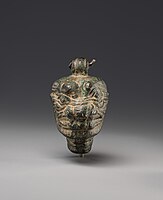
Large numbers of Pazuzu heads have been discovered, made of a variety of materials, mainly terracotta, but also bronze, iron, gold, glass, and bone. These heads often had holes or rings on the top, for so pregnant women could wear them on necklaces to protect the baby from evil forces. Occasionally, the heads were attached to cylinder seals or also used as brooches. Some of these heads have been found in tombs.
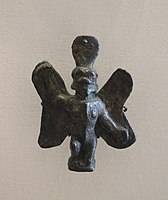
Carved amulets are also common. Uruk ritual texts state that a woman may be given a bronze necklace or Pazuzu amulet to protect her from miscarriage due to Lamastu's interference. Some are rectangular in shape, where Pazuzu is standing or crouching. Larger amulets made of stone could be hung on the wall to protect the room or entrance. One such amulet found inside a house in the Neo-Assyrian city of Tell Sheikh Hamad was lying on the floor of the main reception room and is believed to have hung on the wall opposite the entrance.
Given the volume of artifacts discovered, it is believed to have enjoyed great popularity, and based on the uniformity of the heads, amulets, and statues, it is even speculated that representations of Pazuzu were mass-produced.

Pazuzu Bronze Head, which includes a slack to tie on a collar and use as a protective amulet. British Museum.

An amulet of Pazuzu of the British Museum.

Red jasper stalk of a Pazuzu in squats, this narrow posture suggests its connection to the West Wind. Louvre Museum.
This pendant used a suspension loop to ensure that the demon's look was always heading out. To ensure that the demon's energy was directed at the threats the user faced.

Figurine of bronze of Pazuzu. Collection of the Old Near East of the University of Tübingen.

Bronze plate representing Pazuzu, serving as amulet. British Museum.

Pazuzu heads of bronze and stone. British Museum.

Pazuzu head in red stone with inscription. Louvre Museum.
Pazuzu bronze statuette in razors. Louvre Museum.

Cylindrical seal of bronze, crowned by the head of the demon Pazuzu. Louvre Museum.

Pazuzu head and claws on the Lamashtu plate. Louvre Museum.

Lower Lamashtu plate registration: Pazuzu, on the left, repeling the demon Lamashtu (centre). Louvre Museum.


Ritual texts
In connection with the depictions of Pazuzu, text inscriptions on the reverse of the depictions or on the tablets would invoke or mention Pazuzu.
A ritual text from Assyria prescribes a head of Pazuzu as a way to banish disease. Similarly, a ritual incantation against Lamastu from the late Babylonian period instructs making a necklace of Pazuzu and hanging it around the neck of the afflicted..
Various texts "medicinal-exorcists" (exorcism and medicine are difficult to distinguish in Mesopotamia, where the two practices were combined) involve Pazuzu or figurines of him. For example, a text unearthed at Nimrud in Assyria presents a ritual of making a protective Pazuzu figurine from dust collected from various holy sites or having a symbolic link to disease:
«If any one has been taken by the 'Mano-de Ishtar', disease-LINE.LÁ.EN.NA (diseases), any evil, and does not release it, to heal (the patient): (recoger) the dust of the temple of Marduk, [the dust of the temple of] Ishtar, the dust of the pedestal of worship, the dust of the door of a healthy man, [the dust of the door] of a dead man, dust of the door of the workshop, the dust of the crossroads, the dust of the wall. Mix these 14 dusts in the water tank of the Marduk temple. Make the bust of a statue of a figurine of Pazuzu. If the patient carries (the figure) in both hands, or if placed on the patient's head, whatever evil he has attacked, he will observe and will not approach. This patient will heal. »
Pazuzu, King of the Evil Wind Demons
In the bilingual version (Sumerian and Akkadian) of the Compendium, he identifies himself:
"I am Pazuzu, son of Đanbi, king of evil demons lilû. I became angry (in a violent movement) against the strong mountains and I ascended them."
Another text also narrated by him describes Pazuzu meeting other lilû demons on his travels and breaking their wings, thus preventing them from inflicting damage:
"I went up to a mighty mountain that was shaking, and the (bad) winds I found there were heading west; one by one I broke their wings. »
In another text, he is perceived as more malicious, as the narrator refers to him as "Humanity's Agony", "Humanity's Suffering", "Humanity's Disease", and chants for prevent the devil from entering the home.
Description and mythology
He is usually depicted with the body of a man, the head of a lion or a dog, goat's horns on his forehead, bird's claws instead of feet, two pairs of eagle's wings, a scorpion's tail, and a snake-shaped penis. It is also usually shown with the palm of the right hand up, and the left down. This hand position symbolizes life and death, or creation and destruction.
Pazuzu is the demon of the southwest wind known for bringing famine during the dry seasons and locusts during the rainy seasons. Although Pazuzu is considered an evil spirit, he was invoked to protect himself from other evil spirits. He would protect humans against any kind of misfortune or plague.
Her image was used on apotropaic amulets to ward off her consort and enemy Lamashtu, a female demon who fed on newborns and their mothers. This amulet was placed both on her mother, wearing it around her neck, and on the child, while larger ones were placed above them on a wall.
Statuette in the Louvre Museum


It is undoubtedly the most famous representation of this demon and the one that was used as a model for the movie The Exorcist. This is an image dating from the first millennium BC (VIII century and VII BC) and was found in Iraq. Since 1872 it has been part of the collections of the Louvre Museum in Paris.
The figurine is barely 14.5 cm. height, it was made to be hung around the neck, hence it has a ring on its head. It is located in the Richelieu wing, room 6, showcase 4. This work is a valuable testimony of the bronze art of the Assyrians. In this statue, Pazuzu is depicted as a chimera with the body of a man, a lion's head, eagle's feet, two pairs of wings of a bird of prey, a scorpion's tail, and a serpentine-shaped penis. He is also shown with his right hand pointing up and his left pointing down.
On its back is the inscription: "I am Pazuzu, son of Anu (Hanbi), I am king of the demons of the air who descend with force from the mountains wreaking havoc". Next to the statuette of Pazuzu is the Spell Plaque against the Lamashtu, a bronze amulet made to avoid falling ill or to cure an illness. It was carried out to take the demon Lamashtu back to the Underworld, and in this way she would abandon the body of the sick person that she had possessed. The plate is held by the demon Pazuzu. He sees it from behind, behind the plate. His head is visible on the face in front of the plate.
Pazuzu in popular culture
- Pazuzu appears in the Danish film Häxan 1922.
- In the movie The exorcist, it takes place the same story as in the original novel. Unlike this, Pazuzu is regarded as Satan himself, so in this first part of the saga it is not mentioned as Pazuzu, but as the "demon," Satan, etc.
- In Exorcist II: the hereticPazuzu finds Regan in Washington, returning her to possess. Regan, among memories of his past and viviences of his horrific present, faces Pazuzu, succeeding in defeating him and expelling him from his body. Pazuzu takes shape of a lobster. From this second part of the saga, the demon already appears mentioned as Pazuzu.
- In Exorcist IIIPazuzu comes looking for the body of Father Karras, who managed to possess it and debate it between life and death. Karras after intense suffering dies of a shot in the head, which he asked not to be possessed again by Pazuzu.
- In Exorcist: The Beginning: The first years of Father Lankester Merrin and his eagerness to fight Pazuzu are described. These facts happen obviously before all previous films.
- In the television series The exorcist: Pazuzu continues to search for Regan, so much so he owns his daughter to blackmail her. His anger is uncontrollable and his thirst for insatiable blood. Then he is defeated by Father Thomas thanks to the teachings of Father Marcus.
- Pazuzu is also the name of a group of Austrian black metal.
- In the television series FuturamaPazuzu is the name of Professor Hubert Farnsworth's pet gargole.
- Pazuzu is mentioned, although it does not appear physically, in the episode "The Saint of Last Resorts"of the first season of the series Constantine.
- It also appears in table games Dungeons & Dragons.
- On the sleeve Godsider, one of the main enemies of the protagonist is the reincarnation of Pazuzu.
- In the episode "Treehouse of Horror XXVIII" of the series The Simpsons, baby Maggie Simpson is possessed by Pazuzu, specifically in the chapter section called "The Exor-Sis". The possession takes place by the intervention of a statue received through a fictional version of Amazon. In reference to the film The ExorcistMaggie is able to turn her neck at a 360o angle on various occasions. In addition, although Lisa Simpson also contributes to exorcism, Maggie is exorcized by a Catholic exorcist.
- Pazuzu is the statue of a demon that appeared in the Rockit video of the British band Gorillaz. Pazuzu also appears on the cover of the compilation album D-Sides, as well as on the cover of the album Phase Two: Slowboat to Hades, with the Gorillaz sitting around. It is also located outside the Kong studios overlooking the cemetery, as shown in the beginning of the video clip of the theme "Dare". During the album Plastic BeachYou can see him in Rhinestone Eyes.
- Pazuzu appears as one of the main antagonists of the video game Castlevania: Harmony of Dissonance by Konami for Game Boy Advance.
- Swedish synthetic metal band Therion launches in August 2022 new video of a simple titled "Pazu" of his album Leviathan II, in which they reveal visually important mythological influences of Mesopotian cultures.
- In the movie Legend 1985, you can see several statues of Pazuzu around the swamp of the great tree and within it.
- Pazuzu also appears in the film Wishmaster of 1997.
- In the television series Ultraman GaiaThere's a monster named Pazuzu.