
Oracle corporation
Oracle Corporation is a company specialized in the development of cloud and local solutions. Oracle is headquartered in the town of Austin, the capital of the state of Texas. According to the ranking corresponding to the year 2006, it ranks first in the database category and seventh in the world of information technology companies. Oracle technology is found in many industries around the world and in the offices of 98 of the 100 Fortune 100 companies.
Oracle (Nasdaq: ORCL) is the first stereotype software company to develop and deploy 100 percent Internet-enabled enterprise applications across its entire product line: database, business applications, and software development tools. applications and decision support. Oracle is the world's leading provider of information management software worldwide, well ahead of the second in its segment, Software AG.
History
Larry Ellison, Ed Oates and Bob Miner founded a consulting company called Software Development Laboratories (SDL) in 1977, and later obtained a contract with the CIA to design a special database system keycoded "Oracle". Ellison and Miner had read an article in the IBM Journal of Research and Development describing a preliminary version of the SQL language, based on the article by E. F. Codd proposing the relational model: "A Relational Model of Data for Large Shared Data Banks". IBM had authorized Codd's work to be published, after unsuccessful attempts to make an IBM System R RDBMS, which was also based on Codd's theories. IBM refused to share R system code. Oracle's initial version was 2; there was no Oracle 1. The version number was meant to imply that any bugs that might have existed in a previous version had already been fixed.
The partners founded Oracle by placing US$1400 of their own money, under the name Software Development Laboratories (SDL). In 1979, the company was renamed Relational Software Inc., later renamed Oracle after the success of the flagship Oracle database product. The name was taken from an Intelligence project, to which the database had been sold.
In 1982, seeking consistency with its business objectives, SDL changed its name to Relational Software Incorporated (RSI). The company seeks to have a product that was compatible with IBM's SQL, and also to focus on a minicomputer market, thus covering a segment that IBM was not interested in at that time.
In 1984 RSI changed its name to Oracle Systems Corporation, and shortly after it was shortened to the current "Oracle Corporation". The following year, Oracle V3 begins to be commercialized, adding the handling of transactions through the COMMIT and ROLLBACK instructions. In fact, the product is recoded in C which allows the execution platforms to be expanded to include Unix environments, when until now it was only on Digital VAX/VMS.
In 1986, Oracle V4 supports read consistency and in 1985 Oracle V5 begins to support the client/server model to join the boom in the emergence of networks. In addition, the execution of distributed queries is supported. The same year, 1986, was when Oracle began trading on the NASDAQ index of the New York Stock Exchange (United States).
In 1989, Oracle's ERP, known as Oracle Financials®, was launched on the market, along with version 6 of the engine, which added a procedural language (Pl/Sql), row-level locking, and the possibility of making backups without the need to terminate the processes involved.
In 1990, in the only quarter where it lost money, Oracle laid off about 10% (about 400 people) of its workers due to a cash-revenue mismatch. This crisis came about because of "Oracle's go-to-market strategy," in which sales people were urged to induce potential customers to buy as many programs as possible at once. Sales staff reserve the value of future license sales in the current quarter, which increases their bonuses. This became a problem when future sales subsequently failed to materialize. Oracle ultimately had to restate its earnings twice, and also settle class court action claims that stemmed from overstating its earnings. Ellison would later say that Oracle had made "an incredible business mistake."
Although IBM dominated the mainframe market with hierarchical and networked databases (SQL/DS), it never commercialized its RDBMS (System/R) and took several years to enter the database market relational on UNIX and Windows operating systems. This left the door open for Sybase, Oracle, and Informix—and eventually Microsoft—to dominate midrange systems and microcomputers. Oracle was the first commercial RDBMS.
Around this time, Oracle fell behind Sybase. From 1990-1993, Sybase was the fastest growing relational database management company and the industry's provider of the beloved database, but it soon fell victim to its merger mania. The 1993 merger of Sybase with Powersoft resulted in a loss of focus on its core database technology. In 1993, Sybase sold the rights to its database software running under the Windows operating system from Microsoft Corporation, now trading under the name SQL Server.
In 1992, to become a complete database, Oracle V7h appears, where the "h" comes from "datawareHouse", although the most significant is the support of referential integrity, the storage and execution of programs written in Pl/Sql within the engine and the definition of triggers.
In 1994, Informix Software became Oracle's biggest rival. The intense war between Informix CEO Phil White and Ellison was regular news in Silicon Valley for three years. In April 1997, Informix announced a significant revenue and earnings benefit estimate from the write-offs. Phil White eventually ended up in jail. Informix was absorbed by IBM in 2000.
In 1997, with the Internet already a reality and with new programming paradigms beginning to appear to try to displace the imperative paradigms, Oracle V8 began to support object-oriented developments and the storage and execution of multimedia content, and in 1999 Oracle 8i comes out to be in tune with the requirements of the Internet, from which the "i" Of the name. In addition, the engine incorporates an internal Java Virtual Machine (Java Virtual Machine) to support the storage and execution of Java code within the engine.
21st century
| Year | Company | Transaction in millions of dollars |
|---|---|---|
| 2004 | Peoplesoft | 10500 |
| 2005 | Siebel Systems | 5850 |
| 2007 | Hyperion Solutions | 3300 |
| 2008 | BEA Systems | 8500 |
| 2008 | GKS | |
| 2008 | RuleBurst Holdings Limited | |
| 2009 | Sun Microsystems | 7477 |
| 2011 | Datanomic | |
| 2011 | Pillar Data Systems | |
| 2011 | RightNow Technologies | 1500 |
| 2012 | Tale | 1900 |
| 2012 | Clear Trial | |
| 2012 | Vitrue | 239 |
| 2012 | Collective Intellect | |
| 2014 | Bluekai | |
| 2018 | Zenedge |
Once Informix and Sybase were beaten, Oracle enjoyed years of industry dominance until the place of Microsoft SQL Server in the late 1990s and the acquisition of IBM Informix Software in 2001 to complement its DB2 database. Today Oracle's main competition for new database licenses on UNIX, Linux and Windows operating systems is with IBM's DB2, and with Microsoft SQL Server -whose installed base is mostly on Windows although there is also a version for Linux since the year 2017-. IBM's DB2 continues to dominate the mainframe database market.
In 2001, Oracle 9i brings over 400 new features including the ability to manipulate XML documents, high availability options, clustered databases. An important advance is made on the definition of virtual databases (VPD), authentication via LDAP and self-administration of the database.
In 2003, Oracle Corporation releases Oracle 10g, where the "g" comes from "Grid", incorporating the management and administration of Grid Computing databases, a set of databases whose management of space, resources and services can be managed as if they were one.
In 2005, two years later, the company acquired PeopleSoft, an HR and ERP applications company.
In 2007, Oracle announced the latest version of its database in New York City, calling it Oracle 11g, the next step in Oracle Corporation's history of technological innovation.
In April 2009, Oracle announced its intention to buy Sun Microsystems after a tug-of-war with IBM and Hewlett-Packard. The European Union approved Oracle's acquisition of Sun Microsystems on January 21, 2010, agreeing that "Oracle's acquisition of Sun has the potential to revitalize important assets and create new and innovative products."
In September 2014, its founder, Larry Ellison, retires from the company's general management, remaining as executive chairman of the Board of Directors and general director of Technology. In his replacement, Safra Catz and Mark were appointed as general directors hurd.
In 2018 the company announced the launch of Oracle Autonomous Database, considered the first autonomous database.
Offices
Oracle Corporation is headquartered in Austin, Texas. He formerly owned a resort on the San Francisco Peninsula in the Redwood Shores area of Redwood City, adjacent to Belmont and near the San Carlos Airport (IATA airport code: SQL).
Oracle HQ is located on the former site of Marine World / Africa USA, which moved from Redwood Shores to Vallejo in 1986. Oracle Corporation originally leased two buildings on the site, moving its finance and administration departments from the former headquarters of the corporation on Davis Drive, Belmont, California. Ultimately, Oracle purchased the complex and built four other main buildings.
The distinctive buildings on Oracle Parkway, nicknamed the Emerald City, served as the setting for the futuristic headquarters of the fictional company "NorthAm Robotics" in the Robin Williams film Bicentennial Man (1999). The campus represented the headquarters of Cyberdyne Systems in the film Terminator Genisys (2015). {{| image =|1200px|Former headquarters of the corporation in Austin, Texes.}}

300 Former corporation headquarters in Redwood Shores, California.
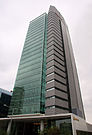
Oracle Aoyama Center Building, with Lexus International Gallery Aoyama
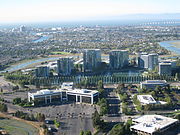
Oracle HQ, with Oracle Plaza building in the foreground to the left

Oracle Conference Center at Oracle Corporation headquarters in Redwood Shores, California

Source on Lake Oracle, Redwood Shores

Oracle Corporation has an important business campus in Thames Valley Park in Reading, England

Oracle in Markham, Ontario


.jpg)


Legal Cases
Sun Microsystems Acquisition
On January 27, 2010, Oracle announced that it had completed its acquisition of Sun Microsystems, valued at more than $7 billion, a move that transformed Oracle from a mere software company to a manufacturer of software and hardware. The acquisition was delayed for several months by the European Commission due to concerns about MySQL, but was ultimately approved unconditionally. This acquisition was important to some in the open source community and some other companies as well, as they feared that Oracle could end Sun's traditional support for open source projects. Since the acquisition, Oracle has discontinued OpenSolaris and StarOffice, and sued Google over its recently acquired Java patents from Sun. In September 2011, US State Department embassy cables were leaked to WikiLeaks. A cable revealed that the United States put pressure on the EU. to allow Oracle to acquire Sun.
Lawsuit against Google
Oracle purchased the Java computer programming language when it acquired Sun Microsystems in January 2010. Java software includes pre-developed sets of software code to perform common tasks consistently across programs and applications. Pre-developed code is organized in "packages" separated, each of which contains a set of "classes". Each class contains numerous methods, which instruct a program or application to perform a certain task. Software developers "got used to using Java's package, class, and method-level designations." Oracle and Google (the defendant) attempted to negotiate an agreement for Oracle to license Java to Google, which would have allowed Google to use Java in the development of programs for mobile devices that use the Android operating system. However, the two companies never reached an agreement. After the negotiations failed, Google created its own programming platform, which was based on Java, and contained a mix of 37 copied Java packages and new packages developed by Google.
In 2010, Oracle sued Google for copyright infringement for its use of the 37 Java packages. The case was heard in the United States District Court for the Northern District of California and was awarded Judge William H. Alsup (who taught himself how to code computers).
In the lawsuit, Oracle requested between $1.4 billion and $6.1 billion. In June 2011, the judge had to compel Google by court order to make public the details of Oracle's claim for damages. At the end of the first jury trial (the legal dispute would eventually move to another trial), Oracle's lawyers' arguments centered on a Java function called "rangeCheck".
OpenOffice.org
Several OpenOffice.org developers formed The Document Foundation and received endorsements from Google, Novell, Red Hat, and Canonical, as well as a few others, but were unable to get Oracle to donate the OpenOffice.org brand, leading to a fork in the development of OpenOffice.org with the foundation now developing and promoting LibreOffice. Oracle expressed no interest in sponsoring the new project and asked the OpenOffice.org developers who started the project to resign from the company due to "conflicts of interest." On November 1, 2010, 33 of the OpenOffice.org developers handed in their letters of resignation. On June 1, 2011, Oracle donated OpenOffice.org to the Apache Software Foundation.
HP and Oracle lawsuit
On June 15, 2011, HP filed a lawsuit in California Superior Court in Santa Clara, alleging that Oracle had breached an agreement to support the Itanium microprocessor used in HP's high-end enterprise servers. Oracle called the lawsuit "an abuse of judicial process" and said that had he known that SAP's Léo Apotheker was about to be hired as HP's new CEO, no support for HP's Itanium servers would have been implicated. On August 1, 2012, a California judge said in an interim ruling that Oracle must continue to port its software at no cost until HP discontinues sales of Itanium-based servers. HP was awarded $3 billion in damages against Oracle in 2016. HP argued that Oracle's cancellation of support damaged HP's Itanium server brand. Oracle has announced that it will appeal both the decision and the damages.
GSA Commercial Bid Veto
On April 20, 2012, the US General Services Administration banned Oracle from the most popular portal for bidding on GSA contracts for undisclosed reasons. Oracle has previously used this portal for about four hundred million dollars a year in revenue. Oracle previously settled a lawsuit filed under the False Claims Act, which accused the company of overbilling the United States government between 1998 and 2006. The 2011 settlement forced Oracle to pay $199.5 million to the Administration of General Services.
TikTok Operations
On September 13, 2020, Bloomberg News reported that Oracle won a bidding war with other US-based companies to take over the US operations of social media company TikTok following pressure company for the Trump Administration to forcibly shut it down. TikTok described Oracle as a "trusted technology partner," suggesting the deal may not be as structured as a direct sale.
Sponsorship

On October 20, 2006, the Golden State Warriors and Oracle Corporation announced a 10-year agreement in which Oakland Arena would be known as Oracle Arena.
Larry Ellison's sailing team competes as Oracle Team USA. The team won the America's Cup twice, in 2010 (as BMW Oracle Racing) and in 2013, despite being penalized for cheating.
The "Challenger II" by Sean Tucker is sponsored by Oracle and frequently performs at air shows across the US.
On January 9, 2019, ESPN reported that the San Francisco Giants have entered into a 20-year agreement to rename their stadium Oracle Park.
On March 25, 2021, Red Bull Racing and Oracle Corporation announced a multi-year strategic agreement to feature in the car, while the team leverages technology systems. On February 9, 2022, during the presentation of the RB18, it was announced that Oracle Corporation becomes the main sponsor, renaming the team to "Oracle Red Bull Racing" in an agreement for 5 years.
Contenido relacionado
Space Shuttle Thermal Protection System
Standard (technology)
Pantography