
Oligocene
| It was | Period | Época | Millions of years |
|---|---|---|---|
| Cenozoico | Quaternary | Holocene | 0.01 (~100,000 BC) |
| Pleistocene | 2.59 | ||
| Neogen | Plioceno | 5,33 | |
| Miocene | 23,03 | ||
| Paleogen | Oligoceno | 33.9 | |
| Eocene | 56.0 | ||
| Paleocene | 66.0 |
The Oligocene (from the Greek oligos, 'few', and xainos, 'recent';) is a division of the geological time scale that belongs to the Paleogene period; Within this, the Oligocene occupies the third and last place following the Eocene. It began about 34 million years ago (ma) and ended approximately 23 million years ago and lasted about 10.87 million years (ma). The name refers to the scarcity of new modern mammals after the burst of Eocene evolution.
The Oligocene is often considered a time of transition between the archaic tropical world of the Eocene and the more modern-looking ecosystems of the Miocene. The most significant change in Oligocene ecosystems is the global expansion of grasslands and a regression of the tropical forests of the equatorial belt.
The beginning of the Oligocene is marked by a great extinction event, a replacement of the fauna of Europe with that of Asia, except for the endemic families of rodents and marsupials, known as Stehlin's "Great Break". The Oligocene-Miocene boundary is not marked by such an easily identifiable event, but rather by regional boundaries between the warmer late Oligocene and the relatively cool Miocene. The extinction that took place in the Oligocene was not very severe, but it eliminated the huge Titanotheres.

Subdivisions
The International Commission on Stratigraphy recognizes the following ages/floors of the Oligocene:
| It was Eradication | Period System | Época Series | Age Flat | Home, in millions of years |
|---|---|---|---|---|
| Cenozoico | Quaternary |  2.588 2.588 | ||
| Neogen | 23,03 | |||
| Paleogen | Oligoceno | Chattiense | 28.1 | |
| Rupeliense | 33.9 | |||
| Eocene | Priaboniense | 37,71 | ||
| Bartoniense | 41.3 | |||
| Luteciense | 47.8 | |||
| Ypresiense | 56.0 | |||
| Paleocene | Thanetiense | 59.2 | ||
| Selandi | ~61,6 | |||
| Daniense | 66.0 | |||
- Rupeliense: started 33.9 ± years ago with the end of the Great Coupurean episode of extinctions, of faunistic changes and of abundant spice, especially among mammals. Stratigraphically, its beginning is marked by plankonic foraminers and the extinction of gender Hantkenina. It was finished 28.4 ± of years and its name, coined in 1850 by the Belgian geologist André Hubert Dumont, refers to the Rupel, a river in northern Belgium, a tributary of the Escalda.
- Chattiense: started 28.4 ± years ago. Stratigraphically, its beginning is marked by plankonic foraminers and the extinction of gender Chiloguembelina. During this period, the largest known individual volcanic eruption took place: the Fish Canyon eruption in La Garita, with an IEV of 9.2 (a volume of ejection 10,000 km3), which took place 27.51 million years ago. This geological age was finished 23,03 ± of years and its name, coined in 1894 by the German geologist Theodor Fuchs, refers to the chatti, a tribe of the ancient Germania.
Continental drift

Australia was completely divided from Antarctica. At the end of that time, India joined Asia, North and South America became closer and the Mediterranean Sea began to form. The Laramide Orogeny continued in western North America and the Alpine Orogeny began in Europe as a consequence of the collision of the African plate with the Eurasian plate, isolating the remains of the Tethys Sea. A brief marine incursion marks the early Oligocene in Europe. Oligocene marine exposures are rare in North America.
There are few signs of intercontinental migrations, except in relation to monkeys and caviomorph rodents, animals that reached South America. There appears to have been a land bridge between North America and Europe in the early Oligocene as the fauna of the two regions is very similar. At some point during the Oligocene, South America finally separated from Antarctica and drifted northward from North America. This allowed the formation of the Antarctic Circumpolar Current, which produced rapid cooling of the continent.
Important paleogeographic changes occurred in the Iberian Peninsula, with the rise of the Iberian and western Cantabrian mountain ranges. Marine sedimentation disappears definitively to the north and the Pyrenees acquire their current configuration. The main Tertiary basins that border the Iberian mountain range (Ebro, Duero and Almazán) are configured in this period in favor of large alignments of faults in a northwest-southeast direction and their conjugate faults.
Climate

When South America separated from Antarctica, the Drake Passage opened near the Eocene-Oligocene boundary, allowing for the first time complete ocean circulation around Antarctica. The Antarctic Circumpolar Current caused rapid cooling by preventing warm waters from reaching Antarctica and allowed glaciers to form on a continent that was previously covered by forests. As a consequence, sea levels decreased. By the beginning of the Oligocene, the broadleaf and deciduous forests of the poles had disappeared and throughout Asia, North America and Europe, in high latitudes, a mixture of coniferous forest and temperate deciduous forest settled. With the cold temperatures of the Oligocene, there were fewer tropical and paratropical forests than today, although there were still no large expanses of grasslands, nor desert or semi-desert areas. A meager tundra had emerged in Antarctica, around the new ice sheet.
Fauna
Remarkable terrestrial faunas are found on all continents except Australia. More open landscapes allow animals to grow in size compared to previous Paleogene landscapes. The marine fauna took on a fairly modern appearance, as did the terrestrial vertebrate fauna of the northern continents. This was probably more a result of the extinction of ancient forms than the evolution of more modern forms. South America was apparently isolated from the other continents as it developed a very distinctive fauna during the Oligocene.

Arsinoitherium

Pyrotherium

Mesohippus

Hyaenodon

Elomeryx
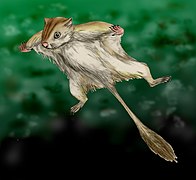
Eomys

Aegyptopithecus


Several classes of mammals diversified such as rodents, primates, canids, brontotheres (or titanotherium), Indricotherium, mastodons, artiodactyls and giant sloths (megatheriums). Mainly in South America, glyptodonts, doedicurus, megatheres and pyrotheres were very abundant. In short, mammals and birds evolved and prospered. Many Eocene families disappeared and the expansion of many recent groups (from tiny rodents to robust elephants) occurred. The horse family had disappeared from Eurasia during the Eocene, but survived in North America with a small number of species, which included three-toed members (genus Mesohippus). Other highly successful ungulates during the Oligocene were rhinoceroses, including the largest land mammal of all time, Indricotherium. The ancestors of pigs also became abundant. Among the first primates, the genus Aegyptopithecus was an arboreal animal the size of a cat, which had teeth and a head very similar to those of an ape.
Reptiles were abundant during the Oligocene. Choristodera, a group of semi-aquatic reptiles similar to crocodiles that appeared as far back as the Jurassic or Triassic, became extinct in the early Oligocene, possibly due to climate changes. Snakes and lizards diversify.
The marine fauna of the Oligocene resembled that of today. Whales (Mysticeti) and the toothed cetaceans Odontoceti appear, while their ancestors, the cetaceans Archaeoceti, remain relatively common, although they begin to decline due to climate changes and competition with modern cetaceans and carcarinid sharks, which also appear in this age. Pinnipeds probably appeared near the end of the era from a bear- or otter-like ancestor.

Aetiocetus

Janjucetus

Halitherium
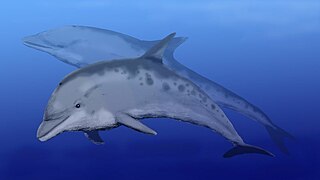
Kentriodon


Flora
Grasses and trees slowly spread throughout America, Africa, Europe and Asia. During this time angiosperms reached a level similar to today's. Furthermore, herbaceous grasses reached their current ecological potential in the Late Oligocene-Miocene. The origin of the continuous growth process, which forces grass to be mowed, was the adaptation that allowed grasses to invade inland with great success. Once they were able to survive the effects of the abundant grazing animals, they spread over immense areas of land to form grasslands. Temperate trees and shrubs such as beech, pine, and rose were common. Legumes from the pea and bean families continue to spread.
Immersion of New Zealand in the Oligocene

New Zealand straddles the boundary of two tectonic plates. The subduction of the Pacific plate under the Australian plate results in volcanism, especially in the Taupo volcanic zone (North Island). The geothermal energy produced is currently used in numerous hydrothermal power plants. Some volcanic points are also famous tourist destinations, such as the Rotorua geysers.
The particular geological situation of New Zealand is at the origin of the so-called Oligocene submergence. At the beginning of the Oligocene, New Zealand's landmass began to sink as the Australian plate pushed toward the Pacific, until 30-25 million years ago, only one-fifth of modern-day New Zealand was above ground. of the sea. This submergence had a double effect. On the one hand, it is likely that many species became completely extinct, causing a huge loss in biodiversity. On the other hand, the highest parts of modern-day New Zealand were isolated in the form of a chain of islands that remained separated for millions of years. This allowed the populations that had been isolated on each island to follow different evolutionary paths and caused great speciation: the result was eleven or more moas, four or more kiwis, numerous lacertids, many invertebrates and numerous plants.
This submergence came to an end when the New Zealand landmass became stuck in the subduction zone between the Australian and Pacific plates. As it was too large to be subducted, it was straddled between the two plates, which has caused intense volcanic and orogenic activity over the last few million years.
Deposits
Some notable sites from the Oligocene are cited below.
Hsanda Gol

The Hsanda Gol Formation (pronounced [ʃændə ɡɒl]) is a paleontological site located in the Mongolian part of the Gobi Desert, especially known for its richness in mammal fossils from the Oligocene epoch, such as hyenodonts, entelodonts or the most complete known fossils of Paraceratherium. Among the latter is a unique skeleton of Paraceratherium that had died standing. He probably died trapped in quicksand, and the position of his paws indicates that he was struggling to escape.
Paleontological exploration in the 19th century and early 20th century had to concentrate mainly on European and North American deposits, such as the Quercy phosphorites or the Hell Creek formation. However, Roy Chapman Andrews, of the American Museum of Natural History, managed to raise the funds to undertake an expedition in the Gobi Desert, until then ignored due to the dangers it represented. Andrews hoped to find the missing link between apes and humans in the Gobi. What he discovered were strata that greatly expanded the information known about the Asian fauna of the Oligocene. However, scientific research at Hsanda Gol was interrupted in 1930 due to political unrest in the area, and the site was not reopened to foreign scientists until the 1990s.
Riversleigh

Riversleigh, located in northwest Queensland, is one of the most famous palaeontological sites in Australia. This 100 km² area has fossil remains of mammals, birds and reptiles from the Oligocene and Miocene. The site was declared a World Heritage Site in 1994 and is an extension of the Boodjamulla National Park.
The Riversleigh fossils are found in calcareous rocks, next to calcium-rich freshwater pools and in caves, and date from when the ecosystem was evolving from a rich jungle to a semi-arid grassland community. Thirty-five bat fossils have been identified, making it the richest site in the world in this sense. Among the finds from the Oligocene of Riversleigh are especially notable Nimbacinus, a prehistoric relative of the marsupial wolf; and Baru, a crocodile with a crescent-shaped head.
Training of John Day
The John Day Formation (by the John Day River in Oregon, United States) represents a series of deciduous forest ecosystems ranging from the Late Eocene (37 million years ago) to the Early Miocene (20 million years ago). More than one hundred groups of mammals have been discovered, including representatives of dogs, cats, pigs, horses, camels, rhinoceroses, rodents, and genera such as Temnocyon or Merycoidodon. During this time, multiple volcanic events left their "mark" in thin layers of volcanic ash that hardened into adobe. These layers have been precisely dated by radiometric means and by comparison with the same layers in other localities, which allows them to be used as temporal markers in this formation.
Contenido relacionado
Baryonyx walkeri
Struthiomimus altus
Weathering
Diplodocus
Oceanography