
Nursing

.jpg)

Nursing (from the Latin in-, «denial»; firmus, firma, firmum, «firm, resistant, strong»; and -eria, "activity, establishment" or "activity, establishment [related] to the not firm, not strong [sick]") is the discipline dedicated to the care and attention of the sick and wounded, as well as other tasks of health care, clinics and health promotion and disease prevention. Nursing is part of what is known as health sciences, working autonomously and independently, and in turn, forming part of of a multidisciplinary team. Nursing encompasses autonomous and collaborative care of individuals of all ages, families, groups, and communities, sick or not, and in all circumstances. It includes the promotion of health, the prevention of diseases and the care provided to the sick, disabled and people in a terminal situation.
Definitions and concepts
Nursing Definitions
According to the International Council of Nursing, nursing is defined as follows:
The traditional infirmary covers self-care and in collaboration, which is provided to people of all ages, families, groups and communities, sick or healthy in all contexts, including health care, disease prevention, and care for the sick, the disabled and the dying. The essential functions of the infirmary are defence, promotion of a safe environment, research, participation in health policy and patient management and health systems, and training.
The North American Association of Nurses declares since 1987, in a document called "Nursing: A Social Policy Statement", nursing as: "The diagnosis and treatment of human responses to real or potential health problems".
The first Nursing Theory was born with Florence Nightingale, from there new models appear, each of which contributes a philosophy of understanding nursing and care. Nurses began to focus their attention on acquiring technical knowledge delegated to them, and with the publication of Florence Nightingale's "Nursing Notes" in 1859, the foundation of professional nursing was laid.
Nursing concepts
- self-care
- research in care
- infirmary metaparadigm
- nurse care methodology: nursing care process
- models and theories of nursing
Nurses
Nursing professionals in Spain are at the university level (registered nurse, graduate or graduate) and Nursing Technicians (intermediate degree graduates of professional training) and are dedicated to the nursing care of individuals of all ages, families, groups and communities.
Spain
In Spain, by law, certified or graduated nurses are responsible for the direction, evaluation and provision of nursing care aimed at promoting, maintaining and recovering health, as well as preventing illness and disability. Some registered or graduated nurses are trained to carry out the functions of nursing care, administration, teaching and research. There is also the figure of the so-called supervisor nurse, whose function is to supervise and organize the work and physical work environment of all the professionals that exist in the unit under their charge.[citation required] Nurses have independent functions (those related to care) and interdisciplinary (medication administration, special bandages and invasive techniques).
The nursing profession has received different nomenclatures throughout its history in Spain. Years ago, they were known as practitioners. After the creation of schools for the training of sanitary technical assistants, between the years 1950 and 1970, the term ATS (Sanitary Technical Assistant) was coined. In 1977, the University Schools of Nursing were created, where professionals with a university diploma degree are trained, and are now called D.U.E. (University degree in nursing). Currently, with the application of the Bologna Plan in Spanish universities, people are beginning to talk about graduate nurses after completing four years of university studies.
On the other hand, assistants are professionals who work as a team with nurses and are known as nursing auxiliary care technicians, nursing assistant technicians or nursing assistants, they obtain their degree after two preparatory academic courses—not university ones. They have medium-level professional training.
Timeline of Nursing Auxiliary Care Technicians:
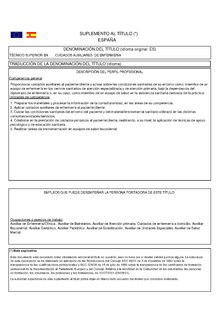 Technical Degree in Assistant Nursing Care according to the National Institute for Professional Qualifications
- In the 1960s, the first appear clinic assistantswithout any required academic training. Under the functional unit and supervision of A.T.S.s are dedicated to meeting the most basic needs of patients.
- In 1973, the Statute of Non-Optional Health Personnel (Order of the Ministry of Labour of 26 April 1973) was adopted, in which for the first time the figure of the Clinical Assistant was collected.
- In 1975, the professional training of the clinic assistant began with the commissioning of the Degree of Vocational Training, Sanitary Branch (FP I).
- In 1984, it includes the requirement of the title of FP, Rama Sanitaria (FP I) to all auxiliary clinic workers who intend to work in health institutions of Social Security.
- In 1986, the Order of 26 December 1986 of the Ministry of Health and Consumer Affairs creates the professional category of the nursing assistant, which replaces that of the clinic assistant, and thus generates full integration into nursing teams.
- In 1990, the Organic Law on General Management of the Educational System (LOGSE) produced important changes in the standard teaching of the FP in Spain. Decrees 546/1995 and 558/1995 establish the training curriculum and the new denomination of the professional title called Medical Assistants.
- In 2007, the National Institute of Professional Qualifications catalogues the title Medical Assistants, previously Level 2 (pertaining to the mid-grade training cycles), such as Level 3 (pertaining to the higher-grade training cycles) of professional qualification, degree so far in external contrast, according to the National Professional Qualifications Family Professional Health, edited by the Ministry of Education and Science.
Specialties
Nursing, by studying the biology, psychology and socioanthropology of the human being, has at its disposal diverse and numerous specialties. Nursing has exclusive specialties for nursing professionals, and other interdisciplinary specialties are also available.
- Cardiorrespiratory Disease
- Psychiatric Nursing
- Oncological disease
- Nursing in Critical Care
- Nephrological disease
- Nursing in occupational health
- Family and community disease
- Surgical Medical Nursing
- Maternal-perinatal nursery
- Hospital management
- Psychopathology and clinical structures
- Medical and health psychology
- Health administration
- Nursing in clinical trials and research
- Penitentiary Nursing
- Military
- School nursery
- Sickness in Palliative Care
- Health audit
- Mental health
- Geriatric and/or Gerontological Nursing
- Medical coordination
- Epidemiology
- Forensic Nursing
- Sickness in Burns
- Neurological disease
- Ophthalmological Nursing
- Public health
- Dermatological disease
- Dermoesthetic Nursing
Specialist Nurse Qualifications in Spain
To access specialist nurse training in Spain, you must take the Internal Resident Nurse (EIR) exam, at the national level and after a two-year residency, you obtain the title of specialist by the Ministry of Education. The currently recognized specialties are:
- Medical-surgical care infirmary (currently no places of this specialty are offered)
- Mental Health Nursing
- Work infirmary
- Family and Community Nursing
- Geriatric nursing
- obstetrical-ginecological infirmary
- Pediatric infirmary
- Military infirmary
- Prison nurse
You can also specialize by completing a Master's Degree and a PhD.
Relevant nurses and nurses
History of Nursing
Early days
Contrary to the perception of some, professional nurses have been an exclusively male-dominated field for much of human history. When the world's first nursing school was opened in India in 250 B.C. C., due to religious beliefs, only men were considered "pure" to be nurses.
Nursing was primarily performed by men during the Byzantine Empire. In ancient Rome the term "nosocomial" it meant "hospital itself", coming from nosocomi, the man who provided nursing care in ancient Rome and diagnosed diseases to his patients.
According to Collière, the origin of care practices is linked to maternal interventions that ensured the continuity of life and of the species. Food, as a basic need that implies substitution and help (by the mother or surrogate) in the first evolutionary stages of man, is considered the oldest care practice.
Since the time of Homer and Socrates there is evidence that it was taken into account that taking care of oneself from the perspective of cleanliness would maintain life and prosperity in a person.
Phebe (AD 60) is the only woman named as a deaconess in the New Testament (Romans 16:1-2). She cared for the poor in her homes and over time this work became an essential part of the work of the deaconesses. However, she is not related to nursing.
Middle Ages
Christianity and its organization had important historical links with nursing care practices from monasteries through religious orders, as well as from the conquest of the Holy Land, with the crusades. As a consequence of the medieval thought related to the Reconquest of Holy Places, an organized movement arose, which crystallized with the historical phenomenon of the crusades, which gave rise to the appearance of three types of figures: the warrior, the religious and the nurse. The demand for hospitals and toilets on the routes followed by the Crusaders led to the appearance of the Military Orders dedicated to nursing: the Knights of the Order of Saint John of Jerusalem, the Teutonic Knights and the Knights of the Order of Saint Lazarus of Jerusalem.. In Spain, the first institution designed to receive patients was the Hospital del Obispo Masona, in Mérida, in the 6th century, according to Domínguez Alcón and the Ecclesiastical Dictionary of Spain.
Among the medieval hospitals where nursing activities were carried out, are the Hôtel-Dieu in Paris and Lyon, the Santo Spirito in Rome, the Hospital de la Seo in Tortosa, the Hospital in Mérida, and the Hospital d'in Clapers de Valencia, of which, according to data collected by Domínguez Alcón, the first two still exist today.
The so-called Beginning movement, made up of "holy women" who cared for the sick, differs within the historical-Christian-charitable framework linked to nursing care mainly in that it does not assume the mandatory vows of religious orders.
The denominations of the people in charge of providing nursing care have varied throughout history depending on the time and the context where it was developed (hospitals, leper colonies, military orders, religious orders and domestic spheres): macipa, mossa, clavera, donated, donated, hospitaler i>, hospital workerand nurse.
According to the historiography studied so far, hospital administrators or solicitors were men, except in the Hospital del Rey de Burgos.
Modern Age
Until the year 1500, the scant attention regarding the regulation of nursing care, practiced in domestic settings, led to a variety of groups that performed these activities outside institutional settings: wet nurses (didas), midwives or midwives, groups dedicated to home care and groups dedicated to other healing practices.
In the 16th century, the Protestant Reformation had serious consequences for health care, due to the suppression of charitable institutions. The Protestant philosophy indicates that "charitable works are not necessary to obtain salvation." This translates into an abandonment of the consideration of nursing care that continued to exist in the Catholic sphere.
Between the years 1500 and 1860, nursing had its worst moment, because the prevailing idea was that nursing was more of a religious occupation than an intellectual one, therefore its scientific advancement was considered unnecessary. In addition, after the Protestant Reformation there was a religious discouragement to dedicate themselves to caring for the sick among lay people and a relegation to former patients, prisoners and other people from the lowest strata of society of the activity of applying care. M. Patricia Donahue called this period the "dark ages of nursing".
Advances in other sciences, such as the invention of the microscope, provided all the so-called health sciences, including nursing, the possibility of providing people with a greater level of well-being.
The Institute of Deaconesses of Kaiserwerth, created in 1836 by the Protestant pastor Theodor Fliedner (1800-1864), marked the beginning of regulated training for nurses. This fact, which occurred in the Protestant sphere, can suppose a contradiction in a superficial analysis; however, the very chaos and disorganization of Protestant nursing care was what required a formal and specific regulation to practice the profession.
Contemporary Age

According to Eileen Donahue Robinson, the book Notes on Nursing (Notes on Nursing), published by Florence Nightingale in 1859 —after her experiences in the Crimean War—, was «a text of crucial influence on modern nursing». The Nightingale Training School for Nurses was established in 1860 and was an independent educational institution financed by the Nightingale Foundation. The originality of the project was to consider that the nurses themselves should train the nursing students through specific training programs and emphasizing both in-hospital and extra-hospital nursing interventions, for the maintenance and promotion of the health of both the individual and of families. Nightingale, a reformer of the concept of nursing, gave a new guideline to the science of caring for the human being, in addition to differentiating what medicine was from nursing from the point of view that nursing placed the patient in the better conditions for nature to act on it in a clean environment free of pathogens.
In the United States, according to Donahue, the first nursing text was published in 1885 by Mrs. Clara Weeks Shaw, and the first national nursing magazine, The Trained Nurse and Hospital Review, appeared in 1888. According to Donahue, Lilian Wald was the precursor of what is now understood as Community Nursing, through a project that began in New York in 1893 as a philanthropic organization, and which would constitute the basis for the subsequent development of Public Health. in said country. In Spain, it is not possible to speak of a specific origin of Public Health Nursing, since Anglo-Saxon ideas did not have much echo among Spanish nurses, until in 1933 when the first 50 posts for visiting and sanitary nurses were created. Later, Mrs. Benford Fenwick would found the International Council of Nurses, the oldest of all international organizations for professional workers. In 1922, at the University of Indiana, the Sigma Theta Tau was founded, an organization that promotes nursing research and management. Its members are selected according to their academic achievements and professional quality, and include students, graduate students in Nursing Programs, and Community Nursing leaders.
At the turn of the 20th century in the United States, it was generally accepted that state-licensure legislation for Nursing would elevate practitioners to a professional level by setting minimum educational standards for Nursing schools. However, as the demand for nurses grew, more nursing schools of varying quality were established, a circumstance that did little to raise the standard of the profession.
In World War II, nursing became more important and prominent. In the last days of the war an article by Bixler and Bixler in the magazine Am. J. of Nursing valued nursing as a profession. The seven criteria for a profession identified by these authors were applicable to nursing as it was practiced at the time and justified consideration of nursing as a profession. Bixler and Bixler reviewed their criteria and the nursing professional level 14 years later and found that both were still valid.

It was not until the 1950s that the need to develop, articulate, and test a global theory of nursing began to be seriously considered, and almost a century after Nightingale, new contributions on the definition of nursing began to appear in the American literature. profession and its functions:
In 1955, Virginia Henderson published:
the only function of a nurse is to assist the sick or healthy person, in carrying out activities that contribute to health or recovery (or to a quiet death) and that she would do without help if she had the necessary strength, will or knowledge, always with the aim of helping him achieve independence as quickly as possible. It identified 14 basic needs, including, in addition to physiological needs, psychological and social needs.
In 1958, Dorothea Orem wrote: "Nursing is a human service whose essential aspect is to attend to the personal need for continuous self-care activities for the maintenance of health or recovery after illness or injury". In her definition, she included people as an important part of her own recovery and the nurse as a facilitator of her autonomy.
Also in 1958, Ami Francis Brown, in her book Medical-Surgical Nursing , insisted on "nursing care and assistance to the patient as a central function of the profession".
In 1962, Gertrud B. Ujhely stated that care is the «support given to the patient in the face of illness», and that the raison d'être of nursing is «to support the patient during his fight against illness», with the interpersonal relationship as a fundamental factor of care.
In 1964, Lydia E. Hall considered nursing functions extended into three circles: body-care, illness-healing, and person-introspection, shared to different degrees with other professionals. She maintained that nursing care was more necessary the less medical care was received and that care provided by nurses accelerated recovery.
Hall identified the following five attitude criteria toward professionalism:
- use of professional organizations as important benchmarks;
- belief in self-regulation, which leads to the idea that only professionals who from a specific area can establish the rules for their practice;
- belief in public service as an essential part of the profession;
- feeling of considering the field or commitment to the profession as a fundamental interest and a desire that goes beyond the economic reward;
- autonomy when the professional must make decisions about his work based on the rules of the same and the deontological code.
Also in 1964, Hildegard Peplau stated that what was truly professional in nursing was the nurse-patient relationship in the psychodynamic aspect of care. She considered care "an educational process that tends to personal development and growth", with interpersonal relationships and educational work as basic elements. Her main contribution was to highlight the communicative work of nursing and identify functions related to assistance in health education and teaching in the exercise of training new professionals.
In 1970, Martha Rogers postulated that the conceptual model of nursing is built around the vital process of the human being, and that the knowledge should be applied in the practice of care. She viewed nursing as either an art or a science, identifying a single knowledge base from scientific inquiry and logical analysis that can be translated into practice. She established the importance of research that continues to this day. For her Rogers, the maintenance and promotion of health should become the first functions of the nurse and she considers them even more important than the treatment of diseases. She also made explicit the need to take into account promotion and prevention in the definition of the functions of the profession.
Callista Roy (1970) assumed that man is a biopsychosocial being who lives within an environment, which together with personality influences him, causing the development of forms of adaptation. The nurse's attention would be necessary when these responses were ineffective. Peplau, Rogers and Roy are included in the so-called interrelationship models, which are the most recent and advanced.
Also in 1970, Beverly Witter Du Gas published the Treatise on Practical Nursing, stating that "care constitutes the role of nursing" and that the care process consists of a series of of steps taken by the nurse to plan and fulfill the function of «caring». The nursing care process provides the profession with a scientific method to carry out its functions.
At the beginning of the 1980s, Rosa M. Alberdi stated that the nurse has the function of dealing with the health needs of the patient or of social groups. In this definition, care for social groups by nursing staff appears for the first time.
In 1986, Yyer, Tapatich and Renocchi-Losey stated that «nursing is an art that knows how to care for the patient while the disease lasts, and is also aimed at helping the human being to achieve maximum health throughout their life cycle." They considered the realization of a care plan as the main axis of nursing action.
At the end of the 1980s, María Consuelo Castrillón considered that nursing practice is made up of three basic functions carried out in different social spheres: health care, administration of nursing care and health services, and education for health.
In Spain, on December 4, 1953, the studies of health assistants were unified in ATS (Health Technical Assistant) following the model of medical specialties with the aim of providing greater post-basic training to the professions of midwives, practices and nurses, so that midwives became a specialty of ATS (BOE of February 12, 1957, Decree of January 1957. For physiotherapy, BOE of August 23, Royal Decree of July 26, 1957). In 1977 (Decree 2128), the teachings leading to the title of ATS were transformed in Spain by those of DUE (University Diploma in Nursing). This historical fact led to the recognition by the University Institution of Nursing as a discipline in the process of construction and as a profession of a university nature with all that this implies: scientific and academic recognition of the ancient activity of nursing care, doctrinal growth and the future possibility of accessing all academic degrees (bachelor's and doctoral degrees).
There are currently two doctoral programs in nursing offered in the United States: the academic doctorate and the doctor of science in nursing. This supposes the achievement of the highest academic degree for nursing in the American context. Likewise, this "double doctorate" entails academic demands that undoubtedly shape nursing knowledge and professional identity. In order to belong to the American Academy of Nursing, it is necessary to have carried out unpublished research works that represent an increase in the corpus of nursing knowledge. This fact is analogous to all scientific disciplines as well as to their respective academies. In Spain, with the study program resulting from the Bologna Process, nursing has reached its maximum development, since it is possible to obtain a doctorate in nursing, which facilitates the research work and consequently the development of the profession.
Contenido relacionado
Enteroviruses
Major histocompatibility complex
Samuel Hahneman