
Nougat
The nougat (in French, touron; in Italian, torrone; in Portuguese, torrão, in Catalan, torró) is a sweet dough obtained by cooking honey (or sugars) to which are added peeled and toasted almonds. Egg white may or may not be added to said dough to emulsify. Said paste is later kneaded and traditionally it is given the final shape of a rectangular tablet or cake. It is typical of various areas of southern Europe. It is traditionally consumed at Christmas in Spain, Portugal [cita requerida] and Italy [cita requerida] and also It is usually prepared in countries previously colonized by the Spanish and Portuguese empires, especially in Latin America.
In addition to the traditional nougat, in Spain other sweet preparations with a wide variety of ingredients (chocolate, marzipan, Catalan cream, candied fruit, coconut, etc.) are also called turrón, especially if they are sold in bars similar to those typical of nougat.
The main production centers in Spain are located in the provinces of Alicante and Lleida, and to a lesser extent the province of Toledo, the municipality of Casinos (Valencia), Cherta (Tarragona) and the Extremaduran municipalities of Castuera and Garrovillas de Alconetar. The elaboration of the nougat is concentrated in the traditional confectionery productions of Jijona, Biar (Province of Alicante, Valencian Community) and Agramunt (Catalonia). It comes in a variety with visible almonds (and which is popularly called from Alicante or hard nougat) and the Jijona nougat that has ground almonds and is pasty in appearance (and which popularly called soft nougat). In Casinos (province of Valencia) although the varieties known as "hard nougat" are well developed, it is mainly marketed with the variety of "soft nougat" (although the local elaboration is own). Both varieties are part of Spanish Christmas gastronomy.
History
Almonds and honey were already used in Al-Andalus to make numerous sweets. Currently, a large part of Spanish confectionery (especially in the southern regions) still maintains a large part of this legacy with sweets like nougat or marzipan. In North Africa, a traditional confectionery based on honey and nuts is also preserved.[citation needed]
Most academics locate the origin of nougat in the Arabian peninsula, this theory is supported by the treatise "De medicinis et cibis semplicibus" from the XI century, written by an Arab doctor, in which he speaks of "turun". The Arabs brought this dessert to the shores of the Mediterranean, in particular to Spain and Italy. The Spanish version of nougat was born in the south of the kingdom of Valencia around the XV century, since in the time of Carlos V it was already a famous candy.
Similarly, in Castuera (Badajoz) there has been a nougat-making tradition since Arab times that has survived to the present day. In Castuera you can visit the Nougat Museum.
One of the earliest written mentions of nougat is found in Step 6˚ "The Generous Beating" (1570) by Lope de Rueda, included in the Registry of Representatives (in many texts it is erroneously claimed to appear in "Los lacayos ladrones" and it is not correct), by Sevillian writer Lope de Rueda: the plot of the play consists of a quarrel between a master and his servants because they have eaten his pound of nougat from Alicante that was on the desk.
In 1582, a document from the municipality of Alicante states that from time immemorial, each year, the city of Alicante used to pay (..) their salaries, partly in money and partly in cash, for Christmas parties. a present that is given to them, of an arroba of nougats (...).
Over time, this dessert was increasingly used in celebrations and in traditional Christmas parties.
The anonymous Women's Manual, from the XVI century, provides the first recipe to be canned to make nougat. In any case, the custom of eating nougat at Christmas was widespread throughout Spain in the XVI century, at least among the more affluent sectors of society.
A letter signed by Felipe II in 1595 exhorts, to reduce expenses, That in nougat and fig bread to present Christmas, I prohibit and order that my city cannot spend [Alicante ]more than fifty pounds every year.
During the 15th, 16th and 17th centuries, nougat was made not only in Jijona but also in Alicante city. In the time of Carlos II, the interference of the guilds of confectioners of the city of Valencia grouped in the "Colegio de la Cera" on the regulation of the nougat activity in Alicante provoked a lawsuit because they tried to submit the nougat masters and confectioners from Alicante to their statutes. For this reason and because of the novelty that chocolate represented, its production in Alicante disappeared for the most part, and since then Jijona, further removed from the attention of the Valencian trade unions, has become the only major center for the production of nougat.
In the "Chronicle of the Most Illustrious, Noble and Loyal City of Alicante" by Dean Bendicho written in the XVII it is said The nougat that is commonly said of Alicante that being made only from honey and almonds, its pieces look like white jaspers. Although the toasted yolk was already beginning.
Apparently, sugar was an ingredient that began to be added later, since it began to be mentioned to make nougat only from the century XVIII, coinciding with the massive planting of sugar cane in America and the extension of the freedom to trade with America to a greater number of Spanish ports, including the port of Alicante. From that time is the so-called snow nougat and guirlache.
In the province of Valencia, in 1881, with the arrival of the preparation of sugared almonds in the Valencian town of Casinos, the artisan production of nougat began, first in its varieties of yolk, toasted yolk, soft and hard almond, marzipan or guirlache Today, Casinos is the main point of reference for artisan production in the province of Valencia for its famous sugared almonds and nougat.
In the Cremonese tradition in Italy, the first nougat was served on October 25, 1441 at the banquet for the wedding, held in Cremona, between Francesco Sforza and Bianca Maria Visconti. The dessert, always according to tradition, was modeled reproducing the shape of the Torrazzo, the city's bell tower, from which it would take its name. This episode is commemorated every year with a Nougat Festival [6]. However, the first certain news about nougat in Cremona dates back to 1543, when the city bought some nougat to donate it to some authorities, especially the Milanese.
Currently, Spain is the world's leading producer of nougat, marzipan and Christmas sweets. In 1992, 1,400 tons of Jijona nougat were exported almost exclusively to Latin America. They are also penetrating with great success in the Far East and Japan and even in countries with a long tradition of exporting sweets such as the United Kingdom, Germany and France. In this sense, 32 of the main business groups in the nougat sector in Spain had a turnover of more than 440 million euros at the end of 2015.
Characteristics and elaboration
The production process is authentically traditional and, although modern machinery facilitates its industrial production and guarantees a higher quality, the nougat sector continues to be guided by the same "recipe" forever.
To make the hard nougat, or Alicante nougat, cook the honey in a double-bottom pot "malaxadora", beat it, add the sugar and the egg white. The baskets of toasted and skinless almonds are poured. The resulting paste is mixed with large wooden paddles and rhythmic movements until the nougat master tastes a small bite and concludes this phase, called "melero point". The dough obtained is deposited in molds and covered with the wafer, cut into bars, cooled and then vacuum-packed to keep them for more than a year.
To obtain the soft or Jijona nougat, after malaxing and beating, it is ground for half an hour and the mass is passed to the refiners so that it is completely pulverized; it is transferred to another tank where it is mixed, acting then the "boixet", a Valencian word that designates a small mortar, here the product becomes Jijona nougat. Let it rest for two days to harden, cut and package.
Spanish varieties

Nougat is found in various locations throughout the Mediterranean geography. In some cases they are called nougats and they consist of a mixture of a coagulated sweet element in which a certain quantity of dried fruits is immersed.
Nougat from Alicante or hard and from Jijona or soft
This pastry includes two main varieties: hard or from Alicante and soft or from Jijona.
- Hard turkey o Turrón de Alicante: Consistent in a mass of honey, sugar, egg white and entire brown almonds, can also carry oblea.
- Soft turkey o Jijona Turrón: Consistent in a molten mass of honey, sugar, egg white and brown almonds.
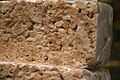
Detail of a specimen of Alicante peat paste, which can be seen the abundance of almonds used in its mass.

Jijona Turrón (named Soft turkey).
.jpg)
.jpg)
Both the denomination "Alicante Turrón" such as "Jijona nougat" They are exclusive to the hard and soft nougats manufactured in the town of Jijona (Alicante). The Regulatory Council is in charge of its protection.
Other varieties
- Tostada yema turret: typical Catalan. Created initially as a yema turret by the Jijona turrons to take advantage of the egg yolks after introducing the clear in the making of the hard and soft turrones, later, in 1850, a Barcelonian pastry burned the turret inspiring as it proceeds with the Catalan cream.
- Agramunt Turbine: Consistent in a mass of honey, sugar, egg white and entire hazelnuts, although it can sometimes also contain framed almonds.
- Cherta turf: made with hazelnuts or almonds, honey, sugar and egg white. It's circular.
- Truffle turret: made with chocolate and other ingredients, it is actually a good quality chocolate and turrón dimensions, which like this is cut into bars.
- Chocolate turret (multiple varieties: chocolate with inflated rice, white chocolate, black chocolate, dried chocolate, such as hazelnuts or almonds, chocolate with stews, etc.)
- Coconut turret: it contains raved coconut in large quantity. It is one of the oldest varieties of "modern", that is, apart from the hard and soft turret of almonds or hazelnuts.
- Guirlache
- Turrón de Mariola: praliné de liqueur de herbero, bathed with chocolate. This sweet comes in 2001 in Heretat de Soler de Biar, a tribute to the emblematic mountain range of Mariola.
The varieties of nougat have been growing and the current offer includes: cream and walnut nougat, marzipan and fruit nougat, pistachio nougat, stone nougat, etc. New flavors have been progressively created, so, for example, in the market we can find nougats with the following flavors: coffee, pineapple mousse, lemon mousse, yogurt, Catalan cream, egg yolk with cherries, rum with raisins, yogurt, etc.
Nougats in other countries
- Doña Pepa turrón, the kiwicha turf and the chumbeque are traditional Peruvian sweets. A variant of the latter is also a typical sweet of the Chilean North.
- Nougat is a French sweet, looking and taste similar to the Spanish turrón. The most famous nougat is that of the city of Montélimar, in the department of Drôme.
- In Italy the turrón exists with the name of Torrone.
- In Denmark it is called fransk nougat.
- In the Arab countries and Israel there is also a very similar sweet related to the turrón: the halva or sesame turrón, made with ground sesame, honey, and sometimes fruit or pistachio.

Turrón de Doña Pepa de Perú

Chumbeques piuranos

Chilean Chumbeques

Nougat French

Nougats in a pastry shop in Prague.
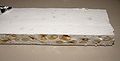
Torrone classic Italy

Tahin helva Turkey

Halvas in Palestine


.jpg)

.jpg)
Contenido relacionado
Seasoning
Mustard
Socks