
New Horizons
The New Horizons mission (in Spanish, Nuevos Horizontes) is an unmanned NASA space mission intended to explore Pluto, its satellites, and asteroids in the Kuiper Belt.
The probe was launched from Cape Canaveral on January 19, 2006. New Horizons approached Jupiter between February and March 2007, to take advantage of the planet's gravitational assistance and thus acquire a speed difference of about 4,023 m/s (14,482 km/h). On July 14, 2015 at 11:49:04 UTC, the probe reached the closest point to Pluto (12,500 km), making all kinds of measurements of the dwarf planet. Following the success of the main mission, the probe is expected to explore at most two Kuiper Belt objects.
New Horizons is one of the space probes with the highest speed with respect to the Sun, reaching a maximum difference between the initial and final speeds of 15.1 km/s. (54,000 km/h). Comparatively, it is surpassed by the Rosetta probe, which reached 108,000 km/h, and by the Voyager 1 and Voyager 2 probes. However, all They are far from the 252,900 km/h reached by Helios B in April 1976 and the 324 000 km/h recorded by the Solar Parker probe on November 1, 2018.
Next, New Horizons flew over the Kuiper Belt object Arrokoth (the nickname was Ultima Thule at the time), which occurred on January 1, 2019, At that time it was at 43.4 AU. In August 2018, NASA cited Alice's "New Horizons" research results to confirm whether there is a "hydrogen wall" at the outer edge of the solar system. In 1992, two Voyager spacecraft discovered the “wall” for the first time.
Background
This probe is the first mission of NASA's New Frontiers program, focused on developing medium-cost probes, more expensive than the Discovery type and cheaper than the Flagship. The total cost of the mission is on the order of 650 million dollars for a period of 15 years (2001 to 2016).[citation needed]
The probe was built by the Southwest Research Institute (SwRI) and the Johns Hopkins Laboratory. In addition to its scientific instruments, the probe carries a collection of 434,738 names compiled by the mission's website and stored on a compact disk, a piece of the SpaceShipOne and a United States flag, as well as a Florida quarter and ashes of Pluto's discoverer, astronomer Clyde Tombaugh.
Objectives

The goal of the mission is to study how the Pluto system, the Kuiper Belt, and the transformation of the early solar system formed. The spacecraft collected data about the atmospheres, surfaces, interiors and environments of Pluto and its moons. Another goal was to study other Kuiper Belt objects. For comparison, New Horizons collected 5,000 times more data from Pluto than the Mariner probes from the Red Planet.
Some of the questions the mission tries to answer are: What is Pluto's atmosphere made of and how does it behave? What does its surface look like? Are there large geological structures? How do solar wind particles interact with Pluto's atmosphere?
Specifically, the mission objectives are:
- map the composition of the surface of Pluto and Caronte
- characterize the geology and morphology of Pluto and Caronte
- characterize the neutral atmosphere of Pluto and its exhaust rate
- find atmosphere around Caronte
- mapping surface temperatures in Pluto and Caronte
- obtain Pluto and Caronte images in high resolution
- Find additional rings and satellites around Pluto
- perform similar research of one or more Kuiper belt objects
On August 28, 2015, NASA announced that the probe's next objective would be to fly over the trans-Neptunian object 2014 MU69, an objective it successfully accomplished on January 1, 2019.
Launch

Its launch was originally scheduled for January 17, 2006 to allow for a more thorough inspection of the Atlas rocket's kerosene boosters, and due to minor delays the launch was moved to January 19, 2006, taking off from the Force Base Aerial at Cape Canaveral.
For its launch, an Atlas V rocket was used, with a third stage of Star 48b solid fuel to increase its escape velocity, giving the rocket a total thrust of 9 MN and a total mass of 726 000 kg.
The launch window in January 2006 and after a brief encounter with the asteroid (132524) APL, allowed it to reach Jupiter, on February 28, 2007 it had its closest approach to the planet at a distance of 2.3 million kilometers (1.4 million miles), then carrying out a gravity assistance maneuver, saving 3 years of travel to reach Pluto. During the flyby of Jupiter, tests of the instruments and capabilities of the probe could be carried out, sending information about the Jovian atmosphere, its moons and its magnetosphere. After the visit to Jupiter, the probe was put into hibernation to preserve all the instruments on board, except for an annual power-up for a small checkup. The probe has the record for the highest speed with respect to Earth and, for now, the only one that has reached the escape velocity of the Sun, without gravitational assistance maneuvers.
Instruments

The instruments on the probe are designed so that in the brief passage over Pluto and Charon the greatest possible information is obtained, such as the composition and behavior of the atmosphere, the way in which the solar wind interacts with it, geographical elements.
Technical characteristics
The ship was built of aluminum, in the shape of a triangle, 0.7 m high, 2.1 m long and 2.7 m wide, and weighed 478 kg at launch, 77 kg of which correspond to the fuel and 30 kg to the scientific instruments. When it arrived at Pluto it weighed only 445 kg. It has a high-gain satellite dish 2.1 m in diameter, mounted at the top of the triangle. The triangle contains the electronic equipment, wiring and propulsion systems. In the center of the triangle there is a breakaway adapter. At the tip of it, the radioisotope thermoelectric generator (RTG) is mounted to reduce interference with equipment. There are no batteries on board, so all electricity is produced by the RTG with plutonium-238 pellets, coated with iridium and wrapped in graphite. The RTGs generate 240W of 30V at launch, which will be reduced to 200W upon arrival at Pluto. Temperature control is achieved with thermal black paint, thermal blankets, the heat produced by the RTG, radiators, blinds and electric heaters.
The ship has three stabilized axes, using as propulsion a hydrazine tank made of titanium with 77 kg of propellant mounted in the center of the triangle that propels it at a speed of 290 m/s (1 044 km/h). The tank drives 16 hydrazine engines: 4 of 4.4 N of thrust for trajectory corrections and twelve of 0.9 N of thrust, used for attitude corrections and other maneuvers. Regarding navigation and orientation of the probe, the attitude is determined using two star tracking cameras (Star Trackers) with CCD sensors and a star catalog. A double inertial measurement unit (MIMU) is also used, each containing three gyroscopes and three accelerometers that keep the space vehicle stable. The ship is controlled by four computers: a command system, data management, guidance, and the processor. The processor is a 12 MHz Mongoose-V (an improved version prepared to withstand the radiation of the MIPS R3000). Time clocks are also used in addition to software. These devices are located in an IEM (Integrated Electronics Module); there are two of them. Data is recorded in two low-power solid-state memories with capacity of 8 gigabit each.
Communications

Communications with the Earth are carried out through the X band. The greater the distance, the lower the communication flow. For example, it was planned that from Jupiter, the communication speed would be 38 kilobits per second. However, from the much greater distance of Pluto, the communication throughput is expected to be only 600 to 1200 bits per second.
This low speed means that it will take a long time to send the photographs of Pluto, and we will have to wait several months until we have them all (9 months of waiting is expected). For example, to send a photograph, at the speed of 1000 bit/s, it will take approximately 12 continuous hours. The approximate amount of data in photographs of Pluto and Charon is estimated at 10 GB, and 9 months are expected in total because there is no capacity to receive data permanently, since the reception antennas (DSN network) must also deal with many other space probes.
For communications, the probe has 2 transmitters and 2 receivers, 2 12 W amplifiers are also used. The spacecraft uses the 2.1 m diameter 48 dB satellite dish and a low gain antenna for communications of emergency.
Images of Pluto


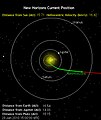
NH on 28 January 2010.
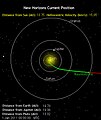
NH on 1 January 2011.
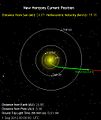
NH on 1 September 2012.

NH on 1 January 2013.

NH on 1 July 2013.

NH on December 8, 2014.


The first images of Pluto made by the probe were taken between September 21 and 24, 2016, to test the Long Range Reconnaissance Imaging Instrument (LORRI) and were released by NASA in November 2016. They were taken at a distance of 4.2 billion kilometers away; With this, the probe's ability to track objects at a great distance was successfully proven.

Pluto Flyby

In July 2013, the probe sent the first images in which Pluto and its largest satellite, Charon, can be distinguished as separate bodies. As New Horizons approached Pluto, the images sent gained resolution. Likewise, the probe took images of Charon as it approached.
The New Horizons probe passed 12,500 km from the surface of Pluto at closest approach on July 14, 2015 at a relative speed of 49,600 km/h. It passed 28,800 km from Charon. The probe took the opportunity to photograph the dwarf planet as well as its five moons (Charon, Hydra, Nix, Kerberos and Styx) given their proximity.
2014 MU69 flyby

On January 1, 2019 at 05:33 UTC, the New Horizons probe flew by the asteroid 2014 MU69, named "Arrokoth". The flyby was carried out at a minimum distance of 3500 km. Never before has a probe visited a celestial object as distant as (486958) Arrokoth, located at a distance of 6,470 million km from the Sun, about 6,620 million km from the Earth. The flyby was carried out at a speed of 14.43 km/s. During the following months Until September 2020, the probe will continue to send the 50 gigabit of data obtained during the flyby.
Data obtained
Arrokoth, previously nicknamed by NASA "Ultima Thule", turned out to be a contact binary with dimensions of 33 x 15 km formed by the union of two bodies. For this reason he was called 'snowman'. The actual color of the asteroid was reddish. It has a rotation period of 15 hours. The surface appears free of large craters in the medium resolution images from the LORRI camera, although we will have to wait for the high resolution images to see to what extent this body has suffered the fury of collisions with other bodies in the solar system (in The images received Ultima was illuminated with the Sun just behind the ship, hence it is difficult to differentiate the relief).
Key dates
- January 11, 2006: Pre-launch work begins at Cabo Cañaveral. Launch delayed for further testing.
- 16 January 2006: Atlas V rocket assembly at the launch tower.
- 17 January 2006: delayed first release due to bad weather conditions.
- 18 January 2006: the second attempt to launch for a loss of electricity in the Applied Physics laboratories at Johns Hopkins University was delayed.
- January 19, 2006: successful launch at 14:00 (local time, 19:00 UTC) after a brief delay due to the present nubosity.
- January 19, 2006: (19:30 UTC), trans-jovian insertion (TJI, trans-jovian insertion), the probe is in escape path with respect to the Earth and the Sun.
- January 19, 2006: after only nine hours of travel, the ship transfers the orbit of the Moon.
- 7 April 2006: The probe crosses the orbit of Mars.

- August 24, 2006: Pluto becomes a dwarf planet.
- 8 January 2007: beginning of the approach to Jupiter.
- 10 January 2007: observations of the Jovian moon Calírroe.
- February 28, 2007 Jupiter overflight, which occurred at 05:43:40 UTC to 2 305 000 km distance, in order to reach the speed of 21,219 km/s (76 388 km/h).
- March 5, 2007: the meeting phase with Jupiter ends.
- 8 June 2008: in electronic hibernation state, the ship reached a distance of 10,06 astronomical units (approximately 1500 million of km) of the Sun, crossing the orbit of Saturn, after the last step, almost 27 years ago, carried out by Voyager 2.
- 25 February 2010: New Horizons He crossed the midpoint of distance in his way between Earth and Pluto.
- October 17, 2010: the ship arrives at half of its flight time to Pluto.
- 18 March 2011: New Horizons He crossed the Uranus orbit.
- 24 August 2014: New Horizons He crossed the orbit of Neptune; exactly 25 years after Voyager 2 overflew this gaseous giant.
- March 2015 began the initial observations of Pluto and continue the observations to the maximum approximation.
- July 3, 2015, images are published with details of the surface of Pluto, showing two different faces.
- 4 July 2015: An anomaly that forced a transition to a safe way.
- 7 July 2015, the probe recovered scientific operativity and its course to Pluto.

- 14 July 2015, Tuesday, at 07:49 EDT, Eastern United States time 11:49 UTC: Maximum approximation 12 450 km Pluto and later Caronte fly.
- January 1, 2019, overflight of the transneptunian object 2014 MU69.
- December 25, 2020, currency (approximately 120.3 UA) to Voyager 1.
Gallery
Images from the launch
|

