
Neobaroque

Neobaroque is the name of an architectural, sculptural, musical and literary style, imitation of the Baroque, which flourished in the second half of the century XIX, as a reaction to the prevailing academic coldness. Paris, as well as other large European cities, have a neo-baroque appearance. Neobaroque has great points of contact with Romanticism. neobaroque is also called a modality of postmodern aesthetics, very unromantic, typical of the late 20th century 20th< /span> and the beginning of this century XXI; For this reason, this article must be broken down into both very different neo-baroque periods. What both "styles" so different so-called neo-baroque (the baroque being, for its part, as they have rightly characterized it - as well as the very opposite Expressionism - Jacob Burckhardt and then Erwin Panofsky a "non-style") is the recharge, a certain lust, the exuberance and destructuring.
Sculpture
At the same time as in architecture, neo-baroque trends appear in sculpture. As the greatest representative of the neo-baroque we can name the Berlin sculptor Reinhold Begas and the Viennese Víctor Tilgner.
Music
In music, a compositional trend from the beginning of the XX century is designated as neobaroque, which takes up forms and styles of music baroque Some important representatives are, among others: Max Reger, Johann Nepomuk David, Paul Hindemith, Ernst Krenek and Henk van Lijnschooten among other members of the Second Vienna School.
Architecture


Neo-Barro architecture, also known in Anglo-Saxon countries as revival Baroque: Baroque Revival) or in France Second Empire style, was one of the late architectural styles of the late centuryXIX, especially since 1880, which coexisted and replaced the neo-Rerenaissance architecture. It is a mainly European current, but then it expanded and can be seen examples in all parts of the world, and it is not always easy to distinguish between the many academic, historical and eclectic styles of the change of century.
The term is used to describe the architecture that recovered some of the characteristics of the baroque architecture, but that is not proper of the baroque period—siglos XVII and XVIII— and that did not lead to a complete recovery, in the revivalistico sense, of the language of artists such as Gian Lorenzo Bernini, Francesco Borromini and Guarino Guarini.
The teaching of the elements of the Baroque architectural tradition was an essential part of the curriculum of the Ecole des beaux-arts of Paris, the most preeminent school of architecture in the second half of the centuryXIX, and was an integral part of the Beaux-Arts or academic architecture that was built both in France and abroad. This is evident at the Teatro dell'Opera in Paris, considered the maximum expression of this current. It was projected by Charles Garnier and built between 1861 and 1875, in the framework of the great reforming urban plan managed by the Baron Haussmann under the empire of Napoleon III. The theater, referring to the architecture of the Italian Renaissance, presents a beautiful interior, strongly articulated in plastic sense (especially in the main foyer), so much that it leads to emerge a complex volumetry also in the exterior profile. Therefore, defining the Parisian theatre as a neo-baroque is correct only if the adjective is understood as imposing, majestic and redundant, while it is improper if it is the search for the typical Baroque elements.
The enthusiastic sense of European imperialism encouraged it to be the official architecture that reflected the greatness of the French and British empires, and to express pride in the new power of the unified state in Germany and Italy. In Austria its use also had a patriotic connotation, as it was supposedly related to the cultural flourishing and political expansion of the early century.XVIII. In its late phase it coexisted with the Jugendstil, in which it partially influenced. The architects Ferdinand Fellner (1847-1917), Hermann Helmer (1849-1919), Arthur Meinig (1853-1904) and, above all, Sir Edwin Lutyens, left Neo-Brock works. The Eduardian Baroque is a local variant of the neo-baroque that was used in many public buildings built in the British Empire during the Eduardian period (1901-1910).
The neo-baroque style was used especially for the design of new and great official buildings, in general civilians, such as palaces, government buildings and courts, as well as new theaters, as the Baroque had contributed to the flourishing of the scenographic arts.
Significant examples are the Brussels Justice Palace, built and designed by Joseph Poelaert since 1866 and described by critics as "the most pompous and overloaded neo-baroque work of the Ottocento."; the Dresden Opera Theatre (1878, with Neo-Renaissance influence); the Berlin Bode-Museum (completed in 1904); the Ashton Memorial in Lancaster (1907-19XX.).
In Italy, where the style is part of what is known as umbertino, the Palace of Justice in Rome (current headquarters of the Supreme Court of Cassation), projected by Guglielmo Calderini around 1884, in which some reminiscences of the Opera of Garnier converge. Another example is the headquarters of the Federico II University of Naples, the work of Pierpaolo Quaglia and Guglielmo Melisurgo (1897-1908).
Today, there are also some postmodern buildings with a style that could be called BaroqueFor example, the Dancer House in Prague by Vlado Milunic and Frank Gehry who have described as "new Baroque."
- Neobarro buildings

Facade of the Palais Garnier (1875), Paris, eclectic exercise presents on this front a clearly baroque style
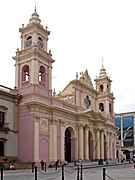
Salta Cathedral (1858-1882), an example of the nineteenth-century Argentinean neo-baroque.

Saint-Jean-de-Kenty Church (1893-1898) Chicago

Bode Museum (1897-1904) Berlin, at the end of the island of the Museums

Saint-Fridolin Church of Mulhouse (Haut-Rhin, 1906).

Saint-Maurice Church (1913) of Freyming-Merlebach (Mosela)


Neo-baroque of the late 20th century and early 21st century
It is attributed to Severo Sarduy in his 1972 text called The Baroque and the Neobaroque, a text in which he analyzes the work of José Lezama Lima, the first mention and brief study of the late Neobaroque. century XX.
Omar Calabrese, among others, perceives a postmodern neo-baroque that arose from a certain destructuring of paradigms resulting from scientific discoveries (for example fractals) and the dizzying socio-political change that occurred at the end of the century XX as well as the great accumulation of capital (such as to allow great expenditures on architecture and other forms of opulence, etc.) in certain places on the planet on those dates. Postmodern neobaroque is expressed in an aesthetic of fluctuation and excess and in the use of ordered chaos. One of the most conspicuous examples of such neobaroque is the Guggenheim Museum in Bilbao. Postmodern neobaroque architecture is also often intertwined with the so-called deconstructive architecture or deconstructivist architecture.
Calabrese considers that the term postmodernism is somewhat misleading and very generic; For the predominant art of that time, he preferred the word "neobaroque", as has been pointed out, the neobaroque of postmodernism was produced by an interrelation of scientific, aesthetic, etc. knowledge, and a change in moral paradigms that is reflected in formal heterogeneity. The Italian philosopher finds a series of features and constants that characterize the postmodern neobaroque: limit and excess, disorder and chaos, rhythm and repetition, < i>instability and metamorphosis, detail and fragment, node and labyrinth, complexity and dissolution, " more or less" and "I don't know what", and distortion and perversion. Such features are observed both in the most complex works of art of that time and in phenomena as seemingly banal as tattoos or piercings, or in certain overloaded graffiti and tags with confusing texts.
The limit and excess is the confrontation with classicism and rationalism, if classicism is based on harmony, limit, moderation; The neobaroque has been based on excess and discordance, diluting the border between good taste and bad taste (for example Kitsch and camp are claimed). The loss of the center is not frowned upon (as it is for the reactionary Hans Sedlmayr), and manifestations of apparently "countercultural" and of "transgression" They are exalted (the aesthetics of the punk movement for example).
The disorder and chaos: the possible beauty of chaos is sought, ignoring the canons based on Euclidean geometry; An example can be found in Benoît B. Mandelbrot's discovery of fractal structures, or in the aesthetics that emerged from psychedelic effects and even computer art.
The rhythm and repetition: to observe these characteristics we can start from the studies that at the beginning of the 20th century. XX made by Walter Benjamin when he noticed the serial reproduction of art, or more recently the massive dissemination of television series and very elaborate advertisements; The persistence of repetition generates a taste for discovering subtle and minimal variations (this can be observed mainly in music).
Instability and metamorphosis: the expression "formless forms" by René Thom is an example of an unstructured aesthetic like that of the neo-baroque.
Detail and fragment: to detail is to detail: to make a cut in a whole to highlight the cut part, in return the fragmentary allows us to find the unfinished form, the open work of a whole.
The node and the labyrinth: Gilles Deleuze developed the motif of the fold as one of the factors of the labyrinthine (cf.: Deleuze: Leibniz and the Baroque), for For its part, computing provides the model of networks and has given special importance to the physical concept of a node as access to a labyrinthine network. Although it may seem very distant from computer science, perhaps typical examples of the neo-baroque in literature are found in certain works by Jorge Luis Borges (The circular ruins, The library of Babel etc..) among other authors, at the same time poststructuralist speeches and prose such as those of Lacan can be considered a form of neo-baroque.
Complexity and dissolution: here again the scientific advances of the second half of the XX century They contributed models to art and aesthetics in general, for example Ilya Prigogine's discoveries of states of equilibrium and disequilibrium in complex systems where there is chaos, fluctuation, turbulence, entropy, dissipation.
"More or less" and "I don't know what": Omar Calabrese considers that this is a feature of the postmo neo-baroque based on, for example, the principle of uncertainty on the one hand, and the questioning of the "truth" (as for example Michel Foucault did).
Distortion and "perversion": at the end of the century XX The rationalist order seemed to have become obsolete, with such order also the moral order (for example the so-called new sexual morality appears) and, by reflection, the aesthetic order; The creation of a different order begins that seems to be a distorted version (a "per-version") of traditional discourses, this in art gives rise to the neo-baroque heterogeneity of postmodernity.
The works of the plastic artist Lynda Benglis also show a neo-baroque scenic, her sculptures seek to represent movement and space in an organic way through the folds, knots and filigrees of the baroque aesthetic.