
Metropolis (1927 film)
Metropolis is a 1927 German silent science fiction film directed by Fritz Lang and produced by the UFA production company. It is considered one of the great films of German expressionist cinema and the history of world cinema.
The screenplay was written by Thea von Harbou and Fritz Lang, based on a 1926 novel by Von Harbou herself.
Metropolis is one of the few films considered Memory of the World by UNESCO. He was the first to possess this category, supported by the vivid embodiment of the entire society, and the depth of its human and social content.
Plot

In a megalopolis of the 21st century the workers live in an underground ghetto where the industrial heart is located with the prohibition of go out into the outside world. Incited by a robot, they rebel against the intellectual class that has power, threatening to destroy the city that is on the surface, but Freder (Gustav Fröhlich), son of the leader of Metropolis, with the help of Maria (Brigitte Helm), Of humble origin, they will try to avoid destruction by appealing to feelings and love.
The film takes place in the year 2026, in a city-state of enormous proportions called Metropolis. Society has been divided into two antagonistic and complementary groups: an elite of owners and thinkers, who live on the surface, seeing the world from the great skyscrapers and urban landscapes, and a caste of workers, who live under the city and who work ceaselessly to maintain the way of life of those on the surface. The president-director of the city is Johan Joh Fredersen (Alfred Abel).
A charismatic and peacemaker figure named Maria champions the workers' cause, but instead of inciting a riot, she urges the workers to seek a peaceful way out and be patient, waiting for the arrival of the "Mediator" who will unite the two half of society. Fredersen's son, Freder, meets Maria and falls for her. By following her without her noticing, he enters the subterranean world of the workers and sees with his own eyes the terrible conditions in which they live and work, as well as the absolute disdain of the owners, who prefer to bring in more workers so that the machines do not stop, to help those who suffer accidents in them. Disgusted by what he sees, Freder decides to join Maria's cause.
However, Fredersen has already become aware of Maria's activities, and fearing a revolt by the workers, he decides to request the help of the scientist Rotwang (Rudolf Klein-Rogge), who in turn shows him an anthropomorphic robot of his invention. Rotwang's robot can take on both the behavior and appearance of a person, so they decide to impersonate Maria. The robot is commanded to promote riots and discontent, thus allowing Fredersen to launch a violent crackdown on the workers. What Fredersen does not know is that the robot contains the spirit of Hel - the one who had been Rotwang's wife, who had an affair with the city director and died giving birth to his son Freder - and that Rotwang will use the automaton as instrument of revenge against the president of Metropolis, his son and, against the entire city.
The real Maria is taken prisoner in Rotwang's mansion in Metropolis, while the robot impersonates her and makes inflammatory speeches, and also begins to follow Rotwang's initiatives in his plan for revenge. She transforms into an exotic dancer at the prestigious Yoshiwara cabaret, and thus she excites the attendees and clouds her reason to promote discord and decadence among the wealthy youth. Following the robot's bad advice, the workers start a riot and destroy the "Heart Machine," which provides the power that runs all the other machinery in Metropolis. The destruction of the machine also causes the city's water tanks to flood, flooding the underworld of the workers, who, blinded by the robot's speech, have neglected the safety of their children, who end up being rescued by Freder and the real Maria. Realizing their grave error, the desperate workers go to the surface in search of their "enemy in the citadel", the presumed Maria. The mob invades the city's amusement district and captures the false Maria, who is tied to a stake and set on fire, while Freder looks on and despairs. But they soon realize that this Maria is an impostor, as her fake flesh burns and the robot is exposed, and as they see the real Maria being chased by the crazed Rotwang on the roofs of the city's cathedral. Freder chases Rotwang and confronts him, until Rotwang plunges off the roof to his death. María and Freder return to the street and go to meet Joh and Grot (city leaders and workers) and reveal the beginning of a new society.
With the motto «Mittler zwischen Hirn und Hand muss das Herz sein» («The mediator between the brain and the hand must be the heart»), which must be interpreted as the need for the The human being's ability to love unites reason and force, the tycoon Joh Fredersen and the workers of Metropolis are reconciled thanks to Freder, three symbolic components: reason, work and heart.
Production
It cost 5,100,000 Reichsmarks to shoot Metropolis, a figure that today, calculating inflation, would mean more than 39 million dollars, one of the most expensive in the origins of cinema. Fritz Lang had a large number of extras and about 620,000 meters of film were filmed, reduced to 4,189 for its first cut, later its duration was further reduced for international distribution. A total of 27,000 extras were used, it shot in more than 310 days and 60 nights.
The production was largely handled by Erich Pommer, who at first did not have much faith in the project. He saw it as too expensive both financially and executively, and despite the fact that Fritz Lang managed to convince him, he was the main producer and executive of the film without still fully believing in it. Lang wrote the script together with his wife Thea von Harbou, who was also in charge of writing the novel that would serve as the basis for the creation of the Metropolis script.
After being accepted by the Universum Film AG, «Erich Pommer, Karl Freund, Günther Rittau, Eugen Schüfftan and the sculptor Walter Schulze-Mittendorff joined their respective studios to make the film that had enjoyed the highest budget in the history of the German cinema".
Metropolis became a blockbuster both in terms of budget and number of participants, with a total of more than 37,000 people. One of the producers, Eugen Schüfftan, was responsible for the special effects. These are considered the most characteristic and representative elements of the film, and it cost a great deal of time and material due to Lang's great effort to do justice to the enormous script. However, the film suffered numerous reissues due to censorship and cuts depending on where the film was screened. For example, in its American distribution, various parts of the feature film were cut because they were considered communist propaganda. "[...] resulted in the filming of 620,000 meters of celluloid, which was reduced to 4,189 meters in the first cut and 3,170 in its international distribution." The third of these cuts featured a soundtrack composed by Giorgio Moroder and in which artists such as Queen and Bonnie Tyler, among others, participated.
Schüfftan "created the sophisticated Schüfftan Process", which consisted of the use of reflections and counter-reflections used in models to simulate large buildings. Another novelty was the use of the gyroscopic camera, "which made it possible to film panoramas in all directions".
Censorship and cuts
_(15418159339).jpg)

Shortly before its official premiere in Berlin (on January 10, 1927 at the UFA-Palast am Zoo), the film was screened for representatives of Paramount, the company that was going to distribute it in the United States, to whom it seemed confusing and, above all, long. Channing Pollock was commissioned to proceed with a new editing to shorten the duration. In addition to making some morality-based cuts, with a view to greater commercial release in the United States (such as the removal of almost all shots in which the false Maria is observed performing her erotic dance), Pollock removed the crucial plot line. about the true nature of the confrontation between Freder and Rotwang, as well as numerous shots of the dramatic flooding of the workers' underground city. From these modifications emerged the version released in the United States, at the Rialto cinema in New York, on March 5, 1927, two months after its German premiere, and the one that reached Great Britain, with about 115 minutes. In Spain it premiered on May 29, 1929 at the Iris Park Cinema in Barcelona and with the title Metropolis (The city above the cities), in two installments.
Shortly after, the production company of the film was left with a huge debt with its North American partners Paramount and Metro-Goldwing-Mayer, which would be assumed by the nationalist millionaire Alfred Hugenberg (who shortly after invested his money in helping Adolf Hitler to reach to power) in April 1927. At the command of the production company, he took Metropolis out of circulation in German cinemas and cut the length of the film from the Pollock edition, largely removing the ideological line that they believed was “inappropriate”. » by communist and religious tendency. In August 1927 the new 117-minute version reached German cinemas and several European cities. In 1936, due to Nazi censorship, the UFA would make even more cuts, this time for 91 minutes. Then the war would come and with it the destruction of the original and mutilated negatives of the film, which led to a reduction to an hour and a half of the film created by Lang. In 2010 a restored version of the film, based on the copy found in Argentina, he recovered 30 minutes that had been cut due to its ideological and erotic charge, and to shorten the footage.
Cast
- Gustav Fröhlich - Freder
- Brigitte Helm - Maria
- Alfred Abel - Joh Fredersen, the master of Metropolis and father of Freder.
- Rudolf Klein-Rogge - Rotwang, a scientist.
- Heinrich George - Grot, the guardian of the "Máquina Corazón".
- Theodor Loos - Josaphat, assistant Fredersen and friend of Freder.
- Fritz Rasp - The slim man, Fredersen spy.
- Erwin Biswanger - Georgy (11811), a worker.
Content and interpretation

Fritz Lang liked to remember that the story of Metropolis began on his trip to the United States, in October 1924, seeing the skyscrapers of the city from his ship at night in front of the New York port and the illuminated streets. Upon returning, Thea von Harbou would go to work on the script. This inspiration can be related to the shooting in the realization of the visual ideas rather than the script, as the story was probably well outlined in July 1924. Von Harbou also wrote a novel that was based on the film's plot.
In the representation of the social order, Metropolis relies on the one hand on Marxism: there are two clearly differentiated and separate social classes, in which one exploits the other without there being any chance of growing up. "Labor alienation" could be related to the fact that there are some machines without a recognizable utility. The robot character Maria, clearly portrayed as evil, launches the workers into the fight, and as a result they destroy their livelihoods, making their situation worse instead of better[citation needed]. The collaboration between social classes, instead of the class struggle, nevertheless reminds us of National Socialism and its ideology, since it was the corporatist economic structure that defended the program of the Nazi party; ideology with which Thea von Harbou sympathized, contrary to Fritz Lang[citation needed].
Lang later implied that the idea of the heart as a mediator between the hand (the power of labor) and the brain (the directing power of society) was false and that was why he no longer liked this film. Behind this opinion he hid the social situation that was being lived and not a conflict of a moral order. Although the central thesis of the brain, the hand and the heart belongs to Thea von Harbou, he was responsible for it, at least in part, as the director of the film that he was. Lang was actually much more interested in the technical and architectural aspects of the film than in the political undertones of the plot.
The discreet success of the film among the public of those years can also be explained by this, since the social image developed in the story opposes the barely questioned beliefs in progress that were held at that time. The silent sci-fi genre presents utopia generally in a positive light, while Lang draws on the enslavement of Biblical times to depict the future. The monumental machines of the underground city provide the lower classes with a undignified life, the human mass is easily manipulated and medieval rites such as the burning of witches are practiced.
From Christianity the parable of the Tower of Babel is taken: in the variant that shows that the architects and the workers spoke the same language but did not understand each other. The figure of Mary, who personifies good, is also rescued, as well as the announcement of the coming of a redeemer and the figure of the false prophet (the robot Mary).
Architecture in the film
Metropolis is a city of skyscrapers whose art deco architecture is reminiscent of that of the most modern cities of that time, mainly New York, although skyscraper architecture arises from the Chicago school.
Avenues and train lines tangle between the buildings. The buildings in the surface city are majestic in structure, while the underground city of workers is simpler, dreary and gloomy.
Between these two basic spaces there are places with their own characteristic architecture. In the superficial city there is the cathedral, with Gothic lines, and the Rottwang house, an old building, also of medieval arts, which is more like an alchemist's workshop than a scientist's laboratory; Lang and Von Harbou agreed to redirect the original idea of giving Rottwang magical abilities. In addition, in the surface city there is a garden that symbolizes the idyllic life for the city directors and a neighborhood of sin portrayed with oriental architecture, traditionally associated with the exotic, the sensual and, from there, with the sinful. In the underground city, there is also a clandestine area associated with cavernous spaces where the allegory of the salvation of the workers is represented by the image of Christians hidden in the catacombs during the times of their persecution.
Restored versions
The original version of Metropolis underwent numerous cuts and modifications in its editing, especially for its premiere in the United States, which greatly distorted the script prepared by Harbou and written by Lang. The discarded footage was presumed lost, so the version known for most of the XX century was not that of his premiere, in 1927. In 2001 the film underwent extensive restoration in which numerous film libraries worldwide participated, which led to its designation as a World Heritage Site by UNESCO.
In 2008, a deteriorated copy of the film was found, with the original footage, in 16 mm format at the Buenos Aires Film Museum. This made it possible to make a new assembly closer to the original, which began to be exhibited and marketed in 2010.
What happened was that in the month following its premiere (January 1927) the distributor Adolfo Z. Wilson bought a copy in its original version, of approximately two and a half hours, to premiere in Argentina, which was effectively done in May 1928. Later, this copy became part of the Manuel Peña Rodríguez collection. In 1959 a screening was organized at the Núcleo cinema club in Buenos Aires. At the end of the '60s, Peña Rodríguez donated the copy to the National Endowment for the Arts; and this in turn transferred it to the Cinema Museum, in 1992. However, for about 40 years, nobody knew it was there.
In 1988 one of the attendees at the 1959 screening told Fernando Martín Peña the details of the film's two and a half hour duration. This made Peña think that unique material could have been preserved there, since the versions known at the time had a much shorter duration. He tried to have access to the film archives of the Cinema Museum, without success until 2008, when Paula Félix-Didier took over as director. Together they reviewed the copy, and confirmed their hypothesis of having the original version from 1927. Then they contacted the owners of the film rights, the German Murnau Foundation.
A new restore was then started. An additional 25 minutes contained in the Buenos Aires copy were added to the already restored 2001 version, which were also digitally restored. However, the quality of this added footage is inferior, because the Buenos Aires copy survived by chance. «The new version (observes Peña) has the narrative complexity that characterizes other silent works by Lang. It gave him back the rhythm he had intended, his architectural sense of assembly. Now the movie is much better".
The new restored version premiered at the Berlin Festival in 2010; and then at other festivals and venues around the world, including New York. The Murnau Foundation delivered a restored copy to the Buenos Aires Film Museum and another to Fernando Martín Peña. The film has been re-released in the MALBA theater numerous times since 2011.
Soundtrack
The original soundtrack was written by composer Gottfried Huppertz and conceived for a large symphony orchestra. The soundtrack is influenced by the music of Richard Strauss and Richard Wagner, combining the classical orchestral timbre with touches of modernism that serve to describe the City of Workers. The Huppertz soundtrack was recorded again in 2001 by the Deutsche Radio Philharmoniker Saarbrücken accompanying the new DVD edition. Huppertz's score has also been performed by different orchestras around the world in live shows and screenings of the film.
There is also a lot of alternative music for the film. In 1975, the BBC published an electronic composition for the tape created by William Fitzwater and Hugh Davies. In 1984, the Italian producer Giorgio Moroder wrote a pop soundtrack that included the collaboration of different musicians of the time, including Freddie Mercury. and Bonnie Tyler. The now-defunct silent film group Club Foot Orchestra premiered its version of Metropolis in 1991. The Montenegrin musician Rambo Amadeus wrote a score in 1994 that was premiered by the Belgrade Philharmonic Orchestra and published on disc four years later. In 2000, producer and disc jockey Jeff Mills created a soundtrack as an audiovisual project, appearing at the Music Museum in Paris, at the Royal Albert Hall in London, and at the Vienna International Film Festival.. The group The New Pollutants made a show called Metropolis Rescore in 2005 that included the projection of the film accompanied by music written by Benjamin Speed. In Spain, the Galician band Caspervek Trio premiered its soundtrack for the film in 2014, with future performances in Hungary, Latvia and the Netherlands. In 2015, the disc jockey Clusterhead presented an electronic version of the film in Madrid.
Models and influences
This film became a strong influence for later science fiction productions, especially those dealing with dystopias. Among the films that are indebted to him, we could mention such a famous proposal as Ridley Scott's Blade Runner. Both have marked the great concepts of architecture and visual design in terms of cinema set in dystopian cities of the future.
Musical Adaptation
Metropolis is a musical based on this film. The music was written by Joe Brooks, the lyrics by Dusty Hughes, and it was directed by Jerome Savary.
Gallery
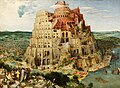 The Tower of Babel (From Toren van Babel, ca. 1563), oil painting in Pieter Brueghel's table, the Old Man in which the tower of the film is supposed to be inspired.
 Car used in the movie. German Technical Museum. Berlin. Archive: Jerzy Kociatkiewicz.
_-_Google_Art_Project_-_edited.jpg)
