
Medusozoa
The jellyfish (Medusozoa), also called aguamalas, malaguas, aguavivas >, aguacuajito, aguacuajada, or sea tears, are marine animals belonging to the phylum Cnidaria (better known as coelenterates); They are pelagic, with a gelatinous body, bell-shaped from which a tubular manubrium hangs, with a mouth at the lower end, sometimes extended by long tentacles loaded with stinging cells called cnidocytes. They appeared about 500 million years ago in the Cambrian.
To move through the water, they are propelled by rhythmic contractions of their entire body; they take in water, which is introduced into their gastrovascular cavity, and expel it using it as a 'propellant'.
The concept of jellyfish is both taxonomic and morphological. Many cnidarians have alternation of generations, with sessile polyps reproducing asexually and pelagic jellyfish carrying out sexual reproduction. Only anthozoans lack a medusa shape; the other three classes of cnidarians (hydrozoans, scyphozoans and cubozoans) have a polyp shape and a medusa shape; These jellyfish present distinctive characteristics in the three classes, so that one can speak of hydromedusae, scyphomedusae, and box jellyfish, respectively.
Morphology

1.- Ectodermis; 2.- Mesoglea; 3.- Gastrodermis; 4.- Stomago; 5.- Radio channel; 6.- Circular channel; 7.- Tentacle; 8.- See it. 9.- External nerve ring; 10.- Internal nerve ring; 11.- Gónada; 12.- Manubrio; 13.- Boca; 14.- Exumbrela; 15.- Upload it.
Jellyfish are bell-shaped or umbrella-shaped. The aboral area (the pole opposite the mouth, see radial symmetry) is convex and is called exumbrella and the oral area, concave, subumbrella. From this hangs the handlebar, at the end of which the mouth opens. From the edge of the exumbrella hang several tentacles equipped with numerous cnidocytes, the stinging cells typical of cnidarians.
The tissue that makes up its body is called the mesoglea, and unlike polyps, it's typically very thick; it is usually gelatinous, but can reach a cartilaginous consistency in some species.
The gastrovascular cavity of these animals has a central stomach from which gastric bags or various radial canals originate, which can be continued inside the tentacles; in this way, nutrients can be more easily distributed throughout the body. Your body is made up of approximately 95% water.
Reproduction and development

From the egg a larva called a pelagic planula is released, pear-shaped and completely ciliated, which, when it finds a suitable substrate, attaches itself and transforms into an asexual polyp; the polyps produce sexed jellyfish that close the cycle.
In the classes Hydrozoa and Scyphozoa, the polyps reproduce asexually, forming buds from which sexual jellyfish will emerge, something that does not occur in Cubozoa:
- Hydrozoa. Hydromeduses are formed by gemation from yemas (horses) on the polyps, either from their walls or specialized gonozoids.
- Scyphozoa. The sciphomeduses originate from small polyps by a process called estrobilation, in which the polyp (scifistoma) is divided into superimposed disks; these disks are released as pelagic larvae called ephiras that will give rise to sexuated jellyfish.
- Cubozoa. In the cubozoa each polyp originates a single cubomeduse through a complete metamorphosis (there is no gemation or strobilization).
Most jellyfish have separate sexes (dioecious). During sexual reproduction, jellyfish release their gametes (eggs and sperm) into the water, where fertilization occurs, or the sperm fertilize the eggs inside the body of the female jellyfish.
Bioluminescence
Some types of jellyfish are bioluminescent, meaning they glow. Both some marine and freshwater jellyfish have this ability. Jellyfish use their bioluminescence to warn predators of their toxicity. An example of a bioluminescent jellyfish is the crystal jelly hydromedusa (Aequorea victoria).

Tentacle toxicity
Jellyfish have tentacles made of stinging cells, or nematocysts, which they use to capture prey and as a form of defense. These cells contain a capsule with a toxic (poisonous) filament. Upon contact with prey, the filaments eject and inject venom. Dead jellyfish tentacles sometimes found on beaches can be poisonous for several weeks.
The toxicity of a jellyfish sting varies by species. Most jellyfish encountered by swimmers cause painful stings with a burning sensation, but they are temporary. However bathers are advised to get out of the water immediately, as there is a possibility of anaphylactic shock and drowning. The most venomous jellyfish is the sea wasp.
Stings from the physalia jellyfish, also called the Portuguese man-of-war (Physalia physalis) and sea nettle (Chrysaora quinquecirrha) are rarely fatal. Stings from the sea wasp jellyfish (Chironex flecheri, Chiropsalmus quadrigatus) can cause death within minutes.
Some fish such as the "mahicharro" They are immune to jellyfish venom and therefore use them as a hideout from potential predators.
Jellyfish of the genera Cyanea and Physalia have tentacles up to 40 meters long, in which some fish take refuge. But in contact with man, certain allergic reactions can occur that could cause death.

Cotylorhiza tuberculata

Pelagia noctiluca

Rhizostoma pulmo
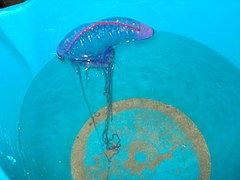
Physalia physalis


Phylogeny

The phylogenetic relationships would be made up of the following classes:
| Medusozoa |
| ||||||||||||||||||
Some species of jellyfish
.jpg)
- Cubozoa
- Chironex fleckeri - Seaplane.
- Chiropsalmus quadrigatus
- Hydrozoa
- Aequorea victory - Sea jelly.
- Benthocodon pedunculata
- Craspedacusta sowerbyi - Freshwater jellyfish
- Physalia physalis - Portuguese carabela.
- Olindia sambaquiensis - Living water or Medusa of the cross.
- Liriope tetraphylla - Pica-pica or Tapioca.
- Scyphozoa
- Cotylorhiza tuberculata - Fried egg jellyfish.
- Rhizostoma octopus - White jellyfish.
- Rhizostoma pulmo - Aguamala, Acalefo blue.
- Aurelia aurita - Common jellyfish
- Nemopilema nomurai - Japanese giant jellyfish
- Cassiopeia xamachana - Inverted jellyfish
- Cyanea chapelta - Arctic lion jellyfish.
- Chrysaora fuscescen - Pacific.
- Chrysaora lactea
- Chrysaora quinquecirrha - Sea urethan.
- Catostylus mosaicus - Medusa mosaic.
- Limnocnida tanganicae - Medusa of the amazons.
Human nutrition
The jellyfish Rhopilema (Rhopilema hispidum and Rhopilema esculentum) and Nemopilema nomurai are edible.
Contenido relacionado
Lasiacis
Chikusichloa
Astasia