
Luxons and tardiones
Luxon is an informal term for massless particles that always travel at the speed of light [citation needed]. The term was coined [who?] as a comparison with hypothetical particles capable of traveling faster than light called tachyons. By comparison, particles with mass that travel at speeds below the speed of light are informally called tardions [citation needed].
Luxons
Physically, luxons are the intermediary particles of the different fundamental forces and are generally known as gauge bosons. Photons (carriers of electromagnetism) and gluons (carriers of the strong nuclear force) are the two types of luxons known so far. Gluons have never been observed alone because they are confined inside massive particles known as hadrons. In quantum theories of gravity, gravitons would also be luxons. Neutrinos were considered for a long time as another type of luxons [citation needed], however, after the discovery of the flavor changes of neutrinos it was determined that they have mass so, although they move at speeds close to those of light, they cannot be considered luxons.
Luxons constitute the basis of an alternative theory on the nature of fundamental particles proposed by the Indian scientist T. S. Natarajan and in which all particles would essentially be luxons with an internal motion and a < i>external movement.
Lateness
Mass matter on the other hand is basically formed by fermions [citation needed] with mass that move at speeds strictly below those of light. Although there are also some unstable mass bosons, whose mass would represent a tiny fraction of all the mass matter in the universe [citation needed]. The speed at which a tardion moves is related to its rest mass and energy by the relationship:
(1)
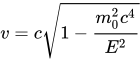
Where:
- It is the resting mass of the tardion.
- It's the total energy of the tardion.
- It's the speed of light.


From the relation () it follows that if a particle with non-zero real mass cannot reach the speed of light, because that It would require an infinite amount of energy. And likewise the same relationship predicts that a particle of zero mass must move at the speed of light.