
Lola Mora
Dolores Candelaria Mora Vega de Hernández, or Dolores Mora, better known as Lola Mora (born in Trancas, Tucumán, on the 17th of November 1866 - Buenos Aires, June 7, 1936), was the most important Argentine sculptor who also ventured into urban planning, mining and the visual arts. She stood out in spaces generally closed to women of her time and was the most flattered and discussed Argentine sculptor of the last years of the 19th century and the beginning of the XX century, La tucumana retains the title of being the first female sculpture in all of Latin America. Her best-known work is the Fountain of the Nereids, popularly known as Fountain of Lola Mora , a sculptural set of Carrara marble that was inaugurated on May 21, 1903 on the Paseo de Julio in Buenos Aires.
Among the tributes he has received is the institution of November 17, the date of his birth, as National Day of the Sculptor and the Plastic Arts carried out by the Congress of the Argentine Nation and the creation in 1998 of the Lola Mora Awards to be awarded by the General Directorate of Women of the city of Buenos Aires to the media, which transmit a positive image of women that breaks with stereotypes of gender, promote equal opportunities and women's rights.
Biography
Childhood and adolescence
Her place of birth is controversial, the people of Salta allege that she was born in El Tala, a town in the south of the province of Salta a few kilometers from where her parents lived, the people of Tucuman base it on where she was baptized (on the 22nd of June 1867) in the north of the province of Tucumán, and where the sculptor always recognized herself as Tucumán.

His father was Romualdo Alejandro Mora, a merchant and landowner of Catalan origin, owner of some ranches in the Tucumán-Salteño area and a house in the city of San Miguel de Tucumán.
In 1857 he arrived in the Salta town of El Tala. He married on March 16, 1859 in the parish of San Joaquín de Trancas (province of Tucumán) with Regina Vega Sardina, a rancher from Salta born in El Tala, of Tarija and Guachipeño ancestry.
Lola Mora (Dolores Candelaria Mora Vega) was the third of seven siblings: three boys and four girls. In 1870, when she was four years old, her family decided to settle in the city of San Miguel del Tucumán. In August 1874, at the age of seven, she began her studies at the Colegio Nuestra Señora del Huerto, where she excelled as a student. In September 1885, when Lola was eighteen years old, her parents died: her mother from pneumonia, and two days later her father from a heart attack.
Beginnings in art
In 1887 the Italian painter Santiago Falcucci (1856-1922) arrived in Tucumán to teach and Lola was one of his students. This is how he began painting, drawing and portraiture and learned about neoclassicism and Italian romanticism, styles that marked his work; He began to make portraits of personalities from Tucuman society with which he was able to finance his other works.
Encouraged by her success, she made a charcoal portrait of the governor of Salta, Delfín Leguizamón, and her work was so perfect that her teacher Falcucci said: "It was a copy of a photograph, but it had everything Lola painted a collection of twenty charcoal portraits of the Tucumán governors since 1853 that were acquired by the province's legislature for five thousand pesos. She was already a well-known artist in Tucumán when in 1895 she traveled to Buenos Aires in search of a scholarship to perfect her studies in Europe, which was granted to her by President José Evaristo Uriburu on October 3, 1896 consisting of a monthly subsidy of one hundred pesos. gold for two years.
First steps in sculpture

Settled in Rome in 1897, she was a student of the painter Francesco Paolo Michetti, who dedicated himself to painting and photography and had been a sculptor in his youth. She learned the art of working with terracotta with the sculptor Constantino Barbella (1852-1925).) and finally decided to dedicate himself fully to sculpture when he met another of his teachers, Giulio Monteverde, a master in marble work. In Rome he set up his home and workshop and traveled frequently to Buenos Aires bringing his works.
While in Italy she interacted with artistic and cultural circles, in which she was highly respected, and the Argentine press began to report on her work, trips to Europe, exhibitions and the awards she received. A self-portrait of Lola Mora, in Carrara marble, was exhibited at the 1900 Paris World's Fair and won a gold medal. When she returned to Argentina in 1900, preceded by her success, she received the commission in Tucumán for a statue of Juan Bautista Alberdi, she agreed in Salta to cast statues and commemorative reliefs for the February 20 Monument and offered the municipality of Buenos Aires her support. most famous work: the Fountain of the Nereids.

The provocation of the nude

Lola Mora returned to her studio in Rome to prepare the orders and returned to Buenos Aires in August 1902 with the blocks of the sculpted statues which, when unpacked, caused a scandal. The Buenos Aires society of the time considered that the statues shamelessly showing naked bodies emerging triumphantly from the waters were "licentious" and "libidinous".
Between Argentina and Rome
At that time he was offered to sculpt a statue of Queen Victoria, to be placed in Melbourne (Australia) and of Tsar Alexander I in Saint Petersburg (Russia), but he rejected both commissions because they required adopting British or Russian citizenship, respectively..

In his country he was commissioned to make a bust of President Julio Roca, a statue of Aristóbulo del Valle, an allegory of independence, two reliefs for the Historical House of Tucumán and four statues to decorate the new building of the National Congress; that would represent the most famous presidents of the historical Argentine congresses: Carlos de Alvear, Francisco Narciso de Laprida, Facundo Zuviría and Mariano Fragueiro. He traveled to Rome and returned in 1904 with all the orders. Mora constantly traveled between Rome where his studio was located and Argentina.
From 1910 her star as a sculptor began to decline. The contractual breaches of her suppliers led her to go into debt and mortgage her workshop in Rome. In 1913 she inaugurated her monument to Nicolás Avellaneda in the city of Avellaneda in the presence of President Roque Sáenz Peña, Vice President Victorino de la Plaza and her great friend, former President Julio Argentino Roca, who died a year later. With her death, Lola lost influence and Roca's political adversaries took their toll on her.
In 1915 Congress decided to dismantle his sculptural works, which it described as "horrible eyesores". Deputy Luis Agote stated that: "They do not demonstrate our culture or our good artistic taste." The group was dispersed among five provinces. That year Lola Mora sold her Roman mansion and returned permanently to Argentina.

In 1918, the Buenos Aires municipality dismantled the Fountain of the Nereidas and sent it to ostracism, locating it on Avenida Costanera Sur, where it currently stands, at the entrance to the Ecological Reserve.
Interest in new technologies

Curious by nature, she approached figures from the theatrical world and, attracted by cinema, wanted to experiment with colored curtains.
Around 1920 he abandoned sculpture and promoted the device called light cinematography, which allowed films to be watched without the need to darken a room, but he was unable to introduce it to the market. She traveled to the north of the country carrying out new projects: first to Jujuy where in 1923 she was named “Sculptor in Charge of Parks and Gardens and Walks” and to Salta at the end of 1924 to begin geological explorations.
In 1925, President Marcelo T. de Alvear canceled the last work commissioned by the State, the design of the Flag Monument. To reverse the blow, he undertook the extraction of fuels based on the distillation of fossil rocks (bituminous shales) in association with other people and unsuccessfully toured the mountains of Salta to develop the business, losing his savings in the process.
Evicted and with her health deteriorating, between 1932 and 1933 she returned to Buenos Aires, under the care of her nieces. She had difficulty walking, wandered, and lost consciousness. In 1933 the Sarmiento Society of Tucumán held an exhibition to benefit the impoverished artist. In 1935, with the conservative order restored, Congress approved a pension of two hundred pesos per month.
On August 17 of that year, Lola Mora suffered a stroke that left her bedridden until June 7, 1936, when she died in Buenos Aires after three long days of unconsciousness, insensitivity and difficulty breathing, surrounded by her three nieces who assisted her throughout her illness.
In the main Argentine publications there were obituary notes. Caras y Caretas, for example, commented:
"We are always surprised by the tragedy of forgotten talent. Now more, by hurting a woman, the first Argentine woman whose vocation was able to face the difficulties of marble, the laborious cousins of clay modeling. "
The evening newspaper Crítica pointed out those responsible for the abandonment of the artist:
"...It is the perennial and sincere homage that compensates, to a certain extent, the material ingratitude of the public powers and the deaf hostility of our artistic circles that saw in Lola Mora the expression of outdated tastes and definitively 'pasados de moda.'"
For its part, the La Nación newspaper, which granted so many favors to Lola Mora in her years of splendor, said about her:
"Determining for art had already meant a prowess, let us remember the date of its beginnings and its initial performance. Woman and sculptor seemed to be excluding terms. The prejudices yielded, overwhelmed by the evidence of his work."
In all the obituaries only the Fountain of the Nereids was remembered of his vast work.
Lola Mora's tomb is located in the West Cemetery of Tucumán, the oldest necropolis in the city, which in 2010 was declared an asset of historical-artistic interest.
Personal life

On June 22, 1909, at the age of forty-two, she married in the Civil Registry with Luis Hernández Otero, who was 17 years younger, son of the former governor of the province of Entre Ríos Sabá Zacarías Hernández, who He had met in the National Congress, where he was an employee, when the sculptor worked for the façade and even, according to researcher Oscar Félix Haedo, he would have been her student.
The religious ceremony was held the next day in the Basilica of Our Lady of Socorro (Buenos Aires). The godmother was Rosario Clorinda G. de Avellaneda, wife of Marco Avellaneda, in turn brother of former president Nicolás Avellaneda, and the best man Manuel Otero Acevedo, the only representative of the groom's family since his family disapproved of the wedding due to the age difference. In both the civil and religious records, Lola Mora appears to be thirty-two years old.
The couple was not happy and five years later her husband left her.
She was a friend of the Italian writer and politician, Gabriele D'Annunzio, and of the Argentine president Julio Argentino Roca. Much of the details of Lola's private life were lost when, upon her death, the family burned her correspondence.
Works
The characteristics of Lola Mora's sculptural art evolved from an academicism highly influenced by Italian Renaissanceism to a kind of brutalism where affinities with Rodin are found. On the other hand, Lola Mora's characteristic is to highlight women in their naturalness, this at a time when women throughout the Western world were absolutely modest and subject to men and female nudity only appeared in a clandestine way as something brothel and pornographic.
Lola Mora's intention in her works was to exalt the free woman with and in her natural beauty, however the majority mentality of the time considered her female nudes as "immoral" works. Lola Mora's work was carried out at a time in the context of women's liberation.
Lola Mora was a prolific worker carrying out outstanding works among which stand out:
- Fountain of the Nereidas, or The Toucher of Venus, in the Southern Costanera, Buenos Aires City, 1903.
- Low reliefs of the House of Independence, San Miguel de Tucumán, 1900.
- Statue "De la Libertad", Plaza Independencia, San Miguel de Tucumán.

- Monument to Juan Bautista Alberdi, Plaza Alberdi, San Miguel de Tucumán.
- The sculptural group of which would be the 2nd National Monument to the Argentine Flag, today part of the 3rd and definitive, erected in the City of Rosario.
- Statues of "La Justicia", "El Progreso", "La Paz" and "La Libertad", in the adjacences of the Palacio de Gobierno de la Ciudad de San Salvador de Jujuy.
- Statue "El Trabajo", in the Maipú de la Ciudad de San Salvador de Jujuy.
- Estatua "Los Leones", in the district of Ciudad de Nieva, San Salvador de Jujuy (Jujuy).
- Monument to Nicolás Avellaneda, in Plaza Alsina, Avellaneda, Province of Buenos Aires.
- Monument to Francisco Narcissus Laprida in the city of San José de Jachal, Province of San Juan.
- Some of the works cast in bronze for the Monument February 20 commemorative of the Battle of Salta, City of Salta, carried out in Paris, under its artistic supervision.
- Dr. Statue. Facundo Zuviría, Jardines de Lola Mora, Parque San Martín, Ciudad de Salta.
- In the town of El Tala (Department La Candelaria, Salta) is his Casa Natal – declared "National Historical Monastery"– and in the Cemetery of that municipality, the first tombstone of which he is author, erected in memory of Don Facundo Victoriano Zelarayán (first head of the railway station of the town).
- Aristobulo del Valle bust. Worksheet: Year: 1906 Location: Municipality of La Plata.
- Statue of General Carlos María de Alvear, first chief of the national state. Located in the Paseo Arazatí, of the city of Corrientes, close to the Belgrano Bridge.
Artistic style
Some of his works are originally synthetic between academic classicism and abstracting tendencies that have overtones of brutalism (they seem almost unfinished and roughly carved with a chisel), such achievements led the French journalist Jules Huret, invited to the Centenary Argentine, in 1910, upon seeing them gave a very unfavorable opinion and yet Lola Mora was approaching with such works the avant-garde of the 20th century< /span> represented by Alberto Giacometti, Eduardo Chillida Juantegui, Pablo Picasso and Henry Moore and anticipated by the outstanding Auguste Rodin and Antoine Bourdelle. But she was often misunderstood although her great merits in her homeland were recognized during her lifetime, although they were then restricted to her classicist and neo-Renaissance carvings.
.jpg)
Fountain of the Nereids

It is considered Lola Mora's most relevant work. Acquired by the Municipality of the City of Buenos Aires, it was initially planned to be installed in front of the Cathedral.
Sculpted in his studio in Rome, when he returned to Buenos Aires with the fountain blocks in August 1902, when it was discovered that it was made up of completely naked statues, a scandal broke out and its location was considered inappropriate.
It was finally inaugurated on May 21, 1903 in the presence of a crowd that wanted to contemplate the source of the scandal.
This sculptural work had its first location a short distance from the Casa Rosada, but, under pressure from the 'moralistic leagues', which in addition to complaining about the nudes in the work, could not tolerate seeing Lola work Mora in pants in his workshop, they forced his transfer to a then remote place: the Costanera Sur, where such a sculptural fountain is still located. From that time on, Mora began to suffer a kind of ostracism, although being able to leave her country she preferred to stay.
Other ventures
After his short marriage, he made risky investments in prospecting for bituminous shale to obtain oil in the jungles of Salta, however such businesses turned out to be losing money.
Lola Mora also participated as a contractor in the work of laying the rails of the Northern Trans-Andean Railway, better known as Huaytiquina, where the train to Las Nubes travels today, in the province of Salta.
Patents in mining
Lola Mora obtained several patents. Among her creations, some ideas for mining exploration stood out, a system for projecting cinema films without a screen using a vapor column and a color cinematography system based on the iridescence of oil emulsions on celluloid. Although her idea was well underway, the lack of a proper scientific basis meant that her idea could not be realized in practice.
As an urban planner, she was the author of the First Subway and Subfluvial Gallery Project in Argentina, planned for the Federal Capital and the street layout of the city of Jujuy.
Tributes and recognitions
The Interprovincial Commission of Permanent Tribute to Lola Mora, on November 17, 1996, discovered the Basal Stone of the “Monument to Lola Mora”, which will be erected in front of the Gardens that bear her name, in the San Martín Park of the city of Salta. At the same time, since 1995, it has been organizing the “Arts Week” year after year, which is celebrated simultaneously in El Tala and the City of Salta (from November 17 to 23) with participation of all artistic disciplines and the Regions of the country under the name of the “Lola Mora” National Arts Festival (or Lola Mora Festival).
The National Commission of Museums and Monuments and Historical Places, the National Executive Branch declared by decree 316, an asset of historical-artistic interest to the grave that houses the remains of Lola Mora in the West Cemetery, of San Miguel de Tucumán.
National Day of the Sculptor and the Plastic Arts
In his memory, the Congress of the Argentine Nation established by law 25,003/98, the date of his birth –November 17–, as “National Day of the Sculptor and the Plastic Arts”.
Lola Mora Awards
In 1999, it is a recognition granted by the General Directorate of Women of the Autonomous City of Buenos Aires to those who, in different media, transmit a positive image of women that breaks gender stereotypes and promotes equality. of opportunities and women's rights.
Its objective is to promote changes in cultural patterns, uses and customs that allow the elimination of stereotypes in the image of women that are transmitted in the media.
It was established after the promulgation of Law No. 188 passed on May 6, 1999 and the award was awarded for the first time in 2000.
Lola Mora quotes
After the Nereids fountain project became public, several movements opposed this work being carried out. However, the artist continued to ignore the opposition. Through a letter she assumed the defense of her artistic creation. Some of her most eloquent paragraphs read:
I do not intend to go down to the terrain of the polemic; nor am I attempting to go into discussion with that invisible and powerful enemy that is evil. But I deeply regret that the spirit of certain people, impurity and sensualism have prevailed over the aesthetic pleasure of contemplating a human nude, the most wonderful architecture that God could create.Lola Mora
Art is man's response to nature and its overcoming; but there is an aesthetic education such as moral and other religious educationLola Mora
Human beings do not reach any of these forms of education but with a fine sensitivity and discipline. Each sees in a work of art what is beforehand in his spirit; the angel or the devil are always fighting in man's gaze. I have not crossed the ocean in order to offend the might of my people; I would be horrified to think that someone has imagined such a thing (...) I deeply regret what is happening, but I do not notice in these expressions of repudiation - let's call it somehow - the pure and noble voice of this people. And that is the one that would interest me to hear; from him I hope the last fault.Lola Mora
Statues in Tucumán

Statue of Liberty, in the Independence Square of Tucumán.
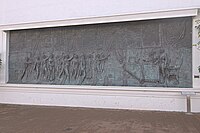
One of the two highlights of Lola Mora, in the third pati of the Tucumán Historical House Museum.

Alberdi Monument, in the Alberdi Square of the capital of Tucumana.
.jpg)

Statues in Rosario


The Gaucho


Statues in San Salvador de Jujuy and in the porticos of the Palace of the Congress of the Argentine Nation

Replicas de obras para el Palacio del Congreso de la Nación Argentina (main event in the North, the originals today are in San Salvador de Jujuy)
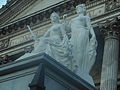
Replica of allegorical works he made for the main access of the Palace of the Congress of the Argentine Nation (south side)
.JPG)

Statue in San Juan
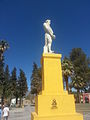
The Laprida

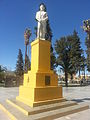


Documentaries
- The source of Las Nereidas (1966) short documentary film written and directed by Carlos Alberto Aguilar for the Argentina series in this century.
- Lola Mora (1996) feature film directed by Javier Torre based on the life of the sculptor.
- The other Lola Mora. Address: Alejandro Arroz. Production: INCAA / Verónica Ardanaz. Direction of Photography and Camera Alejandro Arroz / Sound Rubén Poli / Historic Advice David Sorich / Music Aníbal Alfaro, Pachula Botelli. ATVC Award 1999.
Contenido relacionado
Janet jackson
Joan Miro
Mitsuteru Yokoyama
Kurt Cobain
Shirley Jones