
Leyre Monastery

The monastery of San Salvador de Leyre or Leire, or simply monastery of Leyre or Leire (in Basque Leireko San Salbatore monasterioa), is one of the most important monastic complexes in Spain due to its historical and architectural relevance. Among the different buildings that make up the complex, there are very outstanding Romanesque examples for belonging to a very early period of the same and for their excellent state of conservation. The monastery is located in the northeast of the Foral Community of Navarra, near the border with Aragon.
There is documented news about Leyre as early as the IX century. The monastery had great relevance in the history of the kingdom of Pamplona-Nájera and later in that of Navarra, as well as in the Reconquest. In it is located the pantheon in which the first monarchs of the kingdom of Pamplona lie.
Leyre was founded as a Benedictine monastery, although it later came into the hands of Cistercian monks. At present, the monastic complex belongs to the Foral Community of Navarra, which has ceded it to its original inhabitants, the Benedictine order, for its care and operation.
Place name
The monastery owes its name to the fact that it is located in Leire, a place in the municipality of Yesa, in the Foral Community of Navarra. According to the most probable hypothesis, due to Alfonso Irigoyen, it is a derivative of the Latin legionarius 'legionary', converted into the name of a person Legionarius, which would later give its name to the place in the that he lived. In ancient documentation the name appears with many variants: Lairensis, Leger, Legere, Legior, Legor, Legore, Legurensis, Leier, Leior, Leiore, Leiori, Leioris, Leiro, Leiuri, Leyere Leyor, Leyore, Liger (ss. IX-XII, NEN); Leger, Legiorensis, Leguri, Leior, Leire, Leyro and Sanctus Saluator de (1087-1137, NEN).
Geography
Location and access
The monastery stands on the land of the current municipality of Yesa, 52 km from the Navarrese capital, Pamplona, and 70 km from Jaca, on the branch of the Camino de Santiago that runs along the Aragón river, passing through Jaca, the Aragonese Way of Santiago. The complex is located on a natural balcony on the southern slopes of the Sierra de Leyre, among whose peaks stands out the summit of Arangoiti, 1,356 m high (this mountain range is the first pre-Pyrenean mountain range that stretches over the Berdún channel). Said balcony rises over the valley of the Aragón river, dammed at this point in the Yesa reservoir. From the location of the monastery a large space is covered. To the east are the mountains of Jaca with the Canal de Berdún in the foreground and, beyond, the mountains where the other large neighboring monastery is located, that of San Juan de la Peña. To the west you can see a chain of mountains between which the point of Ujué emerges.
Access to the monastic complex can be done through the N-240 highway that connects Tarragona with San Sebastián. Shortly before reaching Yesa from Pamplona, you have to take a small road that, after traveling 4 km, reaches its gates.

Landscape
The soil is made up of deposits from the secondary and tertiary ages of marine origin, where limestone and dolomites abound, sometimes very sandy, with marls and flysch from the Eocene folded and vergent towards the south. In its vegetation, the beech and red pine forests stand out together with gall oaks, hairy oaks, holm oaks and holm oaks. The predominant fauna is poultry, in which the bearded vulture is the most characteristic and outstanding specimen.
History
Origins
The date and circumstances of the founding of the Legerense monastery are unknown. The first reference to its existence is due to the Cordovan Mozarabic priest Eulogio, in a letter of 851 addressed to the Bishop of Pamplona (Epistula ad Wiliesindum). In it, he recalls his stay in the monastery three years earlier, in the year 848, during a trip to Germanic lands that he had to forcibly interrupt. Eulogio de Córdoba would later be martyred in Córdoba and sanctified, being known as Saint Eulogio. He wrote a chronicle of his trip and in it, among other Pyrenean monasteries that have already disappeared in which he stayed, he named Leyre. In the letter he goes so far as to point out the name of the then abbot, a certain Fortún. These references are confirmed by the apologetic work of Álvaro de Córdoba, Eulogio's friend, on the saint ( Vita vel passio Sancti Eulogii ), as well as with another text by Eulogio in which he says
Being in Pamplona and living in the monastery of Leyre, the curiosity of knowing how to register all the books there preserved. My eyes suddenly fell on the pages of an opuscule without an author's name, which contained the following story about the nefarious prophet: the heresyman Muhammad was born...
These references suggest that by the year 844 the monastery had a certain relevance and had a good library, which indicates that its foundation was earlier. Another important reference to the existence of the monastery in the middle of the IX century is the transfer of the corpses of Saints Nunilo and Alodia by royal order to Leyre.

It is known that at the time when Eulogio traveled through Navarra, the relationship between the Muslims and the Navarrese were good, with no major obstacles to move around the peninsula. However, the political situation of the kingdom of Pamplona changed during those years. Traditionally, the kings of Pamplona and the Banu Qasi had maintained good relations (the Banu Qasi were Hispano-Roman nobles converted to Islam who maintained their dominion over the Ebro valley after the Muslim conquest and who had a rebellious attitude towards the authorities of Córdoba, allies with the kings of Pamplona, to whom they were linked by family ties).
However, after the death of Íñigo Arista, his son García Íñiguez separated from his Muslim relatives, establishing relations with the Asturians. The result of this change of alliances was the battle of Clavijo (858) in which the alliance of Navarrese and Asturians, the latter commanded by King Ordoño I, defeated the troops of the Banu Qasi. However, the attacks of the Navarrese kings against the Banu Qasi provoked the intervention of the Cordovan caliph Abd al-Rahman III. The Caliphate campaigns reached Leyre in 920 when the Christians were defeated by the Caliph at Liédena and the Foz de Lumbier. Pamplona was sacked and its cathedral destroyed. The entry of the Muslims into Navarre had already forced the bishopric and the clergy of Pamplona to settle in Leyre, where they maintained the episcopal seat until the year 1023. Political power also sought refuge in the monastery. The fact that the Bishop of Pamplona resided in the monastery meant that the episcopal and abbatial dignities fell on the same person. King Fortún Garcés, the last of the Aristas, who had lived in Córdoba and was the grandfather of Abd al-Rahman III, retired to the monastery taking the habit in the first half of the century X (there is evidence that he lived there in 928) together with his groom Aznar.
In the IX and X Leyre was one of the most important monasteries of peninsular Christianity, protected by the monarchy of the kingdom where it is based and with influence over a large territory. As an example of the support given by the Kings of Navarre to the Monastery of Leyre, the following documented donations can be pointed out: on August 15, 991, King Sancho Garcés II donated to the monastery the possessions that his brother Ramiro had in Apardués; They had already donated the ones he had in Navardún on February 15; On November 18, 1050, it was García de Nájera who donated goods to Leyre and on January 28, 1085, King Sancho Ramírez incorporated the properties and monasteries of Igal, Urdaspal and Roncal, as well as other goods, into Leyre. The transfer of the Holy Martyrs to the monastery had the purpose of raising the importance of the monastery through the worship and devotion to the relics that was professed at that time, especially around the Jacobean Route.
After the lull in the middle of the X century, the situation worsened again at the end of the century. The church before the existing one, whose foundations have been excavated, was destroyed in the attacks carried out by Almanzor and Abd al-Maliq. A new church was built in its place, of which the crypt and the chancel have been preserved:)
The consecration of the 11th century church
At the end of the X century, during the reign of Sancho Garcés III el Mayor, construction work began on a new church to occupy the site of the one destroyed by the Muslims. In the year 1057 the finished work was consecrated. It is believed that King Sancho el Mayor was educated in the monastery, since there is a document in which the abbot is called domino et magistro meo, which would explain the high esteem that this king had for Leyre.
The 11th century church is somewhat smaller than the current one. The crypt and the chancel have been preserved, since the naves were demolished for the enlargement of the XII century.
On October 24, 1098, another consecration of the temple was carried out with great pomp and pageantry, according to the preserved documents. By this time, the situation of Leyre in the Navarrese ecclesiastical scene was already beginning to change.
Under the kingdom of Aragon
The death of Sancho Garcés IV of Pamplona, the one from Peñalén, in 1076, was deeply felt in the monasteries of Leyre and Irache, since he had been a great beneficiary of them, before Sancho the one from Peñalén the monastery of Leyre It had a large number of added churches and monasteries, 19 royal donations, with Sancho el de Peñalén a further 36 were added to his patrimony, four royal donations. After his death, given the impossibility of being buried in the monastery of Santa María la Real de Nájera, which was then the royal pantheon, it is likely that he was buried in Leyre. The kings Alfonso VI of León and Sancho Ramírez of Aragón go to war to take over the kingdom of Navarre. It is the Aragonese who achieves the objective and Navarra, then still the kingdom of Pamplona-Nájera, remains united to Aragon until 1134. In this period it enters into rivalry with the neighboring Aragonese monastery of San Juan de la Peña, where the kings of Aragon they had established their royal pantheon, and the lawsuit was opened about which bishopric the monastery depends on.
This lawsuit would last for nearly a hundred years. On May 4, 1100, Pope Pascual II pronounced submitting to Pamplona all the churches of the diocese, expressly naming Irache and Leyre. This decision by the Vatican would be followed by a period of thirty years of open litigation in which Leyre came to lose her presumed canonical exemption, which was the basic reason for her existence.
The lawsuit plunged the monastery into a deep crisis with which it entered the 13th century. Being abbot Domingo de Mendavia, he began to study the change of community. When the kingdom of Navarre changed its monarchical house with Teobaldo I, from the French house of Champagne, with the influence of the Cistercian monks, who gradually replaced the decline of the Benedictines of Cluny, to which Leyre had joined along with other monasteries in the Pyrenees, the change of regency is specified. Abbot Fray Domingo de Mendavia denounced the state of indiscipline in which his congregation found itself and arrived in Rome to ask the pope for a change of regency. There is documentation that supports that the abbot had assured King Teobaldo the payment of a thousand maravedís of gold if the Cistercians entered to govern the monastery. In 1239 the regency of the Monastery of Leyre passed from the Benedictine Order to the Cistercian Order. The sentence was not complied with by the Benedictines, who for 70 years maintained a series of fights against the Cistercians for the possession of Leyre, fights between white monks and black monks.
The Cistercian (13th-19th centuries)
Although the importance of the monastery had suffered greatly, it was under the Cistercian order that it became less noticeable. This entry was made in 1237. But it was not until 1269 when the Cistercian General Chapter decreed that Leyre be a subsidiary of the La Oliva monastery, in Carcastillo, under the command of the same abbot. This situation did not last long, soon Leyre would recover his own abbots with direct affiliation to the Escaladieu abbey, as was La Oliva and Fitero.
Under the Cistercian order, the reforms of the church were undertaken. In it, the wooden gabled roof is replaced by a Gothic vault, which can be seen today. To carry out this work, it was necessary to provide buttresses to the walls of the nave and build a flying buttress as they had to raise its height.
In 1562, construction work began on the new monastery, which would end in 1640. This new construction came to replace the old monastery, which was in very poor condition. The new location, between the church and the valley, makes it much more comfortable.
In 1569 ten friars and some laymen lived in Leyre and the monastery had an annual income of 3000 ducats. Intellectual poverty stands out at this time, so much so that in a report it is indicated
It has not been understood until agora that in these monasteries there have been legal monks, nor that it has been exercised in any letters of them.
In 1583, the Navarre Parliament requested that the monks be sent to study at a university.
Congregation of the Crown of Aragon
After attempts in 1609 by the abbot of La Oliva to form a congregation in Navarra with the five Cistercian monasteries, La Oliva, Leire, Fitero, Iranzu and Marcilla
On April 18, 1610, when Juan de Echaide was abbot, the incorporation of all the Navarrese monasteries into the Cistercian Congregation of the Crown of Aragon was dictated in order to correct the problem of the poor training of its members.
The measure to incorporate the Navarrese monasteries into the Aragonese Congregation gave positive results in 1632 when the five Navarrese Cistercian monasteries. Leyre could send three monks annually to the Congregation's Colleges of Higher Studies. The spiritual life reappeared and again the Leyre monastery recovered part of its splendor from another time. Five abbots from Leyre were Vicars General of the Congregation. The library resurfaced and it is known that books were kept there, such as the Book of the Rule and the obituary, the monastic breviaries and an important Latin Chronicle of San Salvador de Leyre; some of them are still preserved in the Archive of Navarra.
The difficult 19th century

The 19th century was a disastrous historical period for religious orders and the Church. The Leyre monastery was abandoned three times by its occupants. In those of 1809 and 1820 the monks were able to return, but in that of 1836, due to the confiscation of Mendizábal, the monastic complex was abandoned until the middle of the century XX.
In 1820 the archives and the library were seized. The relics of the saints of the monastery are dispersed, those of San Virila are deposited in Tiermas and those of Saints Nunilo and Alodia in Sangüesa.
The confiscation of Mendizábal closed the monastery on February 16, 1836. At that time, Leyre had a community made up of eleven priests, two students and five laymen. The monastic ensemble was put up for sale but no one came to buy it. It was used as a shelter for shepherds, and its abandonment and looting led to its total ruin. Even the bones of the Navarrese kings were thrown to the ground when the royal pantheon was desecrated.
In 1844 the Royal Academy of Fine Arts of San Fernando in Madrid created the Commissions for Historical and Artistic Monuments and in 1845 action began to save part of Leyre's monumental heritage and especially the royal pantheon. On May 17, 1863, after hearing news that the tombs of the Kings of Navarre had been desecrated, the royal remains were moved to the church of Yesa.
In 1867 the church of Leyre was declared a National Monument and in 1875 the church of Leyre was reopened for worship. The monastery remains closed. The remains of the kings are moved to their place, where they would remain until in 1888 the improvement works of the temple began.
On May 8, 1915, when the works were finished, the remains of the first kings of Navarre were transferred to the church of Leyre. At the transfer ceremony Juan Vázquez de Mella said:
It is said that this monastery is El Escorial of the Kingdom; but it is more than El Escorial, because it was not only a monastery and convent, but the seat of the Navarre royalty. It was episcopal headquarters and acázar regio, courtroom and councils, a luminous beacon of the homeland culture.
The recovery of the monastery
In 1935, archaeological excavations began in the crypt and in the church, discovering the foundations of the old temple. After the Civil War, the idea of restoring the monastery began to take shape. The Provincial Council of Navarra, to whom it belonged, stated the following:
Leyre is the largest relic in Navarre. Perhaps there would be no Navarre if there was no Leyre. In its old stones is the reason for the Pirenaic Kingdom, which was born precisely in these mountains and in these lands.
Promoted by the then president of the council, the Count of Rodezno, and by Marcelino Olaechea, who would later become Bishop of Pamplona, a project was promoted to rebuild and restore the cult in Leyre. Said project, presented by the Prince of Viana Institution and designed by the architect José Yárnoz, was approved by the Navarra Provincial Council on November 2, 1945. Nine years later, on November 10, 1954, monastic life was restored. The Benedictine community returned to take over the monastery. The monks who settled in Leyre came from the congregation of San Pedro de Solesmes of the abbey of Santo Domingo de Silos.
On November 6, 1965, the monastery of Leyre regained the dignity of an abbey. The following year, on July 1, the Provincial Council handed over the monastery to the Benedictines. In 1979 the first abbot of this new stage was elected, which maintains some thirty monks in Leyre. That same year the new hotel was inaugurated.
In the mid-1970s it was decided to place an image of the Virgin in the apse of the church. An image of the Virgin of Romanesque appearance with the baby Jesus in her arms is acquired, the work of the Valencian carver and sculptor José López Furió. There is evidence that historically there have been various images of the Virgin Mary in the monastery, which the monks have devotionally called Santa María de Leyre. At no time in the history of the monastery has it been dedicated to the Virgin. In Leyre the feast of the Virgin is celebrated on July 9, coinciding with the Benedictine Congregation of Solesmes to which the community of Leyre belongs and coinciding with the feast dedicated to the Virgin with the title of "Mary Mother of Providence" #3. 4; established by the Vatican in 1837.
Art and architecture
Two are the most relevant elements of the monastery: on the one hand, its privileged location; on the other, the buildings that make it up, some of them being the oldest examples of Romanesque in Navarra. Thus, in its church, particularly in the apse and in the crypt, a primitive Romanesque can be seen. The state of conservation of these buildings is very good, although the furniture has been lost over time.
In Leyre, the quality of the stone from its own quarries that were in the vicinity of the monastery, in the middle of the Sierra, stands out. The stone is golden in color with crimson veining due to the presence of iron inlaid with quartz.
Church

The Church of San Salvador de Leyre is the main architectural element of the monastery. It maintains parts of the Romanesque construction from the 11th century to the XII, such as the crypt, the apses, the tower, the main nave and the portico, known as Porta Speciosa, on which later elements are superimposed, such as the Gothic vault, the pantheon of the kings of Pamplona and a small chapel, also Gothic, dating from the XIV and XV. Among the imagery, the image of Santa María de Leyre stands out, a carving of a dead Christ on the cross from the XIV century and the Altarpiece of Saint Nunilo and Saint Alodia, from the XVII.
Header
The head is built on top of the crypt and was consecrated, like that one, in 1057. It is the oldest Romanesque construction in Navarre that is preserved today, and one of the first in Spain. Its three semicircular apses and high naves covered with barrel vaults shelter the altar, the choir with Plateresque stalls and the Neo-Romanesque image of the Virgen del Leyre, the work of José López Furió.
Of the three naves, the central one is wider than the lateral ones. The set does not keep symmetry as those are unequal, the left being narrower than the right. On the other hand, its arches are significantly lowered tending to the horseshoe. The pillars have a cross plan with attached columns, without a base, and are not parallel, but rather converge on the seat of the central apse. The capitals are decorated in a very austere way, based on bulbs, volutes and grooves. The cymas are decorated with geometric motifs with stripes, circles or dotted lines. On the central apse, decentered, there is a small circular window.
Ship
The central nave is Romanesque and is the result of the great extension that was carried out in the XII century, in the during which the cover was also built. It was projected higher than the head and was covered with a wooden gabled roof. The works were consecrated in 1098. Another reform was carried out in the XVI century, in which the nave was covered with a gothic vault. This vault covers the width of the nave in a single arch, 14 m, and is structured in four sections. It is decorated by means of heraldic medallions located in the keys.

The construction of the vault entailed the reinforcement of the exterior walls by means of buttresses and a flying buttress.
In its north wall, in a hole closed by an iron gate from the XIV century, is the mausoleum of the kings of the kingdom of Pamplona. The grouped remains of more than fifteen members of the first Navarrese dynasty have been collected in an oak wood chest with neo-Gothic fittings. At his side, a dead Christ on the cross from the XVIIth century. On the south wall there are two large windows with attached columns and decorated capitals. The chapel is accessed through this same wall, with a Gothic vault from the XV century, in which there is a Renaissance altarpiece from the XVII dedicated to the saints Alodia and Nunilo. Access to this chapel is through a Romanesque doorway from the XII century in which stands out, in its tympanum, a Jacobean crest.
Crypt

Leyre's crypt is not your usual crypt. It does not go underground nor is there evidence that it was ever intended to be a burial place. It stands out for its dimensions and height, as well as for its large capitals, which are raised on small columns.
It was built to level the ground where the church would stand and serve as its foundation. It is square in shape following the shape of the head of the temple, so it has three circular apses and four equal naves covered by barrel vaults. One of them is more recent than the rest, as the staircase that connected the church with the crypt is in that place. It was built in limestone with quartz and iron, which has given it a resistance that has allowed it to be in a good state of preservation.
The crypt was conceived with three naves. However, the central nave was finally divided in two by the central axial arcade, resulting in the four naves that can now be admired. This modification influenced the design of the central apse.
The large capitals are those that maintain the weight of the head of the temple. They are all different from each other, both in size and in terms of decoration. Some carry huge cymas and form a forest of triple-knuckle pillars and very sloping perpiaños that reinforce vaulted naves. The decoration is very simple, based on animal and geometric themes. The crypt, next to the church, was consecrated in 1057.
The entrance door to the crypt, the oldest in the entire monastic complex, is from a nascent Romanesque, very sober and rude. It is made up of three superimposed and staggered semicircular arches that rest directly on the imposts, whose only decoration is the bevel that they have given to the archivolts.
Next to the crypt is the San Virila tunnel that communicates with the crypt through three small, narrow windows that open on the west wall of the crypt. This tunnel served as an exit from the monastery to the surrounding fields. It is currently blinded and in its background there is a sculpture, from the XVII century, of San Virila, abbot of the monastery during the century X. This character is the local protagonist of a legend, spread along the road to Santiago, in which God makes him understand the mystery of eternity.
Porta Speciosa
The Porta Speciosa (Precious Gate) is the portico that was built during the first extension of the original church in the 17th century XII. In it there is evidence, due to the theme of one of the capitals in which two birds appear with their necks intertwined biting their legs, that the master Esteban, author of the door of the Platerías of the cathedral of Santiago de Compostela, worked. In the construction of this portico, elements from other places were reused and different masters of the time worked, which has made it very difficult to give meaning to the whole. The door is protected by a visor and above it there is a transition window and a machicolation from the Gothic construction.
The Porta Speciosa is made up of three different parts:
Eardrum
The circular tympanum above the doors contains six figures. The central and most important is the "Savior", from which the monastery takes its name. To his right are represented the Virgin Mary, Saint Peter and another figure. On the left, Saint John and two other figures that have not been identified and are believed to represent other evangelists. Corbels in the shape of a bull and a lion support the tympanum. The set is surrounded by a crown of palmettes.
Archivolts and Columns
.png)
The four archivolts that are located above the tympanum are decorated by representations of real and fantastic beings with plant and animal motifs in a typical Romanesque harmony.
The columns, three on each side, are crowned by capitals decorated with various themes. From left to right, the capitals represent lions protecting their young, squatting characters typical of Jaca, birds with their necks intertwined biting their paws, or a head imprisoned by acanthus stems and leaves. The door is divided by a marble mullion.
On the sides are figures of saints leaning on lions.
Frieze
Above the archivolts is the frieze. Biblical scenes and characters are represented on it. From left to right, in the highest line are represented Saint Michael, Saint James, El Salvador, Saint Peter, Saint John, scenes of the martyrdom of Saints Nunilo and Alodia, an apocalyptic monster, the devil catching a soul, the dance of the death and Jonah with the whale. In the lower line, the Visitation, the Annunciation, a bishop or saint and a trumpeter angel are represented by stylized figures, and on the left another bishop with a staff and gospel, another trumpeter angel and the head of a man.
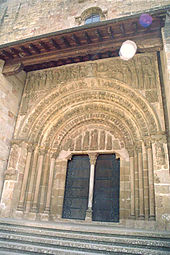

Tímpano
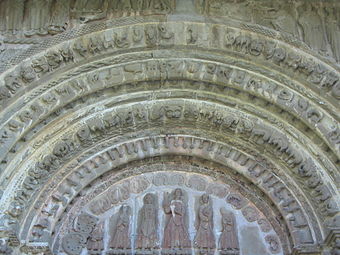
Arquivoltas


Apse and tower

The tower is quadrangular in shape, almost square, with triple-arched windows on all sides. These arches are supported by simple columns, without capitals or decoration. The circular apses have narrow windows and an eaves that is a cornice composed of beveled blocks on modillions decorated with various motifs, human heads, animals, ties, balls, attributes... The walls are clean without any decoration or element. This type of construction was common at that time, first half of the IX century, in Europe and then, later, throughout the peninsula.
The apse and the tower together with the facades of the new and old monasteries form a harmonious ensemble that characterizes the place, being one of the most typical corners of the monastery.
Courtyard of the hostelry
On the north side of the church is the courtyard of the hostelry. In this place stood the Romanesque cloister of the old monastery. This cloister disappeared in the space of 118 years of neglect to which the monumental complex was subjected in the XIX and centuries. style="font-variant:small-caps;text-transform:lowercase">XX; Only a capital found in some excavations remains.
In this space, the great Gothic flying buttress and the access door to the church stand out. The door, located in the north wall of the head, is Romanesque. A little more elaborate than that of the crypt, it is made up of three stepped arches, two of which rest on capitals and columns.
Monasteries
Two buildings were dedicated to monasteries in the Leyre complex. One of them, known as the old monastery, dates from the IX century, but only a few wall canvases and a keep. The north wall is original, it is made of very anarchic masonry that gives it a certain air of fortress. In it you can see the primitive and simple cover, as well as the bolted windows, some ending in a horseshoe arch. On its northeast side stands a tower with a square plan. This monastery had a Romanesque cloister that disappeared during the period that the facilities were abandoned after the confiscation of Mendizábal between 1836 and 1954. At that time, a building was built among the remains of the old monastery, respecting the style and materials, a building to house the hospitality. This new building, together with the church, makes up the courtyard of the hostelry where the old cloister was located.
In the middle of the XVI century, it was decided to build a new monastery as the old one was in very poor condition. The old monastery was to the north of the church, between it and the mountains; the new one rises to the south, between the church and the valley. It is a building 53 m long by 43 m deep, with four floors, attached to the south wall of the church, made in the Aragonese style. The ground floor and the first three floors are made of ashlar stone from the Leyre quarries, the last one in pale brick. This last floor has a series of arcades that alternate between blind and open. The roof has a large overhanging eave carved by Tomás de Gastelu, a resident of the nearby town of Lumbier. The works began in 1562 and ended in 1640.
Leyre's Chest
.jpg)
Among the jewels of the monastery, currently kept in the Museo de Navarra, in Pamplona, is the so-called Arqueta de Leyre, a Hispano-Arabic work delicately carved in ivory that shows a series of reliefs of geometric, vegetable and human type. Dated in 1005, it is signed as Work of Faray with his disciples . The scheme of it adapts to the generalized in this type of pieces.
Saints and dedications
In addition to the main invocation of San Salvador, there are a series of saints closely linked to this monastery: Nunilo and Alodia from Huesca, San Sebastián and San Virila.
Saint Virilla
Legend tells that Virila, abbot of the Leyre monastery, was a monk who was very concerned about understanding the mystery of eternity. For understanding how it was possible to live forever without getting bored and, therefore, stop being happy. In order to understand this mystery, Virila asked God in his prayers to give him the key to understanding him, the necessary help to be able to reveal his concern.
One day the abbot was walking around the monastery, came to a spring and prepared to rest. At that very moment the song of a nightingale captivated him and Virila stayed there listening to it. When she reacted it was already late and she quickly went to the monastery to get to the obligations of the day. When she reached the door, the gatekeeper monk barred her way since she did not know the one who must be her abbot. Virila did not recognize the monk either. He insisted so much that they let him pass and he began to integrate into monastic life without understanding how it was possible that all the monks of Leyre were unknown to him, and they did not recognize him. As time passed, a monk browsing through the old history books of the congregation discovered that more than 300 years ago there had been an abbot named Virila who disappeared in the forest. After the revelation was made when everyone was gathered in the chapter house, the vault was opened and a voice addressed Virila saying: «if three hundred years passed by listening to the song of a nightingale, imagine how time will pass in company of the Most High." In this way Virila understood the mystery of eternity.
The legend, very common throughout the Camino de Santiago, takes on the main character in each place. In Leyre it belonged to Virila, or Viril, who was abbot in the X century. There is a documentary base from the year 928 where they name the abbot Virila. In the time of Sancho el Mayor, this local saint was already worshiped, as is proven in various documents that associate him with the holy Martyrs Nunilo and Alodia. The Cistercians included Virila among the formal saints and his relics are preserved to this day. A fountain with his name has been located in the mountains surrounding the monastery.
Saints Nunilo and Alodia

The figures of Saint Nunilo and Alodia have been closely related to the monastery of Leyre since ancient times. These two sisters were born around the year 830 in Adahuesca, next to the Alquézar fortress in Barbastro, and belonged to wealthy families. Her father converted to Islam and took the name Mu-ladi, while her mother remained faithful to Christianity.
On October 21 of a year before 848 they were beheaded after suffering martyrdom in the city of Huesca for confessing their Christian faith. They were then 18 and 14 years old, respectively. The mortal remains of these sisters were transferred to the monastery of Leyre and remained there until they were lost in the period of abandonment that followed the disentailment of 1862.
The mortal remains of the saints were kept as relics in an Arab-Persian casket. The historical vicissitudes have scattered the relics, which are found, some in Leyre, and others in Adahuesca.
Devotion to these saints was very popular in Navarre, then spread to La Rioja and, in the XVI century, to Toledo. Also in Andalusia, where they are patron saints of Huéscar and Puebla de Don Fadrique, because in 1491 the count of Lerín and constable of the kingdom was exiled from the kingdom of Navarre and marched to the conquest of Granada with separate images of these saints.
San Eulogio de Córdoba expressly mentions the martyrdom of these saints, whose devotion was already firm in the XI century.
Onomastics
The Feast of Santa María de Leyre is celebrated mainly on July 9, the feast of Our Lady Queen of Peace.
Pantheon of the Kings of Navarre
The figure of the monastery of San Salvador de Leyre as the royal pantheon of the kings of the kingdom of Pamplona, at that time the kingdom of Navarre, has been discussed on occasions. Before José Goñi Gaztambide's work Los Obispos de Pamplona was published, it was taken for granted that the first kings of Navarre and their relatives were buried in Leyre. This hypothesis was based on the fact that, during the period of Muslim domination of the Iberian Peninsula, the civil and religious authorities of Pamplona took refuge in Leyre from 860 to 1023, and in the notes of San Eulogio de Córdoba who said
Leyre was for quite some time monastery and episcopal headquarters, royal palace and regio pantheon.
In the IX century, from Pamplona to the east, there are several relevant Christian families that came to be at odds with each other and in sometimes pay tribute to the ruling Muslims based in Zaragoza. There is still no unified and defined power, which prevents the existence, at that time, of what would be understood as a royal pantheon. The first documented news of a bishop in Pamplona dates from the year 829. At that time, the monasteries were very directly dependent on powerful families. Leyre's relationship with the regents in Pamplona was strong, as evidenced by the donations they made to it during the course of history, King Fortún Garcés even becoming a monk of the same in the X.
The importance of San Salvador de Leyre within the kingdom of Pamplona and the relationship that its kings had with it allow us to argue that his burial place was Leyre. What is not known is the location and typology of the tombs. There is no evidence whatsoever that the crypt was used as a burial place, and it is estimated, similar to the kingdom of Asturias at that time, that the burials could have been made in the portico of the church.
The burials of the Navarrese kings
The documentation on the burial of Sancho Garcés I (died in 925) and his son García Sánchez I (died in 970) says that they were buried in Sancti Stefani portico (portico of San Esteban), which has been assigned to the castle of Monjardín in Deyo (formerly the castle of San Esteban, although there is another more recent hypothesis that refers to the castle of Valderresa on the banks of the Ebro). The conquest of Nájera and the establishment of the center of power in that city did not make Leyre lose relevance. There is evidence that in the year 991 the king of Viguesa, Ramiro, son of García Sánchez and Queen Teresa, was buried in Leyre. García Sánchez's other wife, Andregoto Galíndez, settled in Lumbier, near Leyre, after breaking with the king. This makes the hypothesis that she was buried in the monastery plausible.

After García Sánchez el de Nájera founded the monastery of Santa María la Real de Nájera in 1053, the royal pantheon was established there, but the idea that the first kings of the kingdom rested in Leyre was kept alive. In the period of Aragonese rule, San Juan de la Peña would be the royal pantheon and later, as the kingdom of Navarre, the cathedral of Pamplona, although there are burials in other places, such as those of Juan III de Albret and his wife Catalina de Foix. in lescar.
The reappearance of the graves
Tradition held that the royal remains were on the south wall, the left of the altar. For this reason, when it was demolished, on August 13, 1613, Abbot Juan de Echaide judged the presence of the Bishop of Pamplona and other authorities necessary, among which were the historian Fray Prudencio de Sandoval and the Viscount of Zolina and lord of the castle of Javier Juan Garro. They already had prepared (at the request of Jaun Garro) some carved and gilded wooden chests to collect the remains, and in these chests the names of the kings they were going to contain had been written. They were deposited next to the wall of the sacristy. The list of names was based on the Book of the Rule, a codex from the XI and XII. There is a probability that the book has been manipulated at some point, in order to maintain the claim of royal pantheon, which increased the importance of the monastery, and therefore the list of names had some error. The truth is that the regulations in force in the centuries from IX to XII It did not allow it to be buried inside the church, so it had to be carried out in the portico of the same, nor that inscriptions be placed on the identity of the deceased.
The enclosing of the royal remains in the arch adjacent to the altar occurred during the time the monastery was run by the Cistercians. The reasons why it occurred are not known. The incorporation of the peninsular Navarra into the kingdom of Castile in 1512 has been one of the reasons for this concealment. The demolition of the wall was due to the need to build a new sacristy in the context of building the new monastery.
The move to Yesa
When the confiscation of Mendizábal was decreed in 1836, the monastery was abandoned and began to be used as a refuge for shepherds and farmers. In 1863 the chests containing the royal remains were desecrated, and they were scattered on the floor of the church. On May 17, 1863, the priest and the mayor of Yesa went up to the church of Leyre to collect the bones from the tombs desecrated during that period of abandonment. They also collected twelve old tablets that had the following names:
- Sancho Garcés
- Ximeno Íñiguez
- Iñigo Arista
- García Íñiguez
- Fortune VIII
- Sancho Abarca
- García Sánchez
- Sancho García
- Ramiro XIII
- Andrew
- Martín Phoebo Príncipe
- Seven queens
Already in 1845 the Historical Monuments commission had taken an interest in the royal remains, but they did not arrive in time to prevent the desecration. The remains collected by the priest and the mayor of Yesa were transferred and deposited in the town's parish church.
Attempts to move to Pamplona
In 1865 an attempt was made to transfer the remains to the cathedral of Pamplona, for which they requested permission from Queen Elizabeth II. Once the transfer was agreed and organized, which was to be done with a royal presence, it was delayed for various reasons until it was definitively frustrated in 1867.
In 1902 the transfer plan to Pamplona was revived but it was aborted again. This new plan, due to the Monuments Commission of Navarra, intended to bring together in the cathedral of Pamplona all the kings buried in various places. In 1912 the attempt to move to Pamplona was repeated again.
Back to Leyre
The church of Santa María de Leyre was reopened to the public in 1875 and the remains were brought up to their place of origin. A few years later, in 1891, they would go back down to Yesa for the works that were carried out in the church. On this occasion they were endowed with a marble sarcophagus.
Once the works that had begun in 1888 were finished, it was decided to return the kings to Leyre. An oak wood chest is made with neo-Gothic wrought iron engravings, which would be enclosed in a carved white mausoleum.
On July 8, 1915, the ceremony was held, attended by all the civil and religious authorities and a large public. In that act it was where in the speech of Vázquez de Mella it is said:
It is said that the monastery is El Escorial of this kingdom, but it is more than El Escorial, because it was not only a monastery and convent, but a seat of the Navarre royalty...
The mausoleum was located in the center of the presbytery. In 1951 it moved to the then called chapel of San Benito, currently El Santísimo. On October 21, 1982, it was moved, without the marble mausoleum, to its current location, on the north wall protected by a wrought iron fence.
The characters found in Leyre
The list of names contained in the casket and which was based on the tables found in 1863 and these on the list made in 1613, which was based on the obituary book of the monastery dating from the century XIII, is as follows:
- Iñigo Arista, first king of Pamplona between 810-820 and 852
- Jimena, woman of Iñigo Arista
- Jimeno Íñiguez
- Iñigo Jiménez, 842, son of King Jimeno; this king was a contempt for his brother García Jiménez. The news of this monarch is scarce and most of the forged documentation.
- García Íñiguez de Pamplona (805-70), king of Pamplona. It was regent since 842.
- Fortun Garcés, king of Pamplona (882-905). Last king of the Indian dynasty.
- Sancho Garcés I (865?-925), king of Pamplona between 905 and 925.
- García Sánchez I, king of Pamplona (925-970) and count of Aragon (943-970)
- Sancho Garcés II Abarca, king of Pamplona (970-994) and count of Aragon (943-994).
Monastery services
The Monastery of Leyre and the community that lives in it maintain a series of services for visitors. These services are, for the most part, related to monastic and religious life. Participation in religious services held in the church of Santa María de Leyre is open to the general public. In these offices the monks usually sing in Gregorian and Latin.
There is an inn and a restaurant to serve any visitor. More special is the monastic hostel that offers a stay in close contact with the Benedictine community. In this case, only men can access it, since women are not allowed to enter the convent.
Hospitality hotel
With the restoration of the monastery, the new hostelry was built on the remains of the old monastery, which was inaugurated in 1979. The work, carried out with care in respect of the monument, has provided a hotel with 32 rooms, 18 doubles, eleven simple, two quadruple and one triple, as well as a restaurant with two dining rooms.
The monastery has a guided tour service for both individuals and groups.
Monastic hostelry

Along with the normal lodging service there is the possibility of lodging in the monastic inn in the monastery's own rooms. This service, as the entrance to the monastery is restricted to women, is only possible for men. The community has some rooms, about eight cells, for this purpose. Guests must abide by and comply with the principles of monastic life. The length of stay is limited to eight days and three times in the same year.
The purpose of this hostelry is to bring the guest closer to the spirit of peace and tranquility and the approach to God. For this reason, the economic contribution can be agreed taking into account possible difficulties in the economy of the interested party. Even though the Leyre community is a prayerful community aimed at sharing dialogue with God in serene harmony, the hotel business is open to non-Christians, far from Catholic dogma who want to use the climate of peace and tranquility for their own reflections. It is recommended to go to the monastery in a stable mental and spiritual situation, since going to a monastery in "difficult situations of mind or body, can be counterproductive and unsatisfactory."
Life in the community
The Benedictine Order tries to be faithful to the rule of Saint Benedict and the Gospels, for which they follow specific guidelines that the guest must abide by and comply with. The community is dedicated to liturgical prayer and the guest must not interfere, but rather participate in it.
Access to the church and the refectory will be through the route indicated at the entrance. You can walk through the galleries of the lower cloister without entering the rest of the monastery, which is reserved for monks. The exit to the outside can be done through any door, but you must make sure that it is well closed. The use of the fixed telephone for external calls will be made from the porter's telephone, those in the cells are for internal use and external calls can be received with measure.
Efforts will be made to remain silent and not make noise, political or ideological differences cannot be discussed. After Complete the guest will retire to her cell, not being able to stay in other rooms than hers. The guest must be inside the monastery before it closes at 21:30.
The use of tobacco is only allowed in the cell and in the anteroom of the hostel. The food is served at the established times and you have to be a few minutes before them in the lower cloister. The food is established for the community and only for it and the lodgers.
Spiritual help talks or confessions will be done through the mediation of the monk in charge of the hotel business.
Guests must respect the hours of the monastery, although attending services is not mandatory.
Monastic Life
The monastery of San Salvador de Leyre, like any other religious complex, consists of two distinct parts that complement each other. The architectural and artistic part and the spiritual and religious part. In Leyre this last part is defined by the Order of monks that governs the monastery, the Benedictine Order that bases its practice on the Rule of Saint Benedict and on liturgical prayer, its motto is PAX. For Saint Benedict, as he well defines in the prologue to his Rule, a monastery is "a school at the service of the Lord." This makes the monastery the fundamental basis of the existence of the community whose ties must become affective to the degree of family. The monastery must make the relationship with God easy, natural and flexible.
The Benedictines practice the contemplative life, which is the one that gives priority and preference to the exercise of prayer and establishes itself as a pure ideal of Christian life. The relationship of man with Christ, the one sought by the monk of Leyre, is indicated on three occasions in the Rule of Saint Benedict;
Nothing before the love of Christ (Rules IV).
Those who regard nothing as much as Christ (chap. V).
Nothing absolutely prefers Christ (chap. LXXII).
The relationship must be very personal, very direct, reaching intimacy. Benedictine monks must be men of faith, enjoying the joy of it and men of prayer, who oppose activism and agitation, making prayer the highest religious value. Charity understood as love for God and brotherly coexistence is cultivated.
Benedictine monasteries only maintain the main thing;
- Stability, against the pilgrimage of the Andean monks.
- Life in common, against the selfishness of isolation.
- An Abbot, as an active principle of authority.
- An order in life.
Along with charity, discipline is one of the important guidelines. Charity, fostered by life in common, is love of neighbor and fights against selfishness. Discipline rises against protagonism and originality, materializing in obedience and compliance with the Rule. From these directives are born the three vows that the Benedictine monks process:
- Stability: Permanence and perseverance in a monastery.
- Conversion of customs: Let surrender to God be real and not a pure fantasy.
- Obedience under the Rule: Subjecting to the authority of a Chief.

The vow of Obedience according to the Rule can only be carried out with the figure of the abbot. The abbot must be "the representation of Christ in the monastery." He governs the same in its three aspects, the spiritual, the teaching and the management.
So that these objectives that are pursued in monastic life can be carried out, silence is essential. Silence is what allows, in prayer, to hear God.
The prayer culminates with the Divine Office and the Sacred Liturgy, where the Eucharistic Sacrifice is the center. Prayer is the center of Benedictine life.
The life of a monk is based on fraternal charity, without charity it is not possible to maintain the fraternal relationship of monastic life or dedication to God. The Rule says:
This is the zeal that the monks will exercise with the most fervent love, that is to say, to prevent one another with honors; let the defects of the soul and body be patiently filled; let them suffer mutual obedience; let none seek their own usefulness, but rather that of the other.
The search for God through Christ goes through the Passion, through the mortification that the monk must follow. Spiritual mortification which means "voluntary renunciation of one's own will".
The rejection of wealth, of material goods that hinder the path to God results in poverty. The consequence of this poverty is the work necessary to maintain life. Work is the most contributing element to the balance of Benedictine life.
Spiritual direction and liturgical instruction are the forms of apostolate that a Benedictine community exercises. This materializes in the opening of the monastic church to those who want to join in the collective prayer and the monastery to those who seek an environment of peace and serenity.
Monastery hours

The life of a Benedictine community requires a perfect distribution of time, for this reason the community of Leyre has established a schedule of daily activities, these activities are centered on prayer since the rule of Saint Benedict literally says that «Nothing should be preferred to it" referring to prayer. In some of the prayers are performed with Gregorian chants.
Communal prayer is different from individual prayer, the choir is the voice of the community that praises God several times a day when the community gathers in the church to sing praises. For this, all moments of the day must be sanctified, this is done with the Liturgical Hours, which are:
- The VigilsLast hours of the night before dawn, Bible and religious texts are read, especially Psalms.
- Laudespraise par excellence. It consists of hymn, antiphons and psalms, brief reading, New Testament chanting and final preces.
- The Conventual MassAt the main moment of the day the Mass is celebrated, its degree of solemnity depends on the feast of the day. It is often concelebrated and sung by the choir. It is sung in Gregorian and Latin.
- Lesser HoursThey are small strikes in the day to thank God. There are three; Tercia (usually at 9:30), Sixth (usually at 13:20) and Nona (usually at 15:30). The Roman denomination is maintained.
- VespersThey're the late trade, similar to the Laudes.
- Complete, with completes the day, one of the antephones to the Virgin is performed in Gregorian. After this office there is absolute silence until the new day.
The hours between acts are dedicated to personal prayer and reading, to work or study as assigned, at night, after dinner there is a period of community recreation. The time is:
| Activity | Labour | Fellowships |
|---|---|---|
| Beginning of the day | 5:30 | 5:30 |
| Vigils | 6:00 | 6:00 |
| Laudes | 7:30 | 8:00 |
| Breakfast | 8:00 | 8:30 |
| Tercia | -... | 9:30 |
| Mass | 9:00 (tercia) | 11:30 |
| Sixth | 13:20 | 13:45 (with nona) |
| Lunch | 13:30 | 14:00 |
| Nona | 15:30 | -- |
| Vespers | 19:00 | 19:00 |
| Dinner | 20:00 | 20:00 |
| Complete | 21:10 (approx) | 21:10 (approx) |
The balance of the schedule optimizes the Divine Office staggered in canonical hours, rest, work and the Lectio Divina that comes to break the monotony that the other entrusted tasks could mark.
Contenido relacionado
511
491
145