
Leo tolstoy
Lev Nikoláievich Tolstói (in Russian): Николаевич Толстой, pronounced /lj participanf njjjjjjjjjjjjj,  listen , also known in Spanish as León TolstóiYásnaia Poliana, Tula, Russia; August 28Jul./ 9 September 1828Greg.- At present Lev Tolstói, province of Lípetsk, 7 NovemberJul./ 20 November 1910Greg.) was a Russian novelist, considered one of the most important writers of world literature. His two most famous works, War and peace and Ana Karénina, they are considered the cusp of Russian realism, together with works by Fiódor Dostoyevski. He received multiple nominations for the Nobel Prize in Literature every year from 1902 to 1906 and nominations for the Nobel Peace Prize in 1901, 1902 and 1910; the fact that he never won is a great Nobel Prize controversy.
Born into an aristocratic Russian family in 1828, he is known worldwide for the oft-quoted novels War and Peace (1869) and Anna Karenina (1877). as pinnacles of realistic fiction. He first achieved literary success in his youth with his semi-autobiographical trilogy, Childhood, Adolescence and Youth (1852-1856).), and Sevastopol Stories (1855), based on his experiences in the Crimean War. Tolstoy's fiction includes dozens of short stories and several novels such as The Death of Ivan Ilyich (1886), Married Happiness (1859) and Hadji Murat (1912). He also wrote plays and numerous philosophical essays.
In the 1870s, Tolstoy experienced a profound moral crisis, followed by what he considered an equally profound spiritual awakening, as described in his nonfiction A Confession (1882). His literal interpretation of the ethical teachings of Jesus, centered on the Sermon on the Mount, made him a fervent Christian anarchist and pacifist. His ideas on "active non-violence", expressed in books such as The Kingdom of God is on you, had a profound impact on such greats as Gandhi and Martin Luther King. Tolstoy also became a dedicated advocate of Georgism, the economic philosophy of Henry George, which he incorporated into his writings, particularly in < i>Resurrection (1899).
Biography


Tolstoy was born in Yasnaya Polyana, the estate owned by his family in the Tula region (Russia). The Tolstoys were a well-known family of the old Russian nobility. Leo was the fourth of five children born to Count Nikolai Ilyich Tolstoy and Countess Maríya Tolstaya (Volkonskaya). In 1844, he began to study Law and Oriental Languages at Kazan University, but soon abandoned his studies and returned to Yasnaya Polyana, later spending much of his time between Moscow and Saint Petersburg.
During this period of his life, his intention was to seek a suitable job or marriage. In that period of indecision, beset by gambling debts, the Crimean War is declared and his brother Nikolai, the artillery lieutenant, urges him to go with him to the Caucasus, in the Terek Valley. Arriving at the stanitsa, Tolstoy is disappointed and regrets his trip. A few days later, he accompanies his brother who was to escort a convoy of patients to the Stary-Yurt fort. They cross the hot springs of Goriachevodsk where Tolstoy, somewhat rheumatic, takes the opportunity to take thermal baths and where he meets the Cossack Márenka, an idyll that reappears in his novel The Cossacks .
Tolstoy did not belong to the army, but in one of the campaigns of the Crimean War, the commander, Prince Aleksandr Baryatinsky, notices him and after some exams Tolstoy enters the artillery brigade, in the same battery as his brother, as a non-commissioned officer. Some time later he gets permission for a rheumatic cure in the hot springs in Pyatigorsk, where, bored with spending long hours locked in his room, he devotes himself to writing. On July 2, 1852, he finished Childhood and as a result of his stay he wrote The felling of the forest and the Stories of Sebastópol .
Shortly after witnessing the siege of Sevastopol, where the number of dead and wounded in action or disease numbered 102,000, he rejoined the frivolous life of Saint Petersburg, feeling a great emptiness and uselessness.
I have acquired the conviction that almost all were immoral, evil, characterless men, far inferior to the kind of people I had known in my military bohemian life. And they were happy and happy, just as people whose conscience does not accuse them of anything.Tolstói
Associated with the realist current, he tried to faithfully reflect the society in which he lived.

The novel The Cossacks (1863) describes the life of this town.

Anna Karénina (1877) tells the parallel stories of a woman caught up in social conventions and a philosopher landowner, Liovin, who tries to improve the lives of his serfs (last name derived from the name Liova, the short for Lev; that's what Tolstoy was privately called by his wife Sophia Behrs).

War and Peace is a monumental work in which hundreds of different characters are described during the Napoleonic invasion.
Tolstoy had an important influence on the development of the anarchist movement, specifically, as a philosopher of the Christian anarchist current and anarcho-pacifist. The Russian anarchist theorist Pyotr Kropotkin quoted it in the article Anarchism of the Encyclopedia Britannica of 1911.
An enthusiastic reader of the Essay on civil disobedience by American thinker Henry David Thoreau, he sent a letter entitled "Letter to a Hindu" to an Indian newspaper, which led to a brief epistolary exchange with Mahatma Gandhi, then in South Africa, which profoundly influenced the latter's thinking on the concept of nonviolent resistance, a central point of Tolstoy's vision of Christianity. In September 1910, two months before his death, he wrote to her in order to apply "non-resistance", since "the practice of violence is not compatible with love as the fundamental law of life", a principle that was capital in the later development of the satyagraha of the Hindu. He also corresponded with George Bernard Shaw, Rainer Maria Rilke, and Tsar Nicholas II of Russia, among others. His epistolary forms a corpus of about 10,000 letters preserved in the Tolstoy Museum in Moscow.
Leo Tolstoy was a defender of Esperanto, and in his last years, after several spiritual crises, he became a deeply religious and altruistic person, rejecting all his previous literary work and criticizing ecclesiastical institutions in Resurrection, which caused his excommunication. Not even a famous epistle, the one sent to him by his friend Ivan Turgenev on his deathbed asking him to return to literature, made him change his mind.
He was a precursor of what would soon be called naturism. Tolstoy writes in his last book Last Words (1909) that we live according to the law of Christ: loving one another, being vegetarian and working the land with our own hands.. Proof of his vegetarianism are multiple quotes of his, among which stand out:
Feeding meat is a vestige of the greatest primitivism. The passage to vegetarianism is the first natural consequence of the illustration.
A man can live and be healthy without killing animals to eat; therefore, if he eats meat, he takes part in taking the life of an animal only to satisfy his appetite. And acting like that is immoral.
Tolstoy gave rise to the so-called Tolstoyan Movement. After seeing the contradiction of his daily life with his ideology, Tolstoy decided to leave the luxuries and mix with the peasants of Yasnaya Polyana, where he grew up and lived. However, he did not force his family to follow him and he continued to live with them on a large plot of land, a place where he often came only to sleep, spending most of the day as a shoemaker.. He founded a school in the village for the children of the peasants and became their teacher, author and editor of the textbooks they studied. He taught gymnastics modules and preferred the garden to give classes. For this, he created a particular pedagogy whose principles taught respect for themselves and their fellow men.
Death

Tolstoy died in 1910 at the age of 82. He died of pneumonia at the Astapovo (now Lev Tolstoy in Lipetsk Oblast) railway station, after falling ill when he left his house in mid-winter. His death came after fleeing the aristocratic lifestyle and separating from his wife, Tolstoy had tried to give up his property in favor of the poor, although his family, especially his wife, Sofia Behrs, prevented it. This was one of the reasons why Tolstoy had decided to leave his home.
Among his last words, these were heard:
There are millions of men on earth who suffer: why are you taking care of me alone?León Tolstói
Police restricted access to his funeral, but thousands joined the procession; many of them, without knowing about the achievements as an author that Tolstoy had achieved. His mortal remains lie in his house in Yasnaya Polyana.
Anecdotally, on December 26, 1941, the German general of the 2nd Panzer Corps, Heinz Guderian, used his farm in Yasnaya Polyana as his headquarters during the advance towards Moscow and, according to himself, had to deactivate the self-destruction devices of the house and of Tolstoy's own grave placed by Stalin's orders, before being able to occupy it, saving the remains of destruction.[citation required]
However, other sources, especially the Soviet ones, have published graphic material showing that the Germans destroyed part of the properties and works of art on the estate.[citation needed]
Works

The Complete Works of Tolstoy were published between 1928 and 1958. There are 90 volumes, the last 32 volumes of which contain the count's correspondence. This edition is unreliable: the Soviet censorship deemed many passages "politically incorrect." That is why it is necessary to consult the original manuscripts in the Tolstoy Museum in Moscow.
Novels
- Children (. [chuckles]Détstvo],1852)
- Adolescence (Отрочество [chuckles]Otrochestvo], 1854)
- Youth (шность [chuckles]Yúnost'], 1856)
- Conjugal happiness (Семейное счастие [chuckles]Seméynoye schástiye], 1858)
- The Cossacks (Казаки [chuckles]Kazakí], 1863)
- War and peace (Война имир [chuckles]Voyná i mir], 1865-1869)
- Anna Karénina (Ana Karénina1875-1877)
- The Death of Ivan Ilich (Смерть [chuckles]Smert Ivana Ilyichá], 1886)
- The sonata to Kreutzer (Крейцерова соната [chuckles]Kréitzerova Sonata], 1889)
- Resurrection (Воскресение [chuckles]Voskresénie], 1899)
- The fake coupon (Фальшивый купон)Falshivy kupon], 1911, postuma)
- Hadji Murat (CHAADITI-Mурат [chuckles]Jadzhí-Murat], 1912, posthumous
Stories
- The raid, also known as La correría or La incursión (1852)
- Sevastopol (1855): Sevastopol in December, Sevastopol in May and Sevastopol in August 1855.
- The snowstorm (1856)
- Two Husares (1856)
- From the memories of the Caucasus. Degraded (1856)
- The morning of the landlord (1856)
- From the memories of Prince D. Nejliúdov. Lucerne (1857)
- Albert (1858)
- Three deaths (1859)
- Políkushka (1863)
- Two Husares (1866)
- The prisoner of the Caucasus (1872)
- What makes men live (1881)
- The Memories of a Crazy One (1884)
- Iliás (1885)
- Ivan the fool (1885)
- The two brothers and the gold (1885)
- Where Love Is God (1885)
- How much land does a man need? (1885)
- The Three Eremites (1885)
- The two elders (1885)
- Jolstomer (History of a Horse) (1886)
- A missed opportunity (1889)
- Master and servant (1895)
- Father Sergio (Отец Сергий [chuckles]Otéts Sérguiy], 1898)
- After the dance (1903)
- Assyrian king Asarjadon (1903)
- Three issues (1903)
- Aliosha Puchero (1905)
- Kornéi Vasíliev (1905)
- Prayer (1905)
- Divine and human (1905)
- Buddha (1908)
- The Wolf (1908)
- Songs in the village (1909)
- The Devil (1911)
Educational literature
- The ABC (1872)
- New grant (1875)
- Arithmetic (1875)
- First Russian reading book (1875)
- Second Russian reading book (1875)
- Third Russian reading book (1875)
- Fourth Russian reading book (1875)
Religious works
- Confession (1884)
- What is my faith? (1884)
- The kingdom of God is in you (1894)
- The abbreviated gospel (1894)
- The Way of Life (1911)
Essays (selection)
- The first step (1891)
- Church and State (1891)
- I can't shut up.
- What is art? (1897)
- Singing for my life
- Yásnaia Poliana School
- The Origin of Evil
- The slavery of our time (1909)
Others
- Correspondence (1842-1879)
- Correspondence (1880-1910)
- Journals (1847-1894)
- Journals (1895-1910)
Movie adaptations
- 1909. Resurrection (United Kingdom). Film, 12 minutes, based on the homonymous novel. It was filmed in the life of the writer.
- 1911. Anna Karénina. Russia. Mute cinema. Director: Maurice Meter.
- 1914. Anna Karénina. Russia. Mute cinema. Director: Vladimir Gardin.
- 1915. War and peace. Russia. Mute cinema. Director: Yákov Protazánov, Vladimir Gardin.
- 1915. Natasha Rostova. Russia. Mute cinema. Producer: Aleksandr Janzhónkov. Cast: Witold Polonski, Ivan Mozzhujin.
- 1918. Father Sergio. RSFSR. Mute cinema. Yákov Protazánov, starring Iván Mozzhujin.
- 1927. Love. USA. U.S. Based on the novel "Anna Karénina". Mute cinema. In Anna's role: Greta Garbo.
- 1927. Resurrection. United States. Mute cinema. In the role of Katyusha: Dolores del Río.
- 1935. Anna Karénina. USA. U.S. Sound cinema. In Anna's role: Greta Garbo.
- 1929. The living corpse. Soviet Union. Director: Fiódor Ozep, starring Vsévolod Pudovkin.
- 1946 Celsius. Argentina. Director: Mario Soffici.
- 1948. Anna Karénina. United Kingdom. In Anna's role: Vivien Leigh.
- 1956. War and Peace. USA, Italy. Director: King Vidor. In the role of Natasha - Audrey Hepburn.
- 1956. Passional Madness. Mexico. Based on the novel Sonata to Kreutzer. Director: Tulio Demicheli. In the role of Mabel - Silvia Pinal.
- 1959. Hadji Murat, the white devil. Italy, Yugoslavia. In the role of Hadji Murat: Steve Reeves.
- 1959. The same people. Soviet Union, About a fragment of "War and Peace." Director: Georgui Danelia, starring Vsévolod Sanáev and Lev Dúrov.
- 1960. Resurrection. Soviet Union. Director: Mijaíl Schweizer.
- 1961. Anna Karénina. USA. U.S. In the role of Vronsky: Sean Connery.
- 1961. The Cosacos. Soviet Union. Directed by Vasili Pronin, Viktor Shklovski script.
- 1967. Anna Karénina. Soviet Union. Director: Aleksandr Zarjí. In the role of Anna: Tatiana Samóilova; in the role of Princess Betsy Tverskaya: Maya Plisétskaya.
- 1967. War and peace. Soviet Union. Director: Serguéi Bondarchuk.
- 1968. Living corpse. Soviet Union. Director: Vladimir Venguérov. With Alekséi Batálov.
- 1972. War and Peace. United Kingdom. Miniserie. In Pierre's role: Anthony Hopkins.
- 1978. Father Sergio. Soviet Union. Largometraje Ígor Talankin, starring Serguéi Bondarchuk.
- 1978. The History of the Caucasus. Soviet Union, based on the novel The Cossacks. Protagonist: Vladimir Konkin.
- 1982. Filipok (Филипок), short film of cartoons of 1982 produced by the studies Ekrán (Ekкран) and directed by Rosaliya Zelma (Розалия Zельма, n. 1938).
- 1983. "The money". France-Switzerland, in the story "The fake coupon". Director: - Robert Bresson.
- 1983. Let yourself fish, fish! (Get out!): short film of cartoons produced by Ukranimafilm studies (ркранимафильм) and directed by Galina Turguénieva (Галина Тргенева, 1915 - 2002); it is adaptation of the story Hide, hit, wolf tail (Мерзни, мерзни, волчий хвости).
- 1984. Two humsares. Soviet Union. - Vyacheslav Krishtofóvich.
- 1985. Anna Karénina. USA. U.S. In Anna's role: Jacqueline Bisset.
- 1985. Easy death. Soviet Union, based on the novel "The Death of Iván Ilich". Director: Aleksandr Kaidanovski.
- 1987. Sonata to Kreutzer. Soviet Union. Director: Mikhail Schweitzer, starring Oleg Yankovski.
- 1996. What?. Poland/Russia. Director: Jerzy Kawalerowicz.
- 1997. Anna Karénina. USA. U.S. In Anna's role: Sophie Marceau, Vronski: Sean Bean.
- 2001. Resurrezione. Italy. Directors: Paolo Taviani and Vittorio Taviani.
- 2007. Anna Karénina. Russia. In Anna's role: Tatiana Drúbich.
- 2009. Last Station (film, 2010). USA. U.S.-Russia. Address: Michael Hoffman. Main actors: Christopher Plummer (Leon Tolstói), Helen Mirren (Sofía Andréevna, his wife) and Paul Giamatti (Vladimir Chertkov, his principal disciple).
- 2012. Anna Karénina. USA. U.S. Director: Joe Wright. Anna's role: Keira Knightley.
Biographical
- 2009. Last station. Germany-Russia. In Tolstói's role: Christopher Plummer, like Sofia Helen Mirren.
More to see:
- List of cinematic adaptations by Anna Karénina 1910-2007.
- 2007. War and peace. Germany, Russia, Poland, France, Italy. Series. With Alessio Boni on the role of Andréi Bolkonski.
Gallery

Portrait of León Tolstói. 1873.
I. Kramskói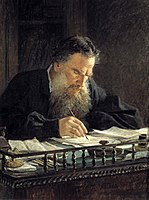
Portrait of León Tolstói. 1884.
N. Gue
Portrait of León Tolstói. 1887.
I. Repin
Leon Tolstói burning. 1887.
I. Repin
Leon Tolstói resting in the forest. 1891.
I. Repin
Leon Tolstói descalzo. 1901.
I. Repin
Leon Tolstói, on the shore of the lagoon in Yásnaia. 1907.
M. Nésterov
Leon Tolstói, in the collection of Yásnaia Poliana. 1910.
V. Meshkov


_-_Portrait_of_Leo_Tolstoy_(1887).jpg)


Further reading
- Craraft, James. Two Shining Souls: Jane Addams, Leo Tolstoy, and the Quest for Global Peace (Lanham: Lexington, 2012). 179 p.
- Lednicki, Waclaw (April 1947). «Tolstoy Through American Eyes». The Slavonic and East European Review 25 (65).
- Trotsky’s 1908 Tribute to Leo Tolstoy. Published by the International Committee of the Fourth International (ICFI).
- The Life of Tolstoy: Later Years by Aylmer Maude, Dodd, Mead and Company, 1911 at Internet Archive.
- Why We Fail as Christians by Robert Hunter, The Macmillan Company, 1919 at Wikiquote.
- Why we fail as Christians by Robert Hunter, The Macmillan Company, 1919 at Google Books.
Spanish translations
- Conjugal happiness. Translation: Joaquín Fernández-Valdés. Barcelona: Ed. Vienna (Invisible Editions). 2022. ISBN 978-84-1240-1998.
- War and peace. Translation: Joaquín Fernández-Valdés. Barcelona: Alba Editorial. March 2021. ISBN 978-84-9065-7348.
- The inner revolution (selection of stories and texts by Stefan Zweig), Madrid, Errata naturae, 2019.
- Stories of Yásnaia Poliana [Children's Tales and The Caucasus Prisoner] (Sara Gutiérrez, trad.) Madrid (Spain): The Kingdom of Cordelia. June 2019 [1871-1875]. ISBN 9788416968817.
- The first step and other writings about vegetarianism. Translation: Joaquín Fernández-Valdés. Barcelona: Kairós. 2017.
- Against those who govern us, Translation of Aníbal Peña. Madrid, Errata naturae, 2014.
- Conjugal happiness. Translation: Selma Ancira. Barcelona: Acantilado. 2012.
- Anna Karénina (Víctor Gallego Ballestero, trad.) Translation Award «La Literatura Rusa en España 2012». Barcelona (Spain): Alba. March 2013. ISBN 9788484288442.
- The snowstorm. Translation: Selma Ancira. Barcelona: Acantilado. 2010.
- The kingdom of God is in you. Translation: Joaquín Fernández-Valdés. Barcelona: Kairós. 2010.
- Confession. Translation: Marta Rebón. Barcelona: Acantilado. 2009.
- The Cossacks. Vilaür: Atalanta. 2009.
- Correspondence. Translation: Selma Ancira. Barcelona: Acantilado. 2008.
- What is art?. Translation: Victor Gallego. Pamplona: Collection Cátedra Félix Huarte, Eunsa. 2007.
- War and peace. Translation (from José Laín Entralgo): Lydia Kúper. Madrid: Mario Muchnik Workshop. 2003.
- Journals (1895-1910). Translation: Selma Ancira. Barcelona: Acantilado. 2003.
- Sonata to Kreutzer. Translation: Ricardo San Vicente. Barcelona: Acantilado. 2003.
- Journals (1847-1894). Translation: Selma Ancira. Barcelona: Acantilado. 2002.
- The Death of Ivan Ilich - Hadyi Murat. Translation: Juan López Morillas. Madrid: Alianza. 1996.
- Resurrection. Translation: Augusto Vidal. Barcelona: Planet. 1985.
- War and Peace, 1983. Translation: José Laín Entralgo. Barcelona: Planet. 1983.
- Complete Works. Translation: Irene and Laura Andresco. Three volumes. Madrid: Aguilar. 1981.
- Ana Karenina. Editing and translation: Josefina Pérez Sacristán. Madrid: Chair. 1981.
- Memories. Children, adolescents and youth. Translation: Victor Andresco. Madrid: Editions Giner. 1977.
- Complete Works. Two volumes. Madrid: Aguilar. 1955-56.
- War and peace. Two volumes. Barcelona: R. Sopena. 1931.
- Cruel pleasures. Preface of Carlos Richet. Translation of Augusto Riera. Barcelona: Maucci. 1902.
- About Tolstói
- Mann, Thomas. Goethe and Tolstói about the problem of humanity. Buenos Aires: Tor.
- Porché, François (1958). Tolstói: psychological portrait. Buenos Aires: Losada.
- Zweig, Stefan (1927). Stellar moments of humanity. Editorial Acantilado.
- Rolland, Romain (2010). Life of Tolstói. Acantied. ISBN 9788492649822.
Contenido relacionado
Annex: Presidents of Iceland
Daniel Barenboim
Diego de Alcala