
Lemniscate


In algebraic geometry, a lemniscate is any one of several curves with a figure of eight (8) or infinity symbol (∞).
The word comes from the Latin "lēmniscātus", which means "decorated with ribbons", in turn from the Greek "λημνίσκος" which means "ribbons", which can also refer to the shape of the skein of wool from which the aforementioned ribbons were made.
Curves generally called lemniscate include three quartic curves: the hippopoda, the Bernoulli lemniscate, and the Gerono lemniscate. The study of lemniscates (and in particular of the hippopoda) dates back to Hellenic mathematics, but the term "lemniscate" for curves of this type comes from the work of Jakob Bernoulli in the late 17th century.
History and examples
Booth's Lemniscate

Consideration of figure-eight curves dates back to Proclus, a Greek philosopher and mathematician of Neoplatonism who lived in the 18th century V d. C. Proclus considered the sections of a bull by planes parallel to the axis of the bull. As he observed, for most sections, the cross section consists of one or two ovals; however, when the plane is tangent to the inner surface of the torus, the cross section takes on a figure eight, which he named with the Greek word hipopoda (because of its similarity to the tether used to immobilize two of a horse's legs by holding them together). The name "Booth's lemniscate" for this curve goes back to its study by the mathematician of the 19th century James Booth.
Lemniscata can be defined as an algebraic curve, the set of zeros of the quartum polynomial when the parameter d It's negative. For positive values d You get a hippod.

Bernoulli's lemniscate

In 1680, Cassini studied a family of curves, now called Cassini ovals, defined as follows: the locus of all points such that the product of their distances from two fixed points, the foci, is a constant. In very particular circumstances (when half the distance between the foci is equal to the square root of the constant), this gives rise to a Bernoulli lemniscate.
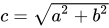
In 1694, Johann Bernoulli studied the case of lemniscata within the Cassini oval family (which would become known as the Bernoulli lemniscata shown above), in relation to a problem of isochronous that had been raised earlier by Gottfried Leibniz. Like the hippod, it is an algebraic curve, the set of zeros of the polynomial . Bernoulli's brother, Jakob Bernoulli, also studied the same curve that same year, and gave him his name. It can also be geometrically defined as the place of the points whose product of distances from two bulbs is equal to the square of half the interfocal distance. It is a special case of the hypopod (Booth lemniscata), with , and can be formed as a cross section of a bull such that its inner hole and its circular sections have the same diameter. The elliptical lemnischatic functions are analogous to the trigonometric functions for the Bernoulli lemniscata, and the lemniscata constants arise when calculating the arch length of this curve.


Lemniscate of Gerono

Another lemniscata, Gerono lemniscata or Huygens lemniscata, is the set of zeros of the quartum polynomial . Viviani's curve, a three-dimensional curve formed by the intersection of a sphere with a cylinder, also has an eight figure, and takes the form of Gerono's lemniscata when projected on a plane.

Others
Other algebraic figure-eight curves include:
- The curve of the devil, a curve defined by the quartum equation in which a related component has a figure in the form of eight,
- Watt curve, an eight-shaped curve generated by a mechanical link. The Watt curve is the set of zeros of the grade six polynomial equation and includes Bernoulli's lemniscata as a special case.
- Besace, curve studied by Gabriel Cramer, with the equation or , with .




Generalization
In analytic geometry, consider n points in the plane F1, F2,..., Fn and k a strictly positive real number. The set of points in the plane whose product of the distances to each of the points F1, F2,...,Fn is constant and equal to k is a curve (place geometrical) called a lemniscate of n foci. The Bernoulli lemniscate has only two foci.
A single-focused lemniscate is a circle.
Lemniscate in the complex plane
The equation of the lemniscate in the complex plane is

Properties
An arbitrary sequence can be approximated by an arbitrary curve. In particular, by taking a different number of foci, arranging them differently, and assigning one or the other value to produce distances, the strangest elements can be obtained, for example, the outline of a human head or a bird.
Examples
- Various examples of lemniscatas

Lemniscata de Bernoulli
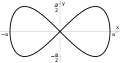
Lemniscata de Gerono

Booth Lemniscata
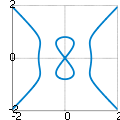
Curve of the Devil
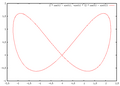
Besace
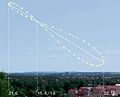
Analema


Contenido relacionado
President
Computational physics
Classification of plants