
Larache
Larache (in Arabic: العرايش) is a port city located in northwest Morocco. It is the capital of the eponymous province. Located within the Tangier-Tetouan-Al Hoceima region, it is about 85 km from Tangier and 105 km from Tetouan. It is located on the Atlantic coast, on the left bank of the Lucus River estuary.
According to the 2004 census, it had a population of 107,371 inhabitants. In its vicinity are the ruins of Lixus, a Phoenician and later Carthaginian settlement that later became a Roman colony and part of the Roman province of Mauretania Tingitana.
Climate
Larache benefits from a Mediterranean climate. Temperatures are warm in summer and mild in winter. Larache has an average of between 700 and 800 millimeters of rain per year. As for temperatures, between 6 °C and 10 °C in winter, and between 27 °C and 35 °C in summer. An all-time high temperature of 46.4 degrees Celsius (115.5°F) was recorded on July 10, 2021.
History

Lixus 7th century BC. C. - 5th century
Ancient city of Lixus (Phoenician and Carthaginian). The legend wants to place the mythical Garden of the Hesperides in Larache, where the golden apples kept by the dragon Ladón were found. The city is considered a natural geographical and historical extension of ancient Lixus, which is three kilometers away.
Middle Ages
Larache was founded in the 8th century; specifically, in the year 828, according to some sources, when the Idrisid prince Mohammed handed it over to his brother Yahia ibn Idrís for his government and Arab fighters installed in Lixus extended their camps on the other bank of the Lucus river. In 1471 under the reign of Alfonso V of Portugal, the Portuguese established in Asilah and Tangier went up the Lucus estuary and reached a toll not far from the city, where they built a fortress. However, they did not finish it, because they were expelled by the Kabyles and by the Maghreb army, commanded by Muley Nácer (Wattásid dynasty), who ordered the construction of walls and a fort called Al-Fath or Leqbibat, with the aim of protecting Larache. from the sea and avoid further incursions along the river.[citation needed]
The Saadian sultan Áhmed Mansur Adahbi built a castle on the outskirts of the medina, on the countryside side, in 1578, giving it the name An-Nasr (Victory), later known by the Spanish as the castle of Our Lady of Europe or popularly as Las Cigüeñas. The Jewish Tower, located north of the Castle of the Storks, dates back to the 14th century. The city once again became a commercial port. and a refuge for Dutch, English and North African pirates on the lookout for Spanish and Portuguese cabotage and transoceanic shipping.
Modern Age

In 1610, Sultan Mohammed esh-Sheikh el-Mamun, defeated by his rival Mawlay Zidan Abu Maali, peacefully gave the city to the Spanish monarch Philip III in exchange for his help in recovering the Saadian throne. The fortification of the Larache prison, with the name San Antonio de Alarache, was commissioned to the expert engineer Bautista Antonelli, among whose works are the Morro de La Habana or the fortification of Cartagena de Indias. The population of Larache upon the arrival of the Spanish was one hundred neighbors. In addition, work was undertaken on the convent of San Francisco and the church of La Fuerza, on top of an existing mosque. The castle of An-Nasr, triangular with sixty cannons, was renamed the castle of Our Lady of Europe or Saint Mary and the castle of Al-Fath, quadrangular, next to the river and with thirty cannons, was renamed the castle of San Antonio. Together with the engineer Juan de Médicis y Alemanni, who also worked on the La Mamora fort, the reconstruction of the wall and bastions, the reinforcement of the moats and parapets, and the construction of an earthen gate between the two castles were undertaken. whose ravelin is the origin of the current Plaza de la Liberación or Plaza de España. The fortification housed the old city, the barracks, parade ground, garrison, church, hospital and other facilities. After the dismissal of Gaspar Valdés y Alcaraz, Pedro Rodríguez de Santisteban was appointed governor in 1614. His supplies were carried out, as for La Mamora, from El Puerto de Santamaría thanks to the logistical capacity of the VII Duke of Medina Sidonia. Other governors of Larache were Lorenzo de Ripalda y Ureta or the field master Diego Pacheco de Arce.
In 1689 it was conquered by Ismail of Morocco, after the conquests of La Mamora (1681) and Tangier (1684).
In the reign of Muley Mohámmed ibn Abdel·lah, Larache experienced very important urban and commercial development. He improved the infrastructure, expanding and equipping the city's souk, popularly called Souk Chico (Sok Sguer, in Arabic). He rehabilitated the first mosque of Larache.
Contemporary Age
_in_1860.jpg)
In 1829, the city was punished and bombed by the Austrian fleet, and in 1860 by some Spanish ships due to the conflict that led to the African War, which arose between Spain and Morocco. In 1860, the city had about 3,500 inhabitants, the majority Muslim, since only 200 of them were Hebrews and 20 Europeans (the majority Spanish).[citation required] During the African war between Morocco and Spain, the port of Larache was subject to a blockade and bombs from the Navy.
Spanish Protectorate of Morocco (1912-1956)

On June 8, 1911, during the Rif War, Spanish troops landed in Larache. The settlement of the Spanish military and civilians in Larache involved the construction of facilities, infrastructure and housing for the new residents. In 1913, the protectorate was militarily divided into three General Commands located in Ceuta, Melilla and Larache, depending on general policy matters on the High Commissioner of Morocco and the Ministry of War. The General Command of Larache disappeared in 1956 with the independence of Morocco. In 1943 the Tercio based in Krimda, north of Larache, was renamed Tercio Don Juan de Austria, which in 1956 was transferred to El Aaiún in the Spanish Sahara.
On October 17, 1921, the pioneering Seville-Larache airmail and military line, run by CETA, the first private airline company in Spain, was inaugurated.
On April 23, 1938, the second line of the reactivation of Iberia was inaugurated, which was the Seville-Larache-Sidi Ifni-Cabo Juby (Tarfaya) route. The Spanish Protectorate of Morocco was in force between 1912 and 1956. time in which the image of Larache changed a lot in all aspects, urban and architectural, such as the Plaza de la Liberación, the old Plaza de España, the Balcón Atlántico, the new avenues and arteries of the radial expansion city of Larache. Among the buildings from this period there are neo-Adalusian, aerodynamic or modern styles, among others.
News
From 1956 to the present, Larache lost many of the acquisitions it had, such as being the capital of the province and the Lukus region. In 1958, the Larache-Alcazarquivir railway line, a branch of the Tangier-Fez that dated from 1922, was closed, the marginalization of its port in favor of those of Tangier and Casablanca, the gradual disappearance of the Hispano-Moroccan legacy and the non-metamorphosis of the city..[citation required]
Artistic and monumental heritage
Medina
The city is accessed through Mohámed V Street, formerly Queen Victoria, the main artery of the Spanish city, which reaches Plaza de España, today Plaza de la Liberación, the nerve center of the city, where the old medina and the expansion. Plaza de España was built with the idea of creating a connection between the old and new city; It is elliptical in shape, to adapt to the walls of the medina, it is surrounded by traditional style buildings. The triangular-shaped ancient city extends between the castle of El-Kebibat, that of La Cigüeña and the port, once walled.
Entering through the Plaza de España, you cross the Bab Barra or Medina gate renovated during the protectorate, accessing a porticoed plaza, the Souk Chico (20th century XVIII) or souk sgher, nerve center of the souk, former parade ground, today a souk with arches restored by the Spanish, presided over by the Major Mosque, which is raised in the 18th century.
To the left of the Souk Chico is the Madrassa (XVIII century), an old fondac, with a large central patio, Next to it is the gate of the Kebibat neighborhood (19th century) which, along the old Hospital Street, ends at its castle. name, also called Castillo de San Antonio built by the Saadians in the XVI century as a fortress to defend the city. A certain defensive fortress, it was enabled by the Spanish in 1911 as a provincial hospital.
If we continue from the Souk Chico in a northerly direction, we find the old Puerta de Mar on the edge of the river, an old dock, today urbanized with the construction of a new avenue and port lands. Towards the east, near the old wall, we find the Nasaria mosque (XVIII century), the old Jewish quarter, with its houses with large balconies, the old church of San José (1909), in neo-Gothic style with a tower, today in ruins, leaving the medina through the dock gate (century XVII), the old Shipyards of the XVIII century, with horseshoe arches, are still in use, and the old Red Crescent hospital, with its small church.
To the right of the Souk is the door of the Alcazaba (XV century), with its fountain, a of the main gates of the city in the XV and XVI. This door gives access to Alcazaba Street, continuing along it towards the east you pass the Anwar Centuries square and mosque with a high octagonal minaret. This building probably sits in an old Christian convent and cemetery of San Francisco.
Nearby, on Majzen Square, where there are splendid views of the port and Lixus Hill, are several notable buildings. The primitive fortress (former General Command), with the clock tower renovated by García de la Herrán, is a fundamental work of the neo-Arabic style that flourished in the protectorate; Today it is a music conservatory. Inside, decorated, the patio and stairs stand out. Next to this old commandery is the Stork Castle, also known as "El-Laqaliq" (and formerly "Our Lady of Europe"), built in the XVI century by the Saadians. Its triangular shape and high walls are reminiscent of the Ceuta bastions; It is surrounded by the so-called "Garden of the Hesperides." In front of these buildings, and at the edge of the slope that overlooks the port, the defensive "Jew's Tower" (15th century), bears the coat of arms of the Austrias and is currently an archaeological museum; Its garden extends to the adjacent walls.
The beach
It is located on the other bank of the mouth of the Lukus River. To get to it, you can cross the river by boat (near the municipal port) or go by car, in which you have to travel about 10 km to reach the beach.
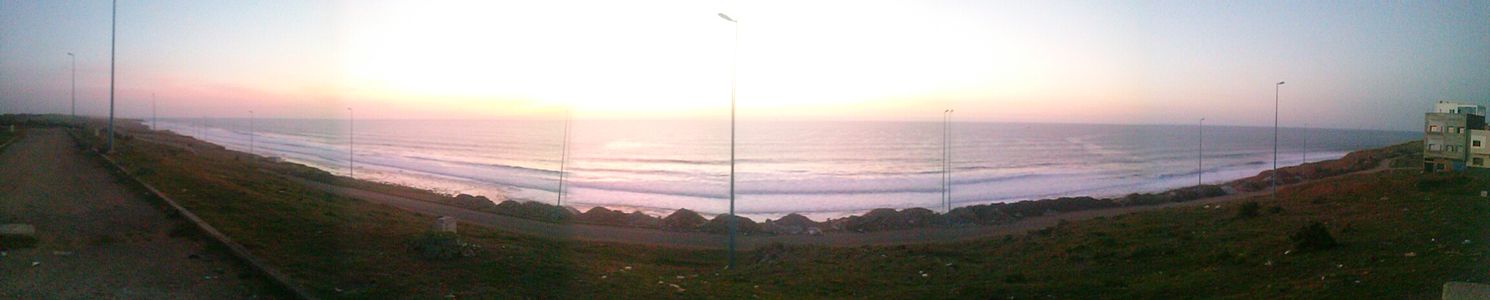
Larache beach.

The port

The geographical layout and the abundance of fish exploitation opportunities in Larache led to the construction of a fishing boat shipyard in 1950 that continues to operate today, being the last artisanal shipyard in the entire country. Founded in the beginning by Self-taught cabinetmaker and caulker Conrado de Sousa González (February 21, 1926, Isla Cristina - March 6, 2021, Málaga), brought significant economic and labor expansion to the Moroccan city. As he said personally, “I have been a great job creator in Larache.” Some of his most famous quotes, which denote his discipline and commitment to a job well done, still remain in certain sectors of the city:
"I've never drunk and never smoked.""She sleeping, and I working, drawing, sanding. Conradito, lie down now. Yes, Mom, now. Five, six, seven, eight, nine, ten, eleven, twelve, one beast, one beast."
Currently, his direct descendants keep the business afloat, which now has commercial relations with the Asian giant. Thanks to the promotion of employment and economic expansion that Conrado fostered, Larache is well-known nationally for the quality of its fish.
The third generation Conrado (in dialectal Arabic, Kurrado) is currently in diaspora between Seville, Malaga, Ceuta and Tangier. Her granddaughter Dalila Sousa Dahbi is the first Larache native to belong to the Moroccan women's national soccer team, for which she was recognized in the city with the award from the Larache Sports Association. His granddaughter Laura Sousa Navarro is a shrewd entrepreneur in various artistic businesses, among which is founding the first tango dance hall in northern Morocco. His grandson Agustín de Sousa García is one of the first PROI artists who sold one of his watercolors at the inauguration of the Multipurpose Room of the Adolfo Suárez Public Library in Ceuta.
Famous Larachenses
Culture
Cultural entities
In Larache is the headquarters of the Association of Moroccan Writers in the Spanish Language. Also located in the city is the house-museum of Mohamed Sibari, one of the most important Moroccan writers in Spanish.
Sports
During the time of the protectorate there were soccer teams in the city such as the Larache Club de Fútbol and the U.D. Las Navas.
Twinning
- Almuñécar (Spain)
- Barbate, Spain
In the arts and popular culture
Larache is the place where most of Mohamed Sibari's literature is set. His book Stories of the Hespérides (2000) takes its name from the garden of the Hespérides in Larache and all the stories included in the book are set in the city. We can also highlight Ode to the Taking of Larache (1612) by Luis de Góngora, commented by Pedro Díaz de Rivas. By the painter Juan Lara you can see the painting Fruit Market from Larache.